What you'll learn
- How redox titrations use electron transfer to find unknown concentrations.
- How to write and use balanced ionic equations for titration calculations.
- How manganate(VII), dichromate(VI) and iodine/thiosulfate titrations work.
- How to avoid common endpoint, acid choice and units mistakes.
Redox recap: what is being measured?
A redox reaction is a reaction involving electron transfer. One species is oxidised while another is reduced.
Oxidation and reduction
Oxidation is loss of electrons or an increase in oxidation number. Reduction is gain of electrons or a decrease in oxidation number.
In a redox titration, the reacting solutions are usually an oxidising agent and a reducing agent. The reaction must be fast, have a clear endpoint, and have a known balanced equation.
Redox titration
A redox titration is a volumetric analysis method in which the volume of one redox reactant needed to react exactly with another is used to calculate an unknown amount or concentration.
A common A-Level example is the reaction between acidified manganate(VII) ions and iron(II) ions:
MnO4−(aq)+8H+(aq)+5Fe2+(aq)→Mn2+(aq)+4H2O(l)+5Fe3+(aq)\mathrm{MnO_4^-}(\mathrm{aq}) + 8\mathrm{H^+}(\mathrm{aq}) + 5\mathrm{Fe^{2+}}(\mathrm{aq}) \to \mathrm{Mn^{2+}}(\mathrm{aq}) + 4\mathrm{H_2O}(\mathrm{l}) + 5\mathrm{Fe^{3+}}(\mathrm{aq})MnO4−(aq)+8H+(aq)+5Fe2+(aq)→Mn2+(aq)+4H2O(l)+5Fe3+(aq)The key point is the mole ratio: 1 mol of manganate(VII) ions reacts with 5 mol of iron(II) ions.
Combining half-equations
-
Write the reduction half-equation for manganate(VII) ions in acidic solution:
MnO4−+8H++5e−→Mn2++4H2O\mathrm{MnO_4^-} + 8\mathrm{H^+} + 5\mathrm{e^-} \to \mathrm{Mn^{2+}} + 4\mathrm{H_2O}MnO4−+8H++5e−→Mn2++4H2O -
Write the oxidation half-equation for iron(II) ions:
Fe2+→Fe3++e−\mathrm{Fe^{2+}} \to \mathrm{Fe^{3+}} + \mathrm{e^-}Fe2+→Fe3++e− -
Multiply the iron half-equation by 5 so that electrons cancel:
5Fe2+→5Fe3++5e−5\mathrm{Fe^{2+}} \to 5\mathrm{Fe^{3+}} + 5\mathrm{e^-}5Fe2+→5Fe3++5e− -
Add the two half-equations and cancel the electrons:
MnO4−+8H++5Fe2+→Mn2++4H2O+5Fe3+\mathrm{MnO_4^-} + 8\mathrm{H^+} + 5\mathrm{Fe^{2+}} \to \mathrm{Mn^{2+}} + 4\mathrm{H_2O} + 5\mathrm{Fe^{3+}}MnO4−+8H++5Fe2+→Mn2++4H2O+5Fe3+
The titration language you need
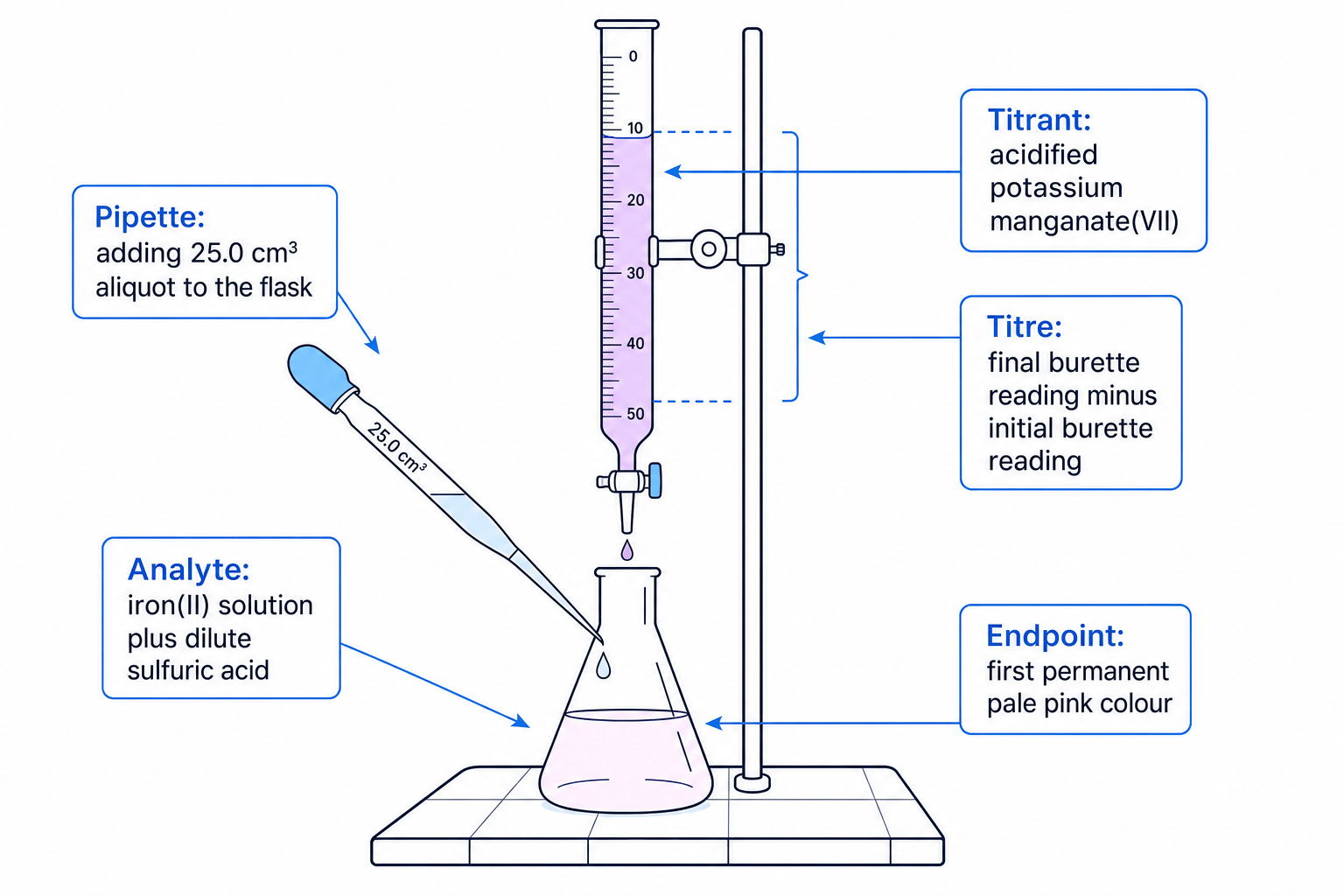
The titrant is the solution in the burette. The analyte is the solution being analysed, usually placed in the conical flask.
An aliquot is a measured portion of solution, usually transferred using a pipette. For example, 25.0 cm³ of an iron(II) solution could be pipetted into a conical flask.
The equivalence point is the point where the reactants have reacted in the exact mole ratio from the balanced equation.
The endpoint is the visible colour change you actually observe. In a good titration, the endpoint is very close to the equivalence point.
Titre
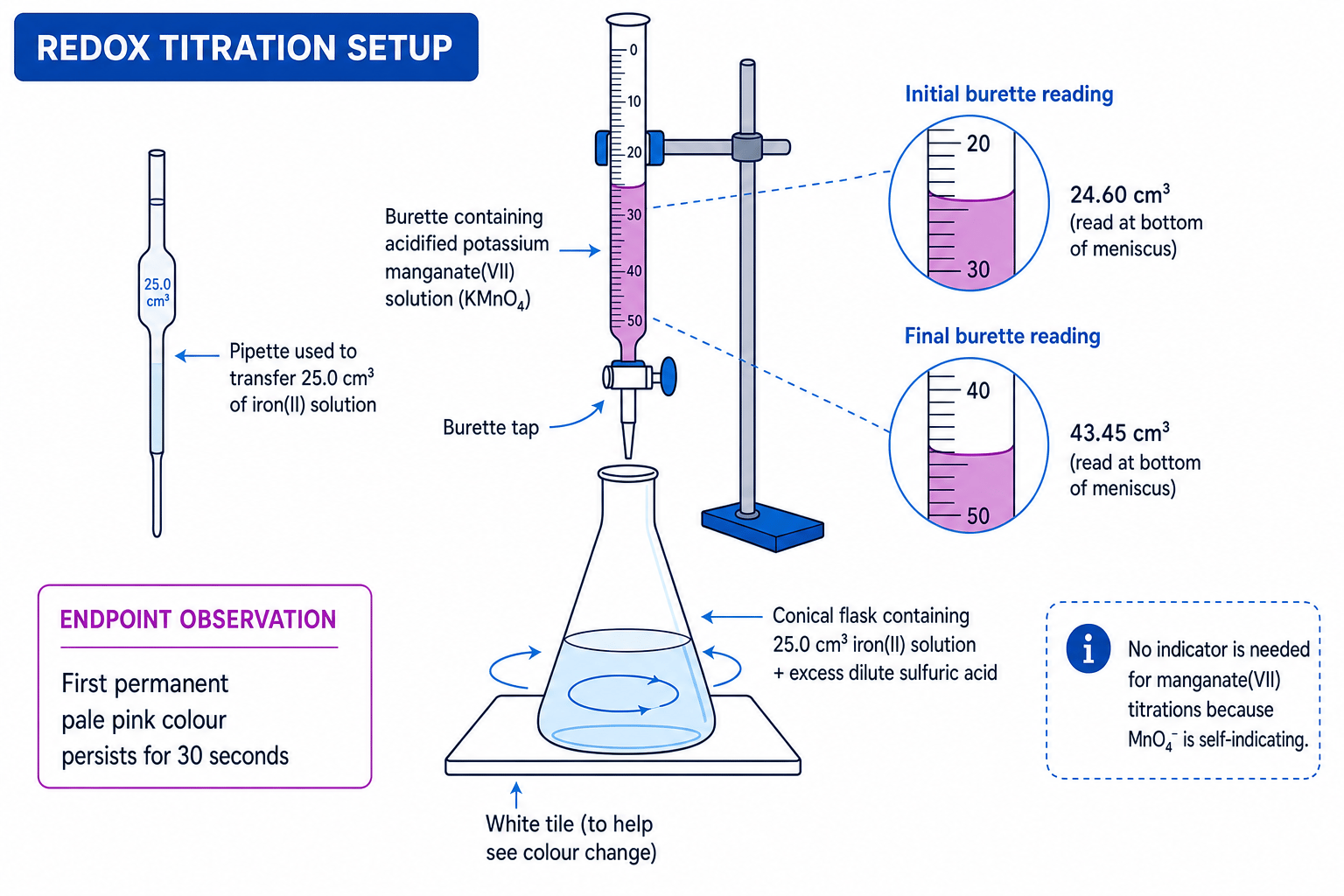
A titre is the volume delivered from the burette, calculated as final burette reading minus initial burette reading.
The calculation foundation: n=cVn = cVn=cV
For solutions, the key relationship is:
n=cVn = cVn=cVwhere:
- nnn is amount of substance in mol
- ccc is concentration in mol dm⁻³
- VVV is volume in dm³
Because burette and pipette volumes are usually measured in cm³, you must convert to dm³:
V(dm3)=V(cm3)1000V(\mathrm{dm^3}) = \frac{V(\mathrm{cm^3})}{1000}V(dm3)=1000V(cm3)Forgetting to convert cm³ to dm³
If concentration is in mol dm⁻³, the volume in n=cVn = cVn=cV must be in dm³. Using 24.80 instead of 0.02480 makes your answer 1000 times too large.
Calculating amount from a titre
25.0 cm³ of iron(II) solution is titrated using 24.80 cm³ of 0.0200 mol dm⁻³ acidified potassium manganate(VII).
-
Convert the titre into dm³:
V=24.801000=0.02480 dm3V = \frac{24.80}{1000} = 0.02480\ \mathrm{dm^3}V=100024.80=0.02480 dm3 -
Use n=cVn = cVn=cV for the manganate(VII) solution:
n(MnO4−)=0.0200×0.02480=4.96×10⁻⁴ moln(\mathrm{MnO_4^-}) = 0.0200 \times 0.02480 = 4.96 \times 10^{-4}\ \mathrm{mol}n(MnO4−)=0.0200×0.02480=4.96×10⁻⁴ mol -
Interpret the answer: the burette delivered 4.96×10−44.96 \times 10^{-4}4.96×10⁻⁴ mol of manganate(VII) ions.
Acidified potassium manganate(VII) titrations
Potassium manganate(VII), KMnO₄, is a strong oxidising agent. In acidic solution, purple manganate(VII) ions are reduced to almost colourless manganese(II) ions.
Manganate(VII) is self-indicating
In manganate(VII) titrations, no separate indicator is needed. The endpoint is the first permanent pale pink colour, caused by a tiny excess of unreacted manganate(VII) ions.
For titrating iron(II) ions, the ionic equation is:
MnO4−+8H++5Fe2+→Mn2++4H2O+5Fe3+\mathrm{MnO_4^-} + 8\mathrm{H^+} + 5\mathrm{Fe^{2+}} \to \mathrm{Mn^{2+}} + 4\mathrm{H_2O} + 5\mathrm{Fe^{3+}}MnO4−+8H++5Fe2+→Mn2++4H2O+5Fe3+The solution is acidified with dilute sulfuric acid.
Use the correct acid
Use dilute sulfuric acid, not hydrochloric acid or nitric acid. Chloride ions can be oxidised by manganate(VII), and nitric acid is itself an oxidising agent.
Finding the concentration of iron(II) solution
25.0 cm³ of iron(II) solution is pipetted into a conical flask and acidified. It requires 18.85 cm³ of 0.0200 mol dm⁻³ potassium manganate(VII) solution to reach the endpoint. Find the concentration of the iron(II) solution.
-
Calculate the amount of manganate(VII) ions used:
n(MnO4−)=0.0200×18.851000=3.77×10⁻⁴ moln(\mathrm{MnO_4^-}) = 0.0200 \times \frac{18.85}{1000} = 3.77 \times 10^{-4}\ \mathrm{mol}n(MnO4−)=0.0200×100018.85=3.77×10⁻⁴ mol -
Use the mole ratio from the equation. 1 mol of MnO4−\mathrm{MnO_4^-}MnO4− reacts with 5 mol of Fe2+\mathrm{Fe^{2+}}Fe2+:
n(Fe2+)=5×3.77×10−4=1.885×10⁻³ moln(\mathrm{Fe^{2+}}) = 5 \times 3.77 \times 10^{-4} = 1.885 \times 10^{-3}\ \mathrm{mol}n(Fe2+)=5×3.77×10−4=1.885×10⁻³ mol -
Calculate the concentration of iron(II) ions in the 25.0 cm³ aliquot:
c(Fe2+)=1.885×10−325.0÷1000=0.0754 mol dm−3c(\mathrm{Fe^{2+}}) = \frac{1.885 \times 10^{-3}}{25.0 \div 1000} = 0.0754\ \mathrm{mol\,dm^{-3}}c(Fe2+)=25.0÷10001.885×10−3=0.0754 moldm−3
Potassium dichromate(VI) titrations
Potassium dichromate(VI), K₂Cr₂O₇, is another oxidising agent used in acidic solution. Dichromate(VI) ions are reduced from orange Cr2O72−\mathrm{Cr_2O_7^{2-}}Cr2O72− to green Cr3+\mathrm{Cr^{3+}}Cr3+.
With iron(II) ions, the equation is:
Cr2O72−+14H++6Fe2+→2Cr3++7H2O+6Fe3+\mathrm{Cr_2O_7^{2-}} + 14\mathrm{H^+} + 6\mathrm{Fe^{2+}} \to 2\mathrm{Cr^{3+}} + 7\mathrm{H_2O} + 6\mathrm{Fe^{3+}}Cr2O72−+14H++6Fe2+→2Cr3++7H2O+6Fe3+So the mole ratio is 1 mol of dichromate(VI) ions to 6 mol of iron(II) ions.
Dichromate(VI) titrations often need a redox indicator because the orange-to-green colour change is not sharp enough for an accurate endpoint.
Read the ratio from the equation
Do not memorise every ratio separately. Once the ionic equation is balanced, the coefficients tell you the reacting mole ratio.
Iodine and thiosulfate titrations
Iodine reacts with thiosulfate ions in a very useful redox titration:
I2+2S2O32−→2I−+S4O62−\mathrm{I_2} + 2\mathrm{S_2O_3^{2-}} \to 2\mathrm{I^-} + \mathrm{S_4O_6^{2-}}I2+2S2O32−→2I−+S4O62−Iodine solution is brown. As iodine is used up, the solution becomes pale yellow. Starch is then added, forming a blue-black colour with iodine. At the endpoint, the blue-black colour disappears.
Adding starch too early
In iodine/thiosulfate titrations, add starch only when the iodine solution is pale yellow. If starch is added too early, the iodine-starch complex can make the endpoint slow and less accurate.
Using thiosulfate to calculate iodine concentration
25.0 cm³ of iodine solution is titrated with 0.100 mol dm⁻³ sodium thiosulfate. The mean titre is 22.40 cm³. Calculate the iodine concentration.
-
Calculate the amount of thiosulfate ions used:
n(S2O32−)=0.100×22.401000=2.24×10⁻³ moln(\mathrm{S_2O_3^{2-}}) = 0.100 \times \frac{22.40}{1000} = 2.24 \times 10^{-3}\ \mathrm{mol}n(S2O32−)=0.100×100022.40=2.24×10⁻³ mol -
Use the equation ratio. 2 mol of S2O32−\mathrm{S_2O_3^{2-}}S2O32− react with 1 mol of I2\mathrm{I_2}I2:
n(I2)=2.24×10−32=1.12×10⁻³ moln(\mathrm{I_2}) = \frac{2.24 \times 10^{-3}}{2} = 1.12 \times 10^{-3}\ \mathrm{mol}n(I2)=22.24×10−3=1.12×10⁻³ mol -
Calculate the iodine concentration in the 25.0 cm³ aliquot:
c(I2)=1.12×10−325.0÷1000=0.0448 mol dm−3c(\mathrm{I_2}) = \frac{1.12 \times 10^{-3}}{25.0 \div 1000} = 0.0448\ \mathrm{mol\,dm^{-3}}c(I2)=25.0÷10001.12×10−3=0.0448 moldm−3
Practical accuracy: getting reliable titres
You usually do one rough titration first, then repeat accurate titrations until you get concordant titres.
Concordant titres
Concordant titres are titres that are close together, usually within 0.10 cm³ of each other at A-Level.
When calculating the mean titre, use only concordant accurate titres. Do not include the rough titre unless specifically told to.
Read the burette at eye level, from the bottom of the meniscus. A burette with 0.10 cm³ graduations is usually read to the nearest 0.05 cm³, so a titre made from two burette readings has an uncertainty of about ±0.10 cm³.
Percentage uncertainty in a titre
A titre is 23.60 cm³. The uncertainty in the titre is ±0.10 cm³. Calculate the percentage uncertainty.
-
Use the percentage uncertainty expression:
percentage uncertainty=absolute uncertaintymeasured value×100\text{percentage uncertainty} = \frac{\text{absolute uncertainty}}{\text{measured value}} \times 100percentage uncertainty=measured valueabsolute uncertainty×100 -
Substitute the titre and uncertainty:
0.1023.60×100=0.424%\frac{0.10}{23.60} \times 100 = 0.424\%23.600.10×100=0.424% -
Round sensibly: the percentage uncertainty is about 0.42%.
A general route for redox titration calculations
Most redox titration questions follow the same calculation path:
- Write or use the balanced redox equation.
- Calculate the amount of titrant using n=cVn = cVn=cV.
- Use the mole ratio to find the amount of analyte in the aliquot.
- Convert to concentration, mass, percentage purity or percentage by mass as required.
Keep the aliquot separate from the whole solution
If a solid sample was dissolved and made up to, say, 250.0 cm³, but only 25.0 cm³ was titrated, your titration only tells you about the 25.0 cm³ aliquot. Scale up to the full volumetric flask only when needed.
In the exam
- Start from the balanced ionic equation and underline the mole ratio you need.
- Convert all titres and pipette volumes from cm³ to dm³ before using n=cVn = cVn=cV.
- Average only concordant titres, not the rough titre.
- State manganate(VII) endpoints carefully: first permanent pale pink colour.
- For practical explanations, mention correct acid choice, swirling, eye-level burette readings and using a white tile if relevant.
Check yourself
- Why does acidified potassium manganate(VII) not need a separate indicator?
- In the equation for manganate(VII) reacting with iron(II), what is the mole ratio of MnO4−\mathrm{MnO_4^-}MnO4− to Fe2+\mathrm{Fe^{2+}}Fe2+?
- Why is starch added near the endpoint, rather than at the start, in iodine/thiosulfate titrations?