What you'll learn
- How electron configurations explain the chemistry of Group 1 and Group 2 metals.
- Why reactivity increases down both groups.
- Key reactions with water, oxygen, chlorine, acids and heat.
- How flame tests and solubility trends help identify metal ions.
1. The starting point: Groups 1 and 2 are reactive metals
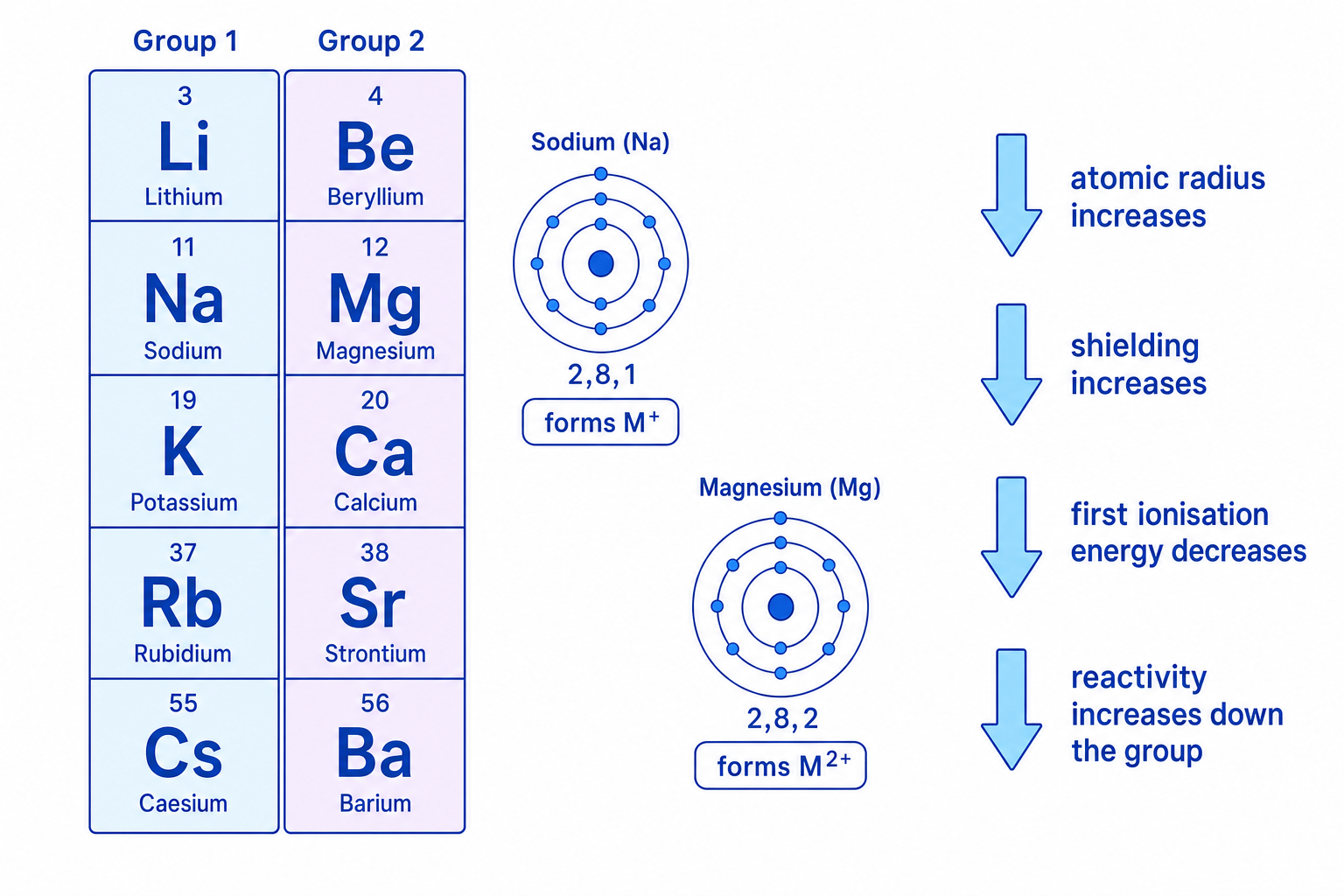
A group is a vertical column in the Periodic Table. Elements in the same group have the same number of electrons in their outer shell, so they often react in similar ways.
- Group 1 metals are the alkali metals: lithium, sodium, potassium, rubidium and caesium.
- Group 2 metals are the alkaline earth metals: beryllium, magnesium, calcium, strontium and barium.
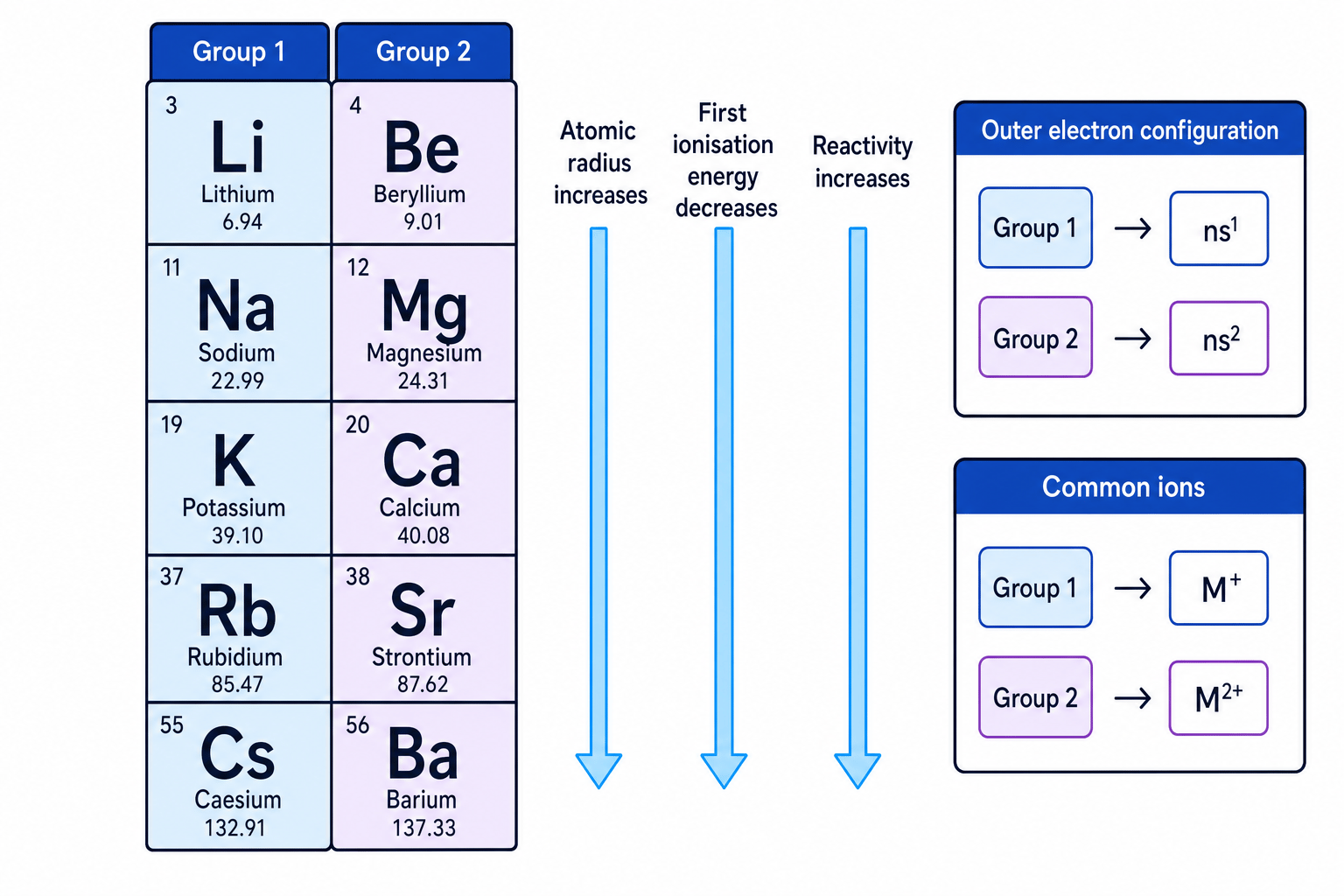
Group 1 metals have one outer-shell electron, so they usually form M+M^+M+ ions. Group 2 metals have two outer-shell electrons, so they usually form M2+M^{2+}M2+ ions.
First ionisation energy
The first ionisation energy is the energy required to remove one mole of electrons from one mole of gaseous atoms to form one mole of gaseous 1+ ions.
M(g)→M+(g)+e−\mathrm{M(g) \to M^+(g) + e^-}M(g)→M+(g)+e−2. Why reactivity increases down the groups
Reactivity in Groups 1 and 2 depends mainly on how easily the metal atoms lose their outer electrons.
Down a group:
- atoms have more electron shells
- atomic radius increases
- shielding by inner electrons increases
- the attraction between the nucleus and outer electrons decreases
- first ionisation energy decreases
So the outer electrons are lost more easily, and the metals become more reactive.
The trend to remember
Down both Group 1 and Group 2, metals become more reactive because their outer electrons are further from the nucleus and more shielded.
Comparing the reactivity of sodium and potassium
Potassium reacts more vigorously with water than sodium. Explain why.
-
Potassium is below sodium in Group 1, so a potassium atom has an extra electron shell and a larger atomic radius.
-
The outer electron in potassium is more shielded from the nucleus by inner-shell electrons.
-
This weaker attraction means potassium has a lower first ionisation energy, so it loses its outer electron more easily.
-
Therefore potassium is oxidised more readily and reacts more vigorously than sodium.
Do not say “more protons means more reactive”
Down a group, nuclear charge increases, but the increase in distance and shielding has the bigger effect. The outer electron is less strongly attracted overall.
3. Reactions of Group 1 metals
Group 1 metals are soft, low-density metals. They are stored under oil because they react with oxygen and water vapour in air.
Reaction with water
Group 1 metals react with cold water to form an alkaline metal hydroxide and hydrogen gas.
General equation:
2M(s)+2H2O(l)→2MOH(aq)+H2(g)\mathrm{2M(s) + 2H_2O(l) \to 2MOH(aq) + H_2(g)}2M(s)+2H2O(l)→2MOH(aq)+H2(g)For sodium:
2Na(s)+2H2O(l)→2NaOH(aq)+H2(g)\mathrm{2Na(s) + 2H_2O(l) \to 2NaOH(aq) + H_2(g)}2Na(s)+2H2O(l)→2NaOH(aq)+H2(g)Typical observations:
- lithium fizzes and moves slowly
- sodium melts into a ball and moves rapidly
- potassium reacts very vigorously, often with a lilac flame
The solution becomes alkaline because hydroxide ions, OH−\mathrm{OH^-}OH−, are produced.
Reaction with oxygen and chlorine
With oxygen, Group 1 metals form ionic oxides, peroxides or superoxides depending on the metal and conditions. For A-Level, be especially comfortable with simple oxide formation, such as:
4Li(s)+O2(g)→2Li2O(s)\mathrm{4Li(s) + O_2(g) \to 2Li_2O(s)}4Li(s)+O2(g)→2Li2O(s)With chlorine, Group 1 metals form white ionic chlorides:
2Na(s)+Cl2(g)→2NaCl(s)\mathrm{2Na(s) + Cl_2(g) \to 2NaCl(s)}2Na(s)+Cl2(g)→2NaCl(s)Oxygen products can vary
Lithium commonly forms lithium oxide, Li2O\mathrm{Li_2O}Li2O; sodium can form sodium peroxide, Na2O2\mathrm{Na_2O_2}Na2O2; potassium can form potassium superoxide, KO2\mathrm{KO_2}KO2. If the question gives a product, use that product when balancing.
4. Reactions of Group 2 metals
Group 2 metals are less reactive than Group 1 metals in the same period because they must lose two outer electrons to form M2+M^{2+}M2+ ions.
Reaction with water
Magnesium reacts very slowly with cold water, but it reacts with steam:
Mg(s)+H2O(g)→MgO(s)+H2(g)\mathrm{Mg(s) + H_2O(g) \to MgO(s) + H_2(g)}Mg(s)+H2O(g)→MgO(s)+H2(g)Calcium, strontium and barium react with cold water to form metal hydroxides and hydrogen:
M(s)+2H2O(l)→M(OH)2(aq)+H2(g)\mathrm{M(s) + 2H_2O(l) \to M(OH)_2(aq) + H_2(g)}M(s)+2H2O(l)→M(OH)2(aq)+H2(g)For calcium:
Ca(s)+2H2O(l)→Ca(OH)2(aq)+H2(g)\mathrm{Ca(s) + 2H_2O(l) \to Ca(OH)_2(aq) + H_2(g)}Ca(s)+2H2O(l)→Ca(OH)2(aq)+H2(g)Calculating hydrogen from calcium and water
A sample of calcium with mass 0.240 g reacts completely with water. Calculate the volume of hydrogen produced at room temperature and pressure, using 24.0 dm³ mol⁻¹.
-
Calculate the amount of calcium:
n(Ca)=0.24040.1=5.99×10⁻³ moln(\mathrm{Ca})=\frac{0.240}{40.1}=5.99 \times 10^{-3}\ \mathrm{mol}n(Ca)=40.10.240=5.99×10⁻³ mol -
Use the balanced equation:
Ca(s)+2H2O(l)→Ca(OH)2(aq)+H2(g)\mathrm{Ca(s) + 2H_2O(l) \to Ca(OH)_2(aq) + H_2(g)}Ca(s)+2H2O(l)→Ca(OH)2(aq)+H2(g)The mole ratio Ca:H2\mathrm{Ca:H_2}Ca:H2 is 1:1, so:
n(H2)=5.99×10⁻³ moln(\mathrm{H_2})=5.99 \times 10^{-3}\ \mathrm{mol}n(H2)=5.99×10⁻³ mol -
Calculate the gas volume:
V=5.99×10−3×24.0=0.144 dm3V=5.99 \times 10^{-3} \times 24.0=0.144\ \mathrm{dm^3}V=5.99×10−3×24.0=0.144 dm3So the volume is 0.144 dm³, or 144 cm³.
Group 2 hydroxide formulae
Group 2 metals form M2+M^{2+}M2+ ions, so their hydroxides have the formula M(OH)2\mathrm{M(OH)_2}M(OH)2, not MOH\mathrm{MOH}MOH.
Reaction with oxygen and chlorine
Group 2 metals form oxides with oxygen:
2Mg(s)+O2(g)→2MgO(s)\mathrm{2Mg(s) + O_2(g) \to 2MgO(s)}2Mg(s)+O2(g)→2MgO(s)Magnesium burns with a bright white flame.
With chlorine, Group 2 metals form ionic chlorides:
Mg(s)+Cl2(g)→MgCl2(s)\mathrm{Mg(s) + Cl_2(g) \to MgCl_2(s)}Mg(s)+Cl2(g)→MgCl2(s)5. Group 2 oxides and hydroxides are basic
A base is a substance that neutralises an acid. Many Group 2 oxides and hydroxides are bases.
For example, magnesium oxide reacts with hydrochloric acid:
MgO(s)+2HCl(aq)→MgCl2(aq)+H2O(l)\mathrm{MgO(s) + 2HCl(aq) \to MgCl_2(aq) + H_2O(l)}MgO(s)+2HCl(aq)→MgCl2(aq)+H2O(l)Magnesium hydroxide also neutralises hydrochloric acid:
Mg(OH)2(s)+2HCl(aq)→MgCl2(aq)+2H2O(l)\mathrm{Mg(OH)_2(s) + 2HCl(aq) \to MgCl_2(aq) + 2H_2O(l)}Mg(OH)2(s)+2HCl(aq)→MgCl2(aq)+2H2O(l)This is why magnesium hydroxide is used in some indigestion remedies: it neutralises excess stomach acid.
Spotting neutralisation
If an oxide or hydroxide reacts with an acid to form a salt and water, it is behaving as a base.
6. Thermal decomposition of carbonates and nitrates
Thermal decomposition means breaking down a compound by heating it.
Group 2 carbonates decompose on heating to form a metal oxide and carbon dioxide:
MCO3(s)→MO(s)+CO2(g)\mathrm{MCO_3(s) \to MO(s) + CO_2(g)}MCO3(s)→MO(s)+CO2(g)For calcium carbonate:
CaCO3(s)→CaO(s)+CO2(g)\mathrm{CaCO_3(s) \to CaO(s) + CO_2(g)}CaCO3(s)→CaO(s)+CO2(g)Group 2 nitrates decompose on heating to form a metal oxide, nitrogen dioxide and oxygen:
2M(NO3)2(s)→2MO(s)+4NO2(g)+O2(g)\mathrm{2M(NO_3)_2(s) \to 2MO(s) + 4NO_2(g) + O_2(g)}2M(NO3)2(s)→2MO(s)+4NO2(g)+O2(g)Down Group 2, carbonates and nitrates become more thermally stable. Larger M2+M^{2+}M2+ ions polarise the carbonate or nitrate ion less strongly, so decomposition is harder.
Polarisation
Polarisation is the distortion of the electron cloud of an ion by a nearby charged ion. Small, highly charged cations polarise anions more strongly.
7. Flame tests
A flame test is a qualitative test used to identify some metal ions from the colour they give in a flame.
Common flame colours:
- Li+\mathrm{Li^+}Li+: crimson red
- Na+\mathrm{Na^+}Na+: yellow
- K+\mathrm{K^+}K+: lilac
- Ca2+\mathrm{Ca^{2+}}Ca2+: brick red
- Sr2+\mathrm{Sr^{2+}}Sr2+: crimson red
- Ba2+\mathrm{Ba^{2+}}Ba2+: apple green
A typical method is to clean a nichrome wire loop with concentrated hydrochloric acid, dip it into the sample, then place it in a non-luminous Bunsen flame.
Sodium contamination
Sodium gives a very strong yellow flame, so even tiny contamination can mask other colours, especially potassium’s lilac flame.
8. Solubility trends in Group 2 compounds
Solubility means how much of a substance dissolves in a solvent, usually water.
Down Group 2:
- hydroxides become more soluble
- sulfates become less soluble
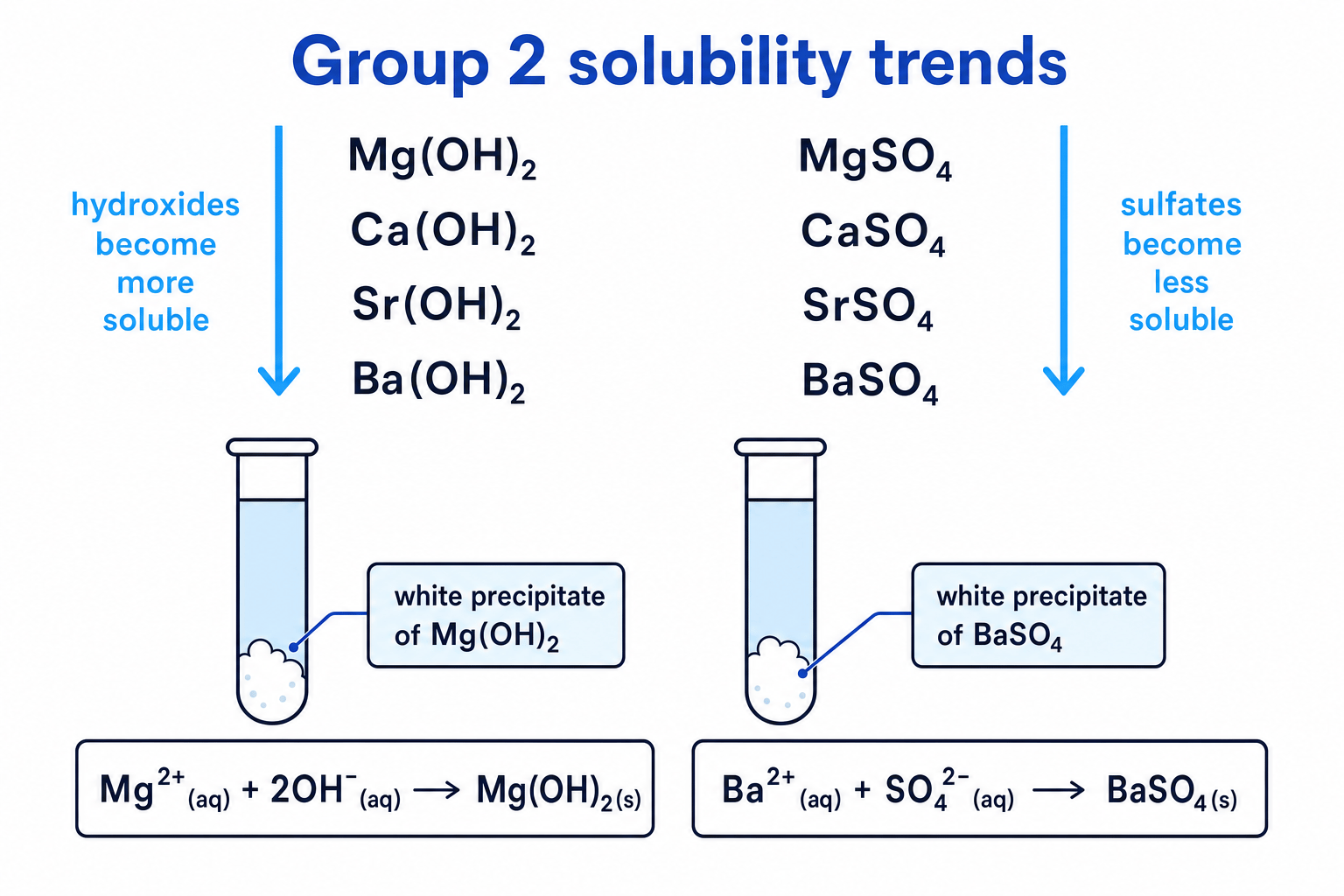
For hydroxides, magnesium hydroxide is only slightly soluble, while barium hydroxide is much more soluble.
For sulfates, magnesium sulfate is soluble, while barium sulfate is very insoluble.
A useful ionic equation for the sulfate test is:
Ba2+(aq)+SO42−(aq)→BaSO4(s)\mathrm{Ba^{2+}(aq) + SO_4^{2-}(aq) \to BaSO_4(s)}Ba2+(aq)+SO42−(aq)→BaSO4(s)The white precipitate of barium sulfate confirms the presence of sulfate ions.
Opposite solubility trends
Group 2 hydroxides become more soluble down the group, but Group 2 sulfates become less soluble down the group.
Barium sulfate is used in barium meals for X-ray imaging. Although soluble barium compounds are toxic, barium sulfate is safe enough for this use because it is extremely insoluble, so it releases very few Ba2+\mathrm{Ba^{2+}}Ba2+ ions.
In the exam
-
For trend questions, always link the observation to atomic radius, shielding and ionisation energy.
-
For reaction equations, check the ion charge first: Group 1 forms M+M^+M+, Group 2 forms M2+M^{2+}M2+.
-
For observations, include both what you see and the product causing it, such as fizzing from hydrogen or a white precipitate of BaSO4\mathrm{BaSO_4}BaSO4.
Check yourself
- Why does potassium react more vigorously with water than sodium?
- What is the balanced equation for calcium reacting with water?
- How do the solubilities of Group 2 hydroxides and sulfates change down the group?