What you'll learn
- How the Group 7 elements, the halogens, are related to halide ions.
- Why melting points, boiling points, electronegativity and oxidising power change down the group.
- How to predict halogen displacement reactions using redox ideas.
- How to test for chloride, bromide and iodide ions in solution.
Starting point: halogens and halide ions
Group 7, also called Group 17 in modern numbering, contains the halogens. At A-Level you mainly meet fluorine, chlorine, bromine and iodine.
A halogen atom has seven electrons in its outer shell. It tends to gain one electron to form a 1− ion with a full outer shell.
Halogen and halide
A halogen is an element in Group 7, such as chlorine, Cl₂. A halide ion is the negative ion formed when a halogen atom gains one electron, such as Cl⁻, Br⁻ or I⁻.
The halogens exist as diatomic molecules, meaning each molecule contains two atoms: F₂, Cl₂, Br₂ and I₂.
At room temperature:
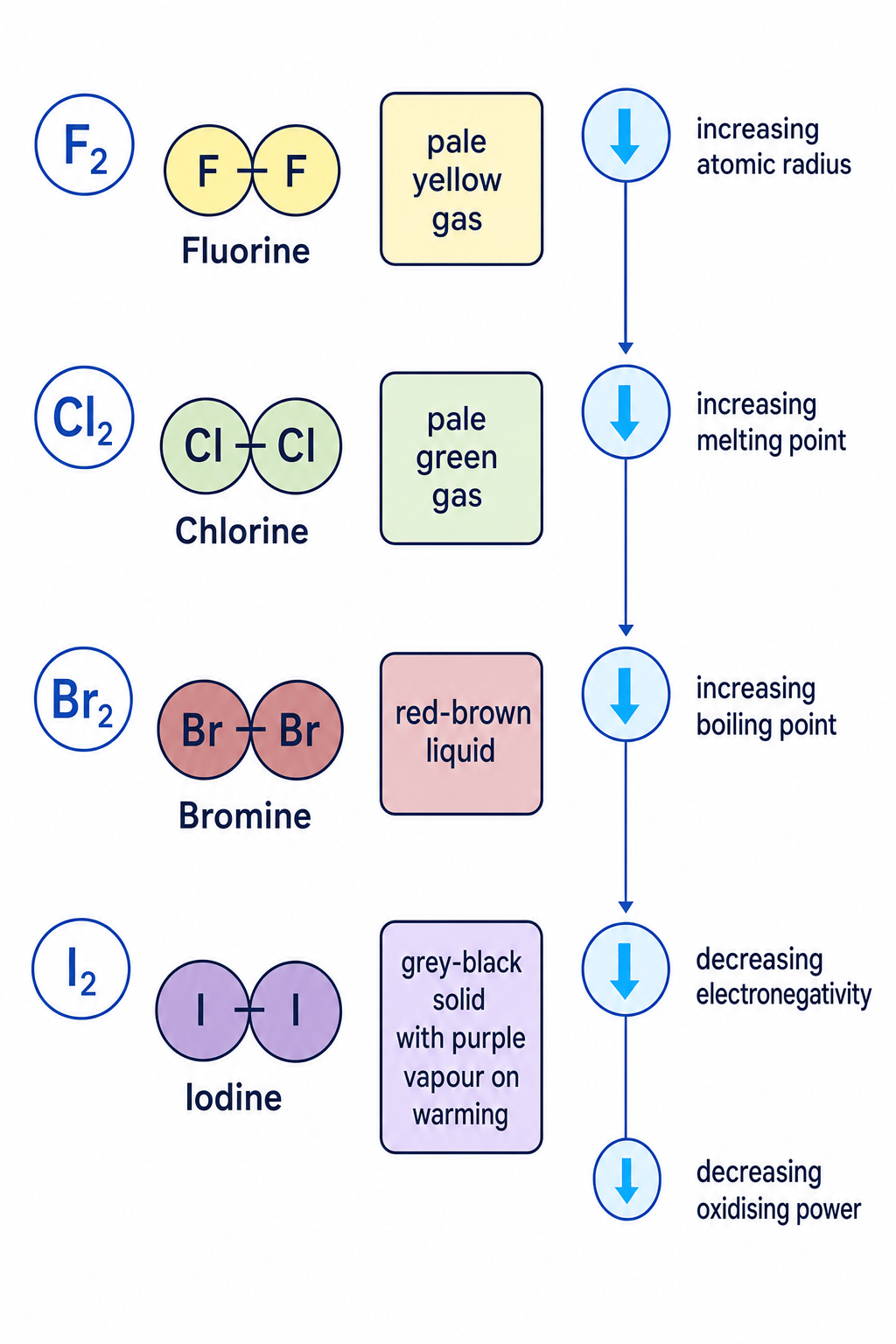
- Fluorine, F₂, is a pale yellow gas.
- Chlorine, Cl₂, is a pale green gas.
- Bromine, Br₂, is a red-brown liquid.
- Iodine, I₂, is a grey-black solid that gives a purple vapour when warmed.
Redox language you need first
Group 7 chemistry is mainly redox chemistry: chemistry involving electron transfer.
Redox words
- Oxidation is loss of electrons, or an increase in oxidation state.
- Reduction is gain of electrons, or a decrease in oxidation state.
- An oxidising agent accepts electrons and is itself reduced.
- A reducing agent donates electrons and is itself oxidised.
- An oxidation state is the charge an atom would have if the bonding were treated as fully ionic.
A useful memory aid is OIL RIG: Oxidation Is Loss, Reduction Is Gain.
Physical trends down Group 7
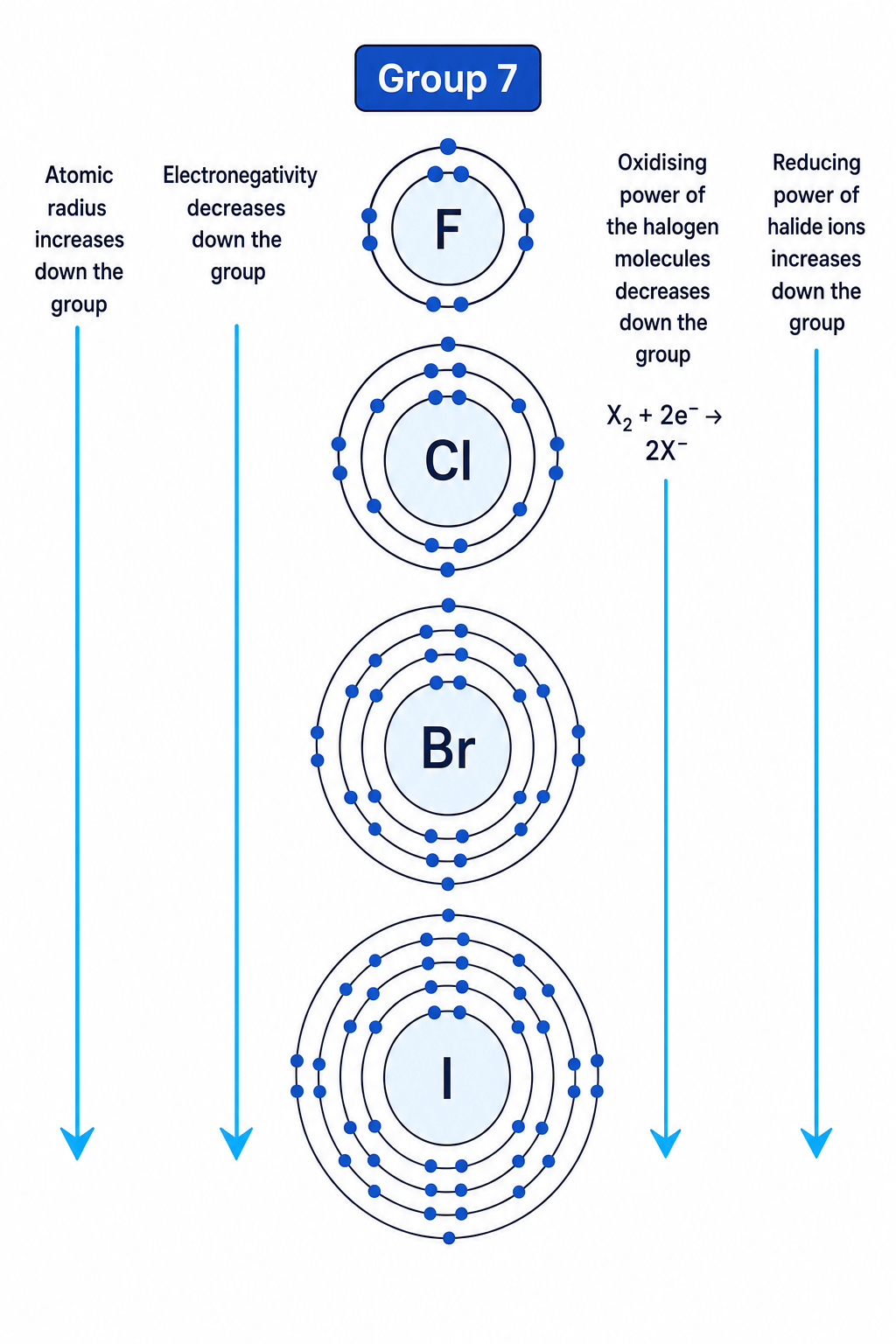
As you go down Group 7, the atoms get larger because each element has an extra electron shell. The molecules also contain more electrons.
The melting points and boiling points increase down the group. This is not because the covalent bond inside X₂ gets stronger; it is because the attractions between separate molecules get stronger.
These attractions are called London forces: temporary dipole-induced dipole attractions between molecules. Larger molecules with more electrons have stronger London forces, so more energy is needed to separate the molecules.
Physical trend
Down Group 7, melting point and boiling point increase because the halogen molecules have more electrons, stronger London forces and need more energy to separate.
Explaining the boiling point trend
-
Identify the particles involved: Cl₂, Br₂ and I₂ are simple molecular substances, so boiling separates molecules rather than breaking covalent bonds.
-
Compare electron numbers down the group: I₂ has more electrons and a larger electron cloud than Br₂, which has more than Cl₂.
-
Link this to intermolecular forces: more electrons produce stronger London forces, so more energy is needed to overcome the attractions.
-
Conclude the trend: boiling point increases from chlorine to bromine to iodine, explaining why Cl₂ is a gas, Br₂ is a liquid and I₂ is a solid at room temperature.
Boiling does not break the X–X bond
When a halogen boils, the covalent bond inside each X₂ molecule remains intact. The forces overcome are intermolecular London forces between molecules.
Electronegativity and oxidising power
Electronegativity is the ability of an atom to attract a bonding pair of electrons.
Down Group 7, electronegativity decreases. Although the nuclear charge increases, the outer shell is further from the nucleus and there is more shielding by inner electrons. The attraction for bonding electrons is therefore weaker.
Halogen molecules are oxidising agents because they gain electrons to form halide ions:
X₂ + 2e⁻ → 2X⁻
The oxidising power decreases down the group:
fluorine > chlorine > bromine > iodine
In routine school laboratory reactions, fluorine is usually not used because it is extremely reactive and dangerous.
Displacement reactions
A displacement reaction happens when a more reactive element takes the place of a less reactive element in a compound or solution.
For Group 7, a more reactive halogen displaces a less reactive halide ion from solution. The halogen higher up the group is the stronger oxidising agent.
Important ionic equations:
Cl₂(aq) + 2Br⁻(aq) → 2Cl⁻(aq) + Br₂(aq)
Cl₂(aq) + 2I⁻(aq) → 2Cl⁻(aq) + I₂(aq)
Br₂(aq) + 2I⁻(aq) → 2Br⁻(aq) + I₂(aq)
Iodine will not displace chloride or bromide ions, because iodine is a weaker oxidising agent than chlorine and bromine.
Predicting a halogen displacement reaction
Bromine water is added to potassium iodide solution.
-
Compare the halogens: bromine is above iodine in Group 7, so Br₂ is a stronger oxidising agent than I₂.
-
Decide the electron transfer: Br₂ gains electrons to form Br⁻, while I⁻ loses electrons to form I₂.
-
Combine the changes into the ionic equation:
Br₂(aq) + 2I⁻(aq) → 2Br⁻(aq) + I₂(aq) -
Predict the observation: iodine is formed, so the solution becomes brown; if an organic solvent layer is used, iodine appears purple in that layer.
Displacing the wrong species
Say “chlorine displaces bromide ions”, not “chloride displaces bromine”. The halogen molecule is the oxidising agent; the halide ion is oxidised.
Chlorine reacts by disproportionation
Chlorine reacts with water and alkali in an important redox pattern called disproportionation.
Disproportionation
A disproportionation reaction is a redox reaction in which the same element is both oxidised and reduced.
Chlorine reacts with water:
Cl₂(aq) + H₂O(l) ⇌ HCl(aq) + HClO(aq)
HClO is chloric(I) acid, also called hypochlorous acid. It is an oxidising agent and is responsible for the disinfecting action of chlorine in water treatment.
With cold dilute sodium hydroxide:
Cl₂(aq) + 2NaOH(aq) → NaCl(aq) + NaClO(aq) + H₂O(l)
NaClO is sodium chlorate(I), also called sodium hypochlorite.
With hot concentrated sodium hydroxide:
3Cl₂(g) + 6NaOH(aq) → 5NaCl(aq) + NaClO₃(aq) + 3H₂O(l)
Here NaClO₃ is sodium chlorate(V).
Recognising disproportionation in chlorine and hydroxide
-
Assign chlorine in Cl₂ an oxidation state of 0 because it is an element.
-
In Cl⁻, chlorine has oxidation state −1, so some chlorine has been reduced.
-
In ClO⁻, oxygen is −2 and the ion has overall charge −1, so chlorine is +1; some chlorine has been oxidised.
-
Because chlorine has changed from 0 to both −1 and +1, the reaction is disproportionation.
Halide ions as reducing agents
The reducing power of halide ions increases down Group 7:
Cl⁻ < Br⁻ < I⁻
This happens because larger halide ions hold their outer electron less strongly, so they are more easily oxidised.
Concentrated sulfuric acid shows this trend clearly.
Chloride ions are not strong enough reducing agents to reduce sulfuric acid. Sodium chloride reacts by an acid-base reaction only:
NaCl(s) + H₂SO₄(l) → NaHSO₄(s) + HCl(g)
You see steamy white fumes of hydrogen chloride.
Bromide ions are stronger reducing agents. Hydrogen bromide forms first, then reduces sulfuric acid:
2HBr(g) + H₂SO₄(l) → Br₂(g) + SO₂(g) + 2H₂O(l)
You may see orange-brown bromine fumes and choking sulfur dioxide.
Iodide ions are even stronger reducing agents. They can reduce sulfuric acid to SO₂, sulfur, S, or hydrogen sulfide, H₂S:
8HI(g) + H₂SO₄(l) → 4I₂(s) + H₂S(g) + 4H₂O(l)
You may see purple iodine vapour or black iodine solid, yellow sulfur, and a bad-egg smell from H₂S.
Concentrated sulfuric acid is hazardous
Reactions of halides with concentrated sulfuric acid can produce toxic and corrosive fumes. These reactions must be done only on a small scale with appropriate safety controls, usually in a fume cupboard.
Linking iodide observations to redox
-
Iodide ions are the strongest reducing agents among Cl⁻, Br⁻ and I⁻, so I⁻ is readily oxidised.
-
Oxidation of iodide forms iodine: 2I⁻ → I₂ + 2e⁻, giving purple vapour or a dark solid.
-
Sulfur in H₂SO₄ is reduced from oxidation state +6 to lower oxidation states, such as 0 in sulfur or −2 in H₂S, explaining the yellow solid or bad-egg gas.
Testing for halide ions
A precipitate is an insoluble solid formed when two solutions react.
To test for halide ions in solution, first add dilute nitric acid, then add silver nitrate solution. The dilute nitric acid removes interfering ions such as carbonate ions and does not add any halide ions itself.
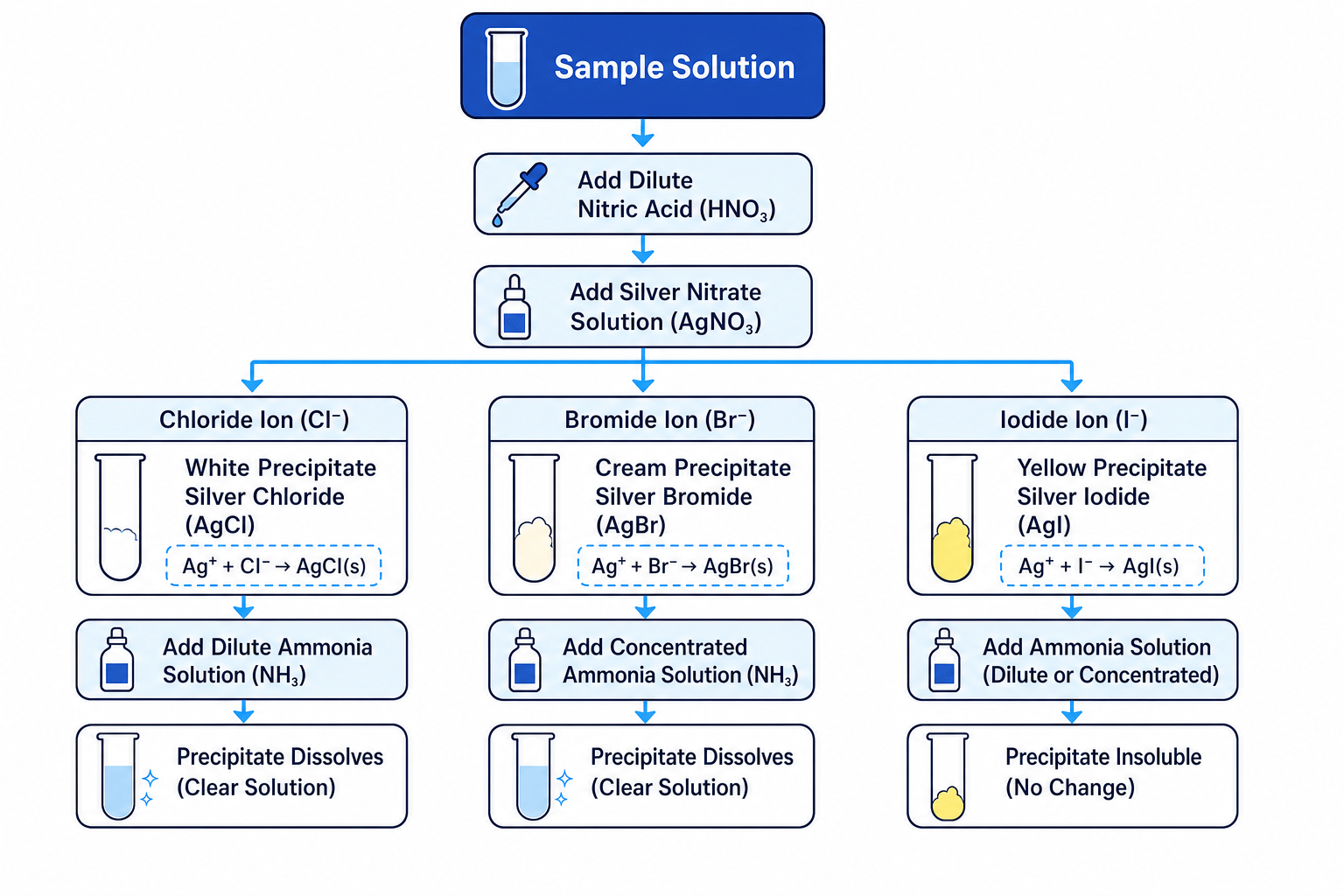
The general ionic equation is:
Ag⁺(aq) + X⁻(aq) → AgX(s)
Results:
- Chloride ions give a white precipitate of AgCl, which dissolves in dilute ammonia.
- Bromide ions give a cream precipitate of AgBr, which dissolves in concentrated ammonia.
- Iodide ions give a yellow precipitate of AgI, which does not dissolve in ammonia.
The precipitates dissolve when ammonia forms the complex ion [Ag(NH₃)₂]⁺ with Ag⁺ ions. Silver iodide is too insoluble for ammonia to dissolve it.
Identifying a halide from silver nitrate results
A solution gives a cream precipitate with acidified silver nitrate. The precipitate dissolves only in concentrated ammonia.
-
A precipitate with silver nitrate shows a silver halide has formed, so the unknown contains Cl⁻, Br⁻ or I⁻.
-
The cream colour matches AgBr rather than white AgCl or yellow AgI.
-
Solubility in concentrated ammonia confirms AgBr, so the original ion was Br⁻.
-
The ionic equation is: Ag⁺(aq) + Br⁻(aq) → AgBr(s).
Do not acidify with hydrochloric acid
Hydrochloric acid adds Cl⁻ ions, which would give a false white precipitate with silver nitrate. Use dilute nitric acid instead.
In the exam
-
For trend questions, always link the observation to a cause: number of shells, shielding, attraction for electrons, or strength of London forces.
-
For displacement reactions, compare the halogens first, then write the ionic equation without spectator ions such as K⁺ or Na⁺.
-
For halide tests, give the full sequence: dilute nitric acid, silver nitrate, precipitate colour, then ammonia solubility.
Check yourself
- Why does iodine have a higher boiling point than chlorine?
- What would you observe when chlorine water is added to potassium iodide solution?
- How would you distinguish chloride, bromide and iodide ions using silver nitrate and ammonia?