What you'll learn
- How to identify common cations and anions in inorganic compounds.
- How flame tests, precipitate tests and gas tests work.
- How to choose the correct reagent and write key ionic equations.
- How to combine observations to identify an unknown salt confidently.
The big idea: testing for ions
An inorganic salt is usually made from positive ions and negative ions. For example, sodium sulfate contains sodium ions, Na⁺, and sulfate ions, SO₄²⁻.
A test is useful only if it gives a clear observation: a colour change, a precipitate, a gas, or a flame colour.
Qualitative analysis
Qualitative analysis means identifying what substances or ions are present. It tells you “what is there”, not “how much is there”.
Cations and anions
A cation is a positively charged ion, such as Cu²⁺ or NH₄⁺. An anion is a negatively charged ion, such as Cl⁻, CO₃²⁻ or SO₄²⁻.
Before you test: good practical habits
Use small amounts of the unknown solution or solid. If you need several tests, put separate fresh portions into clean test tubes.
That matters because one test can add ions that interfere with the next test. For example, adding hydrochloric acid introduces chloride ions, which would spoil a later test for chloride.
Use fresh portions
When identifying an unknown compound, do not keep adding every reagent to the same test tube. Use a fresh portion for each major test unless the method specifically tells you to continue.
Flame tests for metal cations
A flame test identifies some metal cations from the colour they produce in a hot Bunsen flame.
In the flame, electrons in the metal ions gain energy and move to higher energy levels. When they fall back down, they emit light of characteristic colours.
Common flame colours:
| Cation | Flame colour |
|---|---|
| Li⁺ | crimson red |
| Na⁺ | yellow |
| K⁺ | lilac |
| Ca²⁺ | brick red |
| Ba²⁺ | apple green |
| Cu²⁺ | blue-green |
For a solid sample, a typical method is: clean a nichrome or platinum wire loop with concentrated hydrochloric acid, dip it into the sample, then place it in a roaring blue flame.
Sodium contamination
A bright yellow sodium flame can mask other colours, especially potassium’s lilac flame. Clean the wire carefully and, in some practicals, view potassium through cobalt glass to reduce the sodium colour.
Testing ammonium ions, NH₄⁺
Ammonium ions are tested using aqueous sodium hydroxide, NaOH(aq), and gentle warming.
If NH₄⁺ is present, ammonia gas, NH₃, is produced. Ammonia turns damp red litmus paper blue.
Ionic equation:
NH₄⁺(aq) + OH⁻(aq) → NH₃(g) + H₂O(l)
Testing for ammonia
Hold damp red litmus paper near the mouth of the test tube, not inside the liquid. Ammonia is alkaline, so it turns red litmus blue.
Testing metal cations with sodium hydroxide
Many metal cations react with hydroxide ions, OH⁻, to form insoluble metal hydroxides. These appear as precipitates.
Precipitate
A precipitate is an insoluble solid formed when two solutions react.
General ionic equation:
Mⁿ⁺(aq) + nOH⁻(aq) → M(OH)ₙ(s)
Here are common observations with sodium hydroxide solution:
| Ion | Observation with NaOH(aq) |
|---|---|
| Mg²⁺ | white precipitate, insoluble in excess NaOH |
| Ca²⁺ | white precipitate, usually insoluble in excess NaOH |
| Al³⁺ | white precipitate, dissolves in excess NaOH |
| Cu²⁺ | blue precipitate, insoluble in excess NaOH |
| Fe²⁺ | green precipitate, may turn brown in air |
| Fe³⁺ | brown precipitate |
Aluminium hydroxide is special because it is amphoteric: it can react with both acids and bases. That is why Al(OH)₃ dissolves in excess sodium hydroxide.
Al³⁺(aq) + 3OH⁻(aq) → Al(OH)₃(s)
Al(OH)₃(s) + OH⁻(aq) → [Al(OH)₄]⁻(aq)
Amphoteric
An amphoteric substance can react with both acids and bases. Aluminium hydroxide is amphoteric.
Carbonate ion test, CO₃²⁻
Carbonates react with dilute acids to produce carbon dioxide gas.
Add dilute hydrochloric acid or dilute nitric acid to the sample. If carbonate ions are present, you see fizzing or effervescence. Bubble the gas through limewater, Ca(OH)₂(aq). Carbon dioxide turns limewater milky because calcium carbonate forms.
Ionic equation for gas formation:
CO₃²⁻(aq) + 2H⁺(aq) → CO₂(g) + H₂O(l)
Limewater equation:
Ca(OH)₂(aq) + CO₂(g) → CaCO₃(s) + H₂O(l)
Carbonate confirmation
Fizzing with acid suggests a carbonate, but the proper confirmation is that the gas turns limewater milky.
Sulfate ion test, SO₄²⁻
To test for sulfate ions, first acidify the sample with dilute hydrochloric acid. Then add aqueous barium chloride, BaCl₂(aq).
A white precipitate of barium sulfate, BaSO₄, shows that sulfate ions are present.
Ionic equation:
Ba²⁺(aq) + SO₄²⁻(aq) → BaSO₄(s)
The acid removes carbonate ions, which would otherwise also produce a white barium carbonate precipitate and give a false positive.
Forgetting to acidify
If you add barium chloride without acidifying first, carbonate ions may form BaCO₃(s), which is also white. Acidifying helps make the sulfate test more reliable.
Halide ion tests: Cl⁻, Br⁻ and I⁻
Halide ions are chloride, bromide and iodide ions.
To test for halides:
- Add dilute nitric acid, HNO₃(aq).
- Add aqueous silver nitrate, AgNO₃(aq).
- Observe the precipitate colour.
- Use ammonia solution if you need to distinguish similar precipitates.
The precipitates are silver halides:
| Halide ion | Silver halide precipitate | Observation with ammonia |
|---|---|---|
| Cl⁻ | AgCl, white | dissolves in dilute ammonia |
| Br⁻ | AgBr, cream | dissolves in concentrated ammonia |
| I⁻ | AgI, yellow | insoluble in ammonia |
Ionic equations:
Ag⁺(aq) + Cl⁻(aq) → AgCl(s)
Ag⁺(aq) + Br⁻(aq) → AgBr(s)
Ag⁺(aq) + I⁻(aq) → AgI(s)
The nitric acid removes carbonate ions and hydroxide ions, which could otherwise form unwanted silver precipitates.
Use nitric acid, not hydrochloric acid
Do not acidify with hydrochloric acid before the halide test. HCl adds Cl⁻ ions, so it can create a false white AgCl precipitate.
Putting tests together
In the exam and in the lab, you rarely identify an unknown from one test alone. You combine observations from different fresh portions.
For example, a salt contains one cation and one anion. A flame test might identify the cation, while an anion test identifies the anion.
Identifying an unknown salt
An unknown solid gives a lilac flame. A fresh portion is dissolved in water, acidified with dilute nitric acid, then silver nitrate solution is added. A cream precipitate forms, which dissolves in concentrated ammonia.
-
The lilac flame identifies K⁺ as the likely metal cation, because potassium compounds give a lilac flame.
-
The cream precipitate with acidified silver nitrate suggests AgBr, so the anion is Br⁻ rather than Cl⁻ or I⁻.
-
The fact that the precipitate dissolves in concentrated ammonia supports bromide: AgBr dissolves in concentrated ammonia, whereas AgI does not.
-
Combining K⁺ and Br⁻ gives the formula KBr, so the unknown salt is potassium bromide.
Writing observations well
Observation language matters. Say exactly what you see.
Good observation phrases include:
- “A white precipitate forms.”
- “Effervescence is seen.”
- “The gas turns damp red litmus paper blue.”
- “A cream precipitate dissolves in concentrated ammonia.”
Avoid vague phrases like “it reacts”, “it changes” or “something forms”.
Why order matters
Some reagents introduce ions that can interfere with later tests. This is especially important for anion analysis.
For sulfate: acidify with dilute hydrochloric acid, then add barium chloride.
For halides: acidify with dilute nitric acid, then add silver nitrate.
For carbonate: add dilute acid and test the gas with limewater.
Acid choice shortcut
For halides, think: silver nitrate test uses nitric acid. Nitric acid contains nitrate ions, which do not form a confusing silver precipitate under these conditions.
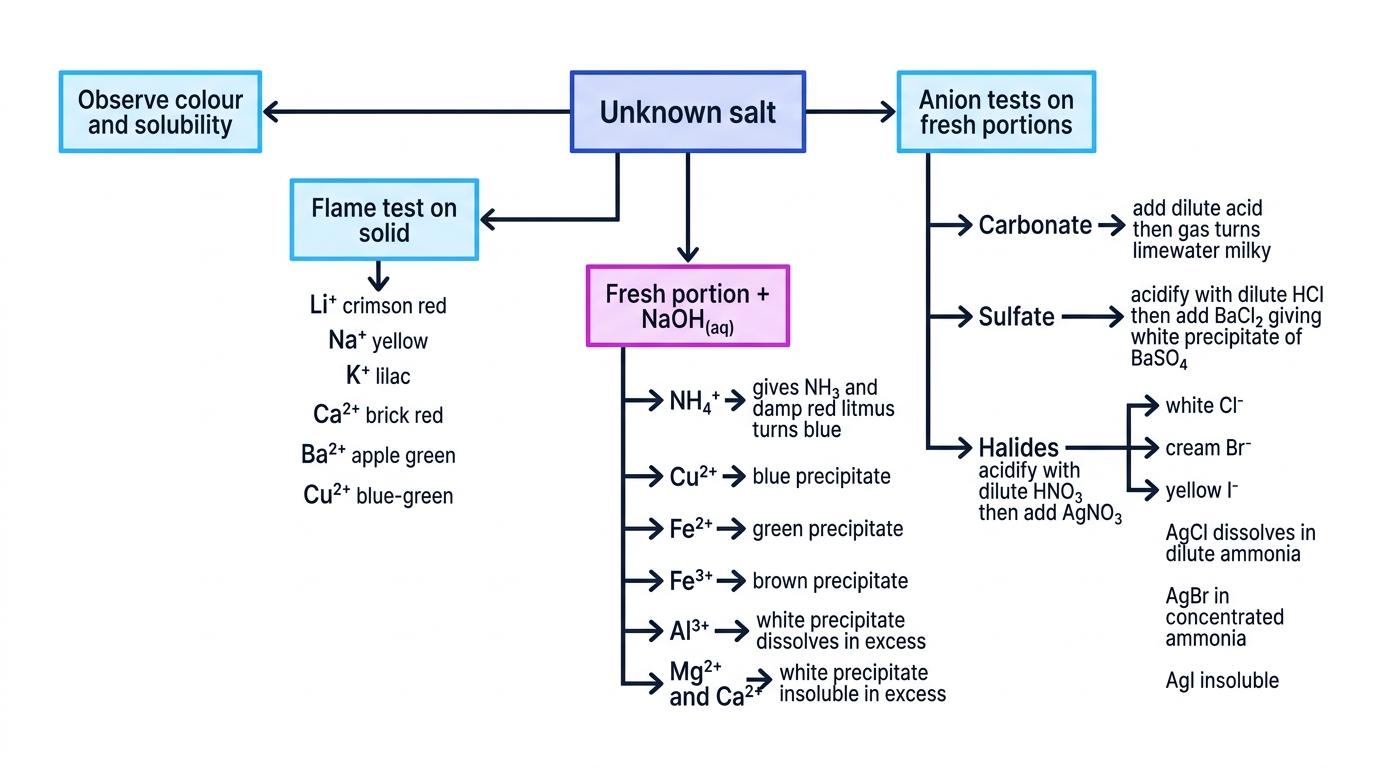
A compact analysis sequence
For an unknown inorganic salt, a sensible plan is:
- Observe the solid or solution: note colour and solubility.
- Do a flame test on a solid sample if a metal cation is likely.
- Test a fresh portion with NaOH(aq), warming if checking for NH₄⁺.
- Use separate fresh portions for carbonate, sulfate and halide tests.
- Combine the positive results to name the compound.
In the exam
-
State the reagent, the condition if needed, and the observation: for example, “add NaOH(aq) and warm; ammonia turns damp red litmus blue.”
-
Use the correct acid: dilute HCl before the sulfate test, but dilute HNO₃ before the halide test.
-
If asked to identify an unknown salt, give both ions and then the full compound name or formula.
Check yourself
-
Why is dilute nitric acid used before adding silver nitrate in the halide test?
-
A solution gives a white precipitate with acidified barium chloride. Which ion is indicated?
-
How would you confirm that a gas produced by adding acid to a solid is carbon dioxide?