What you'll learn
- How two half-cells can be connected to make an electrochemical cell.
- What standard electrode potentials, E∘E^\circE∘, mean and how they are measured.
- How to calculate Ecell∘E^\circ_\text{cell}Ecell∘ and predict the direction of redox reactions.
- How to interpret cell diagrams, salt bridges and electrode notation.
Starting point: redox and electrons
In Redox II, the key idea is still electron transfer.
Oxidation and reduction
Oxidation is loss of electrons. Reduction is gain of electrons. A redox reaction is a reaction where oxidation and reduction happen together.
A useful memory aid is OIL RIG: Oxidation Is Loss, Reduction Is Gain.
For example, in the reaction between zinc and copper(II) ions:
Zn(s)+Cu2+(aq)→Zn2+(aq)+Cu(s)\text{Zn(s)} + \text{Cu}^{2+}\text{(aq)} \to \text{Zn}^{2+}\text{(aq)} + \text{Cu(s)}Zn(s)+Cu2+(aq)→Zn2+(aq)+Cu(s)zinc loses electrons:
Zn(s)→Zn2+(aq)+2e−\text{Zn(s)} \to \text{Zn}^{2+}\text{(aq)} + 2e^-Zn(s)→Zn2+(aq)+2e−copper(II) ions gain electrons:
Cu2+(aq)+2e−→Cu(s)\text{Cu}^{2+}\text{(aq)} + 2e^- \to \text{Cu(s)}Cu2+(aq)+2e−→Cu(s)Combining half-equations
Use the half-equations below to write the overall redox equation.
Fe3+(aq)+e−→Fe2+(aq)\text{Fe}^{3+}\text{(aq)} + e^- \to \text{Fe}^{2+}\text{(aq)}Fe3+(aq)+e−→Fe2+(aq) I−(aq)→12I2(aq)+e−\text{I}^-\text{(aq)} \to \frac{1}{2}\text{I}_2\text{(aq)} + e^-I−(aq)→21I2(aq)+e−-
Match the number of electrons. Both half-equations already involve one electron, so no multiplication is needed.
-
Add the two half-equations and cancel electrons from opposite sides:
Fe3+(aq)+I−(aq)→Fe2+(aq)+12I2(aq)\text{Fe}^{3+}\text{(aq)} + \text{I}^-\text{(aq)} \to \text{Fe}^{2+}\text{(aq)} + \frac{1}{2}\text{I}_2\text{(aq)}Fe3+(aq)+I−(aq)→Fe2+(aq)+21I2(aq) -
If you prefer whole-number coefficients, multiply everything by 2:
2Fe3+(aq)+2I−(aq)→2Fe2+(aq)+I2(aq)2\text{Fe}^{3+}\text{(aq)} + 2\text{I}^-\text{(aq)} \to 2\text{Fe}^{2+}\text{(aq)} + \text{I}_2\text{(aq)}2Fe3+(aq)+2I−(aq)→2Fe2+(aq)+I2(aq)
What is an electrochemical cell?
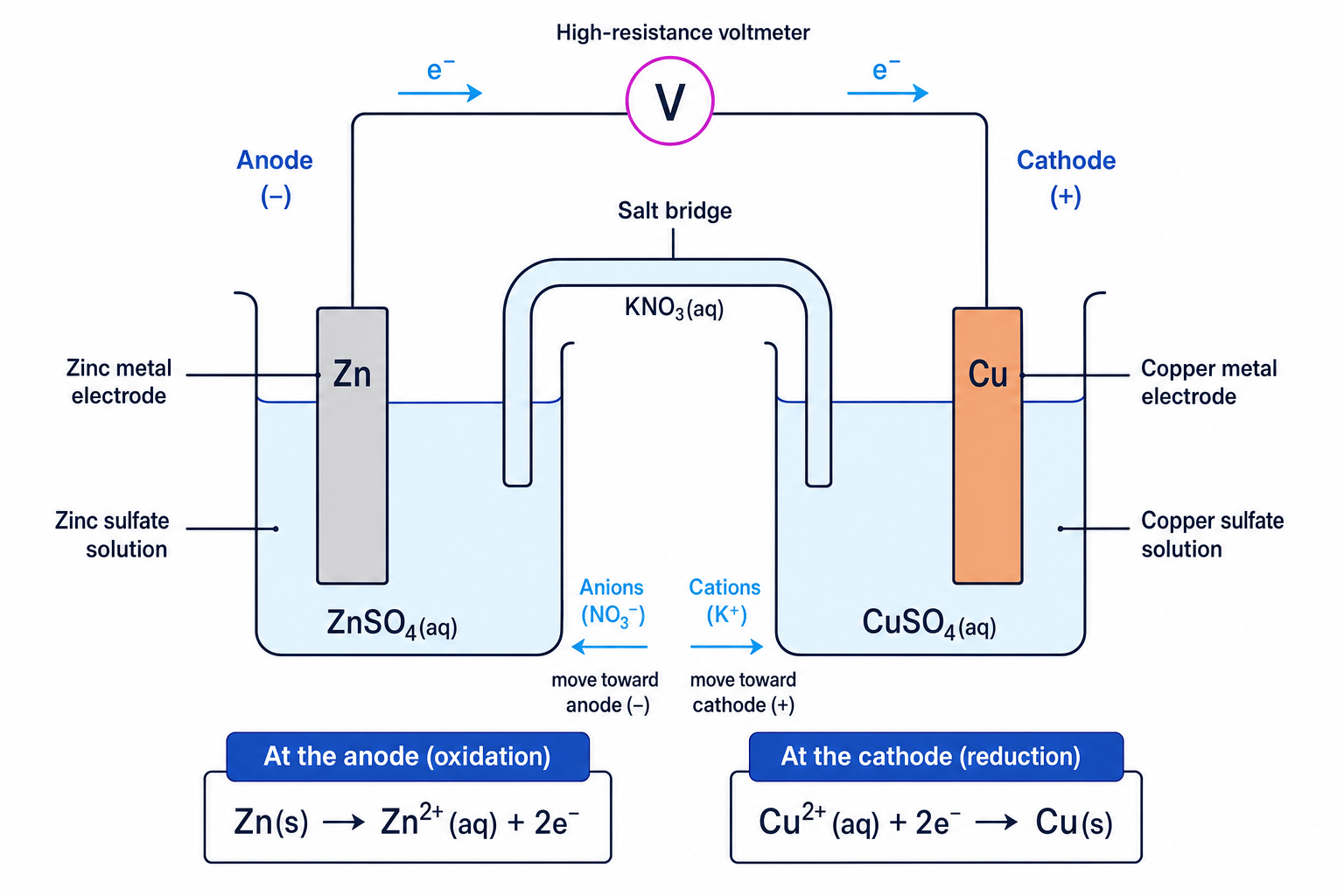
An electrochemical cell uses a redox reaction to produce a measurable voltage. The reaction is split into two separate parts called half-cells.
Half-cell
A half-cell is one half of an electrochemical cell, containing an electrode in contact with chemicals that can undergo oxidation or reduction.
A simple cell can be made from:
- a zinc half-cell: Zn(s) in Zn²⁺(aq)
- a copper half-cell: Cu(s) in Cu²⁺(aq)
- a wire and high-resistance voltmeter
- a salt bridge
Electrodes, anodes and cathodes
An electrode is a conductor that allows electrons to enter or leave a half-cell. In a metal/metal ion half-cell, the metal itself is usually the electrode.
Anode and cathode
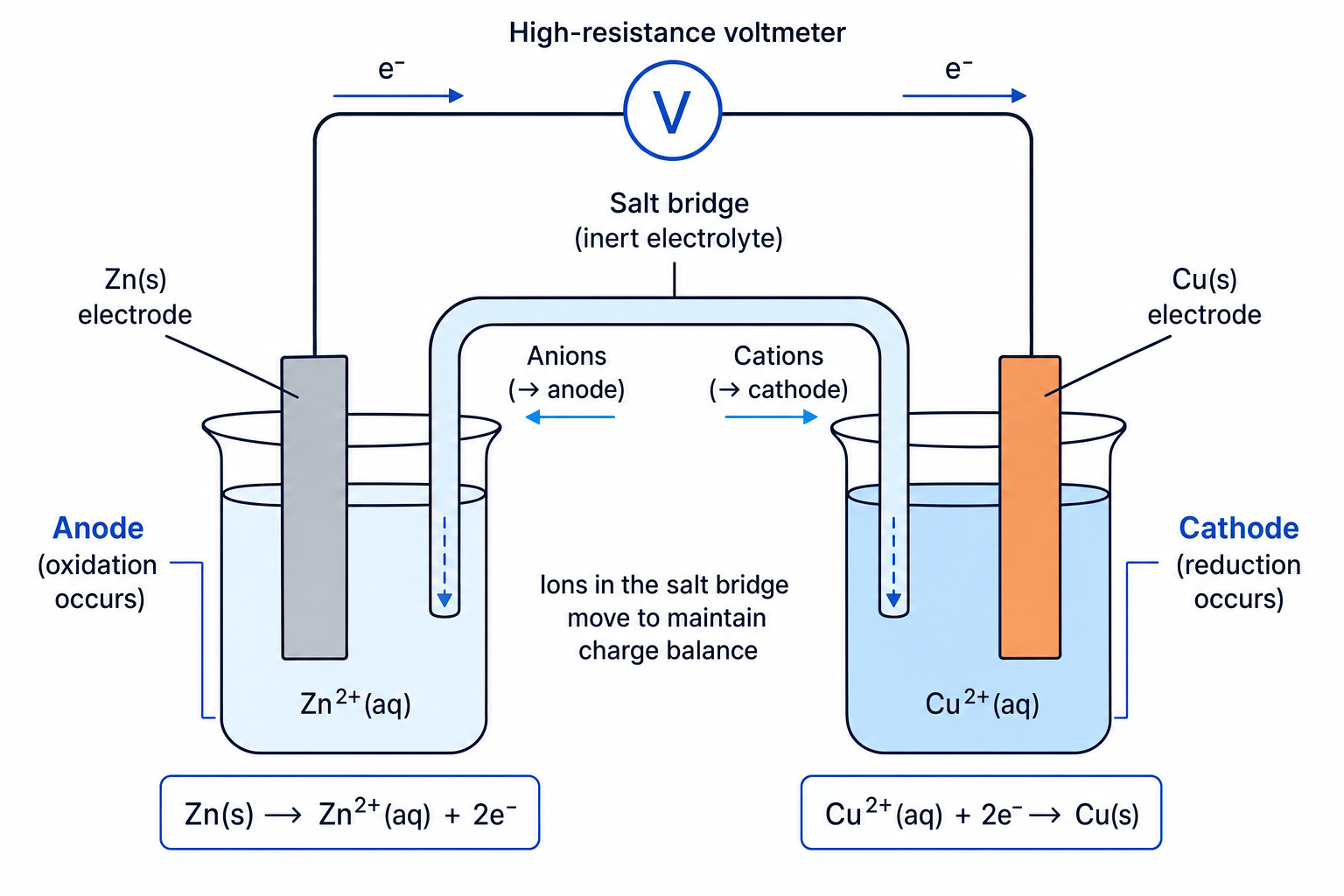
The anode is the electrode where oxidation happens. The cathode is the electrode where reduction happens.
For the zinc-copper cell:
Zn(s)→Zn2+(aq)+2e−\text{Zn(s)} \to \text{Zn}^{2+}\text{(aq)} + 2e^-Zn(s)→Zn2+(aq)+2e−so zinc is oxidised at the anode.
Cu2+(aq)+2e−→Cu(s)\text{Cu}^{2+}\text{(aq)} + 2e^- \to \text{Cu(s)}Cu2+(aq)+2e−→Cu(s)so copper(II) ions are reduced at the cathode.
Electron flow
In a simple electrochemical cell, electrons flow through the external wire from the anode to the cathode.
Anode does not always mean positive
In electrochemical cells, the anode is negative because it releases electrons. In electrolysis, the anode is positive. The definition that always works is: anode = oxidation.
Why is a salt bridge needed?
The salt bridge completes the circuit using moving ions. It is often filter paper soaked in an inert electrolyte such as potassium nitrate, KNO₃(aq).
As oxidation and reduction continue, charge would build up in each half-cell. The salt bridge prevents this by allowing ions to move:
- anions move towards the anode
- cations move towards the cathode
The ions in the salt bridge should be inert, meaning they do not react with the substances in either half-cell.
Choosing a salt bridge electrolyte
KNO₃ is commonly used because K⁺ and NO₃⁻ ions are usually spectators. Avoid ions that form precipitates or take part in redox reactions.
Cell emf and electrode potentials
The voltage measured between two half-cells is the cell potential or emf.
emf
The electromotive force, emf, is the maximum potential difference between two electrodes when essentially no current is drawn. It is measured in volts, V.
A high-resistance voltmeter is used so that very little current flows. This gives a value close to the maximum possible potential difference.
You cannot measure the electrode potential of a single half-cell on its own. You can only measure a potential difference between two half-cells. So chemists compare half-cells against a reference electrode.
The standard hydrogen electrode
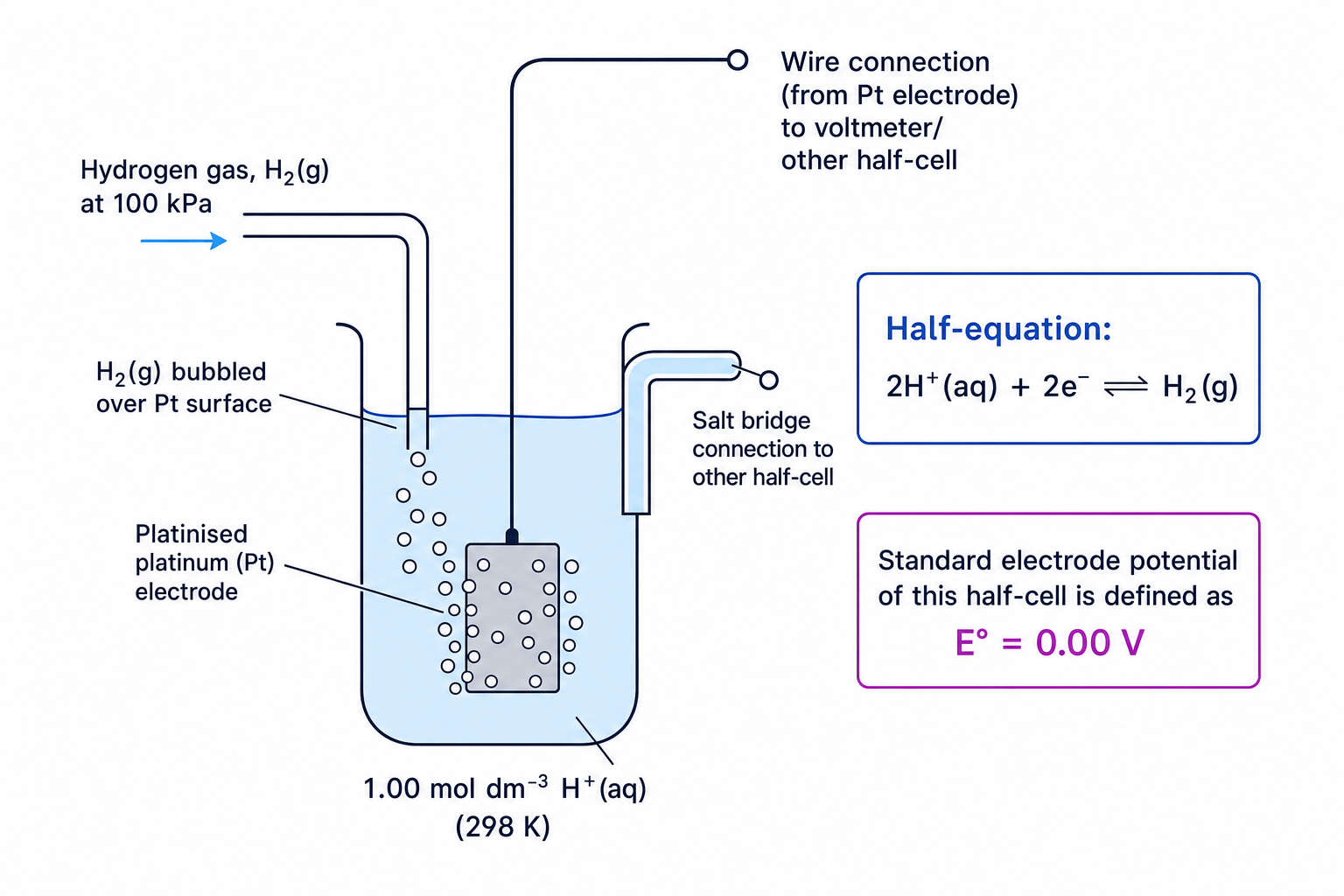
The standard hydrogen electrode, often shortened to SHE, is the reference half-cell. Its standard electrode potential is defined as exactly 0.00 V.
Standard electrode potential
The standard electrode potential, E∘E^\circE∘, is the emf measured when a half-cell is connected to the standard hydrogen electrode under standard conditions.
Standard conditions are:
- temperature of 298 K
- ion concentrations of 1.00 mol dm⁻³
- gas pressures of 100 kPa
The SHE half-equation is:
2H+(aq)+2e−⇌H2(g)2\text{H}^+\text{(aq)} + 2e^- \rightleftharpoons \text{H}_2\text{(g)}2H+(aq)+2e−⇌H2(g)A platinised platinum electrode is used because hydrogen is a gas and hydrogen ions are aqueous, so there is no solid conducting electrode naturally present. Platinum is inert and provides a surface for electron transfer.
Using standard electrode potentials
Standard electrode potentials are normally written as reduction half-equations.
For example:
Cu2+(aq)+2e−⇌Cu(s)E∘=+0.34 V\text{Cu}^{2+}\text{(aq)} + 2e^- \rightleftharpoons \text{Cu(s)} \qquad E^\circ = +0.34\text{ V}Cu2+(aq)+2e−⇌Cu(s)E∘=+0.34 V Zn2+(aq)+2e−⇌Zn(s)E∘=−0.76 V\text{Zn}^{2+}\text{(aq)} + 2e^- \rightleftharpoons \text{Zn(s)} \qquad E^\circ = -0.76\text{ V}Zn2+(aq)+2e−⇌Zn(s)E∘=−0.76 VThe more positive E∘E^\circE∘ value shows the half-cell has a greater tendency to be reduced.
More positive means reduction
The half-equation with the more positive E∘E^\circE∘ value usually goes forwards as reduction. The other half-equation is reversed and occurs as oxidation.
For zinc and copper, copper(II) ions have the more positive electrode potential, so Cu²⁺ is reduced. Zinc is oxidised.
Calculating cell potential
For standard conditions:
Ecell∘=Ecathode∘−Eanode∘E^\circ_\text{cell} = E^\circ_\text{cathode} - E^\circ_\text{anode}Ecell∘=Ecathode∘−Eanode∘Because standard electrode potentials are listed as reductions, this means:
- use the more positive reduction half-cell as the cathode
- use the less positive reduction half-cell as the anode value
- subtract anode from cathode
Calculating the emf of a zinc-copper cell
Calculate Ecell∘E^\circ_\text{cell}Ecell∘ for the cell made from Zn²⁺/Zn and Cu²⁺/Cu.
Data:
Cu2+(aq)+2e−⇌Cu(s)E∘=+0.34 V\text{Cu}^{2+}\text{(aq)} + 2e^- \rightleftharpoons \text{Cu(s)} \qquad E^\circ = +0.34\text{ V}Cu2+(aq)+2e−⇌Cu(s)E∘=+0.34 V Zn2+(aq)+2e−⇌Zn(s)E∘=−0.76 V\text{Zn}^{2+}\text{(aq)} + 2e^- \rightleftharpoons \text{Zn(s)} \qquad E^\circ = -0.76\text{ V}Zn2+(aq)+2e−⇌Zn(s)E∘=−0.76 V-
Compare the electrode potentials. Copper has the more positive value, so copper is the cathode and reduction occurs there.
-
Identify the anode value. Zinc has the less positive value, so zinc is oxidised at the anode, but its listed reduction potential is still used in the calculation.
-
Substitute into the equation:
Ecell∘=+0.34 V−(−0.76 V)E^\circ_\text{cell} = +0.34\text{ V} - \left(-0.76\text{ V}\right)Ecell∘=+0.34 V−(−0.76 V) -
Calculate the cell potential:
Ecell∘=+1.10 VE^\circ_\text{cell} = +1.10\text{ V}Ecell∘=+1.10 V
Do not change the sign before substituting
Even though the anode reaction is reversed to become oxidation, do not reverse the sign of its listed E∘E^\circE∘ value when using Ecell∘=Ecathode∘−Eanode∘E^\circ_\text{cell} = E^\circ_\text{cathode} - E^\circ_\text{anode}Ecell∘=Ecathode∘−Eanode∘.
Cell notation
Electrochemical cells can be represented using compact cell notation.
For the zinc-copper cell:
Zn(s)∣Zn2+(aq)∥Cu2+(aq)∣Cu(s)\text{Zn(s)} \mid \text{Zn}^{2+}\text{(aq)} \parallel \text{Cu}^{2+}\text{(aq)} \mid \text{Cu(s)}Zn(s)∣Zn2+(aq)∥Cu2+(aq)∣Cu(s)The conventions are:
- the left-hand side is the anode, where oxidation occurs
- the right-hand side is the cathode, where reduction occurs
- a single vertical line represents a phase boundary
- a double vertical line represents the salt bridge
- platinum, Pt(s), is included when an inert electrode is needed
For example, an Fe³⁺/Fe²⁺ half-cell needs Pt(s) because both redox species are aqueous:
Pt(s)∣Fe2+(aq),Fe3+(aq)\text{Pt(s)} \mid \text{Fe}^{2+}\text{(aq)}, \text{Fe}^{3+}\text{(aq)}Pt(s)∣Fe2+(aq),Fe3+(aq)Writing cell notation
Write the cell notation for a cell where magnesium is oxidised and silver ions are reduced.
-
Write the oxidation half-cell on the left. Magnesium metal forms magnesium ions:
Mg(s)∣Mg2+(aq)\text{Mg(s)} \mid \text{Mg}^{2+}\text{(aq)}Mg(s)∣Mg2+(aq) -
Write the reduction half-cell on the right. Silver ions form silver metal:
Ag+(aq)∣Ag(s)\text{Ag}^+\text{(aq)} \mid \text{Ag(s)}Ag+(aq)∣Ag(s) -
Join the two half-cells with the salt bridge symbol:
Mg(s)∣Mg2+(aq)∥Ag+(aq)∣Ag(s)\text{Mg(s)} \mid \text{Mg}^{2+}\text{(aq)} \parallel \text{Ag}^+\text{(aq)} \mid \text{Ag(s)}Mg(s)∣Mg2+(aq)∥Ag+(aq)∣Ag(s)
Predicting whether a reaction is feasible
If Ecell∘E^\circ_\text{cell}Ecell∘ is positive, the reaction is thermodynamically feasible under standard conditions.
If Ecell∘E^\circ_\text{cell}Ecell∘ is negative, the reaction is not feasible in that direction under standard conditions.
Feasible does not always mean fast
A positive Ecell∘E^\circ_\text{cell}Ecell∘ suggests a reaction can happen thermodynamically, but it may still be very slow because of a high activation energy or other kinetic barriers.
Predicting a redox reaction
Use the data to predict whether acidified manganate(VII) ions can oxidise Fe²⁺ ions to Fe³⁺ under standard conditions.
MnO4−(aq)+8H+(aq)+5e−⇌Mn2+(aq)+4H2O(l)E∘=+1.51 V\text{MnO}_4^-\text{(aq)} + 8\text{H}^+\text{(aq)} + 5e^- \rightleftharpoons \text{Mn}^{2+}\text{(aq)} + 4\text{H}_2\text{O(l)} \qquad E^\circ = +1.51\text{ V}MnO4−(aq)+8H+(aq)+5e−⇌Mn2+(aq)+4H2O(l)E∘=+1.51 V Fe3+(aq)+e−⇌Fe2+(aq)E∘=+0.77 V\text{Fe}^{3+}\text{(aq)} + e^- \rightleftharpoons \text{Fe}^{2+}\text{(aq)} \qquad E^\circ = +0.77\text{ V}Fe3+(aq)+e−⇌Fe2+(aq)E∘=+0.77 V-
Decide which species is reduced. The manganate(VII) half-equation has the more positive E∘E^\circE∘, so MnO₄⁻ is reduced to Mn²⁺.
-
Reverse the iron half-equation to show oxidation of Fe²⁺:
Fe2+(aq)→Fe3+(aq)+e−\text{Fe}^{2+}\text{(aq)} \to \text{Fe}^{3+}\text{(aq)} + e^-Fe2+(aq)→Fe3+(aq)+e− -
Calculate the standard cell potential:
Ecell∘=+1.51 V−+0.77 V=+0.74 VE^\circ_\text{cell} = +1.51\text{ V} - +0.77\text{ V} = +0.74\text{ V}Ecell∘=+1.51 V−+0.77 V=+0.74 V -
Interpret the sign. Since Ecell∘E^\circ_\text{cell}Ecell∘ is positive, acidified MnO₄⁻ can oxidise Fe²⁺ to Fe³⁺ under standard conditions.
Practical points for measuring emf
When setting up electrochemical cells, good practical technique matters.
Use clean metal electrodes so the surface can transfer electrons properly. Keep ion concentrations known, usually 1.00 mol dm⁻³ for standard measurements. Use a high-resistance voltmeter to reduce current flow. Make sure the salt bridge is soaked in an inert electrolyte and makes contact with both solutions.
If a half-cell involves only aqueous ions, such as Fe³⁺/Fe²⁺, use an inert platinum electrode. If a half-cell involves a gas, such as H₂(g), use platinum and control the gas pressure.
Sanity check for cell voltages
A standard cell potential should usually be positive if you have placed the anode on the left and cathode on the right correctly. If it is negative, you may have the cell direction reversed.
In the exam
-
Write both half-equations as reductions first, using the given E∘E^\circE∘ values exactly as listed.
-
Choose the more positive E∘E^\circE∘ as the cathode reduction, then calculate Ecell∘=Ecathode∘−Eanode∘E^\circ_\text{cell} = E^\circ_\text{cathode} - E^\circ_\text{anode}Ecell∘=Ecathode∘−Eanode∘.
-
For explanations, link the sign of Ecell∘E^\circ_\text{cell}Ecell∘ to feasibility, but mention that kinetics can stop a feasible reaction from being observed quickly.
Check yourself
- Why can’t the electrode potential of a single half-cell be measured directly?
- In the cell Zn(s) | Zn²⁺(aq) || Cu²⁺(aq) | Cu(s), which way do electrons flow?
- What does a positive Ecell∘E^\circ_\text{cell}Ecell∘ tell you, and what does it not tell you?