What you'll learn
- How activation energy controls whether collisions lead to reaction.
- How energy profile diagrams show transition states, intermediates and rate-determining steps.
- How rate equations provide evidence for reaction mechanisms.
- How the Arrhenius equation links temperature, rate constant and activation energy.
Starting point: rate equations
In Kinetics II, you are not just asking how fast a reaction goes — you are asking what the rate tells you about the particles involved in the slowest part of the reaction.
The rate of reaction is the change in concentration of a reactant or product per unit time, usually in mol dm⁻³ s⁻¹.
Rate equation
A rate equation links rate to reactant concentrations:
rate=k[A]m[B]n\text{rate} = k[A]^m[B]^nrate=k[A]m[B]nwhere kkk is the rate constant, and mmm and nnn are the orders with respect to A and B. The overall order is m+nm+nm+n.
The orders are found experimentally, usually from initial rates. They are not normally obtained from the balanced equation.
Orders are not balancing numbers
For an overall equation such as 2A+B→C2A+B \to C2A+B→C, you cannot assume the rate equation is rate=k[A]2[B]\text{rate}=k[A]^2[B]rate=k[A]2[B]. That is only valid if the equation represents a single elementary step, which most overall equations do not.
Finding a rate equation from initial rates
For a reaction involving A and B:
- Run 1: [A]=0.100[A]=0.100[A]=0.100 mol dm⁻³, [B]=0.100[B]=0.100[B]=0.100 mol dm⁻³, rate =2.40×10−4=2.40 \times 10^{-4}=2.40×10⁻⁴ mol dm⁻³ s⁻¹
- Run 2: [A]=0.200[A]=0.200[A]=0.200 mol dm⁻³, [B]=0.100[B]=0.100[B]=0.100 mol dm⁻³, rate =4.80×10−4=4.80 \times 10^{-4}=4.80×10⁻⁴ mol dm⁻³ s⁻¹
- Run 3: [A]=0.100[A]=0.100[A]=0.100 mol dm⁻³, [B]=0.200[B]=0.200[B]=0.200 mol dm⁻³, rate =9.60×10−4=9.60 \times 10^{-4}=9.60×10⁻⁴ mol dm⁻³ s⁻¹
-
Compare runs 1 and 2: [A][A][A] doubles while [B][B][B] is constant, and the rate doubles. The reaction is first order with respect to A.
-
Compare runs 1 and 3: [B][B][B] doubles while [A][A][A] is constant, and the rate increases by a factor of 4. The reaction is second order with respect to B.
-
Combine the orders to write the rate equation:
rate=k[A][B]2\text{rate}=k[A][B]^2rate=k[A][B]2 -
Use run 1 to calculate kkk:
k=2.40×10−40.100(0.100)2=0.240 dm6 mol−2 s−1k=\frac{2.40 \times 10^{-4}}{0.100(0.100)^2} =0.240\ \text{dm}^6\text{ mol}^{-2}\text{ s}^{-1}k=0.100(0.100)22.40×10−4=0.240 dm6 mol−2 s−1
Activation energy: the energy barrier
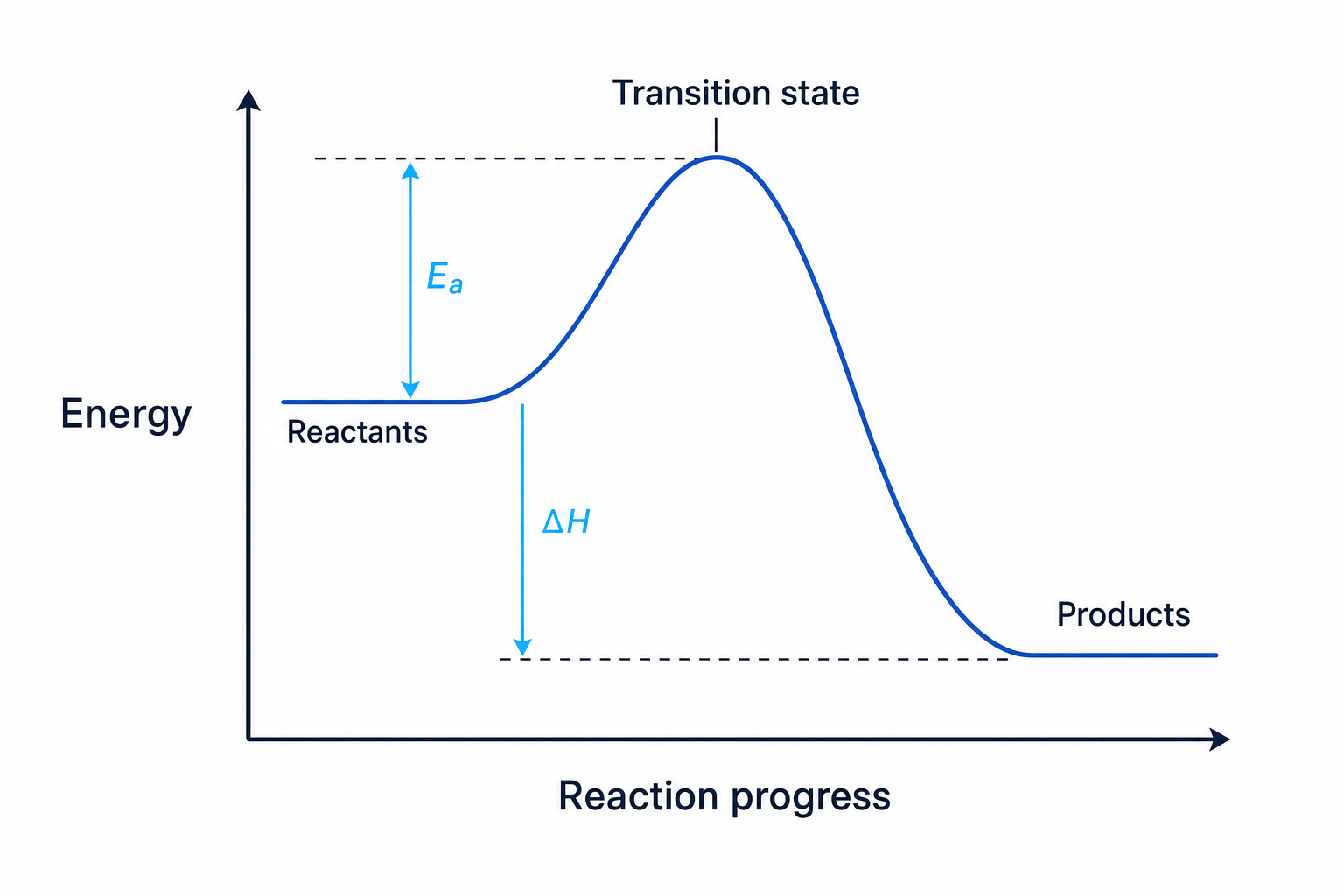
For particles to react, they must collide with the correct orientation and with enough energy to overcome an energy barrier.
Activation energy
The activation energy, EaE_\text{a}Ea, is the minimum energy that reacting particles must have for a collision to be successful.
At the top of the energy barrier is the transition state, also called the activated complex. This is a very unstable arrangement of atoms in which bonds are partly broken and partly formed. It is not normally isolable.
A reaction profile shows energy against reaction progress.
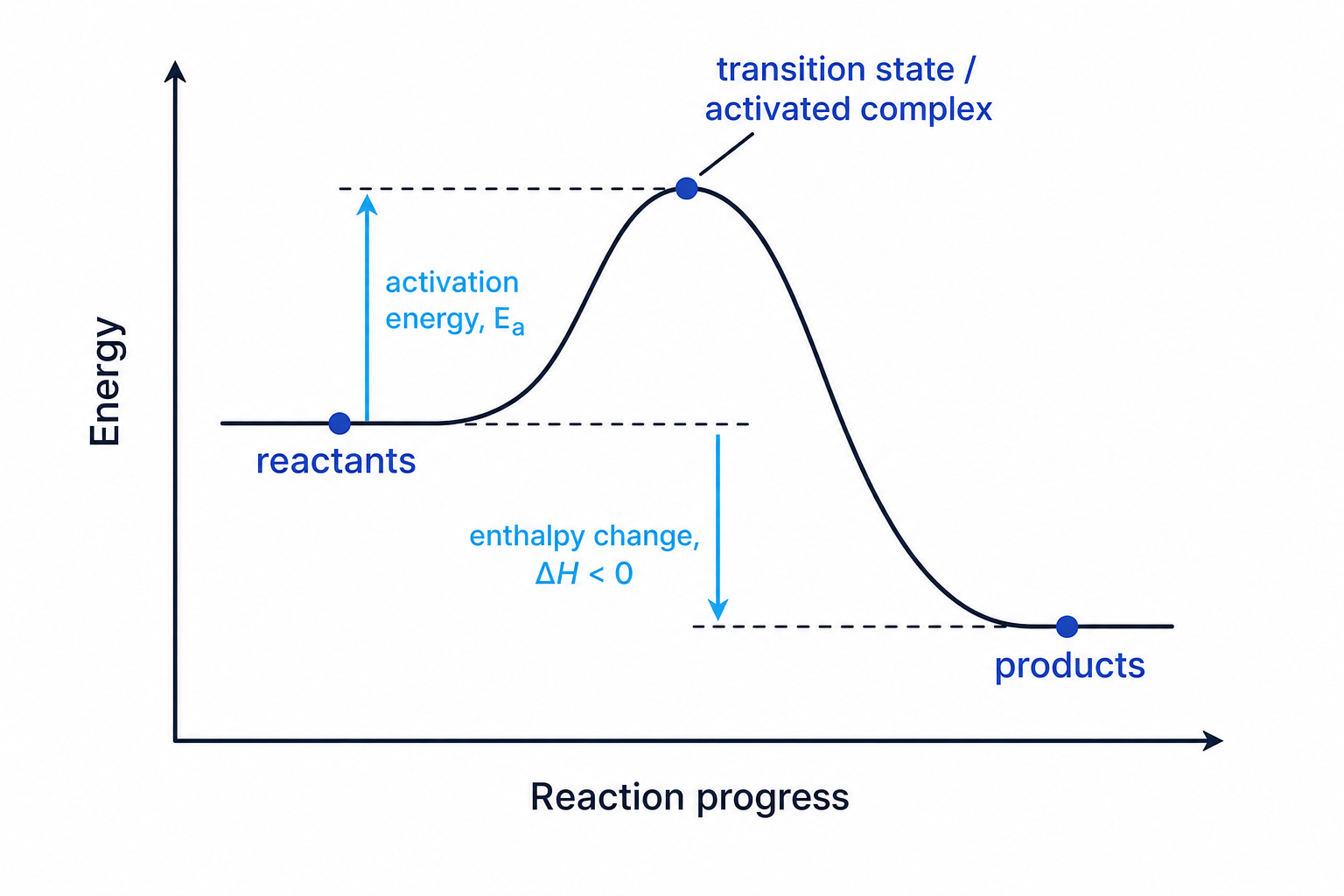
A higher activation energy means fewer particles have enough energy to react at a given temperature, so the reaction is slower. Increasing temperature increases the fraction of particles with energy at least EaE_\text{a}Ea, so the rate increases.
Why temperature has a big effect
A small temperature increase can cause a large rate increase because many more particles have energy greater than or equal to EaE_\text{a}Ea, so many more collisions are successful.
A catalyst increases the rate of reaction by providing an alternative route with a lower activation energy. It does not change the overall enthalpy change, ΔH\Delta HΔH, and it is regenerated by the end of the reaction.
Reading a reaction profile
A reaction profile has reactants at 40 kJ mol⁻¹, products at 10 kJ mol⁻¹, and a transition state at 115 kJ mol⁻¹.
-
Calculate the forward activation energy by comparing the transition state with the reactants:
Ea, forward=115−40=75 kJ mol−1E_\text{a, forward}=115-40=75\ \text{kJ mol}^{-1}Ea, forward=115−40=75 kJ mol−1 -
Calculate the reverse activation energy by comparing the transition state with the products:
Ea, reverse=115−10=105 kJ mol−1E_\text{a, reverse}=115-10=105\ \text{kJ mol}^{-1}Ea, reverse=115−10=105 kJ mol−1 -
Calculate the enthalpy change from products minus reactants:
ΔH=10−40=−30 kJ mol−1\Delta H=10-40=-30\ \text{kJ mol}^{-1}ΔH=10−40=−30 kJ mol−1The reaction is exothermic because ΔH<0\Delta H<0ΔH<0.
Reaction mechanisms
A balanced equation often hides the real sequence of events. A reaction may happen through several smaller steps.
Mechanism, elementary step and intermediate
A reaction mechanism is a sequence of elementary steps that add together to give the overall reaction. An intermediate is made in one step and used up in a later step, so it does not appear in the overall equation.
For an elementary step, the rate law can be inferred from the particles involved in that step. This is why mechanisms are so useful: they connect the experimental rate equation to a possible molecular pathway.
The rate-determining step
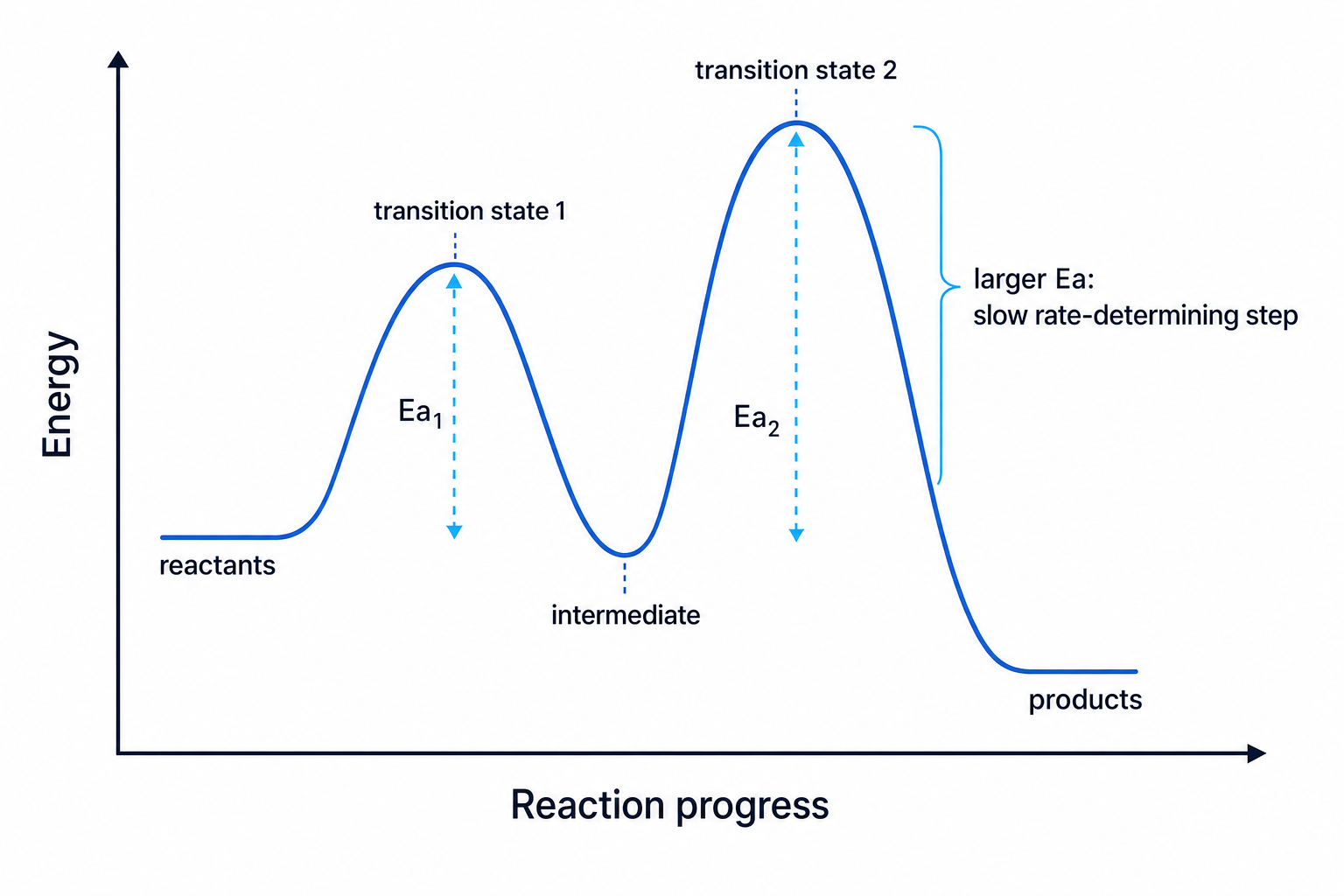
The rate-determining step, often shortened to RDS, is the slowest step in a mechanism. It controls the overall rate in a similar way to how the slowest stage of a production line controls the output.
In an energy profile for a multi-step reaction, intermediates appear as valleys between peaks. Each peak is a transition state.
Highest peak versus largest barrier
The rate-determining step is linked to the largest activation energy barrier for a step, not simply the highest point on the whole diagram. Compare each transition state with the species immediately before it.
If the slow step is elementary, the species in that step usually appear in the rate equation. Species that only appear after the slow step usually do not affect the rate.
Testing a proposed mechanism
The reaction
NO2(g)+CO(g)→NO(g)+CO2(g)\text{NO}_2(g)+\text{CO}(g)\to \text{NO}(g)+\text{CO}_2(g)NO2(g)+CO(g)→NO(g)+CO2(g)has the experimental rate equation:
rate=k[NO2]2\text{rate}=k[\text{NO}_2]^2rate=k[NO2]2A proposed mechanism is:
NO2(g)+NO2(g)→NO3(g)+NO(g)slowNO3(g)+CO(g)→NO2(g)+CO2(g)fast\begin{aligned} \text{NO}_2(g)+\text{NO}_2(g)&\to \text{NO}_3(g)+\text{NO}(g) \quad \text{slow} \\ \text{NO}_3(g)+\text{CO}(g)&\to \text{NO}_2(g)+\text{CO}_2(g) \quad \text{fast} \end{aligned}NO2(g)+NO2(g)NO3(g)+CO(g)→NO3(g)+NO(g)slow→NO2(g)+CO2(g)fast-
Add the two elementary steps and cancel species that appear on both sides. NO3\text{NO}_3NO3 cancels because it is made then used up, and one NO2\text{NO}_2NO2 cancels, giving:
NO2(g)+CO(g)→NO(g)+CO2(g)\text{NO}_2(g)+\text{CO}(g)\to \text{NO}(g)+\text{CO}_2(g)NO2(g)+CO(g)→NO(g)+CO2(g) -
Identify the intermediate: NO3\text{NO}_3NO3 is produced in step 1 and consumed in step 2, so it is an intermediate.
-
Use the slow elementary step to predict the rate equation. The slow step involves two NO2\text{NO}_2NO2 particles, so:
rate=k[NO2]2\text{rate}=k[\text{NO}_2]^2rate=k[NO2]2 -
Compare with the experimental rate equation. It matches, so the proposed mechanism is consistent with the kinetic evidence.
A mechanism that matches the rate equation is not automatically “proven”; it is supported by the evidence. There may be other possible mechanisms unless further evidence rules them out.
Activation energy and the Arrhenius equation
The rate constant kkk changes with temperature. For many reactions, this relationship is described by the Arrhenius equation.
Arrhenius equation
The Arrhenius equation is:
k=Ae−Ea/RTk=Ae^{-E_\text{a}/RT}k=Ae−Ea/RTwhere AAA is the pre-exponential factor, EaE_\text{a}Ea is activation energy in J mol⁻¹, RRR is the gas constant, 8.31 J K⁻¹ mol⁻¹, and TTT is temperature in K.
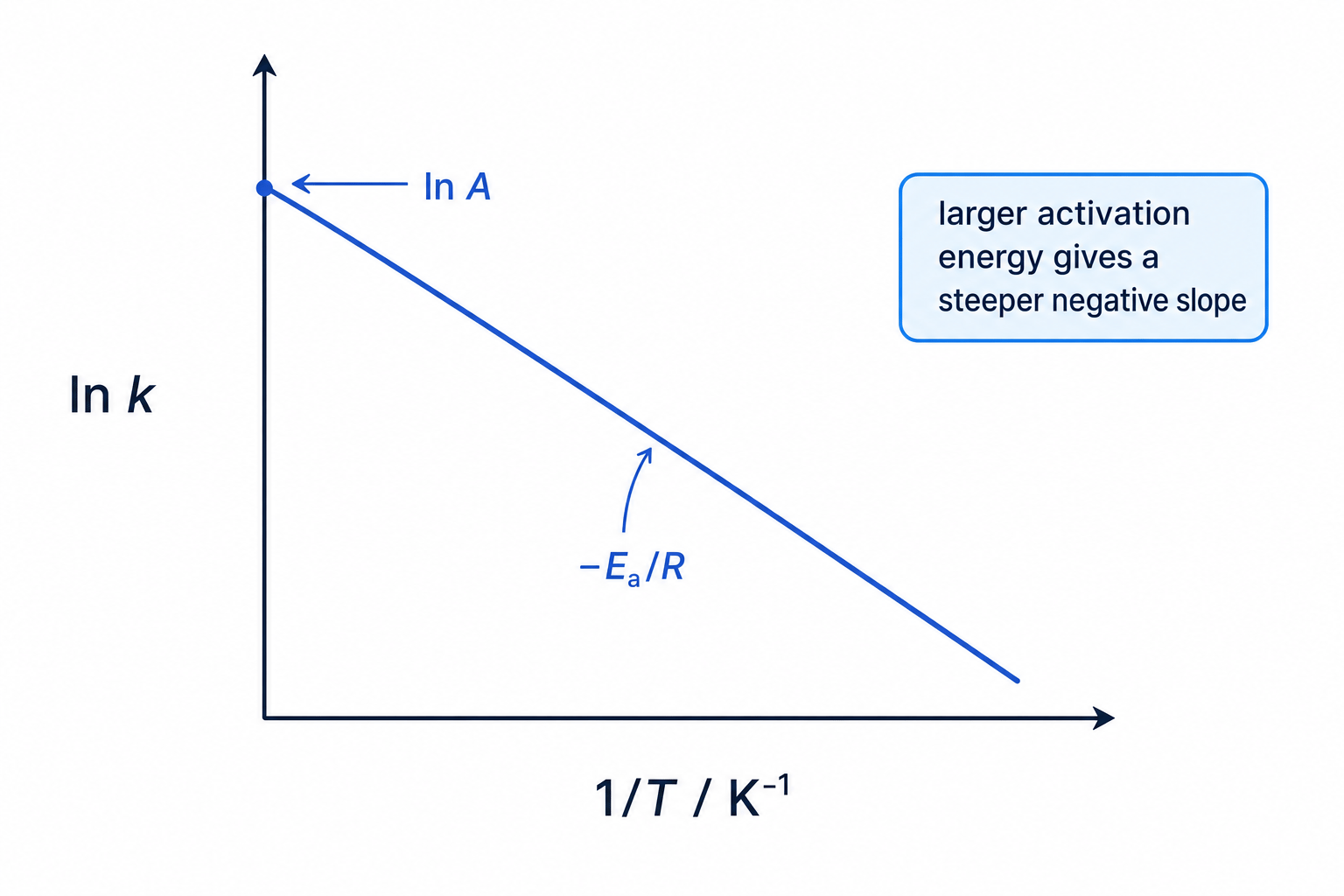
Taking natural logs gives a straight-line form:
lnk=−EaR(1T)+lnA\ln k=-\frac{E_\text{a}}{R}\left(\frac{1}{T}\right)+\ln Alnk=−REa(T1)+lnASo a graph of lnk\ln klnk against 1/T1/T1/T has gradient −Ea/R-E_\text{a}/R−Ea/R.
Arrhenius graph shortcut
If you are given an Arrhenius plot, use Ea=−gradient×RE_\text{a}=-\text{gradient}\times REa=−gradient×R. The gradient should be negative, so the calculated activation energy should be positive.
You can also use two values of kkk at two temperatures:
ln(k2k1)=EaR(1T1−1T2)\ln\left(\frac{k_2}{k_1}\right) = \frac{E_\text{a}}{R} \left(\frac{1}{T_1}-\frac{1}{T_2}\right)ln(k1k2)=REa(T11−T21)Calculating activation energy from two rate constants
For a first-order reaction, k=0.0150 s−1k=0.0150\ \text{s}^{-1}k=0.0150 s−1 at 25.0 °C and k=0.0970 s−1k=0.0970\ \text{s}^{-1}k=0.0970 s−1 at 45.0 °C.
-
Convert temperatures to kelvin:
T1=25.0+273=298 KT_1=25.0+273=298\ \text{K}T1=25.0+273=298 K T2=45.0+273=318 KT_2=45.0+273=318\ \text{K}T2=45.0+273=318 K -
Substitute into the two-temperature Arrhenius equation:
ln(0.09700.0150)=Ea8.31(1298−1318)1.87=Ea8.31(2.11×10⁻⁴)\begin{aligned} \ln\left(\frac{0.0970}{0.0150}\right) &= \frac{E_\text{a}}{8.31} \left(\frac{1}{298}-\frac{1}{318}\right) \\ 1.87 &= \frac{E_\text{a}}{8.31} (2.11 \times 10^{-4}) \end{aligned}ln(0.01500.0970)1.87=8.31Ea(2981−3181)=8.31Ea(2.11×10⁻⁴) -
Rearrange and convert from J mol⁻¹ to kJ mol⁻¹:
Ea=1.87×8.312.11×10−4=7.36×10⁴ J mol−1=73.6 kJ mol−1E_\text{a} = \frac{1.87 \times 8.31}{2.11 \times 10^{-4}} = 7.36 \times 10^4\ \text{J mol}^{-1} = 73.6\ \text{kJ mol}^{-1}Ea=2.11×10−41.87×8.31=7.36×10⁴ J mol−1=73.6 kJ mol−1
Mixing J and kJ
Because RRR is usually 8.31 J K⁻¹ mol⁻¹, your calculated EaE_\text{a}Ea initially comes out in J mol⁻¹. Convert to kJ mol⁻¹ at the end by dividing by 1000.
Practical note: getting Arrhenius data
To determine EaE_\text{a}Ea experimentally, you need values of kkk at several temperatures. In practice, you would keep concentrations controlled, use a thermostatted water bath, measure initial rates or follow concentration changes, and repeat measurements to reduce random uncertainty. Temperature control matters because kkk is very temperature-sensitive.
In the exam
-
Use experimental rate data to find orders; do not use balancing numbers from the overall equation.
-
For a proposed mechanism, add the steps, cancel intermediates, and check that the slow step gives the experimental rate equation.
-
On energy profiles, measure EaE_\text{a}Ea from the species immediately before the barrier to the transition state.
-
For Arrhenius calculations, use kelvin temperatures and R=8.31 J K−1 mol−1R=8.31\ \text{J K}^{-1}\text{ mol}^{-1}R=8.31 J K−1 mol−1, then convert J mol⁻¹ to kJ mol⁻¹ if needed.
Check yourself
- Why can a reactant appear in the overall equation but not in the rate equation?
- How would you identify an intermediate on a two-step reaction profile?
- What does the gradient of a graph of lnk\ln klnk against 1/T1/T1/T tell you?