What you'll learn
- How a tetrahedral carbon atom can make a molecule chiral.
- How to spot chiral centres in organic molecules.
- What enantiomers, optical isomerism and racemic mixtures mean.
- Why nucleophilic addition to some carbonyl compounds can form racemic mixtures.
Starting point: organic molecules are 3D
Many organic molecules are drawn flat on paper, but the atoms are arranged in three dimensions.
A carbon atom with four single bonds is usually tetrahedral, with bond angles of about 109.5°. To show this on paper:
- a normal line means a bond in the plane of the page
- a solid wedge means a bond coming out towards you
- a dashed wedge means a bond going back away from you
This 3D arrangement matters because two molecules can have the same connectivity but different spatial arrangements.
Chirality
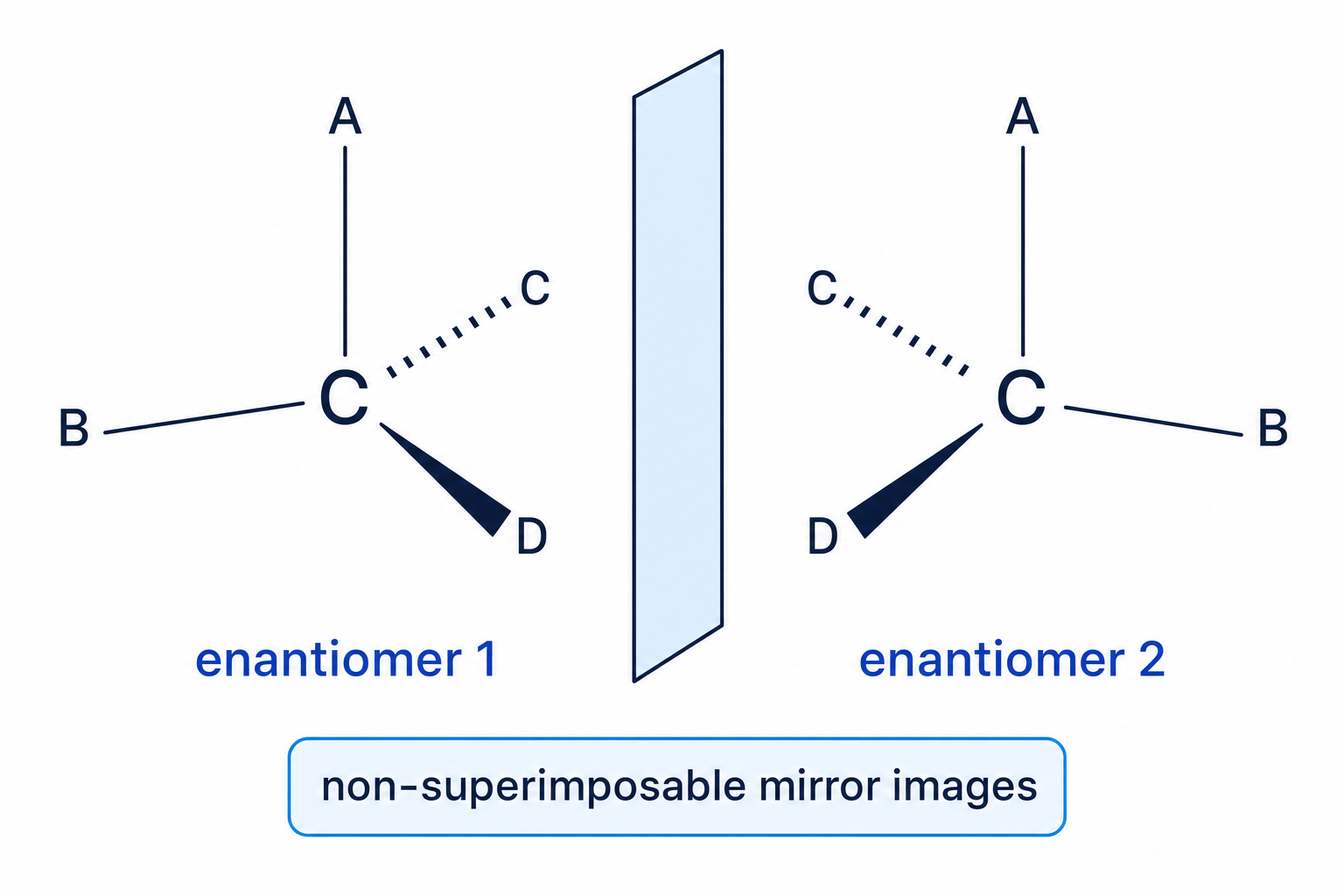
A molecule is chiral if its mirror image is non-superimposable: you cannot rotate one structure so that it fits exactly on top of the other. A molecule that is superimposable on its mirror image is achiral.
Left and right hands
Your left and right hands are mirror images, but they are not identical when placed on top of each other palm-to-palm. Chiral molecules behave in a similar “left-handed/right-handed” way.
Chiral centres
For Edexcel A-Level Chemistry, the most common cause of chirality is a chiral centre.
Chiral centre
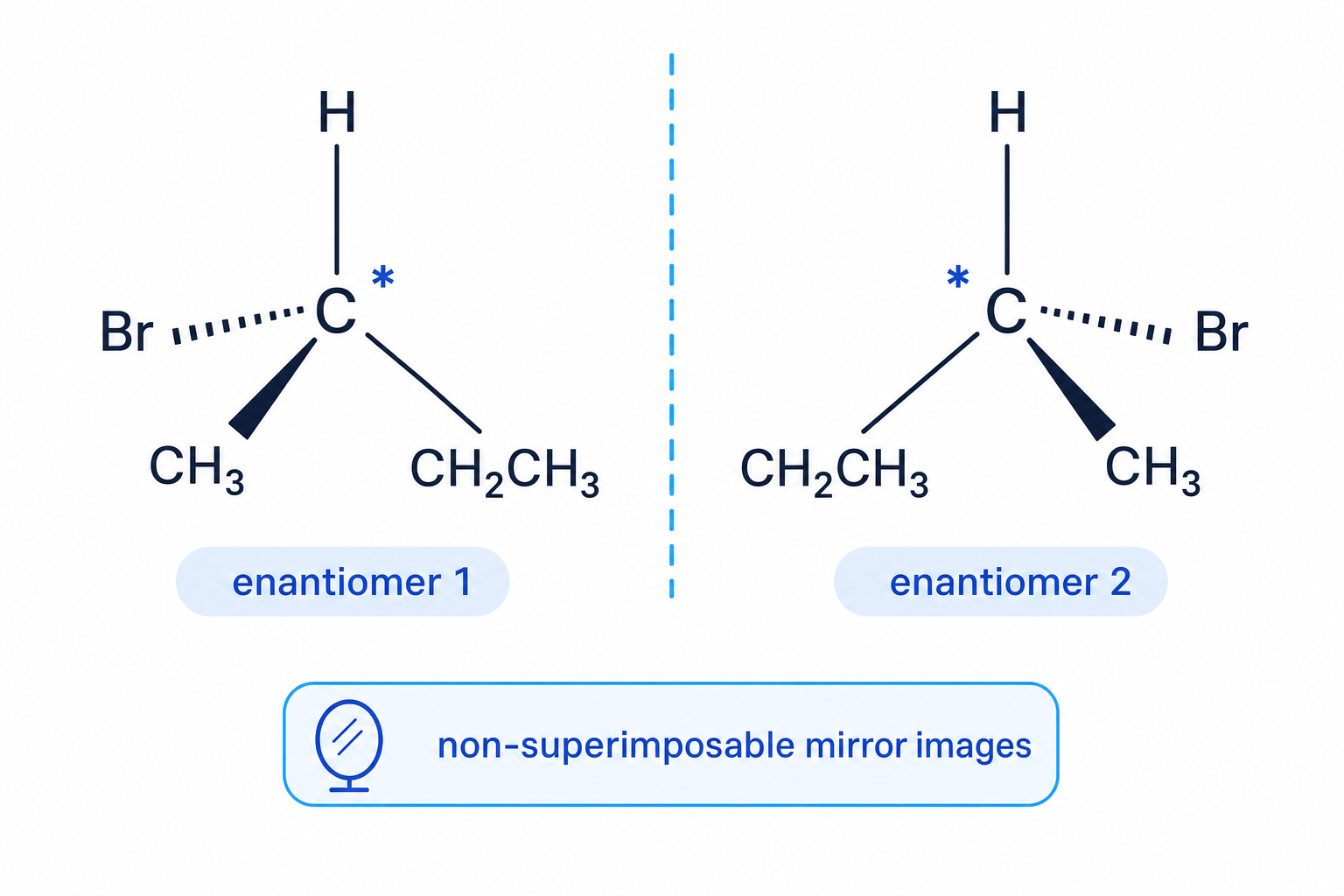
A chiral centre is usually a carbon atom bonded to four different atoms or groups. It is sometimes marked with an asterisk, C*.
A group means the whole atom or chain attached to the carbon, not just the first atom directly bonded to it. For example, CH₃ and CH₂CH₃ are different groups, even though both begin with carbon.
The four-different-groups test
A tetrahedral carbon is chiral only if the four groups attached to it are all different. If any two groups are identical, that carbon is not a chiral centre.
Identifying chiral centres
Decide whether CH₃CHBrCH₂CH₃ and CH₃CH(OH)CH₃ contain a chiral centre.
-
In CH₃CHBrCH₂CH₃, inspect carbon 2 because it is tetrahedral and bonded to four groups: H, Br, CH₃ and CH₂CH₃.
-
Compare the groups attached to carbon 2. H and Br are clearly different; CH₃ and CH₂CH₃ are also different carbon chains.
-
Since all four groups are different, carbon 2 is a chiral centre, so CH₃CHBrCH₂CH₃ can exist as two enantiomers.
-
In CH₃CH(OH)CH₃, the central carbon is bonded to H, OH, CH₃ and CH₃.
-
Two groups are identical, so the central carbon is not a chiral centre and the molecule is achiral.
Four bonds is not enough
Do not say “a carbon with four single bonds is chiral”. It must be bonded to four different groups. For example, the central carbon in propan-2-ol has two identical CH₃ groups, so it is not chiral.
Enantiomers and optical isomerism
Enantiomers
Enantiomers are stereoisomers that are non-superimposable mirror images of each other. Stereoisomers have the same structural formula but a different arrangement of atoms in space.
Because enantiomers are mirror images, they usually have the same melting temperature, boiling temperature and solubility in an achiral environment. Their key difference at this level is how they affect plane-polarised light.
Optical isomerism
Optical isomerism is a type of stereoisomerism shown by chiral molecules. The two optical isomers, or enantiomers, rotate plane-polarised light by equal angles in opposite directions.
Plane-polarised light is light that vibrates in one plane only. A substance is optically active if it rotates the plane of plane-polarised light.
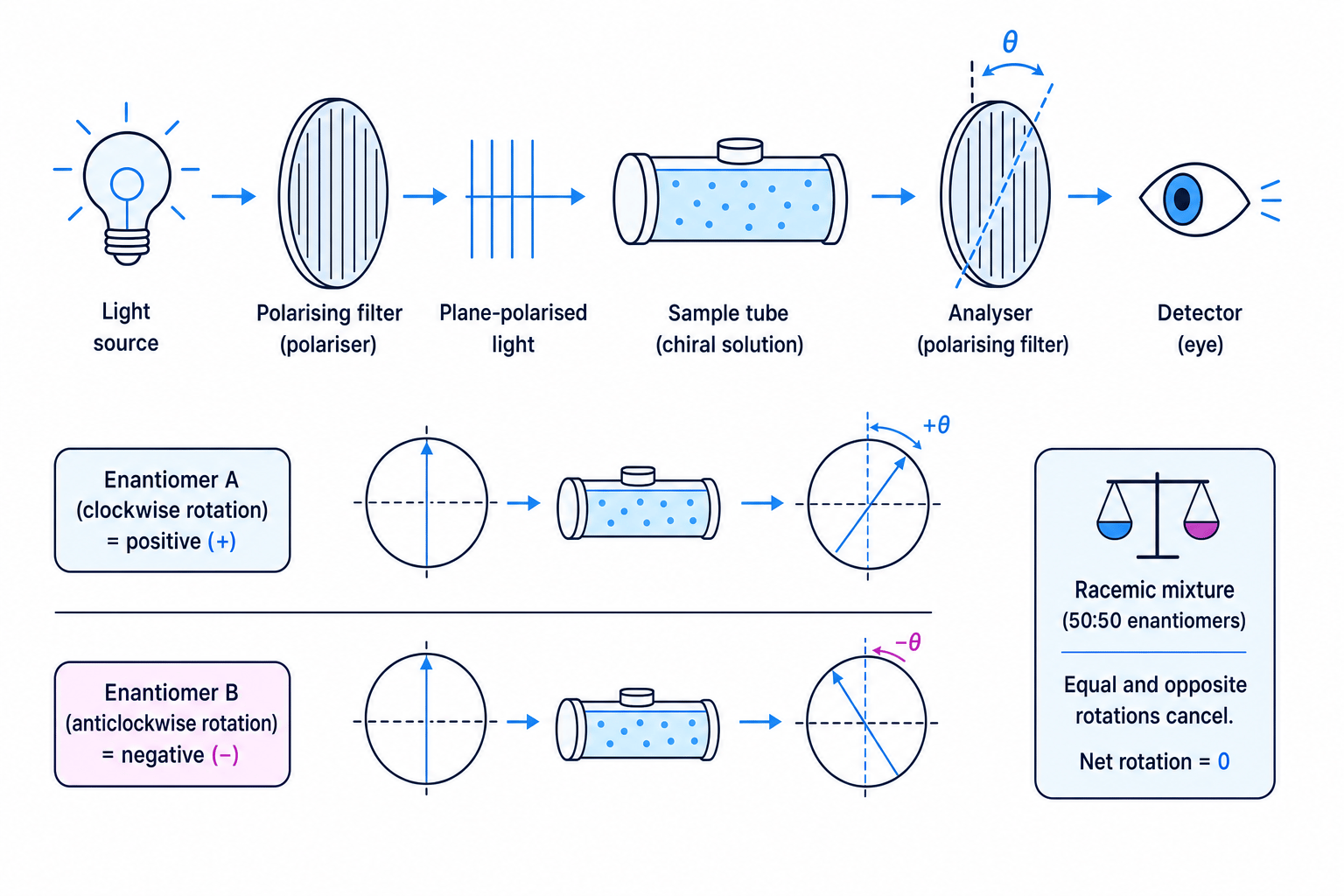
One enantiomer rotates plane-polarised light clockwise and is labelled positive, (+). The other rotates it anticlockwise by the same amount and is labelled negative, (−).
+ and − are experimental labels
You cannot tell from a displayed formula alone whether an enantiomer is (+) or (−). The direction of rotation must be measured experimentally using a polarimeter.
Racemic mixtures
Racemic mixture
A racemic mixture is a 50:50 mixture of two enantiomers. It is optically inactive overall because the equal and opposite rotations cancel.
This does not mean the molecules are achiral. Each molecule in the mixture is still chiral; the sample as a whole shows no net rotation.
Interpreting optical rotation
A mixture contains 70% of the (+) enantiomer and 30% of the (−) enantiomer. A pure sample of the (+) enantiomer would rotate plane-polarised light by +10.0° under the same conditions. Find the observed rotation.
-
Equal amounts of the two enantiomers cancel, so compare the excess: 70% − 30% = 40% excess of the (+) enantiomer.
-
The observed rotation is 40% of the pure enantiomer’s rotation: θobs=0.40×(+10.0∘)=+4.0∘\theta_\text{obs} = 0.40 \times (+10.0^\circ) = +4.0^\circθobs=0.40×(+10.0∘)=+4.0∘.
-
The sign is positive because the (+) enantiomer is present in excess.
Racemic does not mean unreactive
A racemic mixture has zero net optical rotation, but it still contains chiral molecules. In biological systems, the two enantiomers may behave very differently because enzymes and receptors are themselves chiral.
How racemic mixtures form in carbonyl reactions
A carbonyl compound contains the C=O functional group. In aldehydes and ketones, the carbonyl carbon is trigonal planar and δ+ because oxygen is more electronegative.
In nucleophilic addition with hydrogen cyanide, HCN, the nucleophile is CN⁻. The reaction forms a hydroxynitrile, which contains both an OH group and a C≡N group.
For ethanal:
CH3CHO+HCN→CH3CH(OH)CN\text{CH}_3\text{CHO} + \text{HCN} \to \text{CH}_3\text{CH(OH)CN}CH3CHO+HCN→CH3CH(OH)CNThe mechanism is:
- CN⁻ attacks the δ+ carbonyl carbon.
- The C=O π bond breaks and the electron pair moves onto oxygen, forming an alkoxide ion.
- The alkoxide ion gains H⁺ from HCN, forming the alcohol group.
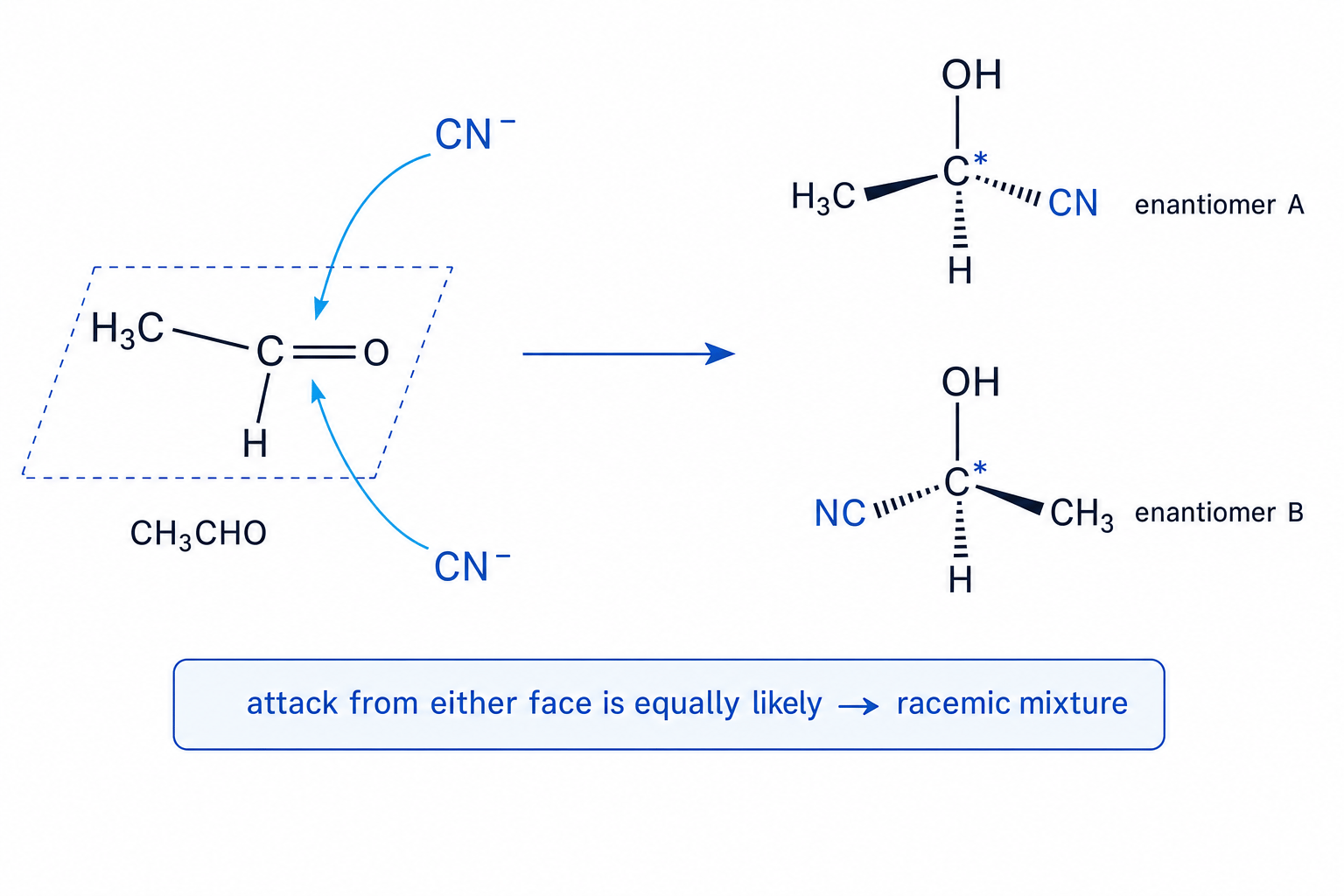
Because the carbonyl group is planar, CN⁻ can attack from either side of the plane. If the product has a chiral centre, attack from opposite sides forms opposite enantiomers in equal amounts.
Planar carbonyls give two faces
If a planar carbonyl compound reacts in an achiral environment, attack from either face is equally likely. When this creates a chiral centre, the product is usually a racemic mixture.
Predicting whether carbonyl addition gives a racemate
Compare the addition of HCN to ethanal, CH₃CHO, and propanone, CH₃COCH₃.
-
For ethanal, addition of HCN gives CH₃CH(OH)CN. The new central carbon is bonded to CH₃, H, OH and CN.
-
These four groups are different, so the product molecule is chiral.
-
Since ethanal’s carbonyl group is planar, CN⁻ can attack from either side with equal probability, producing a 50:50 mixture of the two enantiomers: a racemic mixture.
-
For propanone, addition of HCN gives (CH₃)₂C(OH)CN. The carbon bearing OH and CN is also bonded to two identical CH₃ groups.
-
Because two groups are identical, the product is achiral, so no pair of enantiomers is formed.
Why chirality matters
Chirality is especially important in medicine and biochemistry. Many biological molecules, such as enzymes, proteins and receptors, are chiral. This means one enantiomer of a drug may fit a receptor well, while the other may have a weaker effect or a different effect.
At A-Level, you usually need to explain this qualitatively: enantiomers can interact differently with chiral biological molecules because their 3D arrangements are different.
Forgetting the 3D requirement
A displayed formula that looks flat may hide chirality. If a carbon has four different groups, you should think in 3D and use wedge/dash bonds if asked to draw the enantiomers.
In the exam
-
To spot chirality, find tetrahedral carbons and list the four groups attached to each one.
-
If a reaction forms a chiral product from a planar carbonyl compound, explain racemic formation using “attack from either side of the plane is equally likely”.
-
Do not claim a racemic mixture has no chiral molecules; say it has equal amounts of two enantiomers, so their optical rotations cancel.
Check yourself
- Which carbon, if any, is chiral in CH₃CHClCH₂CH₃?
- Why does ethanal form a racemic mixture when it reacts with HCN?
- Why is the product from propanone and HCN achiral?