

What you'll learn
- What pH measures and why it is a logarithmic scale.
- What makes an acid “strong” in A-Level chemistry.
- How to calculate pH from the concentration of a strong acid.
- How to work backwards from pH to hydrogen ion concentration, including dilution questions.
Starting point: acids in water
In Brønsted–Lowry theory, acids are substances that donate protons. A proton is a hydrogen ion, H⁺, because a hydrogen atom has lost its electron.
In water, a bare H⁺ ion does not really float around on its own; it attaches to water molecules. At A-Level, we usually write H⁺(aq) as a convenient shorthand.
Acid and hydrogen ion concentration
An acid is a proton donor. In aqueous solution, acids increase the concentration of hydrogen ions, written as [H+][\text{H}^+][H+], where square brackets mean “concentration in mol dm⁻³”.
The higher the value of [H+][\text{H}^+][H+], the more acidic the solution.
Concentration reminders
For pH calculations, concentration is usually measured in mol dm⁻³. You will often need:
c=nVc = \frac{n}{V}c=Vnwhere:
- ccc is concentration in mol dm⁻³
- nnn is amount of substance in mol
- VVV is volume in dm³
Remember that 1000 cm³ = 1 dm³, so:
250 cm3=0.250 dm3250\ \text{cm}^3 = 0.250\ \text{dm}^3250 cm3=0.250 dm3Forgetting to convert cm³ to dm³
If you use c=nVc = \frac{n}{V}c=Vn, the volume must be in dm³ when concentration is in mol dm⁻³. Using cm³ directly makes your concentration 1000 times too small.
Strong acids
A strong acid is not just an acid with a low pH. It has a specific meaning: it dissociates completely in water.
Strong acid
A strong acid is an acid that fully dissociates in aqueous solution. Dissociation means the acid particles split to form ions in solution.
For example:
HCl(aq)→H+(aq)+Cl−(aq)HNO3(aq)→H+(aq)+NO3−(aq)\begin{aligned} \text{HCl(aq)} &\to \text{H}^+\text{(aq)} + \text{Cl}^-\text{(aq)} \\ \text{HNO}_3\text{(aq)} &\to \text{H}^+\text{(aq)} + \text{NO}_3^-\text{(aq)} \end{aligned}HCl(aq)HNO3(aq)→H+(aq)+Cl−(aq)→H+(aq)+NO3−(aq)Hydrochloric acid and nitric acid are both monobasic strong acids.
Monobasic acid
A monobasic acid donates one proton per acid molecule.
So, for a strong monobasic acid:
[H+]=acid concentration[\text{H}^+] = \text{acid concentration}[H+]=acid concentrationFor example, 0.100 mol dm⁻³ HCl(aq) gives [H+]=0.100 mol dm−3[\text{H}^+] = 0.100\ \text{mol dm}^{-3}[H+]=0.100 mol dm−3.
Strong monobasic acids
For a strong monobasic acid such as HCl or HNO₃, complete dissociation means every acid molecule forms one H⁺ ion, so [H+]=c[\text{H}^+] = c[H+]=c.
Strong does not mean concentrated
Strong describes the extent of dissociation. Concentrated describes how many moles of acid are dissolved per dm³. A dilute strong acid can still be fully dissociated.
What pH means
pH is a mathematical way of expressing hydrogen ion concentration.
pH
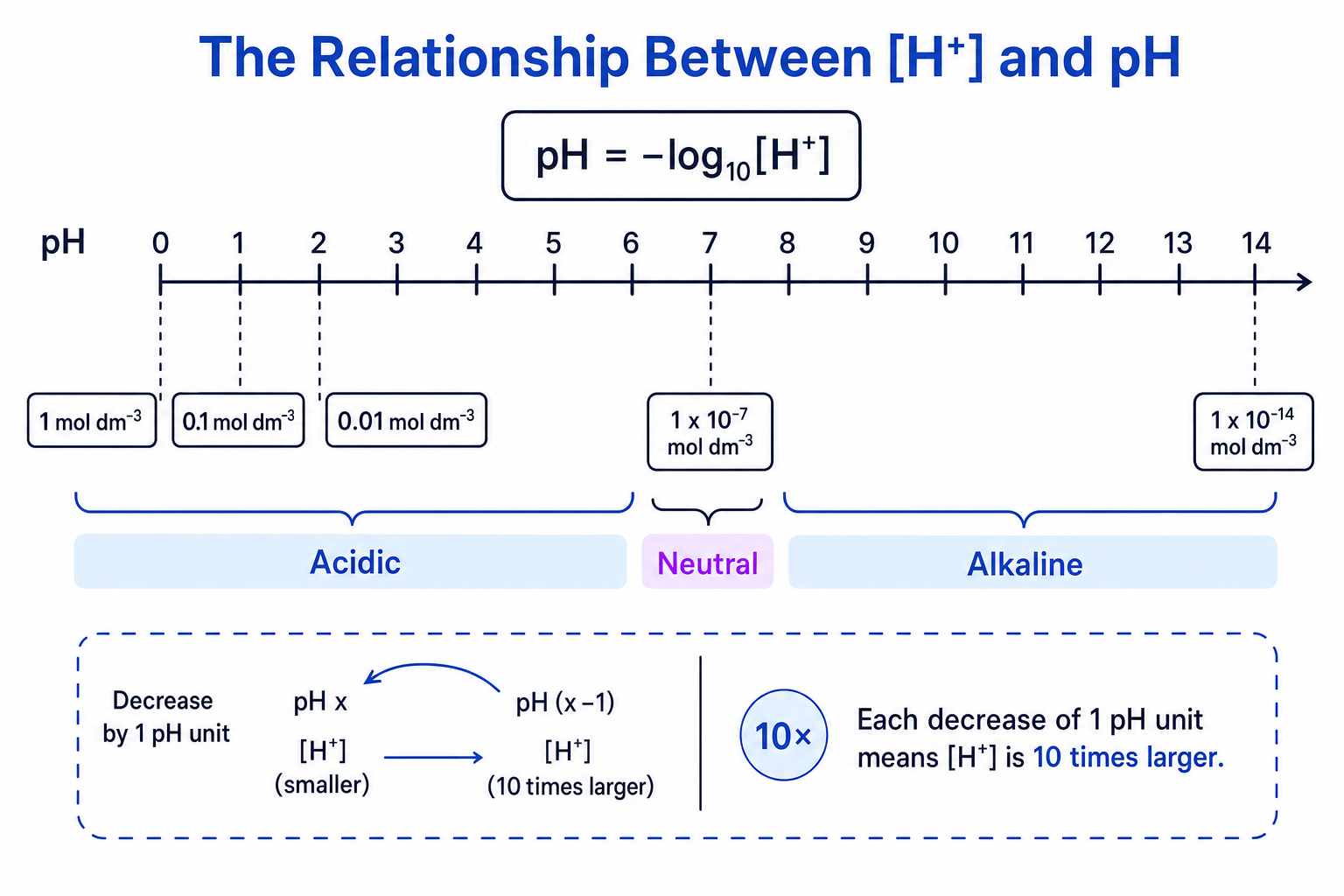
pH is defined by the equation pH=−log10[H+]\text{pH} = -\log_{10}[\text{H}^+]pH=−log10[H+]. In A-Level calculations, use the numerical value of [H+][\text{H}^+][H+] in mol dm⁻³.
The negative sign is there because acidic solutions have small decimal values of [H+][\text{H}^+][H+], such as 0.01 mol dm⁻³. Taking the negative logarithm turns these into more convenient positive pH values.
The diagram shows why pH changes are not linear: each decrease of one pH unit means the hydrogen ion concentration is 10 times larger.
Calculator buttons
Use the base-10 log button, usually labelled log, not the natural log button ln.
Calculating pH of a strong acid
The full method is:
- Find the acid concentration in mol dm⁻³.
- Use the dissociation ratio to find [H+][\text{H}^+][H+].
- Substitute into pH=−log10[H+]\text{pH} = -\log_{10}[\text{H}^+]pH=−log10[H+].
Calculating pH from a prepared HCl solution
0.365 g of hydrogen chloride, HCl, is dissolved in water and made up to 500 cm³ of solution. Calculate the pH of the solution. Use Mr(HCl)=36.5M_r(\text{HCl}) = 36.5Mr(HCl)=36.5.
-
Calculate the amount of HCl dissolved:
n=mM=0.36536.5=0.0100 moln = \frac{m}{M} = \frac{0.365}{36.5} = 0.0100\ \text{mol}n=Mm=36.50.365=0.0100 mol -
Convert the volume into dm³ and calculate the concentration:
500 cm3=0.500 dm3500\ \text{cm}^3 = 0.500\ \text{dm}^3500 cm3=0.500 dm3 c=nV=0.01000.500=0.0200 mol dm−3c = \frac{n}{V} = \frac{0.0100}{0.500} = 0.0200\ \text{mol dm}^{-3}c=Vn=0.5000.0100=0.0200 mol dm−3 -
Use the fact that HCl is a strong monobasic acid:
[H+]=0.0200 mol dm−3[\text{H}^+] = 0.0200\ \text{mol dm}^{-3}[H+]=0.0200 mol dm−3 -
Calculate pH:
pH=−log10(0.0200)=1.70\text{pH} = -\log_{10}(0.0200) = 1.70pH=−log10(0.0200)=1.70
The pH scale is logarithmic
A pH difference of one unit means a tenfold difference in [H+][\text{H}^+][H+].
So:
- pH 1 has 10 times greater [H+][\text{H}^+][H+] than pH 2.
- pH 2 has 100 times greater [H+][\text{H}^+][H+] than pH 4.
- pH 3 has 1000 times greater [H+][\text{H}^+][H+] than pH 6.
Comparing acidity using pH
Compare the hydrogen ion concentrations of two solutions: solution A has pH 2.00 and solution B has pH 5.00.
-
Convert each pH into a hydrogen ion concentration:
[H+]A=10−2.00[\text{H}^+]_\text{A} = 10^{-2.00}[H+]A=10−2.00 [H+]B=10−5.00[\text{H}^+]_\text{B} = 10^{-5.00}[H+]B=10−5.00 -
Find the ratio:
[H+]A[H+]B=10−210−5=103\frac{[\text{H}^+]_\text{A}}{[\text{H}^+]_\text{B}} = \frac{10^{-2}}{10^{-5}} = 10^3[H+]B[H+]A=10−510−2=103 -
Interpret the result:
Solution A has 1000 times greater hydrogen ion concentration than solution B.
Treating pH as a linear scale
A solution with pH 2 is not “twice as acidic” as pH 4. It has 100 times greater [H+][\text{H}^+][H+].
Working backwards from pH
You can rearrange the pH equation:
[H+]=10−pH[\text{H}^+] = 10^{-\text{pH}}[H+]=10−pHThis is useful when you are given pH and asked for hydrogen ion concentration, or the concentration of a strong monobasic acid.
Finding acid concentration from pH
A solution of nitric acid has pH 2.30. Calculate the concentration of HNO₃(aq), assuming complete dissociation.
-
Use the rearranged pH equation:
[H+]=10−2.30[\text{H}^+] = 10^{-2.30}[H+]=10−2.30 -
Calculate the hydrogen ion concentration:
[H+]=5.01×10⁻³ mol dm−3[\text{H}^+] = 5.01 \times 10^{-3}\ \text{mol dm}^{-3}[H+]=5.01×10⁻³ mol dm−3 -
Use the 1:1 dissociation of HNO₃:
HNO3(aq)→H+(aq)+NO3−(aq)\text{HNO}_3\text{(aq)} \to \text{H}^+\text{(aq)} + \text{NO}_3^-\text{(aq)}HNO3(aq)→H+(aq)+NO3−(aq)Therefore the concentration of HNO₃ is 5.01×10⁻³ mol dm−35.01 \times 10^{-3}\ \text{mol dm}^{-3}5.01×10⁻³ mol dm−3.
Diluting a strong acid
When you dilute an acid, you add water. The amount of acid in mol stays the same, but the total volume increases, so the concentration decreases.
For dilution calculations, use:
c1V1=c2V2c_1V_1 = c_2V_2c1V1=c2V2This works because the amount of solute is unchanged.
Calculating pH after dilution
20.0 cm³ of 0.150 mol dm⁻³ HCl(aq) is diluted with water to a final volume of 250.0 cm³. Calculate the pH of the diluted solution.
-
Use the dilution equation, keeping both volumes in the same units:
c2=c1V1V2c_2 = \frac{c_1V_1}{V_2}c2=V2c1V1 -
Substitute the values:
c2=0.150×20.0250.0=0.0120 mol dm−3c_2 = \frac{0.150 \times 20.0}{250.0} = 0.0120\ \text{mol dm}^{-3}c2=250.00.150×20.0=0.0120 mol dm−3 -
Use complete dissociation of HCl:
[H+]=0.0120 mol dm−3[\text{H}^+] = 0.0120\ \text{mol dm}^{-3}[H+]=0.0120 mol dm−3 -
Calculate the pH:
pH=−log10(0.0120)=1.92\text{pH} = -\log_{10}(0.0120) = 1.92pH=−log10(0.0120)=1.92
Sanity check for dilution
A tenfold dilution of a strong acid increases the pH by about one unit, provided the acid is not extremely dilute.
Very dilute strong acids
For very dilute acids, around 10−7 mol dm−310^{-7}\ \text{mol dm}^{-3}10−7 mol dm−3 or lower, the H⁺ from water itself becomes significant. The simple assumption that all [H+][\text{H}^+][H+] comes from the acid then breaks down.
A note on pH 7 and temperature
At 298 K, pure water is neutral and has pH 7.00 because:
[H+]=[OH−]=1.00×10⁻⁷ mol dm−3[\text{H}^+] = [\text{OH}^-] = 1.00 \times 10^{-7}\ \text{mol dm}^{-3}[H+]=[OH−]=1.00×10⁻⁷ mol dm−3The familiar pH scale from 0 to 14 is a useful range for many dilute aqueous solutions at 298 K. It is not an absolute limit: very concentrated acids can have pH below 0.
Measuring pH practically
For approximate pH, universal indicator or pH paper is enough. For quantitative A-Level work, use a calibrated pH meter.
Good pH measurement
Calibrate the pH meter using buffer solutions, rinse the probe with distilled water between solutions, and remember that pH depends on temperature.
In the exam
- Decide whether the acid is strong or weak, and whether it is monobasic or not.
- Convert volumes into dm³ before using n=cVn = cVn=cV, unless using c1V1=c2V2c_1V_1 = c_2V_2c1V1=c2V2 with both volumes in the same unit.
- For a strong monobasic acid, use [H+]=c[\text{H}^+] = c[H+]=c, then calculate pH=−log10[H+]\text{pH} = -\log_{10}[\text{H}^+]pH=−log10[H+].
- To work backwards, use [H+]=10−pH[\text{H}^+] = 10^{-\text{pH}}[H+]=10−pH.
- Check your answer: a more concentrated strong acid should have a lower pH.
Check yourself
- What is [H+][\text{H}^+][H+] in 0.0350 mol dm⁻³ HNO₃(aq)?
- Calculate the pH of 0.00400 mol dm⁻³ HCl(aq).
- A strong monobasic acid has pH 1.50. What is its concentration in mol dm⁻³?
