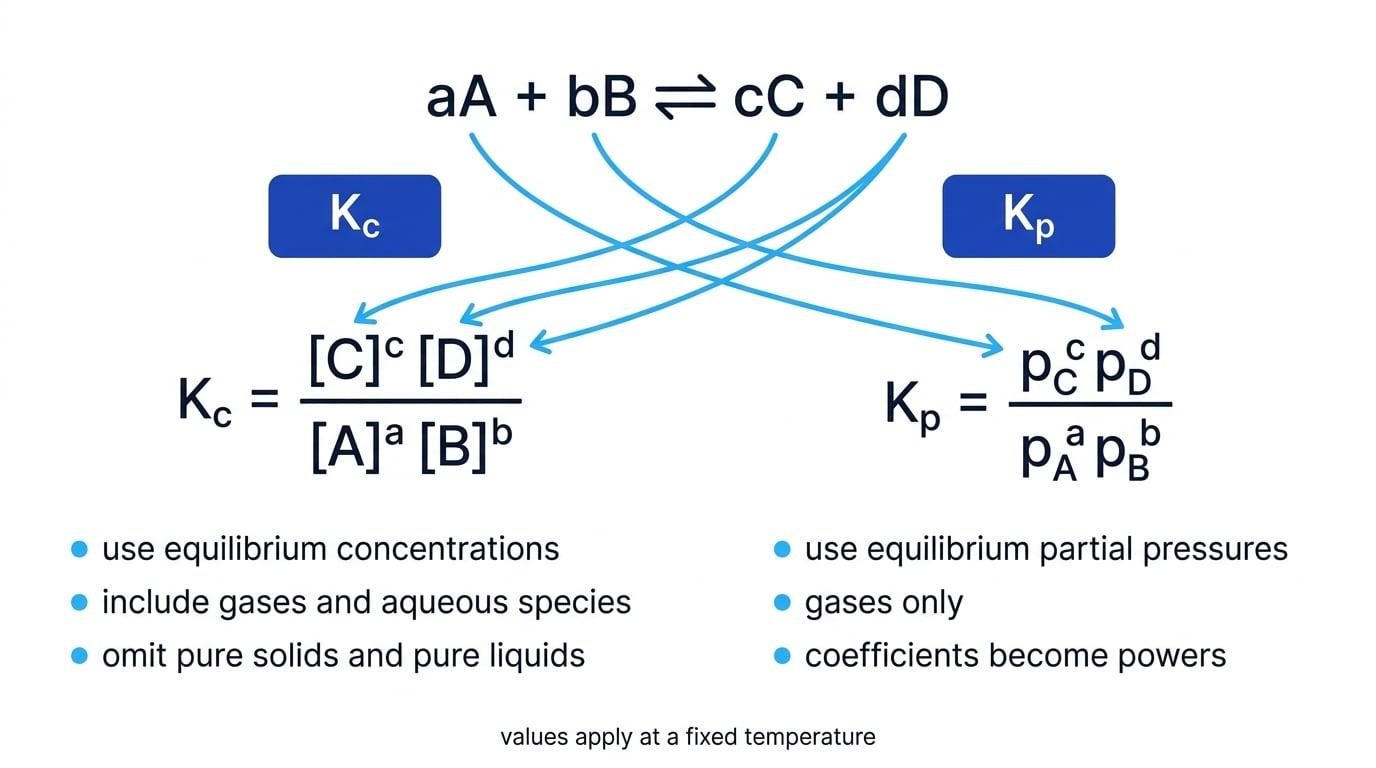
What you'll learn
- How equilibrium constants describe the position of a reversible reaction at a fixed temperature.
- How to write expressions for KcK_\mathrm{c}Kc and KpK_\mathrm{p}Kp from balanced equations.
- How to calculate KcK_\mathrm{c}Kc from equilibrium concentrations and KpK_\mathrm{p}Kp from partial pressures.
- How changes in temperature, pressure and concentration affect equilibrium constants.
Starting point: dynamic equilibrium
A reversible reaction is one that can go in both directions. We write it using the equilibrium arrow, ⇌.
A reaction can only reach equilibrium in a closed system, where substances cannot escape. For gases, this usually means a sealed container.
Dynamic equilibrium
A dynamic equilibrium is reached when the forward and reverse reactions are both still happening, but at the same rate, so the concentrations of reactants and products remain constant.
“Constant” does not mean “equal”. At equilibrium, there might be far more product than reactant, or far more reactant than product.
Equilibrium constants need equilibrium values
KcK_\mathrm{c}Kc and KpK_\mathrm{p}Kp are calculated using the composition of the mixture at equilibrium, not the starting amounts.
Why use an equilibrium constant?
For a reversible reaction, the equilibrium mixture depends on how far the reaction goes towards products or reactants. An equilibrium constant gives a numerical measure of this position at a particular temperature.
For the general equilibrium:
aA+bB⇌cC+dDa\mathrm{A}+b\mathrm{B}\rightleftharpoons c\mathrm{C}+d\mathrm{D}aA+bB⇌cC+dDthe coefficients in the balanced equation become powers in the equilibrium expression.
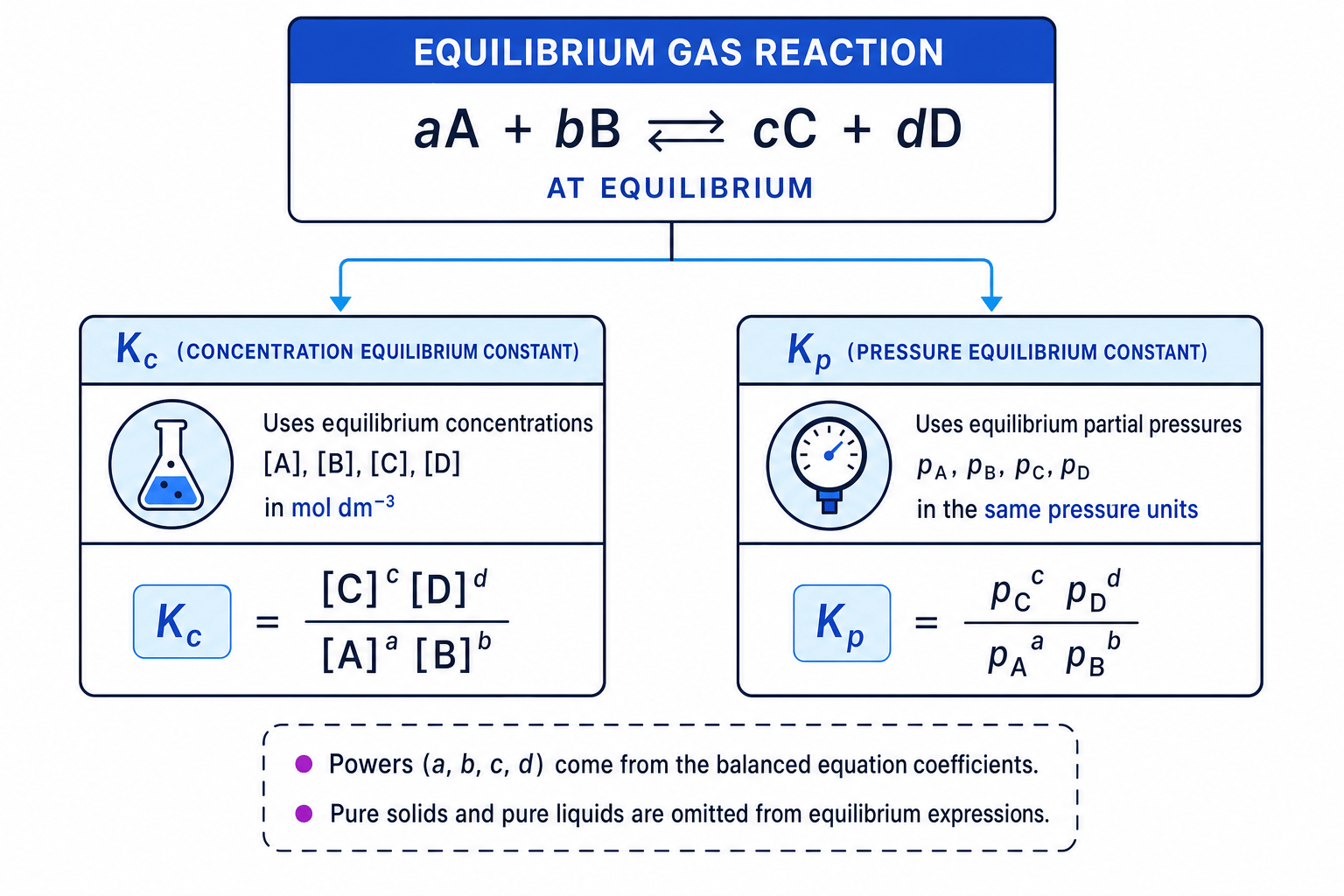
KcK_\mathrm{c}Kc: equilibrium constant using concentrations
Kc
KcK_\mathrm{c}Kc is the equilibrium constant written using the equilibrium concentrations of substances, usually in mol dm⁻³.
For:
aA+bB⇌cC+dDa\mathrm{A}+b\mathrm{B}\rightleftharpoons c\mathrm{C}+d\mathrm{D}aA+bB⇌cC+dDthe expression is:
Kc=[C]c[D]d[A]a[B]bK_\mathrm{c}=\frac{[\mathrm{C}]^c[\mathrm{D}]^d}{[\mathrm{A}]^a[\mathrm{B}]^b}Kc=[A]a[B]b[C]c[D]dSquare brackets mean concentration, so [A][\mathrm{A}][A] means the equilibrium concentration of A.
What goes into a KcK_\mathrm{c}Kc expression?
Include species whose concentration can change significantly in the equilibrium mixture. At A-Level, you usually:
- include gases, aqueous substances and solutes
- omit pure solids
- omit pure liquids
For example, in:
CaCO3(s)⇌CaO(s)+CO2(g)\mathrm{CaCO_3(s)}\rightleftharpoons \mathrm{CaO(s)}+\mathrm{CO_2(g)}CaCO3(s)⇌CaO(s)+CO2(g)the solids are omitted, so:
Kc=[CO2]K_\mathrm{c}=[\mathrm{CO_2}]Kc=[CO2]Including solids and pure liquids
Do not put pure solids or pure liquids into KcK_\mathrm{c}Kc or KpK_\mathrm{p}Kp expressions. Their concentration is effectively constant, so it is absorbed into the value of the equilibrium constant.
Writing a Kc expression and units
For the equilibrium:
2SO2(g)+O2(g)⇌2SO3(g)2\mathrm{SO_2(g)}+\mathrm{O_2(g)}\rightleftharpoons2\mathrm{SO_3(g)}2SO2(g)+O2(g)⇌2SO3(g)-
All species are gases, so all three appear in the KcK_\mathrm{c}Kc expression.
-
Put products over reactants, with powers from the balanced equation:
- Work out the units by replacing each concentration with mol dm⁻³:
Calculating KcK_\mathrm{c}Kc from equilibrium amounts
Exam questions often give amounts in mol and a volume in dm³. You must convert amounts into concentrations before substituting into KcK_\mathrm{c}Kc:
c=nVc=\frac{n}{V}c=Vnwhere ccc is concentration in mol dm⁻³, nnn is amount in mol, and VVV is volume in dm³.
If the question gives starting amounts and one equilibrium amount, use the balanced equation to build an amount-change-equilibrium calculation.
Calculating Kc from equilibrium amounts
Hydrogen and iodine react in a sealed 2.00 dm³ container:
H2(g)+I2(g)⇌2HI(g)\mathrm{H_2(g)}+\mathrm{I_2(g)}\rightleftharpoons2\mathrm{HI(g)}H2(g)+I2(g)⇌2HI(g)Initially, 1.00 mol of hydrogen and 1.00 mol of iodine are present. At equilibrium, there are 1.20 mol of hydrogen iodide. Calculate KcK_\mathrm{c}Kc.
- Use the stoichiometry to find how much reactant has been used. Forming 1.20 mol of HI uses half as much H₂ and I₂ because the ratio is 1 : 1 : 2:
- Find the equilibrium amounts:
- Convert amounts into concentrations by dividing by 2.00 dm³:
- Substitute into the expression:
- Check the units. The total powers on the top and bottom are both 2, so the units cancel. Kc=9.00K_\mathrm{c}=9.00Kc=9.00 with no units.
Use a clear amount table
For harder questions, set up rows for initial amount, change, and equilibrium amount. Do stoichiometry in mol first, then convert to concentrations at the end.
KpK_\mathrm{p}Kp: equilibrium constant using partial pressures
KpK_\mathrm{p}Kp is used for equilibria involving gases. Instead of concentrations, it uses partial pressures.
Partial pressure
The partial pressure of a gas in a mixture is the pressure it would exert if it alone occupied the container at the same temperature. For gas iii, pi=xiPtotalp_i=x_iP_\text{total}pi=xiPtotal, where xi=nintotalx_i=\frac{n_i}{n_\text{total}}xi=ntotalni is its mole fraction.
For:
aA(g)+bB(g)⇌cC(g)+dD(g)a\mathrm{A(g)}+b\mathrm{B(g)}\rightleftharpoons c\mathrm{C(g)}+d\mathrm{D(g)}aA(g)+bB(g)⇌cC(g)+dD(g)the expression is:
Kp=pCcpDdpAapBbK_\mathrm{p}=\frac{p_{\mathrm{C}}^c p_{\mathrm{D}}^d}{p_{\mathrm{A}}^a p_{\mathrm{B}}^b}Kp=pAapBbpCcpDdUse one pressure unit consistently, usually kPa or Pa.
Calculating Kp from mole fractions
For the equilibrium:
N2O4(g)⇌2NO2(g)\mathrm{N_2O_4(g)}\rightleftharpoons2\mathrm{NO_2(g)}N2O4(g)⇌2NO2(g)an equilibrium mixture contains 0.300 mol of N₂O₄ and 0.700 mol of NO₂ at a total pressure of 200 kPa. Calculate KpK_\mathrm{p}Kp.
- Calculate the total amount and mole fractions:
- Convert mole fractions into partial pressures:
- Substitute into the KpK_\mathrm{p}Kp expression:
- Check the units from the pressure powers: pressure squared divided by pressure leaves kPa.
Mixing pressure units
If you use kPa for one partial pressure, use kPa for all of them. Do not mix Pa and kPa in the same KpK_\mathrm{p}Kp calculation.
What does the size of KKK tell you?
A large equilibrium constant means products are favoured at equilibrium. A small equilibrium constant means reactants are favoured.
- If KKK is much greater than 1, the equilibrium lies mainly to the right.
- If KKK is much less than 1, the equilibrium lies mainly to the left.
- If KKK is close to 1, appreciable amounts of both reactants and products are present.
Be careful: this is a qualitative interpretation. The exact amounts still depend on the balanced equation and starting conditions.
What changes KcK_\mathrm{c}Kc and KpK_\mathrm{p}Kp?
At a fixed temperature, the value of KcK_\mathrm{c}Kc or KpK_\mathrm{p}Kp is constant for a particular reaction.
Changing concentration or pressure can change the equilibrium composition, but the mixture shifts until the same equilibrium constant is restored. A catalyst does not change the equilibrium constant; it only helps the system reach equilibrium faster.
Temperature is the only condition that changes K
For a given reaction, KcK_\mathrm{c}Kc and KpK_\mathrm{p}Kp change only when temperature changes.
For temperature changes, use the enthalpy change of the forward reaction:
- If the forward reaction is exothermic, increasing temperature decreases KKK.
- If the forward reaction is endothermic, increasing temperature increases KKK.
Predicting how temperature changes Kp
For the Haber equilibrium:
N2(g)+3H2(g)⇌2NH3(g)ΔH<0\mathrm{N_2(g)}+3\mathrm{H_2(g)}\rightleftharpoons2\mathrm{NH_3(g)} \qquad \Delta H<0N2(g)+3H2(g)⇌2NH3(g)ΔH<0predict what happens to KpK_\mathrm{p}Kp when temperature is increased.
-
The forward reaction is exothermic, so the reverse reaction is endothermic.
-
Increasing temperature favours the endothermic direction, so equilibrium shifts left towards N₂ and H₂.
-
In the expression
the numerator becomes smaller relative to the denominator, so KpK_\mathrm{p}Kp decreases.
Converting between Kc and Kp
Only use Kp=Kc(RT)ΔnK_\mathrm{p}=K_\mathrm{c}(RT)^{\Delta n}Kp=Kc(RT)Δn if the question asks for it and the units are consistent: pressure in Pa, concentration in mol m⁻³, temperature in K, and Δn\Delta nΔn is gaseous product moles minus gaseous reactant moles.
In the exam
- Start from the balanced equation, then write the equilibrium expression before substituting numbers.
- Use equilibrium concentrations for KcK_\mathrm{c}Kc and equilibrium partial pressures for KpK_\mathrm{p}Kp.
- Convert mol to mol dm⁻³ for KcK_\mathrm{c}Kc, and convert mole fractions to partial pressures for KpK_\mathrm{p}Kp.
- Check units from the powers in the expression, and state “no units” only when they cancel.
- For changes in conditions, remember: temperature changes KKK; pressure, concentration and catalysts do not.
Check yourself
- Can you write the KcK_\mathrm{c}Kc expression for 2NO2(g)⇌N2O4(g)2\mathrm{NO_2(g)}\rightleftharpoons\mathrm{N_2O_4(g)}2NO2(g)⇌N2O4(g) and work out its units?
- If a gas mixture has mole fraction 0.25 of CO₂ at 400 kPa total pressure, what is the partial pressure of CO₂?
- For an endothermic forward reaction, what happens to the value of KKK when temperature is increased?