What you'll learn
- What “weak acid” really means, and how it differs from “dilute”.
- How to write and use the acid dissociation constant, KaK_aKa.
- How to calculate the pH of a weak acid from KaK_aKa and concentration.
- How to calculate KaK_aKa from a measured pH.
Prerequisites: acids, hydrogen ions and pH
A Brønsted–Lowry acid is a substance that donates a proton, H⁺. In aqueous solution, H⁺ is more accurately present as hydroxonium ions, H₃O⁺, but A-Level calculations usually use the shorthand H⁺.
The pH scale measures hydrogen ion concentration. Lower pH means higher concentration of H⁺ ions.
pH
For an aqueous solution,
pH=−log10[H+]\text{pH} = -\log_{10}[H^+]pH=−log10[H+]where [H+][H^+][H+] is the hydrogen ion concentration in mol dm⁻³.
You can rearrange this to find hydrogen ion concentration:
[H+]=10−pH[H^+] = 10^{-\text{pH}}[H+]=10−pHConverting pH to hydrogen ion concentration
A solution has pH 3.40. Find [H+][H^+][H+].
-
Use the rearranged pH equation:
[H+]=10−pH[H^+] = 10^{-\text{pH}}[H+]=10−pH -
Substitute pH 3.40:
[H+]=10−3.40[H^+] = 10^{-3.40}[H+]=10−3.40 -
Calculate the concentration:
[H+]=3.98×10⁻⁴ mol dm−3[H^+] = 3.98 \times 10^{-4}\ \text{mol dm}^{-3}[H+]=3.98×10⁻⁴ mol dm−3
Strong, weak, concentrated and dilute
The words strong and weak describe how much an acid dissociates into ions in water.
A strong acid fully dissociates in aqueous solution. For example:
HCl(aq) → H⁺(aq) + Cl⁻(aq)
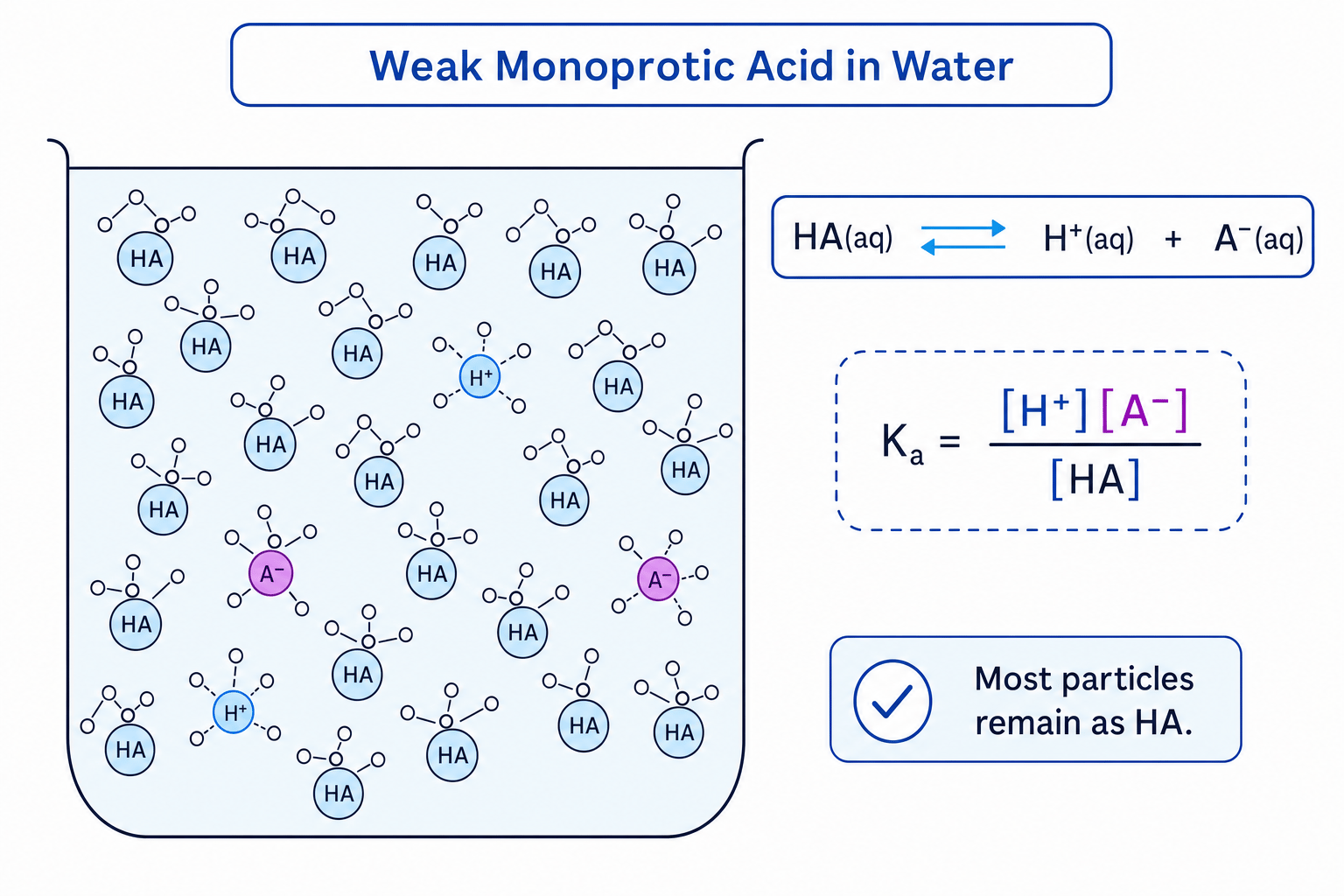
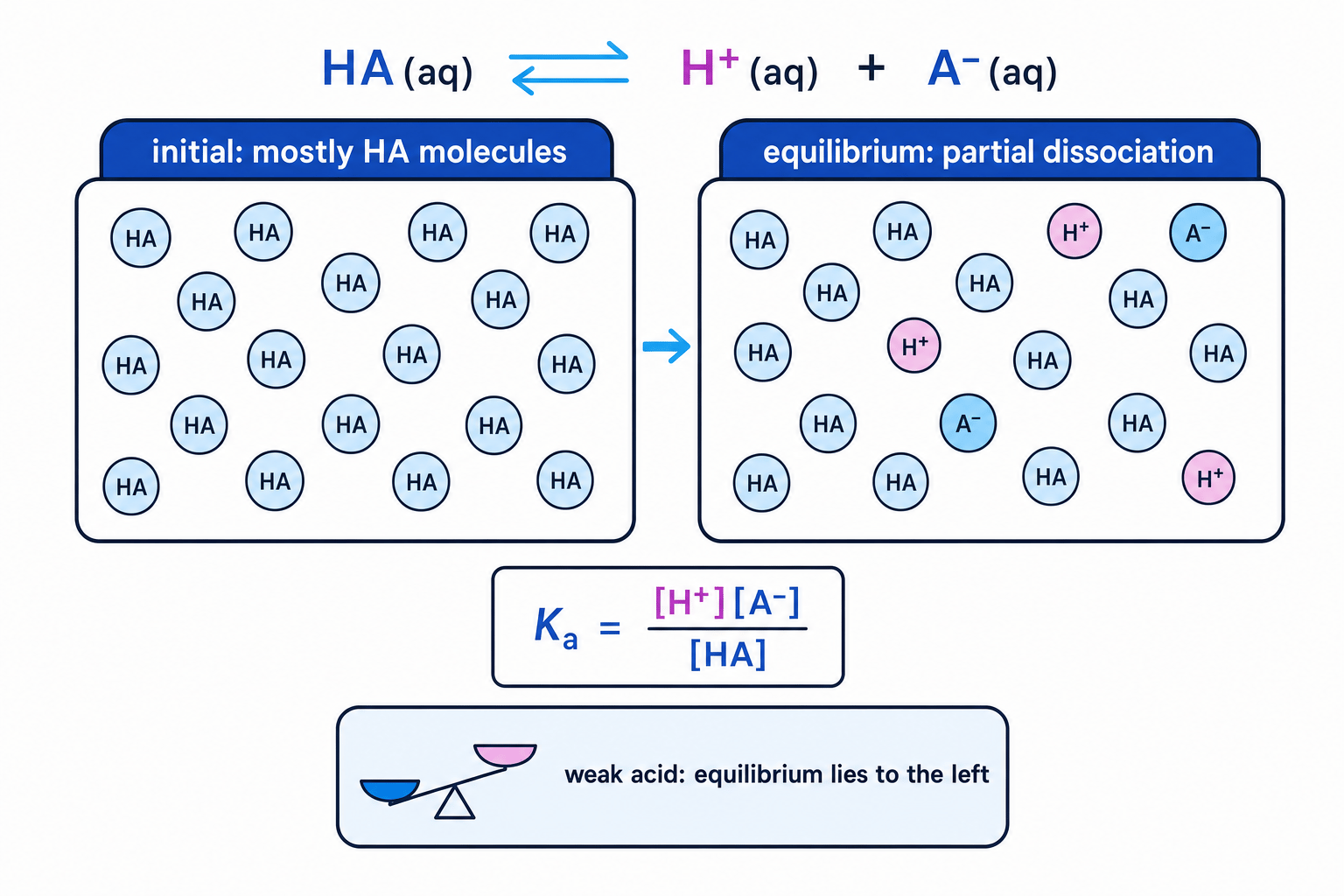
A weak acid only partially dissociates, so an equilibrium is set up. For a general monoprotic acid, HA:
HA(aq) ⇌ H⁺(aq) + A⁻(aq)
A monoprotic acid donates one proton per acid molecule. The species A⁻ is the conjugate base, formed after HA has donated H⁺.
Weak acid
A weak acid is an acid that partially dissociates in aqueous solution, forming an equilibrium mixture of undissociated acid molecules and ions.
At equilibrium, a weak acid solution usually contains mostly HA molecules and relatively few H⁺ and A⁻ ions. This is the key particle-level idea behind weak-acid pH calculations.
Strength is not concentration
Strong/weak tells you the extent of dissociation. Concentrated/dilute tells you how much acid is dissolved per dm³. A dilute acid can still be strong, and a concentrated acid can still be weak.
The acid dissociation constant, Ka
For the weak monoprotic acid HA:
HA(aq) ⇌ H⁺(aq) + A⁻(aq)
the equilibrium constant is called the acid dissociation constant, written KaK_aKa.
Acid dissociation constant
For a weak acid HA,
Ka=[H+][A−][HA]K_a = \frac{[H^+][A^-]}{[HA]}Ka=[HA][H+][A−]using equilibrium concentrations. A larger KaK_aKa means the acid is more dissociated, so it is a stronger weak acid.
For this expression, KaK_aKa usually has units of mol dm⁻³ at A-Level, because the numerator has two concentration terms and the denominator has one.
KaK_aKa is temperature-dependent, so values should only be compared at the same temperature.
pKa
You may also see pKa, defined as:
pKa=−log10Ka\text{p}K_a = -\log_{10}K_apKa=−log10KaA lower pKa means a stronger acid, because it corresponds to a larger KaK_aKa.
Writing a Ka expression
Methanoic acid, HCOOH, partially dissociates:
HCOOH(aq) ⇌ H⁺(aq) + HCOO⁻(aq)
-
Identify the weak acid as HCOOH and the ions produced as H⁺ and HCOO⁻.
-
Put the product concentrations on the top and the undissociated acid concentration on the bottom:
Ka=[H+][HCOO−][HCOOH]K_a = \frac{[H^+][\text{HCOO}^-]}{[\text{HCOOH}]}Ka=[HCOOH][H+][HCOO−] -
Use equilibrium concentrations only; do not use the initial acid concentration unless an approximation has been justified.
Calculating pH of a weak acid from Ka
Suppose you have a weak monoprotic acid HA with initial concentration ccc.
HA(aq) ⇌ H⁺(aq) + A⁻(aq)
Let the equilibrium concentration of H⁺ be xxx.
Because the acid is monoprotic:
- [H+]=x[H^+] = x[H+]=x
- [A−]=x[A^-] = x[A−]=x
- [HA]=c−x[HA] = c - x[HA]=c−x
So:
Ka=x2c−xK_a = \frac{x^2}{c - x}Ka=c−xx2For most weak acid calculations at A-Level, the acid is only slightly dissociated, so xxx is much smaller than ccc. That means:
c−x≈cc - x \approx cc−x≈cSo the expression simplifies to:
Ka≈x2cK_a \approx \frac{x^2}{c}Ka≈cx2and therefore:
[H+]=x≈Kac[H^+] = x \approx \sqrt{K_a c}[H+]=x≈KacCalculating the pH of a weak acid
Calculate the pH of 0.100 mol dm⁻³ ethanoic acid, CH₃COOH, with Ka=1.74×10⁻⁵ mol dm−3K_a = 1.74 \times 10^{-5}\ \text{mol dm}^{-3}Ka=1.74×10⁻⁵ mol dm−3.
-
Write the dissociation equation and link the concentrations:
CH₃COOH(aq) ⇌ H⁺(aq) + CH₃COO⁻(aq)
Since one molecule of acid forms one H⁺ and one CH₃COO⁻, let [H+]=[CH3COO−]=x[H^+] = [CH_3COO^-] = x[H+]=[CH3COO−]=x.
-
Use the weak-acid approximation:
Ka≈x2cK_a \approx \frac{x^2}{c}Ka≈cx2so:
x≈Kacx \approx \sqrt{K_a c}x≈Kac -
Substitute the values:
x=(1.74×10⁻⁵)(0.100)x = \sqrt{(1.74 \times 10^{-5})(0.100)}x=(1.74×10⁻⁵)(0.100) x=1.32×10⁻³ mol dm−3x = 1.32 \times 10^{-3}\ \text{mol dm}^{-3}x=1.32×10⁻³ mol dm−3 -
Convert [H+][H^+][H+] to pH:
pH=−log10(1.32×10⁻³)\text{pH} = -\log_{10}(1.32 \times 10^{-3})pH=−log10(1.32×10⁻³) pH=2.88\text{pH} = 2.88pH=2.88 -
Check the approximation:
xc×100=1.32×10−30.100×100=1.32%\frac{x}{c} \times 100 = \frac{1.32 \times 10^{-3}}{0.100} \times 100 = 1.32\%cx×100=0.1001.32×10−3×100=1.32%This is small, so the approximation is reasonable.
Treating a weak acid like a strong acid
For a 0.100 mol dm⁻³ weak acid, [H+][H^+][H+] is not 0.100 mol dm⁻³. Only a small fraction of the acid molecules dissociate, so you must use KaK_aKa to find [H+][H^+][H+].
Calculating Ka from pH
Sometimes you are given the pH of a weak acid solution and asked to find KaK_aKa.
The usual method is:
- Convert pH to [H+][H^+][H+].
- Use the 1:1 ratio to find [A−][A^-][A−].
- Work out the remaining [HA][HA][HA].
- Substitute into the KaK_aKa expression.
For a weak monoprotic acid with no other source of H⁺:
[H+]=[A−][H^+] = [A^-][H+]=[A−]and:
[HA]=c−[H+][HA] = c - [H^+][HA]=c−[H+]Calculating Ka from pH
A 0.0500 mol dm⁻³ solution of a weak monoprotic acid HA has pH 2.93. Calculate KaK_aKa.
-
Convert pH to hydrogen ion concentration:
[H+]=10−2.93[H^+] = 10^{-2.93}[H+]=10−2.93 [H+]=1.17×10⁻³ mol dm−3[H^+] = 1.17 \times 10^{-3}\ \text{mol dm}^{-3}[H+]=1.17×10⁻³ mol dm−3 -
Use the dissociation ratio:
HA(aq) ⇌ H⁺(aq) + A⁻(aq)
Since the ratio is 1:1:
[A−]=1.17×10⁻³ mol dm−3[A^-] = 1.17 \times 10^{-3}\ \text{mol dm}^{-3}[A−]=1.17×10⁻³ mol dm−3 -
Find the equilibrium concentration of undissociated acid:
[HA]=0.0500−1.17×10⁻³[HA] = 0.0500 - 1.17 \times 10^{-3}[HA]=0.0500−1.17×10⁻³ [HA]=0.0488 mol dm−3[HA] = 0.0488\ \text{mol dm}^{-3}[HA]=0.0488 mol dm−3 -
Substitute into the KaK_aKa expression:
Ka=[H+][A−][HA]K_a = \frac{[H^+][A^-]}{[HA]}Ka=[HA][H+][A−] Ka=(1.17×10⁻³)(1.17×10⁻³)0.0488K_a = \frac{(1.17 \times 10^{-3})(1.17 \times 10^{-3})}{0.0488}Ka=0.0488(1.17×10⁻³)(1.17×10⁻³) Ka=2.81×10⁻⁵ mol dm−3K_a = 2.81 \times 10^{-5}\ \text{mol dm}^{-3}Ka=2.81×10⁻⁵ mol dm−3
The weak-acid approximation
The approximation c−x≈cc - x \approx cc−x≈c works when the acid dissociates only slightly. A common check is whether the calculated dissociation is less than about 5% of the original concentration.
If:
xc×100\frac{x}{c} \times 100cx×100is small, the approximation is acceptable.
When the approximation breaks
If the calculated [H+][H^+][H+] is not small compared with the original acid concentration, do not use [HA]≈c[HA] \approx c[HA]≈c. Use Ka=x2c−xK_a = \frac{x^2}{c - x}Ka=c−xx2 and solve the resulting quadratic equation.
Dilution and weak acids
For a weak acid where the approximation is valid:
[H+]≈Kac[H^+] \approx \sqrt{K_a c}[H+]≈KacThis means [H+][H^+][H+] depends on the square root of concentration.
So if you dilute a weak acid by a factor of 10, the hydrogen ion concentration falls by about 10\sqrt{10}10, not by 10. The pH therefore increases by about 0.50, not 1.00.
Dilution sanity check
For a strong monoprotic acid, tenfold dilution increases pH by about 1. For a weak acid, tenfold dilution usually increases pH by about 0.5, provided the weak-acid approximation still applies.
Practical link: measuring Ka
You can determine KaK_aKa experimentally by preparing a weak acid solution of known concentration and measuring its pH using a calibrated pH meter.
Good practical technique includes calibrating the pH meter with buffer solutions, rinsing the probe with distilled water between measurements, keeping temperature constant, and recording pH to an appropriate number of decimal places. The measured pH is then converted to [H+][H^+][H+] and used in the KaK_aKa expression.
In the exam
- Always decide first whether the acid is strong or weak; do not automatically set [H+][H^+][H+] equal to the acid concentration.
- For weak monoprotic acids, start from Ka=[H+][A−][HA]K_a = \frac{[H^+][A^-]}{[HA]}Ka=[HA][H+][A−] and use [H+]=[A−][H^+] = [A^-][H+]=[A−] when appropriate.
- Check whether the approximation [HA]≈c[HA] \approx c[HA]≈c is reasonable, especially if KaK_aKa is large or the acid is very dilute.
Check yourself
- Why does a weak acid have a higher pH than a strong acid of the same concentration?
- How would you calculate pH from KaK_aKa and the initial concentration of HA?
- What does a larger KaK_aKa tell you about the position of equilibrium for HA(aq) ⇌ H⁺(aq) + A⁻(aq)?