

What you'll learn
- How to plan a synthetic route by working backwards from a target molecule.
- The key functional group interconversions you need for Edexcel A-Level organic chemistry.
- How to lengthen a carbon chain using cyanide ions and carbonyl chemistry.
- How to judge a route using reagents, conditions, yield, purity and safety.
The big idea: making a target molecule
Organic synthesis
Organic synthesis is the preparation of an organic compound from simpler starting materials using one or more chemical reactions.
In this topic, you are not learning lots of brand-new reactions from scratch. You are learning how to combine reactions you already know into a route.
A target molecule is the compound you are trying to make. A synthetic route is the sequence of reactions used to get there.
Functional group interconversion
A functional group interconversion is a reaction that changes one functional group into another, often while keeping most of the carbon skeleton the same.
For example, converting propan-1-ol into propanal is a functional group interconversion: an alcohol group becomes an aldehyde group.
Your synthesis toolbox
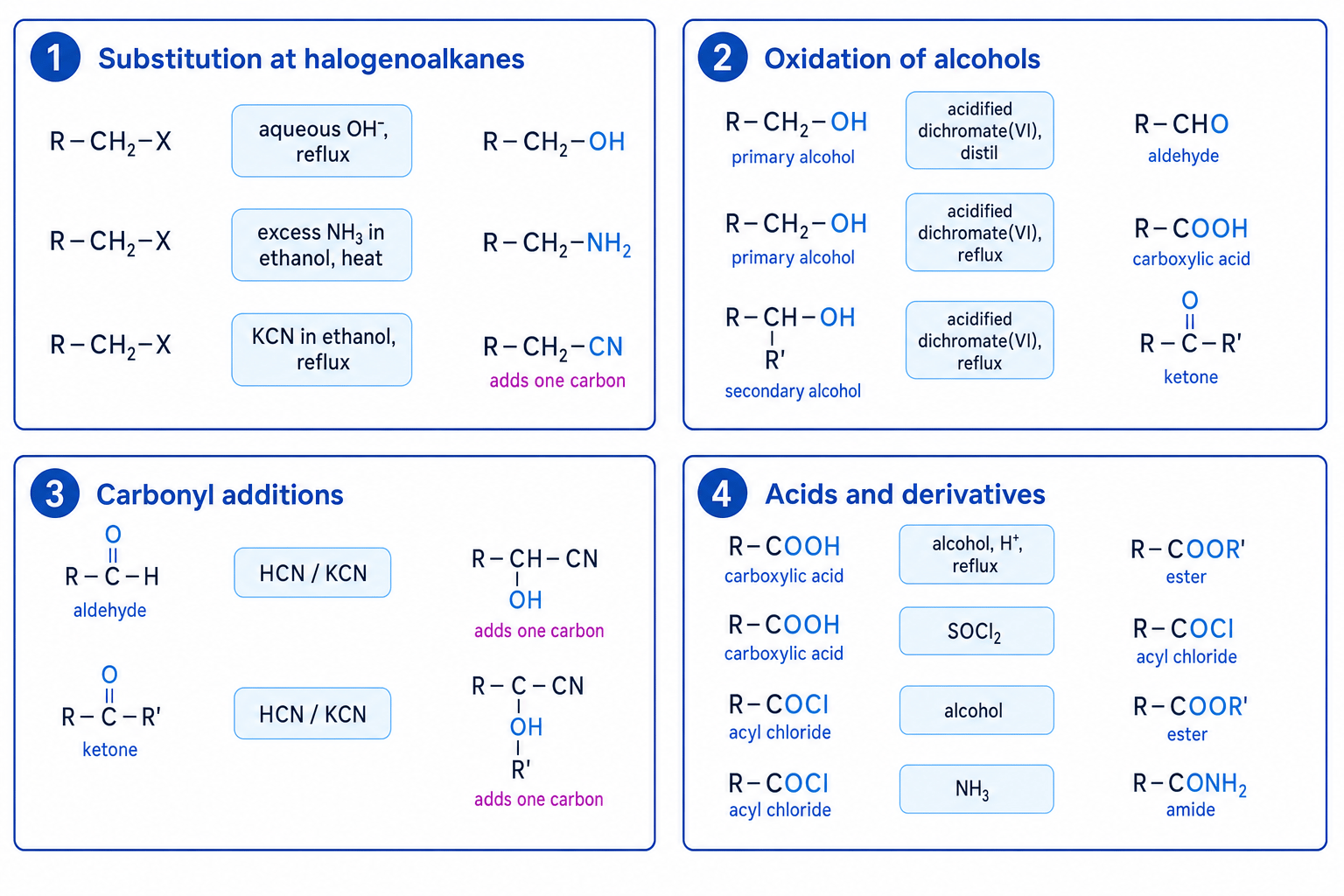
Before planning routes, you need a reliable mental map of common conversions. The diagram below summarises many of the most useful aliphatic reactions for A-Level synthesis.
Oxidation and reduction
A primary alcohol can be oxidised to an aldehyde or further to a carboxylic acid.
- Primary alcohol → aldehyde: acidified potassium dichromate(VI), distil.
- Primary alcohol → carboxylic acid: acidified potassium dichromate(VI), reflux.
- Secondary alcohol → ketone: acidified potassium dichromate(VI), reflux.
- Aldehyde → carboxylic acid: acidified potassium dichromate(VI), reflux.
- Aldehyde or ketone → alcohol: sodium tetrahydridoborate(III), NaBH₄.
Reflux
Reflux means heating a reaction mixture with a condenser so volatile substances evaporate, condense and return to the flask. It allows prolonged heating without losing reactants or products.
Choosing oxidation conditions
You need to convert butan-1-ol into butanal, not butanoic acid.
-
Butan-1-ol is a primary alcohol, so oxidation can produce either an aldehyde or a carboxylic acid depending on conditions.
-
The target, butanal, is an aldehyde, so you must prevent further oxidation to butanoic acid.
-
Use acidified potassium dichromate(VI) and distil the butanal as it forms, because aldehydes have lower boiling temperatures than the corresponding carboxylic acids.
Reflux versus distil
Do not write “reflux” when making an aldehyde from a primary alcohol. Reflux promotes further oxidation to the carboxylic acid; distillation removes the aldehyde before that happens.
Planning backwards: retrosynthesis
Retrosynthesis
Retrosynthesis is planning a synthesis by working backwards from the target molecule to simpler starting materials.
A useful question is: What immediate precursor could make this target in one known reaction?
For example, if the target is a carboxylic acid, possible precursors include:
- a primary alcohol, using oxidation under reflux;
- an aldehyde, using oxidation;
- a nitrile, using acidic hydrolysis.
Work backwards, then write forwards
Plan the route backwards from the target molecule, but present the final answer forwards from starting material to product, with reagents and conditions above each arrow.
Lengthening the carbon chain
Many reactions change functional groups but keep the same number of carbon atoms. In synthesis, you often need to add carbon atoms.
Two especially important A-Level methods are:
1. Halogenoalkane to nitrile
A halogenoalkane reacts with cyanide ions, CN⁻, by nucleophilic substitution:
R–X → R–CN
Reagents and conditions:
- potassium cyanide, KCN;
- ethanol as solvent;
- heat under reflux.
The carbon in the CN group becomes part of the main carbon chain, so this adds one carbon atom.
For example:
CH₃CH₂Br → CH₃CH₂CN
Bromoethane has two carbon atoms; propanenitrile has three.
2. Carbonyl compound to hydroxynitrile
An aldehyde or ketone reacts with HCN in the presence of KCN catalyst to form a hydroxynitrile.
Hydroxynitrile
A hydroxynitrile is an organic compound containing both an –OH group and a –CN group.
This is a nucleophilic addition reaction. The carbonyl group, C=O, is attacked by CN⁻, and the product contains one extra carbon atom.
HCN is highly toxic
In real laboratory work, hydrogen cyanide is extremely hazardous. In exam answers, give the required reagent system, usually HCN with KCN or NaCN as a catalyst, but do not suggest casual handling of HCN.
Planning a carbon-chain extension
Plan a synthesis of butanoic acid from 1-bromopropane.
-
Compare carbon chains: 1-bromopropane has three carbon atoms, but butanoic acid has four. The route must add one carbon atom.
-
Convert the halogenoalkane into a nitrile using KCN in ethanol under reflux:
CH₃CH₂CH₂Br → CH₃CH₂CH₂CN
-
Hydrolyse the nitrile to the carboxylic acid using dilute acid under reflux:
CH₃CH₂CH₂CN + 2H₂O + H⁺ → CH₃CH₂CH₂COOH + NH₄⁺
-
Therefore the forward route is:
1-bromopropane → butanenitrile → butanoic acid.
Acids, acyl chlorides, esters and amides
Carboxylic acids are useful synthesis “hubs” because they can be converted into several derivatives.
A carboxylic acid derivative is a compound related to a carboxylic acid where the –OH part has been replaced by another group.
Useful conversions:
- Carboxylic acid + alcohol ⇌ ester + water, using concentrated H₂SO₄ or HCl catalyst and reflux.
- Carboxylic acid → acyl chloride, using SOCl₂.
- Acyl chloride + alcohol → ester.
- Acyl chloride + NH₃ → amide.
Acyl chlorides are much more reactive than carboxylic acids, so they are often used when a faster or higher-yielding route to an ester or amide is needed.
Spotting ester routes
If your target contains –COO–, think “ester”. Work backwards by splitting the molecule at the C–O single bond: one side often comes from a carboxylic acid or acyl chloride, and the other side from an alcohol.
Aromatic synthesis routes
For benzene-based compounds, remember the common aromatic sequence:
Benzene → nitrobenzene → phenylamine → diazonium salt → azo dye
Key reagents and conditions:
- Benzene to nitrobenzene: concentrated HNO₃ and concentrated H₂SO₄, about 50 °C.
- Nitrobenzene to phenylamine: Sn and concentrated HCl, then NaOH.
- Phenylamine to diazonium salt: NaNO₂ and HCl below 10 °C.
- Diazonium salt to azo dye: phenol or aromatic amine in alkaline conditions.
This matters because exam routes often ask you to make an aromatic amine, dye, amide or substituted benzene from benzene.
Evaluating a synthesis
A good route is not just chemically possible. It should also be practical.
Consider:
- Number of steps: fewer steps usually give a better overall yield.
- Yield: each step loses some product.
- Purity: products may need distillation, recrystallisation or drying.
- Safety: reagents such as HCN, SOCl₂ and acyl chlorides need care.
- Selectivity: if a molecule has several functional groups, a reagent may react with more than one.
Percentage yield
Percentage yield compares the actual amount of product made with the theoretical maximum predicted by the balanced equation.
Calculating percentage yield
4.20 g of 1-bromopropane is converted into butanenitrile. The actual mass of butanenitrile obtained is 1.75 g. Calculate the percentage yield. Assume a 1:1 mole ratio.
-
Find the amount of 1-bromopropane. Its molar mass is 122.9 g mol⁻¹.
n=4.20 g122.9 g mol−1=0.0342 moln = \frac{4.20\ \text{g}}{122.9\ \text{g mol}^{-1}} = 0.0342\ \text{mol}n=122.9 g mol−14.20 g=0.0342 mol -
Use the 1:1 mole ratio, so the theoretical amount of butanenitrile is 0.0342 mol. Its molar mass is 69.0 g mol⁻¹.
m=0.0342 mol×69.0 g mol−1=2.36 gm = 0.0342\ \text{mol} \times 69.0\ \text{g mol}^{-1} = 2.36\ \text{g}m=0.0342 mol×69.0 g mol−1=2.36 g -
Compare the actual yield with the theoretical yield.
percentage yield=1.75 g2.36 g×100=74.2%\text{percentage yield} = \frac{1.75\ \text{g}}{2.36\ \text{g}} \times 100 = 74.2\%percentage yield=2.36 g1.75 g×100=74.2%
Checking the product
In practical synthesis, you often need evidence that you made the intended compound.
Common checks include:
- IR spectroscopy: useful for identifying bonds such as O–H, C=O, N–H and C≡N.
- Mass spectrometry: gives molecular mass and fragmentation evidence.
- NMR spectroscopy: helps confirm carbon and hydrogen environments.
- Melting temperature or boiling temperature: a sharp value close to the data-book value suggests good purity.
In the exam
-
Start by identifying the functional group in the target molecule, then work backwards to a likely precursor.
-
For every arrow in a route, give both the reagent and the condition, such as “acidified potassium dichromate(VI), reflux” or “KCN in ethanol, reflux”.
-
Check carbon counts carefully: cyanide reactions often add one carbon atom, but oxidation and reduction usually do not.
Check yourself
- How would you convert propan-1-ol into propanoic acid, and why are the conditions important?
- Which reagent would you use to convert 1-bromobutane into pentanenitrile?
- How could you make an ester if you were given an acyl chloride and an alcohol?
