What you'll learn
- How the nitrogen lone pair controls the basicity and nucleophilic reactions of amines.
- How primary amines are prepared from halogenoalkanes, nitriles and nitro compounds.
- Why amides behave differently from amines, and how amide links are made and hydrolysed.
- How amino acids form zwitterions, peptide bonds and proteins.
Start point: the nitrogen lone pair
Nitrogen normally forms three covalent bonds and has one lone pair — a pair of outer-shell electrons not used in bonding. That lone pair is the “reactive feature” behind most of this topic.
Base and nucleophile
A base accepts a proton, H⁺. A nucleophile donates an electron pair to an electron-deficient atom, usually a carbon atom with a partial positive charge.
Amines are usually both bases and nucleophiles because the nitrogen lone pair can either bond to H⁺ or attack a carbon atom.
Follow the lone pair
If the nitrogen lone pair is available, the molecule tends to be basic and nucleophilic. If the lone pair is delocalised into a carbonyl group or benzene ring, it is less available.
Amines
Amine
An amine is an organic derivative of ammonia, NH₃, in which one or more hydrogen atoms have been replaced by alkyl or aryl groups.
Amines are classified by how many carbon groups are bonded directly to nitrogen:
- Primary amine: RNH₂, for example CH₃CH₂NH₂.
- Secondary amine: R₂NH, for example CH₃NHCH₃.
- Tertiary amine: R₃N, for example N(CH₃)₃.
- Aryl amine: nitrogen is attached to an aromatic ring, for example phenylamine, C₆H₅NH₂.
Basicity of amines
Amines react with acids to form ammonium salts:
CH₃CH₂NH₂ + HCl → CH₃CH₂NH₃⁺Cl⁻
In water, amines act as weak bases:
CH₃CH₂NH₂ + H₂O ⇌ CH₃CH₂NH₃⁺ + OH⁻
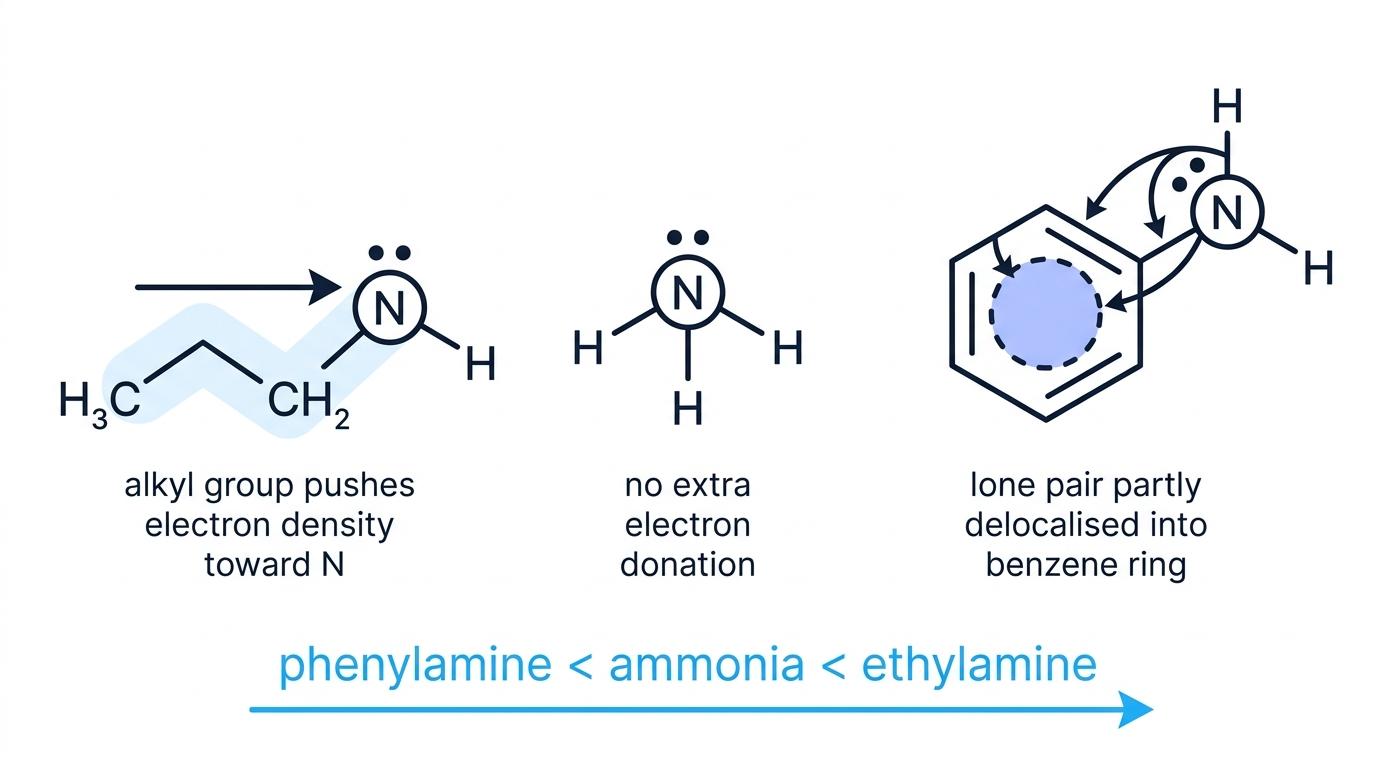
Aliphatic amines are usually stronger bases than ammonia because alkyl groups push electron density towards nitrogen, making the lone pair more available for bonding to H⁺. Phenylamine is weaker than ammonia because the nitrogen lone pair is partly delocalised into the benzene ring.
Comparing basicity
Put phenylamine, ammonia and ethylamine in order of increasing basic strength.
-
Compare how available the nitrogen lone pair is. A more available lone pair accepts H⁺ more readily, so the molecule is a stronger base.
-
Ethylamine has an electron-releasing ethyl group, so electron density on nitrogen is increased compared with ammonia.
-
Phenylamine has its lone pair partly delocalised into the benzene ring, so the lone pair is less available than in ammonia.
-
Therefore the order of increasing basic strength is: phenylamine < ammonia < ethylamine.
Assuming all amines have the same basicity
Do not just say “amines are basic”. In explanations, refer to the availability of the nitrogen lone pair and whether nearby groups donate electron density or delocalise the lone pair.
Preparing primary amines
From halogenoalkanes and ammonia
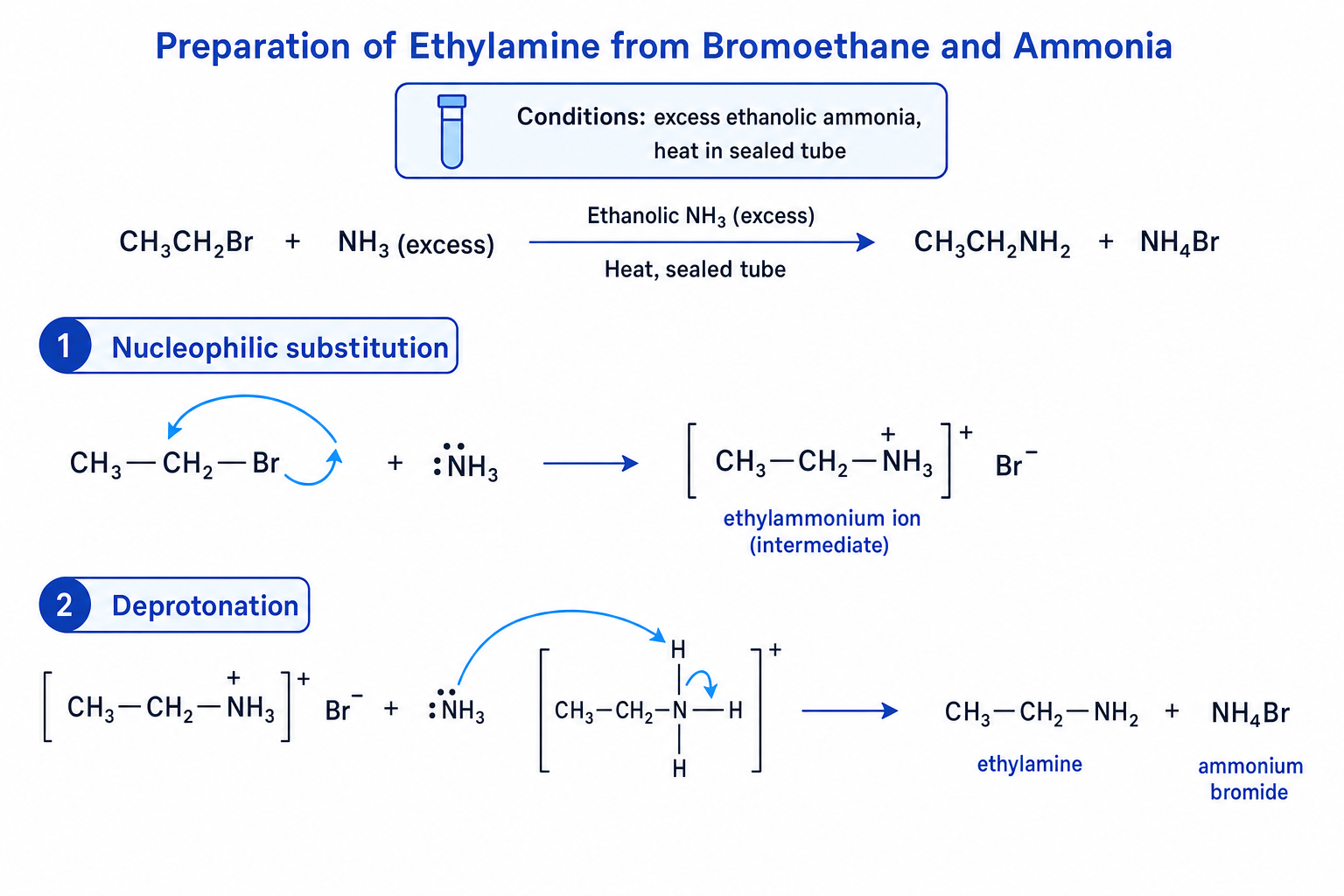
A primary amine can be made by heating a halogenoalkane with excess ethanolic ammonia in a sealed tube:
CH₃CH₂Br + 2NH₃ → CH₃CH₂NH₂ + NH₄Br
This is a nucleophilic substitution reaction. Ammonia attacks the carbon bonded to the halogen, then another ammonia molecule removes H⁺ from the alkylammonium ion.
Why excess ammonia?
The amine product still has a lone pair, so it can react again with more halogenoalkane to form secondary and tertiary amines. Using excess ammonia makes ammonia, not the amine product, the main nucleophile.
From nitriles
Nitriles, RCN, are reduced to primary amines:
CH₃CN + 4[H] → CH₃CH₂NH₂
Typical conditions are LiAlH₄ in dry ether, followed by water or dilute acid. Catalytic hydrogenation with H₂/Ni can also be used.
This route is useful because the carbon chain gains one carbon atom when a halogenoalkane is first converted into a nitrile using cyanide ions.
From nitrobenzene to phenylamine
Phenylamine is prepared by reducing nitrobenzene:
C₆H₅NO₂ + 6[H] → C₆H₅NH₂ + 2H₂O
Use tin and concentrated hydrochloric acid under reflux, then add sodium hydroxide solution to release free phenylamine from the phenylammonium salt.
Reactions of amines
Formation of salts
Amines react with acids to form ionic salts, often making the compound more soluble in water:
C₆H₅NH₂ + HCl → C₆H₅NH₃⁺Cl⁻
This is useful in separations because an amine can be converted into a water-soluble salt, then regenerated by adding alkali.
Acylation to form amides
Primary and secondary amines react with acyl chlorides to form amides. For example:
CH₃COCl + 2CH₃NH₂ → CH₃CONHCH₃ + CH₃NH₃⁺Cl⁻
The first amine molecule forms the amide; the second removes HCl to form an ammonium salt.
Predicting an amide product
Propanoyl chloride reacts with methylamine. Predict the organic product.
-
Identify the acyl part from propanoyl chloride: CH₃CH₂COCl becomes CH₃CH₂CO– in the product.
-
Identify the amine part from methylamine: CH₃NH₂ contributes –NHCH₃ after one N–H bond is replaced by the acyl group.
-
Join the acyl carbonyl carbon to nitrogen to form the amide link: CH₃CH₂CONHCH₃.
-
Name the product as N-methylpropanamide.
Diazonium salts from phenylamine
Primary aromatic amines such as phenylamine react with nitrous acid at low temperature to form diazonium salts:
C₆H₅NH₂ + HNO₂ + HCl → C₆H₅N₂⁺Cl⁻ + 2H₂O
Nitrous acid is usually made in situ from sodium nitrite and hydrochloric acid. Diazonium salts can couple with phenols or aromatic amines to form azo dyes containing the –N=N– group.
Keep diazonium reactions cold
Benzenediazonium salts are unstable if warmed, so diazotisation is carried out below about 10 °C.
Amides
Amide
An amide is a carboxylic acid derivative containing the group –CONH₂, –CONHR or –CONR₂. The carbonyl carbon is directly bonded to nitrogen.
Amides can be made from acyl chlorides and ammonia or amines:
CH₃COCl + 2NH₃ → CH₃CONH₂ + NH₄Cl
Amides are much less basic than amines. The nitrogen lone pair is delocalised towards the carbonyl group, so it is less available to accept H⁺.
Confusing amines and amides
An amine has nitrogen bonded only to carbon or hydrogen. An amide has nitrogen directly attached to a carbonyl group, C=O, and its chemistry is strongly affected by that carbonyl.
Hydrolysis of amides
Hydrolysis means breaking a bond using water. Amides hydrolyse when heated under reflux with acid or alkali.
Acid hydrolysis:
RCONH₂ + H₂O + H⁺ → RCOOH + NH₄⁺
Alkaline hydrolysis:
RCONH₂ + OH⁻ → RCOO⁻ + NH₃
For a substituted amide, the nitrogen-containing product is an amine or ammonium ion depending on the conditions.
Amino acids
Amino acid
An amino acid contains both an amino group, –NH₂, and a carboxylic acid group, –COOH. In an α-amino acid, both groups are attached to the same carbon atom.
A general α-amino acid is:
H₂NCH(R)COOH
The R group is the side chain and changes from one amino acid to another. Glycine has R = H.
Zwitterions and amphoteric behaviour
Zwitterion
A zwitterion is an ion with both a positive and a negative charge, but no overall charge.
In the solid state and often in aqueous solution, amino acids exist mainly as zwitterions:
H₂NCH(R)COOH ⇌ ⁺H₃NCH(R)COO⁻
Amino acids are amphoteric, meaning they can act as both acids and bases.
- In acidic solution: ⁺H₃NCH(R)COOH forms, with an overall positive charge.
- In alkaline solution: H₂NCH(R)COO⁻ forms, with an overall negative charge.
- At the isoelectric point, the average net charge is zero.
Predicting amino acid charge
An amino acid with no ionisable side chain is placed in a solution below its isoelectric point. Predict its charge and movement in an electric field.
-
Below the isoelectric point means the solution is relatively acidic, so the amino acid is more protonated.
-
The amino group is mainly –NH₃⁺ and the carboxyl group is more likely to be –COOH than –COO⁻, giving an overall positive charge.
-
A positive ion moves towards the negative electrode, so it migrates towards the cathode.
Chirality
A carbon atom bonded to four different groups is a chiral centre. Most α-amino acids are chiral because the central carbon is bonded to –NH₂, –COOH, H and R. Glycine is the exception because R is also H.
Proteins and peptide bonds
Amino acids join by condensation reactions, where two molecules combine and eliminate a small molecule, usually water.
Peptide bond
A peptide bond is the amide link, –CONH–, formed between the carboxyl group of one amino acid and the amino group of another.
For two amino acids:
H₂NCH(R¹)COOH + H₂NCH(R²)COOH → H₂NCH(R¹)CONHCH(R²)COOH + H₂O
A dipeptide contains two amino acid residues joined by one peptide bond. A polypeptide contains many amino acid residues. Proteins are natural polypeptides with specific sequences and 3D shapes.
Proteins are polyamides
A protein is a condensation polymer of amino acids. Its repeating link is an amide link, so peptide hydrolysis is amide hydrolysis.
Protein structure is described in levels:
- Primary structure: the sequence of amino acids.
- Secondary structure: local folding such as α-helices and β-sheets, held by hydrogen bonds between peptide groups.
- Tertiary structure: the overall 3D fold, held by interactions between R groups, including hydrogen bonds, ionic interactions, London forces and disulfide bridges.
- Quaternary structure: the arrangement of multiple polypeptide chains, if present.
Heating or extreme pH can cause denaturation, where the 3D structure is disrupted. The primary structure is usually unchanged unless peptide bonds are hydrolysed.
In the exam
-
When comparing basicity, always explain using the availability of the nitrogen lone pair, not just “more electrons”.
-
Learn the key preparation conditions: excess ethanolic NH₃ for halogenoalkanes, LiAlH₄ in dry ether for nitriles, and Sn/HCl reflux then NaOH for phenylamine.
-
For amino acid pH questions, draw the charged groups first, then check the overall charge before deciding movement in an electric field.
Check yourself
- Why is phenylamine a weaker base than ethylamine?
- What products form when N-methylethanamide is hydrolysed under acidic and alkaline conditions?
- Draw the zwitterion of glycine and circle the peptide bond in a dipeptide.