

What you'll learn
- How nuclear magnetic resonance, or NMR, detects different carbon and hydrogen environments in organic molecules.
- How to interpret chemical shift, integration and splitting in proton NMR.
- How carbon-13 NMR and proton NMR complement each other.
- How to piece together an unknown structure from NMR data.
The basic idea of NMR
Nuclear magnetic resonance spectroscopy
Nuclear magnetic resonance spectroscopy, usually shortened to NMR spectroscopy, is an analytical technique that uses the interaction between certain atomic nuclei and a strong magnetic field to provide information about the structure of a molecule.
Some nuclei behave like tiny magnets because they have nuclear spin. Important A-Level examples are:
- ¹H nuclei: protons, used in proton NMR.
- ¹³C nuclei: carbon-13 atoms, used in carbon-13 NMR.
When these nuclei are placed in a strong magnetic field, they can absorb radiofrequency energy. The exact energy absorbed depends on the chemical surroundings of the nucleus, so NMR gives structural information.
What NMR tells you
NMR does not usually “see” the whole molecule at once. It tells you about different nuclear environments inside the molecule, then you assemble the structure from the evidence.
Chemical environments
Chemical environment
A chemical environment is the local bonding situation around a nucleus. Nuclei in the same chemical environment give the same NMR signal; nuclei in different environments give different signals.
For example, in ethanol, CH3CH2OH:
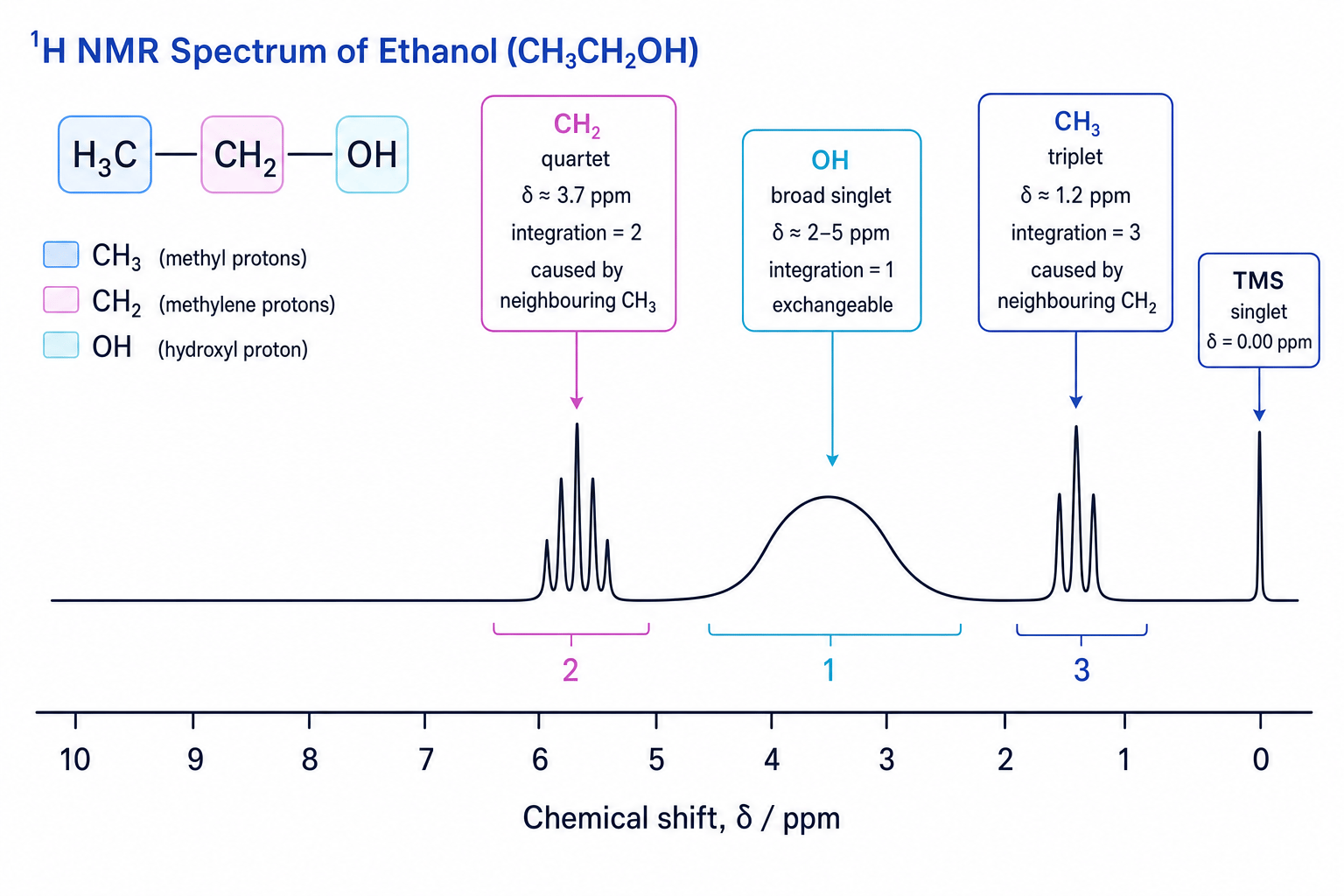
- the three CH3 protons are equivalent to each other;
- the two CH2 protons are equivalent to each other;
- the OH proton is in a different environment.
So ethanol gives three proton NMR signals.
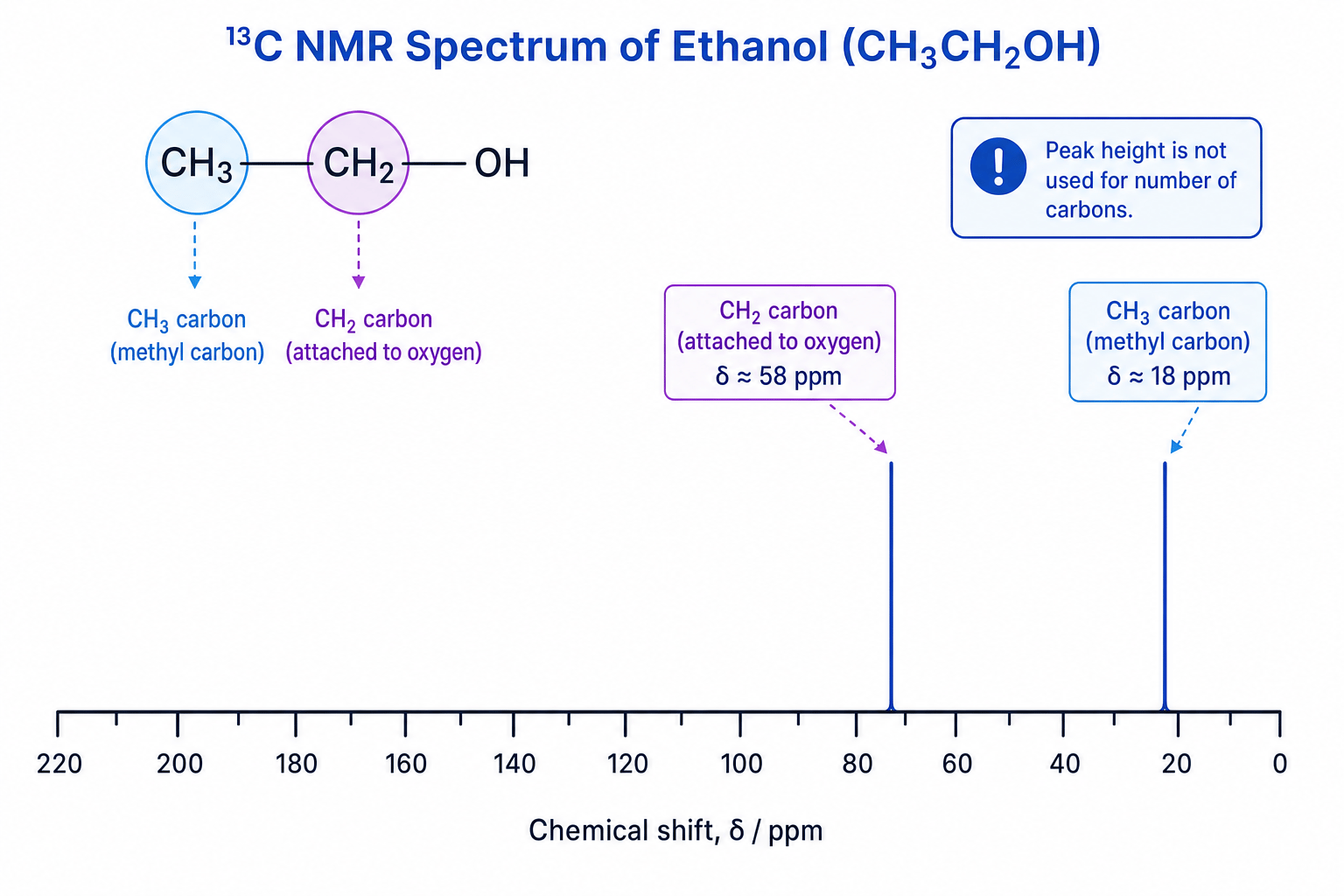
In carbon-13 NMR, ethanol has two carbon environments:
- the CH3 carbon;
- the CH2 carbon attached to oxygen.
Counting carbon environments
How many carbon-13 NMR signals would propanone, CH3COCH3, show?
- Compare the two methyl carbons. The molecule is symmetrical, so the left-hand CH3 carbon and right-hand CH3 carbon are in identical environments.
- Compare those methyl carbons with the carbonyl carbon, C=O. The carbonyl carbon is bonded very differently, so it is a separate environment.
- Therefore propanone has two carbon environments, so it gives two ¹³C NMR signals.
Forgetting symmetry
Do not just count the number of carbon atoms or hydrogen atoms. Count the number of different environments, taking molecular symmetry into account.
Chemical shift
Chemical shift
Chemical shift, symbol δ, is the position of an NMR signal compared with a reference compound. It is measured in ppm, which means parts per million.
NMR spectra are usually plotted with δ / ppm increasing from right to left. This feels backwards at first:
- signals near 0 ppm are on the right;
- signals at higher chemical shift are further left.
A nucleus is said to be shielded if surrounding electrons reduce the magnetic field it experiences. More shielded nuclei appear at lower δ values. Electronegative atoms such as oxygen, chlorine and nitrogen withdraw electron density, so nearby nuclei are deshielded and usually appear at higher δ values.
TMS
Tetramethylsilane, Si(CH3)4, often called TMS, is the reference compound used in NMR. Its signal is defined as 0 ppm.
TMS is useful because it is chemically inert, volatile, gives one sharp signal, and all its protons/carbon atoms are in one environment.
Carbon-13 NMR
Carbon-13 NMR, written ¹³C NMR, detects carbon environments. Most carbon atoms are carbon-12, which is not NMR-active, but the small natural abundance of carbon-13 is enough to give a spectrum.
In A-Level interpretation, the most important points are:
- the number of peaks tells you the number of carbon environments;
- the chemical shift suggests the type of carbon environment;
- peak heights are usually not used to count carbons.
Typical ¹³C chemical shift regions:
| ¹³C chemical shift / ppm | Carbon environment |
|---|---|
| 0–50 | Alkyl carbon, C–C |
| 50–90 | Carbon bonded to O, N or halogen |
| 100–150 | Alkene or aromatic carbon |
| 160–185 | Carboxylic acid, ester or amide C=O |
| 190–220 | Aldehyde or ketone C=O |
Using ¹³C NMR first
Carbon-13 NMR is often a quick way to check symmetry. If a molecule has fewer ¹³C peaks than carbon atoms, at least some carbons are equivalent.
Proton NMR
Proton NMR, written ¹H NMR, detects hydrogen environments. It gives more information than ¹³C NMR because proton spectra can show:
- the number of hydrogen environments;
- chemical shift;
- integration;
- splitting patterns.
Integration
Integration
Integration is the area under a proton NMR signal. It is proportional to the number of protons in that environment.
The integration may be shown as a stepped line or as numbers printed above peaks. The values are ratios, not always actual numbers of hydrogens, so you may need to simplify them.
Converting integration values
A proton NMR spectrum has three signals with integration values 18, 12 and 6. Find the proton ratio.
- Divide all integration values by the smallest value, 6:
- Write the simplified ratio in the same order as the signals: 3 : 2 : 1.
- Interpret this as three proton environments containing relative numbers of protons 3, 2 and 1. For ethanol, this matches CH3, CH2 and OH.
Splitting and the n + 1 rule
In high-resolution proton NMR, a signal can be split into several smaller peaks. This is caused by spin-spin coupling, an interaction between non-equivalent protons on neighbouring carbon atoms.
The n + 1 rule
If a proton environment has nnn equivalent neighbouring protons on adjacent carbon atoms, its signal is split into n+1n+1n+1 peaks.
Common splitting patterns:
| Neighbouring protons | Splitting pattern | Peak intensity ratio |
|---|---|---|
| 0 | Singlet | 1 |
| 1 | Doublet | 1 : 1 |
| 2 | Triplet | 1 : 2 : 1 |
| 3 | Quartet | 1 : 3 : 3 : 1 |
For ethanol:
- CH3 is next to CH2, so it has two neighbouring protons and appears as a triplet.
- CH2 is next to CH3, so it has three neighbouring protons and appears as a quartet.
- OH is often broad and may not split clearly because its proton exchanges rapidly.
Splitting uses neighbouring protons
Integration tells you the number of protons in the environment itself. Splitting tells you the number of equivalent protons on neighbouring carbon atoms.
Exchangeable protons and D₂O
Protons bonded to oxygen or nitrogen, such as in alcohols, phenols, carboxylic acids and amines, are called exchangeable protons. Their NMR signals can be broad and variable because the proton can rapidly exchange between molecules.
D₂O exchange
D₂O exchange is a test in proton NMR where deuterium oxide, D₂O, is added. Exchangeable OH or NH protons are replaced by deuterium, so their ¹H NMR signal disappears.
For example:
CH3CH2OH + D2O ⇌ CH3CH2OD + HOD
The O–D proton is not detected in a normal ¹H NMR spectrum, so the OH peak disappears.
Spotting OH and NH
If a peak disappears after adding D₂O, it was due to an exchangeable OH or NH proton.
Solvents used in NMR
NMR samples are dissolved in a solvent. For proton NMR, the solvent must not produce a large interfering ¹H signal, so deuterated solvents are commonly used.
Deuterated solvent
A deuterated solvent contains deuterium, ²H, instead of ordinary hydrogen, ¹H. A common example is CDCl3, deuterated chloroform.
Deuterium is not detected in the same way as ¹H in a normal proton NMR experiment, so it avoids swamping the spectrum.
Interpreting a proton NMR spectrum
A good approach is to combine all the evidence, rather than trying to identify the molecule from one feature.
Identifying an alcohol from proton NMR data
A compound has molecular formula C2H6O. Its proton NMR spectrum has three signals: a triplet with integration 3 at about 1.2 ppm, a quartet with integration 2 at about 3.7 ppm, and a broad singlet with integration 1 that disappears after adding D₂O. Identify the compound.
- Use the molecular formula C2H6O. The compound could be ethanol, CH3CH2OH, or methoxymethane, CH3OCH3.
- Use integration. The ratio 3 : 2 : 1 suggests three different proton environments: CH3, CH2 and one exchangeable proton.
- Use the D₂O evidence. The signal that disappears must be OH, so the compound contains an alcohol group.
- Use splitting. A triplet integrating to 3 and a quartet integrating to 2 show a CH3CH2 group.
- Combine the evidence: the structure is ethanol, CH3CH2OH.
Combining NMR with other techniques
NMR is powerful, but exam questions often give other data too:
- Mass spectrometry can give the molecular ion peak, helping you find relative molecular mass.
- Infrared spectroscopy can identify functional groups such as O–H, C=O or C≡N.
- Elemental analysis or molecular formulae restrict the possible structures.
Building the structure
Use each spectrum to remove possibilities. ¹³C NMR tells you carbon environments, ¹H NMR tells you hydrogen environments and neighbours, while IR often confirms the functional group.
The n + 1 rule has limits
At A-Level, the n+1n+1n+1 rule is usually applied to simple neighbouring proton environments. It may not work cleanly for rapidly exchanging OH/NH protons, overlapping signals, or more complex coupling situations.
In the exam
- Start with the molecular formula and any IR or mass spectrum data to identify likely functional groups.
- Use ¹³C NMR to count carbon environments and check for symmetry.
- For ¹H NMR, use chemical shift, integration and splitting together — do not rely on just one feature.
- Remember that D₂O removes exchangeable OH or NH signals.
- Sketch possible structures and test each one against every peak in the data.
Check yourself
- Why does ethanol give three ¹H NMR signals but only two ¹³C NMR signals?
- What splitting pattern would you expect for a CH3 group next to a CH2 group?
- What does it mean if a proton NMR signal disappears after adding D₂O?
