

What you'll learn
- How chromatography separates mixtures using a stationary phase and a mobile phase.
- How to calculate and interpret retention factor, RfR_fRf, values in TLC/paper chromatography.
- How gas chromatography and HPLC produce chromatograms.
- How to use retention time and peak area for identification and quantitative analysis.
The big idea: separating a mixture
Chromatography is used when a sample contains more than one substance and you want to separate, identify, or measure the components.
Chromatography
Chromatography is a separation technique in which substances in a mixture distribute differently between a fixed stationary phase and a moving mobile phase.
The stationary phase stays in one place. The mobile phase moves through or over it, carrying the sample mixture with it.
A component that spends more time in the mobile phase moves further or leaves the column sooner. A component that interacts more strongly with the stationary phase moves more slowly or leaves later.
Why separation happens
Chromatography works because different substances have different relative attractions for the stationary phase and the mobile phase.
Key terms you must know
Stationary phase
The stationary phase is the phase that does not move. It may be a solid surface, such as silica gel in thin-layer chromatography, or a liquid coated onto an inert solid in gas chromatography.
Mobile phase
The mobile phase is the phase that moves. It may be a liquid solvent or a gas carrier.
Adsorption and partition
Adsorption means particles sticking to the surface of a solid. This is important in thin-layer chromatography, where molecules can adsorb onto the polar silica surface.
Partition means a substance distributing itself between two phases. In gas-liquid chromatography, a substance partitions between the gaseous mobile phase and the liquid stationary phase.
A useful phrase
If you are explaining separation, write something like: “The component has a stronger attraction to the stationary phase, so it spends more time there and moves more slowly.”
Thin-layer chromatography and paper chromatography
In thin-layer chromatography, usually shortened to TLC, the stationary phase is a thin layer of silica gel or alumina on a plate. The mobile phase is a solvent that rises up the plate.
In paper chromatography, the stationary phase is water held in the fibres of the paper, and the mobile phase is a solvent.
A small spot of the mixture is placed on a pencil baseline. The solvent rises up the plate by capillary action, carrying substances with it. Different substances travel different distances.
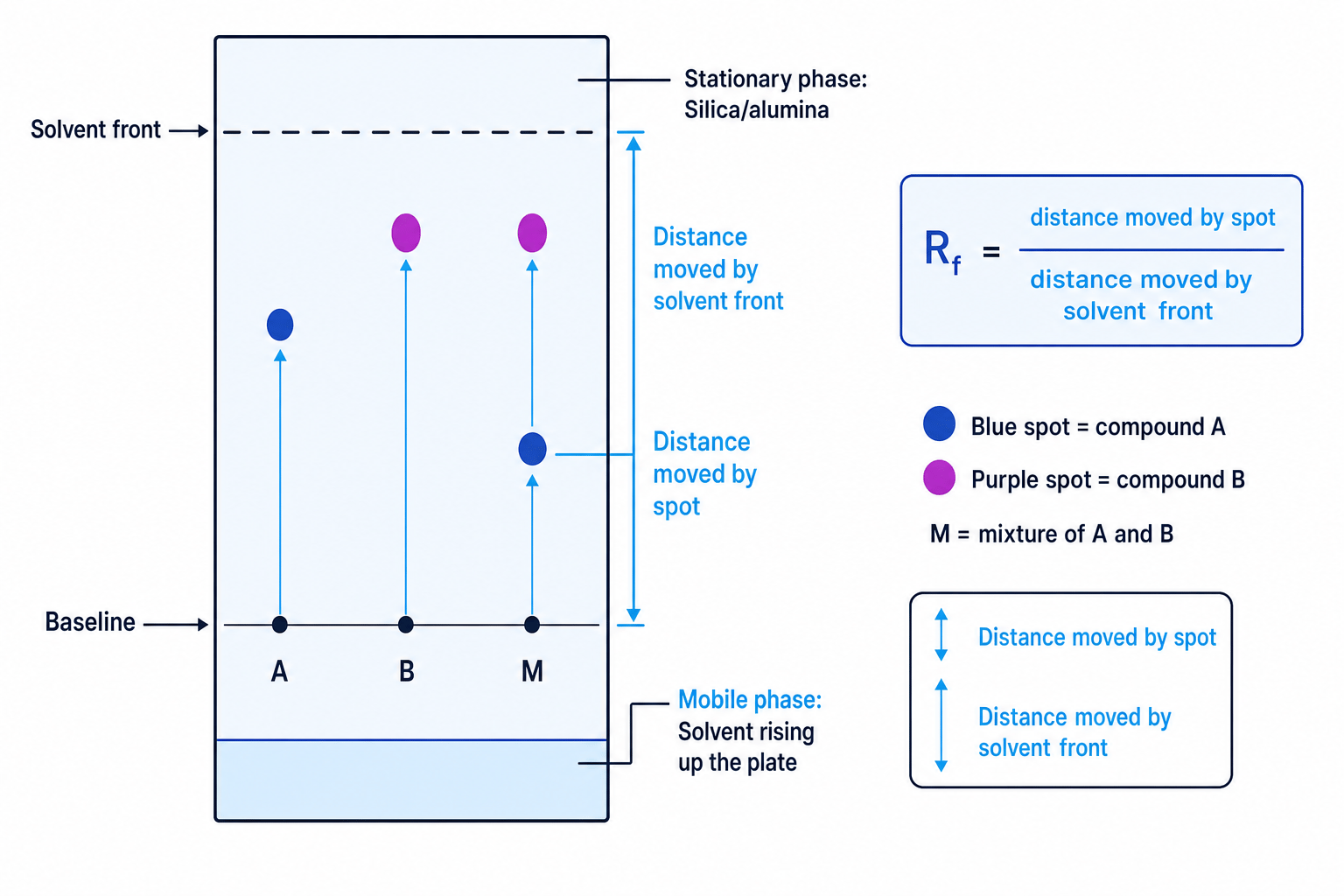
What controls how far a spot moves?
For a common TLC plate with polar silica as the stationary phase:
- More polar substances interact more strongly with silica, so they usually move less far.
- Less polar substances interact less strongly with silica, so they usually move further.
- A substance that is more soluble in the mobile phase tends to move further.
Predicting which substance moves further
A mixture contains hexane and propanone. It is run on a TLC plate with polar silica as the stationary phase.
- Identify the stationary phase: silica is polar and can form strong dipole interactions and hydrogen-bonding interactions with suitable molecules.
- Compare the molecules: propanone is polar because it contains a C=O group, whereas hexane is non-polar.
- Decide which is held more strongly: propanone interacts more strongly with the silica, so it spends more time on the stationary phase.
- Predict movement: hexane spends more time in the mobile phase, so it moves further up the plate and has the larger RfR_fRf value.
Blaming mass alone
Do not explain chromatography by saying “the heavier molecule moves more slowly” unless the question is specifically about volatility in gas chromatography. At A-level, focus on relative attraction, solubility, adsorption and partition.
Retention factor, Rf
The retention factor, RfR_fRf, compares how far a spot has travelled with how far the solvent front has travelled.
Retention factor
The retention factor is calculated using:
Rf=distance moved by spotdistance moved by solvent frontR_f = \frac{\text{distance moved by spot}}{\text{distance moved by solvent front}}Rf=distance moved by solvent frontdistance moved by spotBoth distances are measured from the baseline, so the units cancel. RfR_fRf has no units.
You measure the distance to the centre of the spot, not to the top or bottom of the spot.
Calculating a retention factor
A TLC plate gives a spot 4.2 cm above the baseline. The solvent front is 7.5 cm above the baseline. Calculate the RfR_fRf value.
-
Select the two distances measured from the baseline: spot distance = 4.2 cm and solvent front distance = 7.5 cm.
-
Substitute into the formula:
Rf=4.27.5R_f = \frac{4.2}{7.5}Rf=7.54.2 -
Calculate the value:
Rf=0.56R_f = 0.56Rf=0.56 -
Check the answer: an RfR_fRf value should usually be between 0 and 1, so 0.56 is sensible.
Rf values are not universal
Only compare RfR_fRf values if the chromatography conditions are the same: same stationary phase, same solvent, same temperature and same method. Changing the solvent can change the RfR_fRf value.
Good TLC practical technique
There are several details that matter in practice.
Use a pencil baseline because pencil graphite is insoluble in most chromatography solvents. Ink could dissolve and produce extra spots.
The baseline must start above the solvent level. If the sample spot is submerged, it can dissolve directly into the solvent reservoir instead of travelling up the plate.
After running the chromatogram, mark the solvent front immediately, because the solvent may evaporate.
Some substances are colourless, so the plate may need to be viewed under UV light or treated with a locating agent such as iodine vapour or ninhydrin.
Forgetting the solvent front
If the solvent front is not marked before it evaporates, you cannot calculate a reliable RfR_fRf value.
Gas chromatography
Gas chromatography, often written as GC, separates volatile substances. A volatile substance evaporates easily.
In gas chromatography:
- The mobile phase is an inert carrier gas, such as helium or nitrogen.
- The stationary phase is usually a high-boiling liquid coated onto a solid support inside a long column.
- The sample is injected and vaporised.
- Components travel through the column at different rates.
- A detector records each component as it leaves the column.
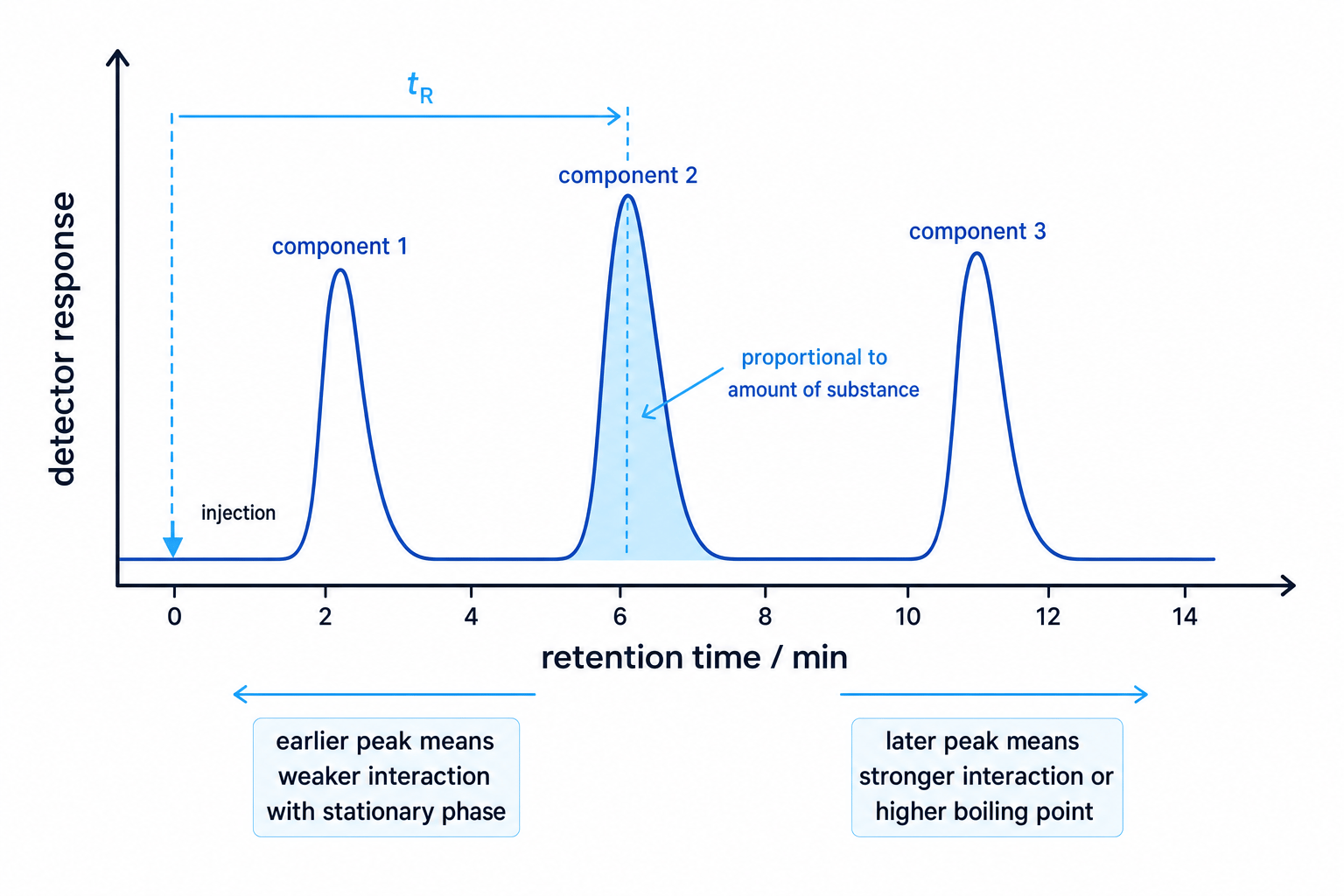
The output is a chromatogram, which is a graph of detector response against retention time.
Retention time
The retention time, tRt_RtR, is the time taken for a component to travel through the column and reach the detector, measured from injection to the peak maximum.
Interpreting a gas chromatogram
Each peak usually represents one component of the mixture. The retention time can be compared with known standards to help identify a component.
The area under a peak is proportional to the amount of that component, assuming the detector response is calibrated appropriately.
A component may have a longer retention time if:
- it has stronger attraction to the stationary phase;
- it partitions more into the stationary phase;
- it is less volatile, often because it has a higher boiling temperature.
Using peak areas to find composition
A gas chromatogram of a two-component mixture gives peak areas of 240 and 560 arbitrary units. Assume the detector gives the same response per mole for both substances. Find the percentage of the second component.
-
Add the peak areas to find the total detector response:
240+560=800240 + 560 = 800240+560=800 -
Divide the second component’s area by the total area:
560800=0.700\frac{560}{800} = 0.700800560=0.700 -
Convert to a percentage:
0.700×100=70.0%0.700 \times 100 = 70.0\%0.700×100=70.0% -
State the assumption: this is the percentage by amount only if the detector response is the same for both components or has been corrected using calibration.
Peak height instead of peak area
For quantitative analysis, use peak area rather than peak height. A broad peak can contain more substance than a narrow, taller-looking peak.
HPLC
High-performance liquid chromatography, or HPLC, uses a liquid mobile phase pumped under high pressure through a column packed with a stationary phase.
HPLC is useful for substances that are not suitable for gas chromatography, especially compounds that are non-volatile or decompose when heated.
In reversed-phase HPLC, the stationary phase is non-polar, often containing long hydrocarbon chains, while the mobile phase is relatively polar. In this case, more non-polar substances tend to interact more strongly with the stationary phase and have longer retention times.
GC versus HPLC
GC is best for volatile, thermally stable substances. HPLC is better for many larger, less volatile or heat-sensitive molecules.
Identification and reliability
Chromatography can provide strong evidence, but it is more reliable when combined with standards or another analytical technique.
For example, in GC-MS, gas chromatography first separates the mixture, then mass spectrometry analyses each component as it leaves the column. This gives both retention-time evidence and mass-spectrum evidence.
How to make identification stronger
A matching RfR_fRf value or retention time suggests a possible identity. A matching chromatogram plus another technique, such as mass spectrometry, gives much stronger evidence.
In the exam
- When explaining separation, compare attractions for the stationary and mobile phases; do not just say “different substances travel at different speeds”.
- For RfR_fRf calculations, measure from the baseline to the centre of the spot and to the solvent front; give no units.
- For GC or HPLC chromatograms, use retention time for identification and peak area for amount, mentioning calibration if the question is quantitative.
Check yourself
- Why might a polar compound have a smaller RfR_fRf value than a non-polar compound on a silica TLC plate?
- A spot travels 3.2 cm and the solvent front travels 8.0 cm. What is the RfR_fRf value?
- In gas chromatography, what does peak area tell you, and why might calibration be needed?
