

What you'll learn
- What lattice energy means: the enthalpy change when an ionic lattice forms or breaks apart.
- How atomisation, ionisation energy and electron affinity fit together in a Born-Haber cycle.
- How to calculate lattice enthalpy using Hess’s law.
- How ionic charge, ionic radius and polarisation explain trends and deviations from theory.
Why this topic matters
Ionic compounds such as sodium chloride, magnesium oxide and calcium fluoride have very high melting points because their oppositely charged ions are held together in giant ionic lattices. Lattice energy is the energy change linked to making or breaking those lattices.
A Born-Haber cycle is a thermochemical cycle that lets you calculate a lattice enthalpy indirectly, because you cannot usually measure it directly in the lab.
Prerequisite: standard enthalpy changes and Hess’s law
Before lattice energy, you need to be confident with standard enthalpy changes.
Standard enthalpy change
A standard enthalpy change, written with the symbol ΔH∘\Delta H^{\circ}ΔH∘, is the enthalpy change when all substances are in their standard states under standard conditions, usually 100 kPa and 298 K.
For example, the standard enthalpy change of formation of sodium chloride is for:
Na(s)+12Cl2(g)→NaCl(s)\text{Na(s)} + \frac{1}{2}\text{Cl}_2\text{(g)} \to \text{NaCl(s)}Na(s)+21Cl2(g)→NaCl(s)Hess’s law
Hess’s law states that the total enthalpy change for a reaction is independent of the route taken, provided the starting and finishing points are the same.
Same start, same finish
A Born-Haber cycle works because the direct route from elements to ionic solid must have the same total enthalpy change as the indirect route through gaseous atoms and gaseous ions.
Lattice enthalpy: two sign conventions
You will meet two closely related definitions. The sign depends on whether the lattice is being made or broken.
Lattice enthalpy of formation
The lattice enthalpy of formation is the enthalpy change when one mole of a solid ionic compound is formed from its gaseous ions under standard conditions.
For sodium chloride:
Na+(g)+Cl−(g)→NaCl(s)\text{Na}^{+}\text{(g)} + \text{Cl}^{-}\text{(g)} \to \text{NaCl(s)}Na+(g)+Cl−(g)→NaCl(s)This is exothermic, so the value is negative.
Lattice enthalpy of dissociation
The lattice enthalpy of dissociation is the enthalpy change when one mole of a solid ionic compound is separated into its gaseous ions under standard conditions.
For sodium chloride:
NaCl(s)→Na+(g)+Cl−(g)\text{NaCl(s)} \to \text{Na}^{+}\text{(g)} + \text{Cl}^{-}\text{(g)}NaCl(s)→Na+(g)+Cl−(g)This is endothermic, so the value is positive.
Mixing up formation and dissociation signs
If the question says the lattice is formed from gaseous ions, the lattice enthalpy is negative. If the lattice is separated into gaseous ions, the lattice enthalpy is positive.
In Pearson Edexcel questions, always read the definition in the question carefully. If they simply say “lattice energy”, they usually mean lattice enthalpy, but the sign convention must come from the wording.
The energy steps needed for a Born-Haber cycle
A Born-Haber cycle breaks the formation of an ionic compound into small enthalpy changes.
Enthalpy change of atomisation
Enthalpy change of atomisation
The enthalpy change of atomisation is the enthalpy change when one mole of gaseous atoms is formed from an element in its standard state.
Examples:
Na(s)→Na(g)\text{Na(s)} \to \text{Na(g)}Na(s)→Na(g) 12Cl2(g)→Cl(g)\frac{1}{2}\text{Cl}_2\text{(g)} \to \text{Cl(g)}21Cl2(g)→Cl(g)Atomisation is endothermic because bonds or metallic attractions must be overcome.
Ionisation energy
First ionisation energy
The first ionisation energy is the enthalpy change when one mole of electrons is removed from one mole of gaseous atoms to form one mole of gaseous 1+ ions.
For sodium:
Na(g)→Na+(g)+e−\text{Na(g)} \to \text{Na}^{+}\text{(g)} + \text{e}^{-}Na(g)→Na+(g)+e−Ionisation energies are always endothermic, so they are positive.
Electron affinity
First electron affinity
The first electron affinity is the enthalpy change when one mole of electrons is added to one mole of gaseous atoms to form one mole of gaseous 1− ions.
For chlorine:
Cl(g)+e−→Cl−(g)\text{Cl(g)} + \text{e}^{-} \to \text{Cl}^{-}\text{(g)}Cl(g)+e−→Cl−(g)The first electron affinity of a non-metal is usually exothermic, so it is often negative.
Second electron affinities
A second electron affinity is always endothermic because an electron is being added to an already negative ion. For oxygen:
O−(g)+e−→O2−(g)\text{O}^{-}\text{(g)} + \text{e}^{-} \to \text{O}^{2-}\text{(g)}O−(g)+e−→O2−(g)Do not treat this as another negative value.
Building a Born-Haber cycle
A Born-Haber cycle combines all the enthalpy changes needed to form an ionic compound from its elements.
The diagram below shows the cycle for sodium chloride. Notice that the ions in the lattice enthalpy step are gaseous ions, not aqueous ions.
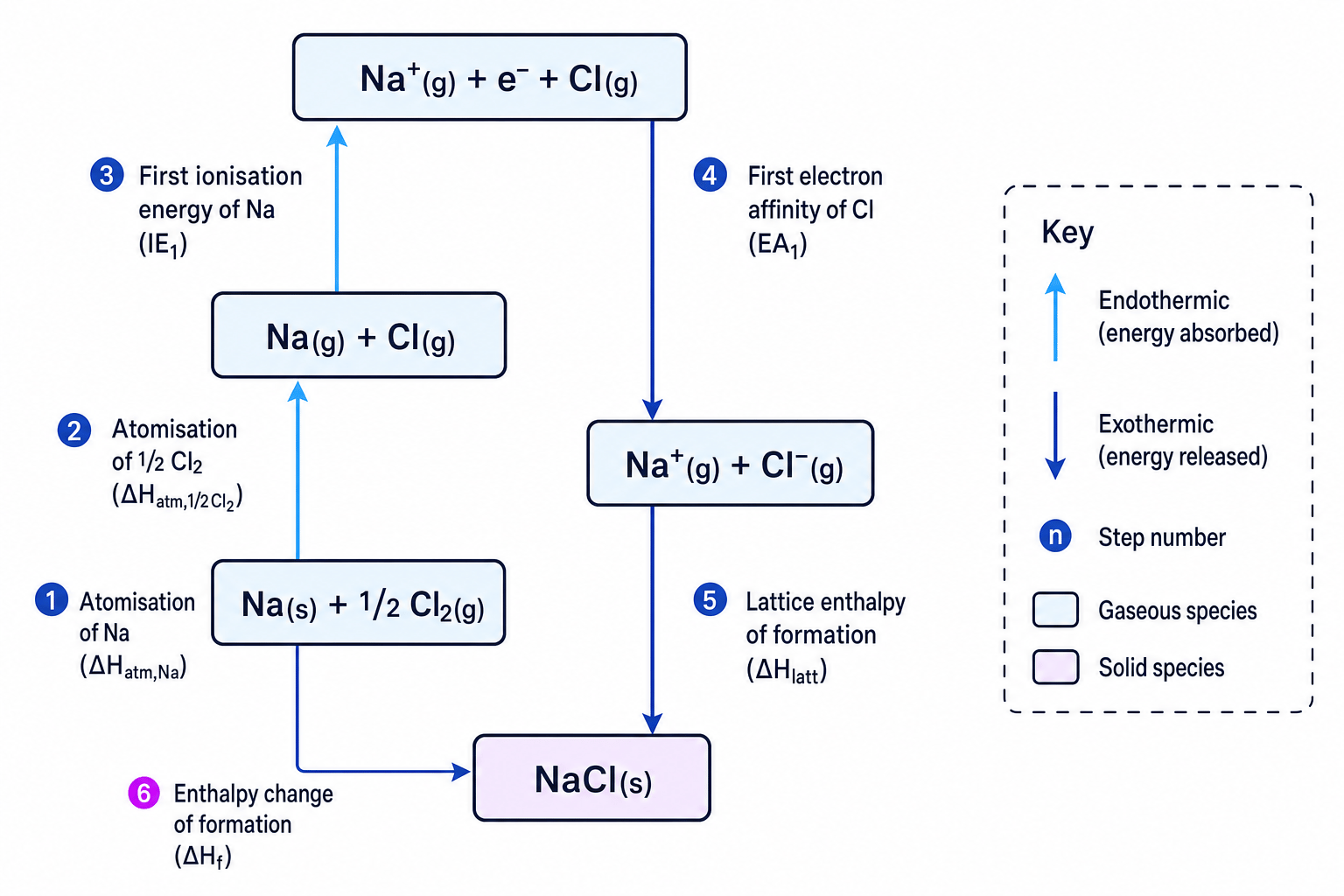
For sodium chloride, the Hess’s law equation is:
ΔHf∘(NaCl)=ΔHat∘(Na)+ΔHat∘(12Cl2)+IE1(Na)+EA1(Cl)+ΔHlatt∘\begin{aligned} \Delta H_\text{f}^{\circ}(\text{NaCl}) ={}& \Delta H_\text{at}^{\circ}(\text{Na}) + \Delta H_\text{at}^{\circ}\left(\frac{1}{2}\text{Cl}_2\right) \\ &+ \text{IE}_1(\text{Na}) + \text{EA}_1(\text{Cl}) + \Delta H_\text{latt}^{\circ} \end{aligned}ΔHf∘(NaCl)=ΔHat∘(Na)+ΔHat∘(21Cl2)+IE1(Na)+EA1(Cl)+ΔHlatt∘where ΔHlatt∘\Delta H_\text{latt}^{\circ}ΔHlatt∘ is the lattice enthalpy of formation.
Calculating lattice enthalpy of formation
Use the following data to calculate the lattice enthalpy of formation of sodium chloride.
- ΔHf∘(NaCl)=−411 kJ mol−1\Delta H_\text{f}^{\circ}(\text{NaCl}) = -411\text{ kJ mol}^{-1}ΔHf∘(NaCl)=−411 kJ mol−1
- ΔHat∘(Na)=+107 kJ mol−1\Delta H_\text{at}^{\circ}(\text{Na}) = +107\text{ kJ mol}^{-1}ΔHat∘(Na)=+107 kJ mol−1
- ΔHat∘(12Cl2)=+122 kJ mol−1\Delta H_\text{at}^{\circ}\left(\frac{1}{2}\text{Cl}_2\right) = +122\text{ kJ mol}^{-1}ΔHat∘(21Cl2)=+122 kJ mol−1
- IE1(Na)=+496 kJ mol−1\text{IE}_1(\text{Na}) = +496\text{ kJ mol}^{-1}IE1(Na)=+496 kJ mol−1
- EA1(Cl)=−349 kJ mol−1\text{EA}_1(\text{Cl}) = -349\text{ kJ mol}^{-1}EA1(Cl)=−349 kJ mol−1
-
Substitute the values into the Hess’s law expression:
−411=107+122+496−349+ΔHlatt∘-411 = 107 + 122 + 496 - 349 + \Delta H_\text{latt}^{\circ}−411=107+122+496−349+ΔHlatt∘ -
Add the non-lattice terms:
107+122+496−349=376107 + 122 + 496 - 349 = 376107+122+496−349=376 -
Rearrange to find the lattice enthalpy:
−411=376+ΔHlatt∘ΔHlatt∘=−787 kJ mol−1\begin{aligned} -411 &= 376 + \Delta H_\text{latt}^{\circ} \\ \Delta H_\text{latt}^{\circ} &= -787\text{ kJ mol}^{-1} \end{aligned}−411ΔHlatt∘=376+ΔHlatt∘=−787 kJ mol−1 -
Check the sign: lattice formation should be exothermic, so a negative value is sensible.
A quick cycle check
For a lattice enthalpy of formation, the final step should go from gaseous ions down to the solid lattice. That arrow is exothermic and negative.
Compounds with 2+ or 2− ions
For compounds such as magnesium oxide, you must include every electron removed or added.
Formation equation:
Mg(s)+12O2(g)→MgO(s)\text{Mg(s)} + \frac{1}{2}\text{O}_2\text{(g)} \to \text{MgO(s)}Mg(s)+21O2(g)→MgO(s)Indirect route:
Mg(s)→Mg(g)\text{Mg(s)} \to \text{Mg(g)}Mg(s)→Mg(g) 12O2(g)→O(g)\frac{1}{2}\text{O}_2\text{(g)} \to \text{O(g)}21O2(g)→O(g) Mg(g)→Mg+(g)+e−\text{Mg(g)} \to \text{Mg}^{+}\text{(g)} + \text{e}^{-}Mg(g)→Mg+(g)+e− Mg+(g)→Mg2+(g)+e−\text{Mg}^{+}\text{(g)} \to \text{Mg}^{2+}\text{(g)} + \text{e}^{-}Mg+(g)→Mg2+(g)+e− O(g)+e−→O−(g)\text{O(g)} + \text{e}^{-} \to \text{O}^{-}\text{(g)}O(g)+e−→O−(g) O−(g)+e−→O2−(g)\text{O}^{-}\text{(g)} + \text{e}^{-} \to \text{O}^{2-}\text{(g)}O−(g)+e−→O2−(g) Mg2+(g)+O2−(g)→MgO(s)\text{Mg}^{2+}\text{(g)} + \text{O}^{2-}\text{(g)} \to \text{MgO(s)}Mg2+(g)+O2−(g)→MgO(s)Choosing the Born-Haber steps for magnesium oxide
-
Start from the formula MgO, so the gaseous ions needed before lattice formation are Mg2+(g)\text{Mg}^{2+}\text{(g)}Mg2+(g) and O2−(g)\text{O}^{2-}\text{(g)}O2−(g).
-
Magnesium must lose two electrons, so include both the first and second ionisation energies of magnesium.
-
Oxygen must gain two electrons, so include both the first and second electron affinities of oxygen.
-
The oxygen starts as 12O2(g)\frac{1}{2}\text{O}_2\text{(g)}21O2(g), so include the atomisation of oxygen to make one mole of O(g) atoms.
Forgetting coefficients
If the formula is MgCl2\text{MgCl}_2MgCl2, you need two chlorine atoms and two chloride ions. That means two lots of chlorine atomisation and two lots of the first electron affinity of chlorine.
What affects the size of lattice enthalpy?
The magnitude of lattice enthalpy depends mainly on electrostatic attraction between oppositely charged ions.
Two factors matter most:
- Ionic charge: higher charges give stronger attractions.
- Ionic radius: smaller ions can get closer together, giving stronger attractions.
A useful way to think about it is that ∣ΔHlatt∣|\Delta H_\text{latt}|∣ΔHlatt∣ increases when ∣z+z−∣r++r−\frac{|z_+z_-|}{r_+ + r_-}r++r−∣z+z−∣ increases.
So magnesium oxide has a much more exothermic lattice enthalpy of formation than sodium chloride because Mg2+\text{Mg}^{2+}Mg2+ and O2−\text{O}^{2-}O2− have higher charges than Na+\text{Na}^{+}Na+ and Cl−\text{Cl}^{-}Cl−.
Comparing lattice enthalpy magnitudes
Which should have the more exothermic lattice enthalpy of formation: NaF or NaI?
-
The cation is the same in both compounds, Na+\text{Na}^{+}Na+, so compare the anions.
-
Fluoride ions are smaller than iodide ions, so the distance between ion centres is smaller in NaF.
-
Smaller ion separation gives stronger electrostatic attraction, so NaF has the more exothermic lattice enthalpy of formation.
Saying “bigger” without sign clarity
For lattice enthalpy of formation, “larger magnitude” means more negative. For lattice enthalpy of dissociation, “larger magnitude” means more positive.
Experimental and theoretical lattice enthalpies
A Born-Haber cycle gives an experimental lattice enthalpy because it is calculated from measured enthalpy changes.
A theoretical lattice enthalpy is calculated using an ionic model. This model assumes the ions are spherical point charges and the bonding is purely ionic.
If the experimental value is much more exothermic than the theoretical value for lattice formation, the compound has more covalent character than the ionic model predicts.
Polarisation
Polarisation is the distortion of an anion’s electron cloud by a nearby cation. It increases covalent character because electron density is pulled towards the cation.
Polarisation is more likely when:
- the cation is small and/or highly charged, so it has high polarising power;
- the anion is large and/or highly charged, so it is easily polarised.
This is why compounds involving ions such as Al3+\text{Al}^{3+}Al3+ or I−\text{I}^{-}I− often show more covalent character than a simple ionic model suggests.
Interpreting experimental and theoretical values
Two compounds have these lattice enthalpies of formation:
- Compound A: theoretical −3000 kJ mol⁻¹, experimental −3200 kJ mol⁻¹
- Compound B: theoretical −3000 kJ mol⁻¹, experimental −3050 kJ mol⁻¹
-
Compare how far each experimental value is from the theoretical ionic value. Compound A differs by 200 kJ mol⁻¹, while compound B differs by 50 kJ mol⁻¹.
-
For lattice formation, a more negative experimental value means extra stabilisation compared with the purely ionic model.
-
Compound A has the larger extra stabilisation, so it has greater covalent character.
Summary of the method
When constructing or using a Born-Haber cycle:
- Write the formation equation from elements in standard states.
- Atomise the elements to form gaseous atoms.
- Form gaseous cations using the required ionisation energies.
- Form gaseous anions using the required electron affinities.
- Combine gaseous ions to make the solid lattice.
- Use Hess’s law to solve for the missing enthalpy change.
In the exam
- Always check whether lattice enthalpy is defined as formation or dissociation before deciding the sign.
- Use state symbols carefully: atomisation and ionisation/electron affinity steps involve gaseous atoms or gaseous ions.
- For formulae such as MgCl2\text{MgCl}_2MgCl2 or Al2O3\text{Al}_2\text{O}_3Al2O3, multiply atomisation, ionisation and electron affinity terms by the correct coefficients.
Check yourself
- Why is the second electron affinity of oxygen endothermic?
- In a Born-Haber cycle for CaCl2\text{CaCl}_2CaCl2, which steps need to be doubled?
- Why might an experimental lattice enthalpy be more exothermic than the theoretical ionic value?
