What you'll learn
- What entropy means, and why gases usually have high entropy.
- How to predict whether entropy increases or decreases in a reaction.
- How to calculate a standard entropy change using data.
- How entropy links to feasibility using total entropy change and Gibbs energy.
The big idea: energy spreading out
In Energetics I, you met enthalpy change, ΔH\Delta HΔH, which tells you about heat energy transferred at constant pressure. Entropy adds another idea: chemical change is also affected by how spread out matter and energy become.
A reaction may be exothermic and release heat, but that is not the only reason reactions happen. Many processes are favoured because they lead to a greater spreading out of particles and energy.
Entropy
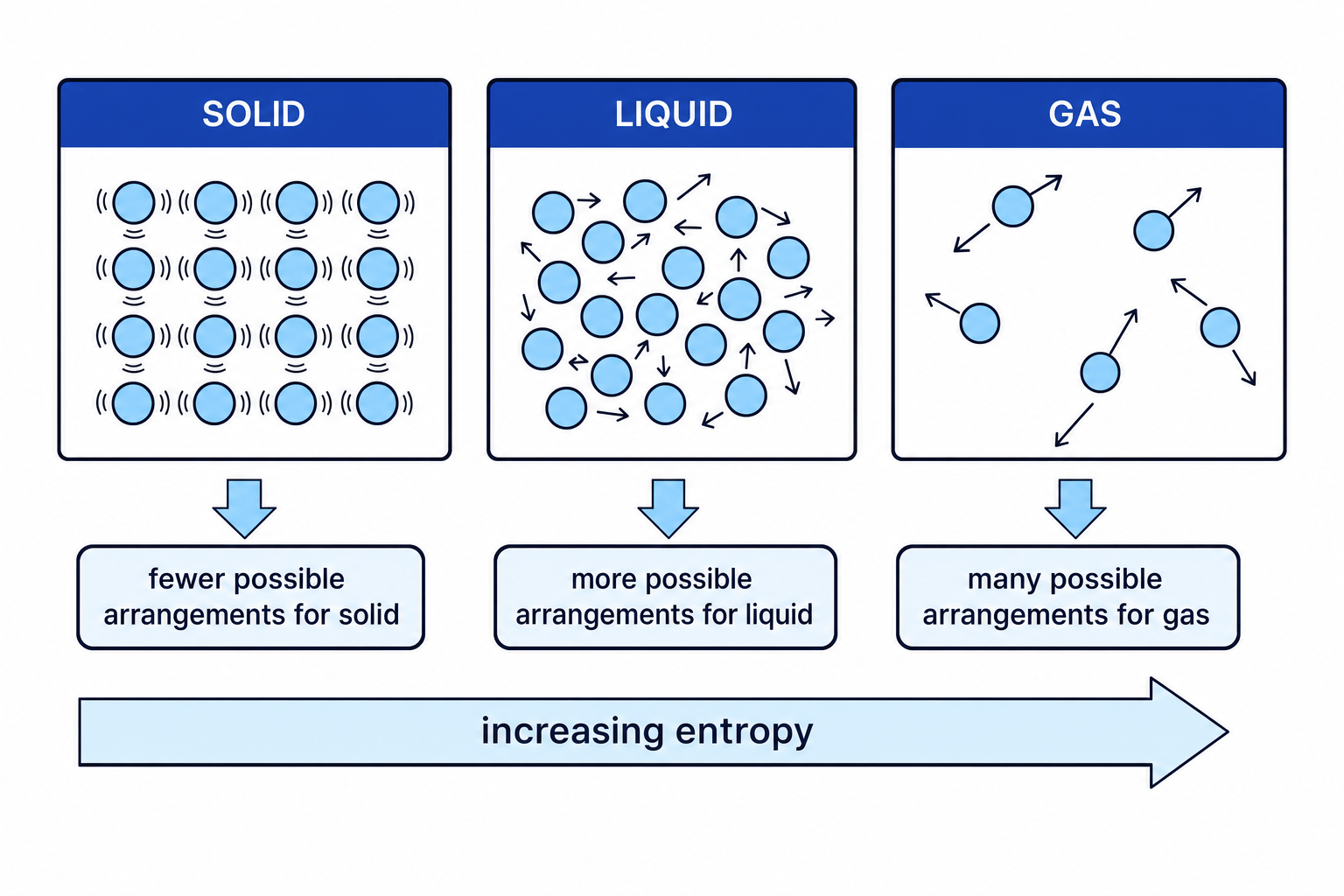
Entropy, symbol SSS, is a measure of how dispersed energy and particles are in a system. At A-Level, you can think of higher entropy as more possible arrangements of particles and energy.
A system is the chemical reaction or physical change you are focusing on. The surroundings are everything outside the system. Together, system plus surroundings make up the universe.
Entropy and physical state
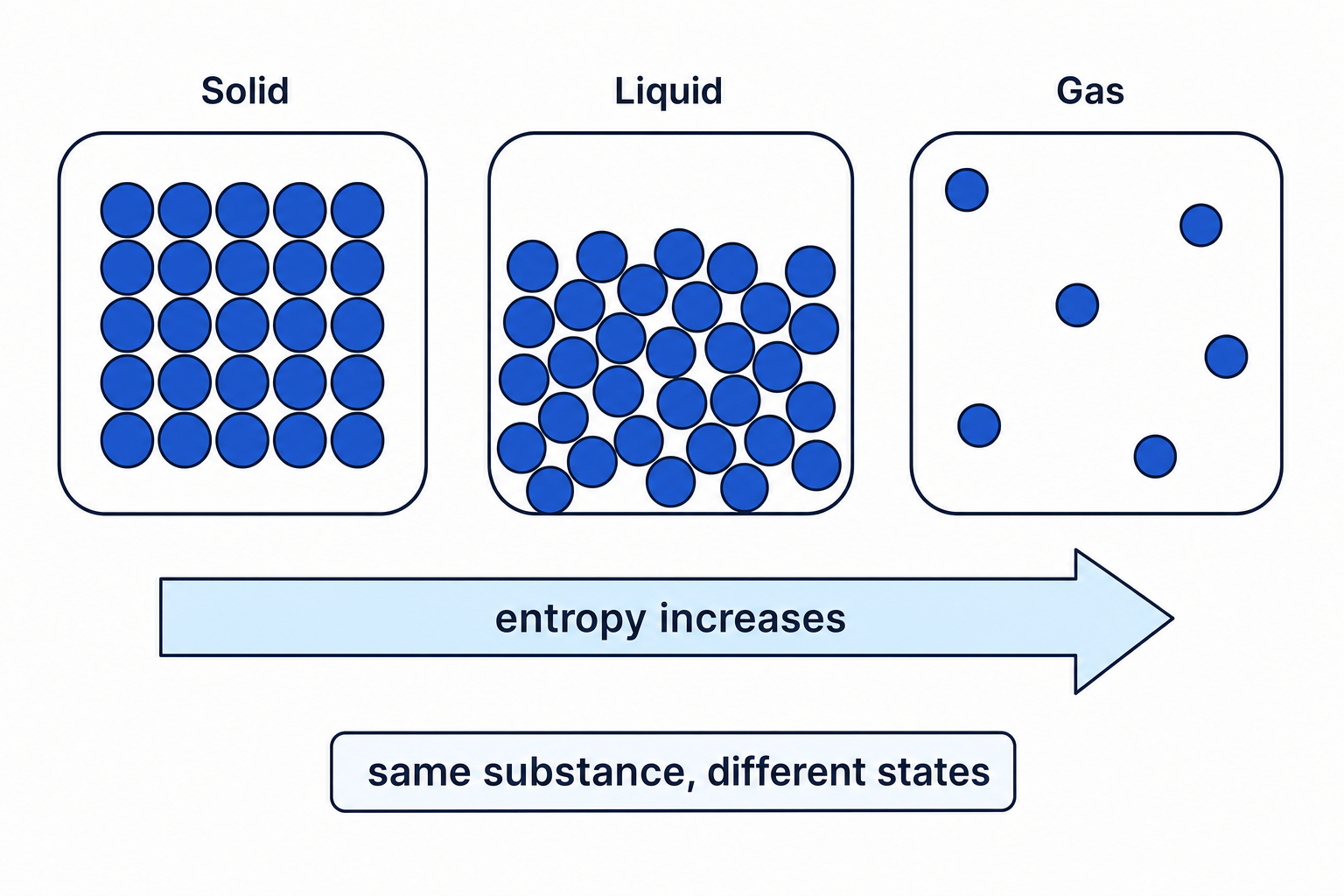
Particles in a solid are held in fixed positions, so there are relatively few ways to arrange them. In a liquid, particles can move around each other. In a gas, particles are far apart and move randomly, giving many more possible arrangements.
So, for the same substance:
solid has the lowest entropy, liquid is higher, and gas is highest.
State changes and entropy
Processes that form gases, increase the number of gas particles, dissolve solids, or mix substances usually increase entropy.
Predicting the sign of an entropy change
An entropy change, ΔS\Delta SΔS, compares entropy after a change with entropy before it:
ΔS=Sfinal−Sinitial\Delta S = S_{\text{final}} - S_{\text{initial}}ΔS=Sfinal−SinitialIf ΔS\Delta SΔS is positive, entropy has increased. If ΔS\Delta SΔS is negative, entropy has decreased.
Predicting entropy change from state symbols
For the thermal decomposition of calcium carbonate:
CaCO3(s)→CaO(s)+CO2(g)\text{CaCO}_3(s) \to \text{CaO}(s) + \text{CO}_2(g)CaCO3(s)→CaO(s)+CO2(g)-
Compare the states of the reactants and products. The reactant is one solid; the products include a solid and a gas.
-
Focus especially on gas particles, because gases usually dominate entropy changes. The reaction produces carbon dioxide gas from a solid.
-
Conclude that the entropy of the system increases, so ΔSsystem\Delta S_{\text{system}}ΔSsystem is positive.
Only counting total moles
Do not just count total moles and stop. The number of gas particles usually matters much more than the number of solid or liquid particles.
Standard molar entropy
Unlike enthalpy, entropy values can be measured on an absolute scale. This is because a perfect crystal at 0 K is taken to have zero entropy.
Standard molar entropy
The standard molar entropy, S∘S^\circS∘, is the entropy of one mole of a substance in its standard state, usually at 298 K and 100 kPa. Its units are J K⁻¹ mol⁻¹.
Standard molar entropy values depend on the state symbol. For example, steam has a much higher entropy than liquid water because gas particles have many more possible arrangements.
Calculating the entropy change of a system
For a reaction, the standard entropy change of the system is calculated using:
ΔSsystem∘=∑Sproducts∘−∑Sreactants∘\Delta S^\circ_{\text{system}} = \sum S^\circ_{\text{products}} - \sum S^\circ_{\text{reactants}}ΔSsystem∘=∑Sproducts∘−∑Sreactants∘Remember to multiply each entropy value by the balancing number in the equation.
Calculating standard entropy change
Calculate ΔSsystem∘\Delta S^\circ_{\text{system}}ΔSsystem∘ for the combustion of methane:
CH4(g)+2O2(g)→CO2(g)+2H2O(l)\text{CH}_4(g) + 2\text{O}_2(g) \to \text{CO}_2(g) + 2\text{H}_2\text{O}(l)CH4(g)+2O2(g)→CO2(g)+2H2O(l)Data:
- S∘S^\circS∘ of CH₄(g) = 186.3 J K⁻¹ mol⁻¹
- S∘S^\circS∘ of O₂(g) = 205.0 J K⁻¹ mol⁻¹
- S∘S^\circS∘ of CO₂(g) = 213.7 J K⁻¹ mol⁻¹
- S∘S^\circS∘ of H₂O(l) = 69.9 J K⁻¹ mol⁻¹
-
Add the entropy values for the products, using the equation coefficients:
213.7+2(69.9)=353.5 J K−1 mol−1213.7 + 2(69.9) = 353.5\ \text{J K}^{-1}\text{ mol}^{-1}213.7+2(69.9)=353.5 J K−1 mol−1 -
Add the entropy values for the reactants, again using the coefficients:
186.3+2(205.0)=596.3 J K−1 mol−1186.3 + 2(205.0) = 596.3\ \text{J K}^{-1}\text{ mol}^{-1}186.3+2(205.0)=596.3 J K−1 mol−1 -
Subtract reactants from products:
ΔSsystem∘=353.5−596.3=−242.8 J K−1 mol−1\Delta S^\circ_{\text{system}} = 353.5 - 596.3 = -242.8\ \text{J K}^{-1}\text{ mol}^{-1}ΔSsystem∘=353.5−596.3=−242.8 J K−1 mol−1
So the system entropy decreases. This makes sense because three moles of gaseous reactants form only one mole of gas plus liquid water.
A quick sense check
If your calculated ΔSsystem∘\Delta S^\circ_{\text{system}}ΔSsystem∘ says entropy decreases, check whether gas moles decrease or a gas forms a liquid or solid. That often explains the sign.
Entropy of the surroundings
A reaction can decrease the entropy of the system but still be feasible because the surroundings gain entropy.
For the surroundings:
ΔSsurroundings=−ΔHT\Delta S_{\text{surroundings}} = \frac{-\Delta H}{T}ΔSsurroundings=T−ΔHHere, ΔH\Delta HΔH must be in J mol⁻¹ if entropy is in J K⁻¹ mol⁻¹, and TTT must be in K.
For an exothermic reaction, ΔH\Delta HΔH is negative. Therefore −ΔH-\Delta H−ΔH is positive, so the surroundings gain entropy.
For an endothermic reaction, ΔH\Delta HΔH is positive. Therefore −ΔH-\Delta H−ΔH is negative, so the surroundings lose entropy.
Calculating entropy change of the surroundings
For methane combustion at 298 K:
ΔH∘=−890 kJ mol−1\Delta H^\circ = -890\ \text{kJ mol}^{-1}ΔH∘=−890 kJ mol−1Use the value from the previous example:
ΔSsystem∘=−242.8 J K−1 mol−1\Delta S^\circ_{\text{system}} = -242.8\ \text{J K}^{-1}\text{ mol}^{-1}ΔSsystem∘=−242.8 J K−1 mol−1-
Convert ΔH∘\Delta H^\circΔH∘ into J mol⁻¹:
−890 kJ mol−1=−890000 J mol−1-890\ \text{kJ mol}^{-1} = -890000\ \text{J mol}^{-1}−890 kJ mol−1=−890000 J mol−1 -
Substitute into the surroundings equation:
ΔSsurroundings=−(−890000)298\Delta S_{\text{surroundings}} = \frac{-(-890000)}{298}ΔSsurroundings=298−(−890000) -
Calculate:
ΔSsurroundings=+2987 J K−1 mol−1\Delta S_{\text{surroundings}} = +2987\ \text{J K}^{-1}\text{ mol}^{-1}ΔSsurroundings=+2987 J K−1 mol−1
The surroundings gain a large amount of entropy because heat is released into them.
Mixing kJ and J
Entropy is usually in J K⁻¹ mol⁻¹, while enthalpy is often in kJ mol⁻¹. Convert carefully before using ΔSsurroundings=−ΔH/T\Delta S_{\text{surroundings}} = -\Delta H/TΔSsurroundings=−ΔH/T.
Total entropy change and feasibility
The total entropy change combines the system and surroundings:
ΔStotal=ΔSsystem+ΔSsurroundings\Delta S_{\text{total}} = \Delta S_{\text{system}} + \Delta S_{\text{surroundings}}ΔStotal=ΔSsystem+ΔSsurroundingsA reaction is thermodynamically feasible if the total entropy change is positive.
Feasible reaction
A feasible reaction is thermodynamically possible under the stated conditions. It does not necessarily happen quickly.
Judging feasibility using total entropy
Using methane combustion at 298 K:
- ΔSsystem∘=−242.8\Delta S^\circ_{\text{system}} = -242.8ΔSsystem∘=−242.8 J K⁻¹ mol⁻¹
- ΔSsurroundings=+2987\Delta S_{\text{surroundings}} = +2987ΔSsurroundings=+2987 J K⁻¹ mol⁻¹
-
Add the system and surroundings entropy changes:
ΔStotal=−242.8+2987\Delta S_{\text{total}} = -242.8 + 2987ΔStotal=−242.8+2987 -
Calculate the total entropy change:
ΔStotal=+2744 J K−1 mol−1\Delta S_{\text{total}} = +2744\ \text{J K}^{-1}\text{ mol}^{-1}ΔStotal=+2744 J K−1 mol−1 -
Compare with zero. Since ΔStotal\Delta S_{\text{total}}ΔStotal is positive, methane combustion is thermodynamically feasible at 298 K.
Feasible does not mean fast
A reaction can be thermodynamically feasible but have a very high activation energy, so it may be extremely slow without a catalyst or spark. Entropy tells you about thermodynamics, not rate.
Gibbs energy: a convenient shortcut
Instead of calculating the entropy change of the surroundings separately, chemists often use Gibbs energy change, ΔG\Delta GΔG:
ΔG=ΔH−TΔSsystem\Delta G = \Delta H - T\Delta S_{\text{system}}ΔG=ΔH−TΔSsystemUse consistent units: if ΔH\Delta HΔH is in kJ mol⁻¹, then ΔSsystem\Delta S_{\text{system}}ΔSsystem must be converted into kJ K⁻¹ mol⁻¹.
The rule is:
- If ΔG<0\Delta G < 0ΔG<0, the reaction is feasible.
- If ΔG=0\Delta G = 0ΔG=0, the system is at equilibrium.
- If ΔG>0\Delta G > 0ΔG>0, the reaction is not feasible under those conditions.
Finding the temperature for feasibility
Calcium carbonate decomposes as follows:
CaCO3(s)→CaO(s)+CO2(g)\text{CaCO}_3(s) \to \text{CaO}(s) + \text{CO}_2(g)CaCO3(s)→CaO(s)+CO2(g)Suppose:
- ΔH∘=+178 kJ mol−1\Delta H^\circ = +178\ \text{kJ mol}^{-1}ΔH∘=+178 kJ mol−1
- ΔSsystem∘=+161 J K−1 mol−1\Delta S^\circ_{\text{system}} = +161\ \text{J K}^{-1}\text{ mol}^{-1}ΔSsystem∘=+161 J K−1 mol−1
Find the temperature above which the reaction becomes feasible.
-
At the threshold of feasibility, ΔG=0\Delta G = 0ΔG=0:
0=ΔH−TΔS0 = \Delta H - T\Delta S0=ΔH−TΔS -
Rearrange for temperature:
T=ΔHΔST = \frac{\Delta H}{\Delta S}T=ΔSΔH -
Convert entropy into kJ K⁻¹ mol⁻¹:
161 J K−1 mol−1=0.161 kJ K−1 mol−1161\ \text{J K}^{-1}\text{ mol}^{-1} = 0.161\ \text{kJ K}^{-1}\text{ mol}^{-1}161 J K−1 mol−1=0.161 kJ K−1 mol−1 -
Substitute:
T=1780.161=1106 KT = \frac{178}{0.161} = 1106\ \text{K}T=0.161178=1106 K
So the decomposition becomes thermodynamically feasible above about 1110 K.
Temperature can change feasibility
If ΔH\Delta HΔH and ΔS\Delta SΔS have the same sign, temperature can determine whether a reaction is feasible because of the TΔST\Delta STΔS term in ΔG=ΔH−TΔS\Delta G = \Delta H - T\Delta SΔG=ΔH−TΔS.
Sign patterns for Gibbs energy
You can reason about feasibility without full calculation:
- If ΔH\Delta HΔH is negative and ΔS\Delta SΔS is positive, ΔG\Delta GΔG is always negative, so the reaction is feasible at all temperatures.
- If ΔH\Delta HΔH is positive and ΔS\Delta SΔS is negative, ΔG\Delta GΔG is always positive, so the reaction is not feasible at any temperature.
- If both are positive, high temperature favours feasibility.
- If both are negative, low temperature favours feasibility.
Be careful: this assumes ΔH\Delta HΔH and ΔS\Delta SΔS do not change significantly over the temperature range.
In the exam
- Always include state symbols when judging entropy qualitatively; gas particles are usually the key evidence.
- For calculations, write products minus reactants and multiply by equation coefficients.
- Check units before using Gibbs energy: convert J to kJ, or kJ to J, so ΔH\Delta HΔH and TΔST\Delta STΔS match.
Check yourself
- Why does forming a gas usually increase entropy?
- How would you calculate ΔSsystem∘\Delta S^\circ_{\text{system}}ΔSsystem∘ from standard molar entropy data?
- What is the difference between a reaction being feasible and a reaction being fast?