

What you'll learn
- How acid-base titrations use measured volumes to find unknown concentrations.
- How to carry out a titration accurately and calculate a reliable mean titre.
- How titration curves show equivalence points for strong and weak acids/bases.
- How to choose a suitable indicator from its pH transition range.
The big idea: reacting acid with base quantitatively
An acid-base titration is a practical method where you add one solution to another until neutralisation is just complete. Because you know the concentration and volume of one reactant, you can calculate the amount and concentration of the other.
Titration
A titration is a quantitative practical technique in which a solution of known concentration is added to a measured volume of another solution until the reaction is complete.
For acid-base titrations, the reaction is usually neutralisation, where hydrogen ions and hydroxide ions react:
H+(aq)+OH−(aq)→H2O(l)\text{H}^+(aq)+\text{OH}^-(aq)\to \text{H}_2\text{O}(l)H+(aq)+OH−(aq)→H2O(l)The key calculation relationship is:
n=cVn=cVn=cVwhere nnn is amount in mol, ccc is concentration in mol dm⁻³, and VVV is volume in dm³.
Volumes must be in dm³ for n = cV
If concentration is in mol dm⁻³, convert cm³ to dm³ by dividing by 1000 before using n=cVn=cVn=cV.
Key titration words
Titre, end point and equivalence point
The titre is the volume delivered from the burette. The end point is the observed colour change of the indicator. The equivalence point is the point where reactants have been mixed in the exact stoichiometric ratio from the balanced equation.
The end point and equivalence point are not always exactly the same, but a good indicator makes them very close.
Apparatus and practical method
A typical setup uses a burette for the solution being added, a volumetric pipette for measuring a fixed volume into the conical flask, and an indicator or pH meter to detect the end point.
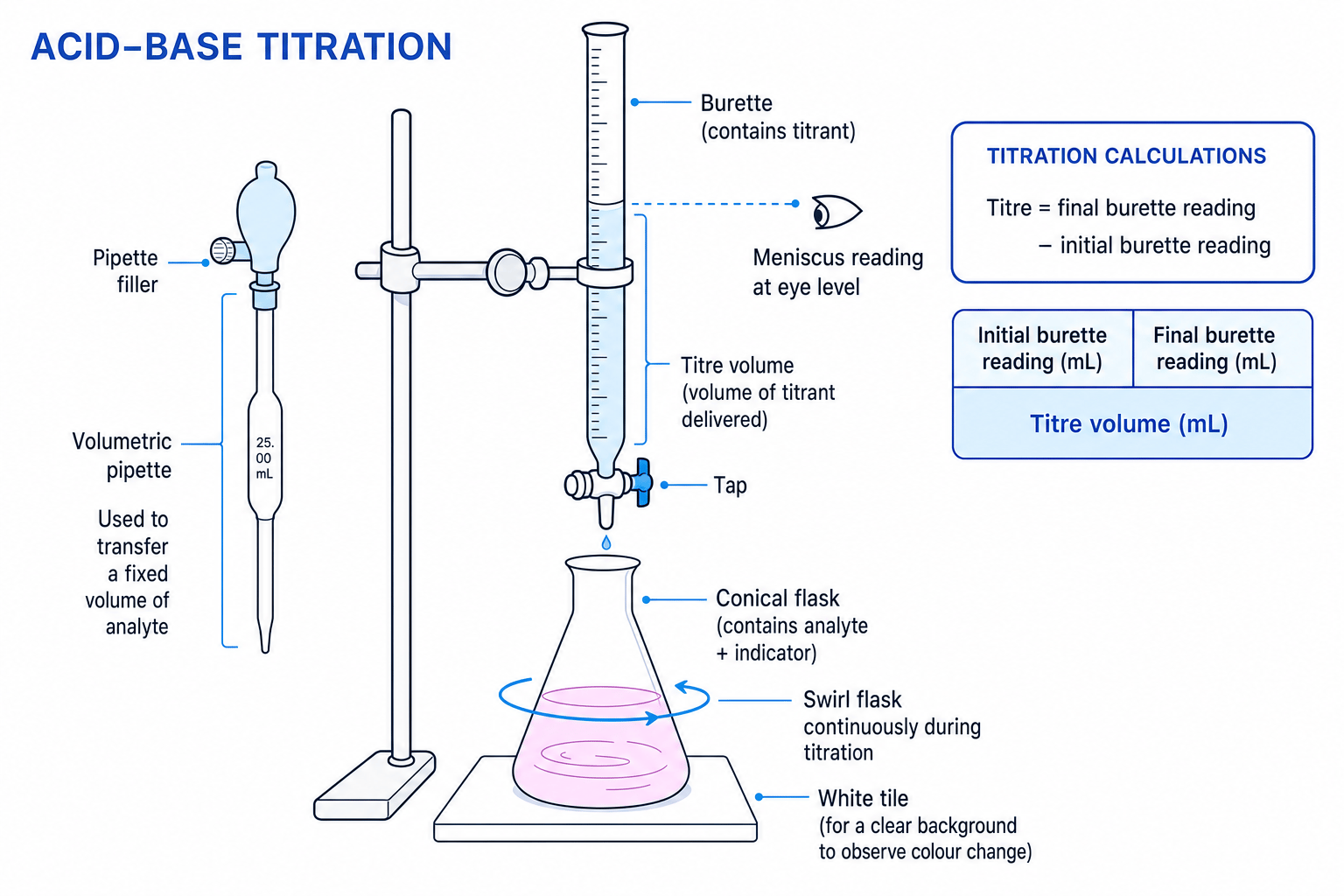
Good practical technique
- Rinse the burette with the solution it will contain.
- Rinse the pipette with the solution it will transfer.
- Rinse the conical flask only with deionised water, not with the solution in it.
- Use a pipette filler, never mouth pipette.
- Remove the funnel from the burette before taking readings.
- Read the bottom of the meniscus at eye level.
- Do a rough titration first, then repeat accurately until you get concordant titres.
Concordant titres
Concordant titres are repeated titres that are close enough to be considered reliable, commonly within 0.10 cm³ of each other.
Including the rough titre in the mean
The rough titre helps you find the approximate end point, but you should not include it when calculating the mean titre unless told otherwise.
Titration calculations
The calculation always follows the same logic:
- Use the known concentration and titre to find moles of known solution.
- Use the balanced equation to find moles of the unknown.
- Divide by the pipetted volume of unknown solution in dm³.
Finding the concentration of sodium hydroxide
25.00 cm³ of sodium hydroxide solution is pipetted into a conical flask. It requires 23.60 cm³ of 0.100 mol dm⁻³ sulfuric acid for neutralisation. Calculate the concentration of the sodium hydroxide solution.
Reaction:
H2SO4(aq)+2NaOH(aq)→Na2SO4(aq)+2H2O(l)\text{H}_2\text{SO}_4(aq)+2\text{NaOH}(aq)\to \text{Na}_2\text{SO}_4(aq)+2\text{H}_2\text{O}(l)H2SO4(aq)+2NaOH(aq)→Na2SO4(aq)+2H2O(l)-
Convert the acid titre into dm³ and calculate moles of sulfuric acid:
n=cV=0.100×0.02360=0.002360 moln=cV=0.100\times 0.02360=0.002360\ \text{mol}n=cV=0.100×0.02360=0.002360 mol -
Use the equation ratio. One mole of sulfuric acid reacts with two moles of sodium hydroxide:
n(NaOH)=2×0.002360=0.004720 moln(\text{NaOH})=2\times 0.002360=0.004720\ \text{mol}n(NaOH)=2×0.002360=0.004720 mol -
Divide by the volume of sodium hydroxide in dm³:
c=nV=0.0047200.02500=0.1888 mol dm−3c=\frac{n}{V}=\frac{0.004720}{0.02500}=0.1888\ \text{mol dm}^{-3}c=Vn=0.025000.004720=0.1888 mol dm−3 -
Give the answer to a sensible number of significant figures:
c(NaOH)=0.189 mol dm−3c(\text{NaOH})=0.189\ \text{mol dm}^{-3}c(NaOH)=0.189 mol dm−3
Use the balanced equation, not acid/base intuition
Do not assume acid and base react in a 1:1 ratio. Sulfuric acid and sodium hydroxide react in a 1:2 ratio, while hydrochloric acid and sodium hydroxide react 1:1.
Strong and weak acids/bases in titrations
A strong acid fully dissociates in water, for example:
HCl(aq)→H+(aq)+Cl−(aq)\text{HCl}(aq)\to \text{H}^+(aq)+\text{Cl}^-(aq)HCl(aq)→H+(aq)+Cl−(aq)A weak acid only partially dissociates, for example ethanoic acid:
CH3COOH(aq)⇌H+(aq)+CH3COO−(aq)\text{CH}_3\text{COOH}(aq)\rightleftharpoons \text{H}^+(aq)+\text{CH}_3\text{COO}^-(aq)CH3COOH(aq)⇌H+(aq)+CH3COO−(aq)This affects the pH before, during and after a titration.
Titration curve
A titration curve is a graph of pH against volume of acid or base added during a titration.
The curve shape depends on whether the acid and base are strong or weak.
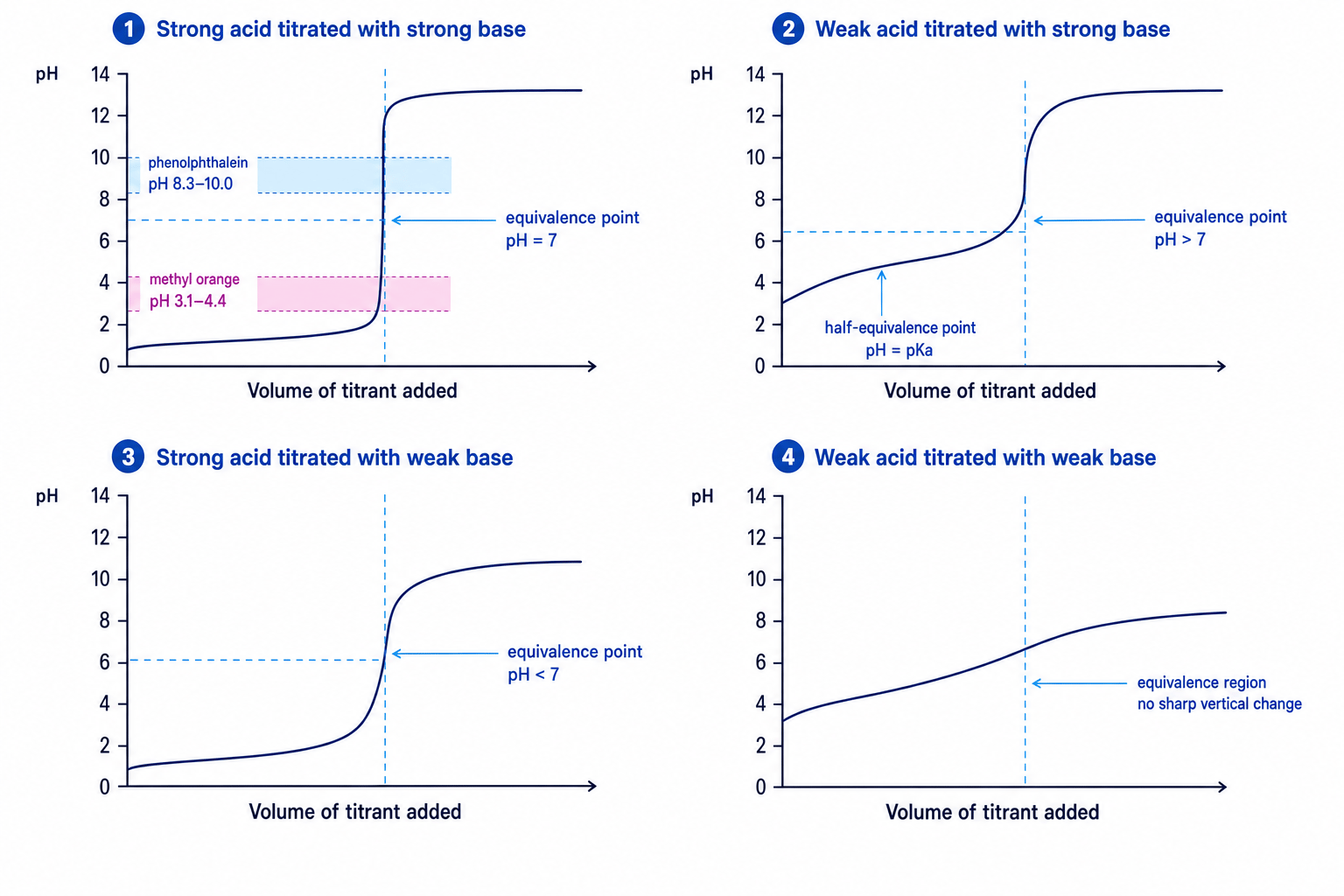
Reading titration curves
Strong acid with strong base
The pH starts very low, rises slowly, then changes very sharply near the equivalence point. At the equivalence point, the pH is 7 at 298 K because the salt formed is neutral.
Weak acid with strong base
The initial pH is higher than for a strong acid of the same concentration. Before equivalence, a buffer region forms because both the weak acid and its conjugate base are present.
At the equivalence point, the pH is above 7 because the conjugate base reacts with water to produce hydroxide ions.
Strong acid with weak base
The equivalence point is below 7 because the conjugate acid of the weak base makes the solution acidic.
Weak acid with weak base
There is no sharp vertical section, so it is difficult to detect the equivalence point accurately using an indicator. A pH meter is usually more suitable.
Equivalence pH depends on strength
Strong acid + strong base gives equivalence at pH 7. Weak acid + strong base gives pH above 7. Strong acid + weak base gives pH below 7.
Half-equivalence and pKa
For a weak acid titrated with a strong base, the half-equivalence point is where half of the weak acid has been neutralised.
At this point, the concentration of the weak acid equals the concentration of its conjugate base:
[HA]=[A−][\text{HA}]=[\text{A}^-][HA]=[A−]Using:
Ka=[H+][A−][HA]K_a=\frac{[\text{H}^+][\text{A}^-]}{[\text{HA}]}Ka=[HA][H+][A−]if [HA]=[A−][\text{HA}]=[\text{A}^-][HA]=[A−], then Ka=[H+]K_a=[\text{H}^+]Ka=[H+], so:
pH=pKa\text{pH}=\text{p}K_apH=pKaFinding Ka from a titration curve
A weak acid is titrated with sodium hydroxide. The equivalence point occurs after 24.80 cm³ of sodium hydroxide has been added. At 12.40 cm³ added, the pH is 4.76. Find KaK_aKa.
-
Identify that 12.40 cm³ is half of 24.80 cm³, so this is the half-equivalence point.
-
At half-equivalence, use the relationship:
pH=pKa\text{pH}=\text{p}K_apH=pKaso pKa=4.76\text{p}K_a=4.76pKa=4.76.
-
Convert from pKa\text{p}K_apKa to KaK_aKa:
Ka=10−4.76=1.7×10⁻⁵ mol dm−3K_a=10^{-4.76}=1.7\times 10^{-5}\ \text{mol dm}^{-3}Ka=10−4.76=1.7×10⁻⁵ mol dm−3
Choosing an indicator
An indicator is a dye that changes colour over a particular pH range. The indicator is suitable if its colour change occurs within the steep vertical part of the titration curve.
Indicator transition range
An indicator’s transition range is the pH range over which it changes colour.
Common examples:
- Methyl orange changes over about pH 3.1–4.4.
- Phenolphthalein changes over about pH 8.3–10.0.
For strong acid–strong base titrations, the vertical jump is large, so several indicators may work. For weak acid–strong base titrations, phenolphthalein is usually suitable. For strong acid–weak base titrations, methyl orange is usually suitable. For weak acid–weak base titrations, indicators are generally unsuitable.
Choosing a suitable indicator
A weak acid is titrated with a strong base. The titration curve has a steep vertical section from pH 7.8 to pH 10.7. Choose between methyl orange and phenolphthalein.
-
Compare methyl orange with the steep region. Its range, pH 3.1–4.4, is below the vertical section, so it would change colour too early.
-
Compare phenolphthalein with the steep region. Its range, pH 8.3–10.0, lies within the vertical section.
-
Choose phenolphthalein because its end point will be close to the equivalence point.
Indicator choice is curve-dependent
Do not choose an indicator just because you recognise its name. Always compare its transition range with the steep part of the pH curve.
Measuring a pH curve practically
To produce a titration curve, you replace the indicator with a calibrated pH meter. Add the titrant in measured portions and record the pH after each addition. Near the equivalence point, use smaller volume increments because the pH changes very rapidly.
Good practice includes rinsing the pH probe with deionised water between solutions, gently swirling after each addition, and waiting for the pH reading to stabilise.
Missing the vertical jump
If you add large volumes near the end point, you may skip over the steep section and draw a poor curve. Use smaller additions close to equivalence.
In the exam
- Start titration calculations with the balanced equation and write the mole ratio clearly.
- Convert all volumes used in n=cVn=cVn=cV into dm³, even if the question gives them in cm³.
- For indicator questions, compare the indicator’s pH range with the steep vertical part of the titration curve.
Check yourself
- Why is the equivalence point for a weak acid–strong base titration above pH 7?
- What is the difference between an end point and an equivalence point?
- How would you decide whether methyl orange or phenolphthalein is more suitable for a titration?
