What you'll learn
- What dynamic equilibrium means in a closed system.
- How to use Le Chatelier’s principle to predict shifts in equilibrium position.
- How to write and calculate KcK_cKc expressions, including units.
- Which changes affect the equilibrium constant and which only affect the position of equilibrium.
1. Reversible reactions and closed systems
Some reactions are reversible: the products can react to reform the reactants. We show this using the equilibrium arrow ⇌ rather than a one-way arrow.
For example:
N2O4(g)⇌2NO2(g)\text{N}_2\text{O}_4(g) \rightleftharpoons 2\text{NO}_2(g)N2O4(g)⇌2NO2(g)A closed system is one where matter cannot enter or leave, although energy may still be transferred. Equilibrium can only be properly established in a closed system, because reactants and products must remain available to react both ways.
Reversible reaction
A reversible reaction is a reaction in which the forward reaction and the reverse reaction can both occur under the same conditions.
2. Dynamic equilibrium
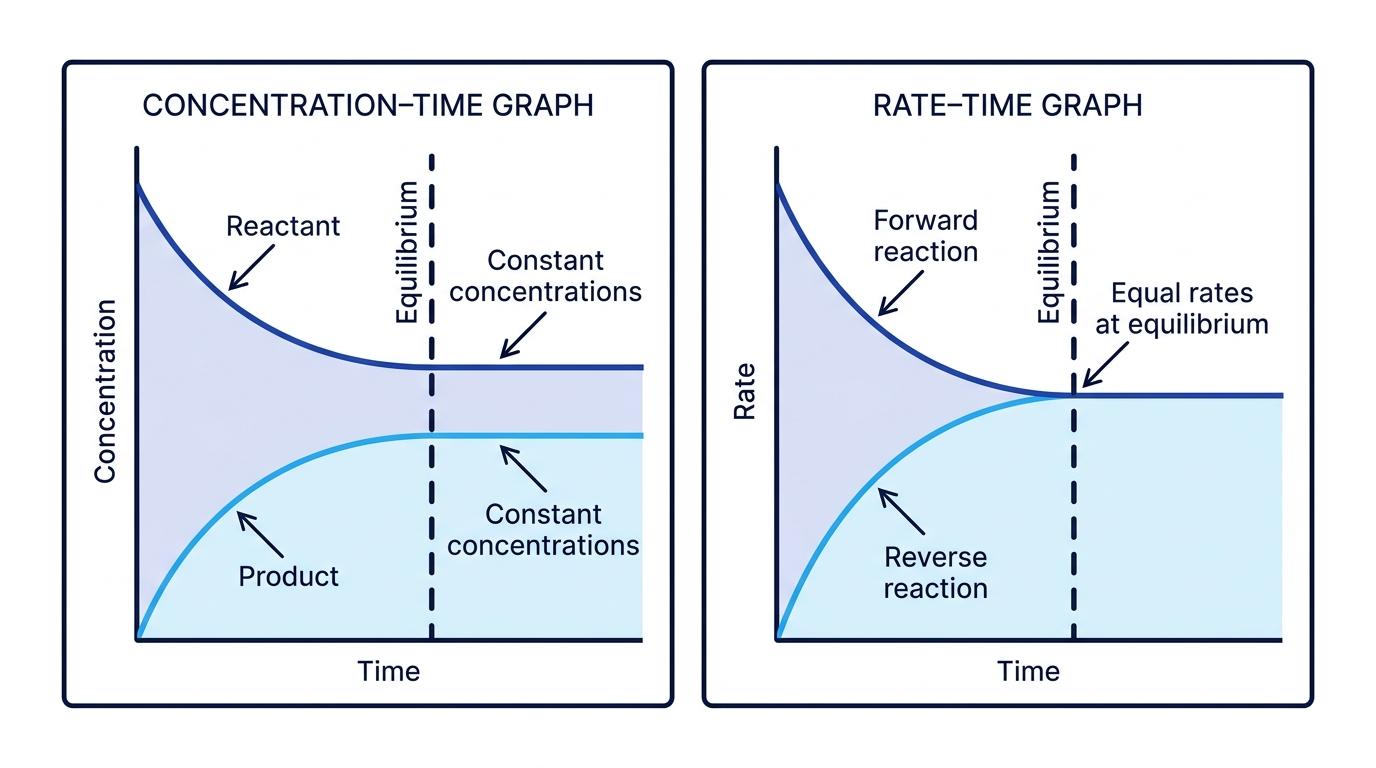
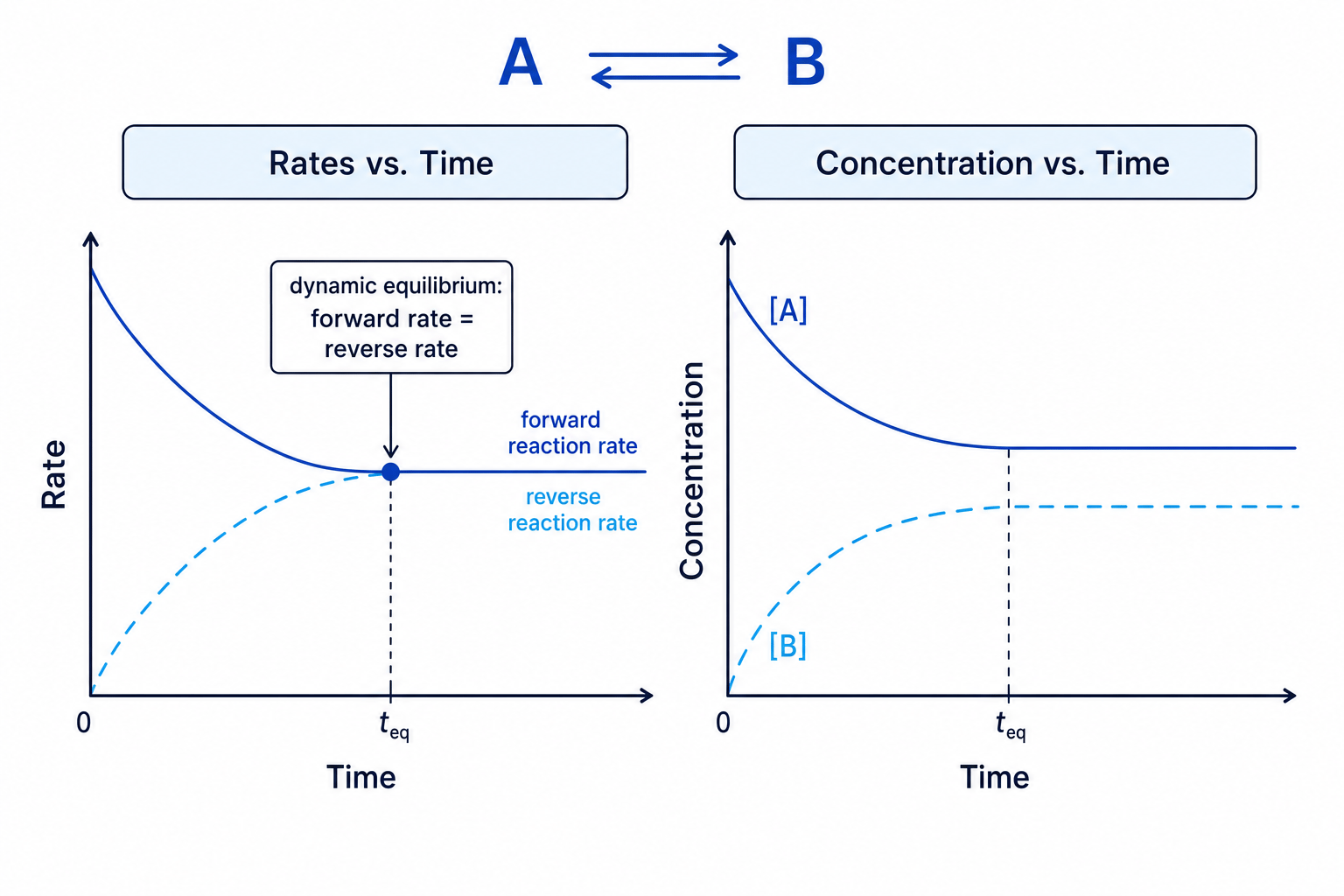
At first, if you start with only reactants, the forward reaction is fast because reactant concentration is high. As products form, the reverse reaction begins and speeds up.
Eventually, the forward and reverse reactions occur at the same rate. The concentrations of reactants and products then stay constant, even though particles are still reacting.
Dynamic equilibrium
A dynamic equilibrium is reached in a closed system when the rate of the forward reaction equals the rate of the reverse reaction, so the concentrations of reactants and products remain constant.
Equilibrium has not stopped
At equilibrium, the reaction is still happening in both directions. “Constant concentration” does not mean “no reaction”; it means both directions are balanced.
Interpreting equilibrium from rates
A reversible reaction is carried out in a closed container. At one moment, the forward rate is 0.18 mol dm⁻³ s⁻¹ and the reverse rate is 0.12 mol dm⁻³ s⁻¹. Later, both rates are 0.15 mol dm⁻³ s⁻¹.
- Compare the two rates at the first moment: the forward rate is greater than the reverse rate, so more product is being made than used up.
- Predict the concentration change: reactant concentration decreases and product concentration increases overall.
- Compare the later rates: the rates are equal, so the system has reached dynamic equilibrium.
- State the concentration behaviour at equilibrium: reactant and product concentrations are constant, but not necessarily equal.
3. Le Chatelier’s principle
Le Chatelier’s principle helps you predict what happens when an equilibrium mixture is disturbed.
Le Chatelier’s principle
If the conditions of a system at equilibrium are changed, the position of equilibrium shifts in the direction that opposes the change.
The position of equilibrium describes the relative amounts of reactants and products at equilibrium. If the position shifts to the right, more products form. If it shifts to the left, more reactants form.
Changing concentration
If you increase the concentration of a reactant, the system shifts to use up some of that added reactant, so it shifts towards products.
For example, adding more N₂O₄ to this equilibrium shifts it to the right, forming more NO₂:
N2O4(g)⇌2NO2(g)\text{N}_2\text{O}_4(g) \rightleftharpoons 2\text{NO}_2(g)N2O4(g)⇌2NO2(g)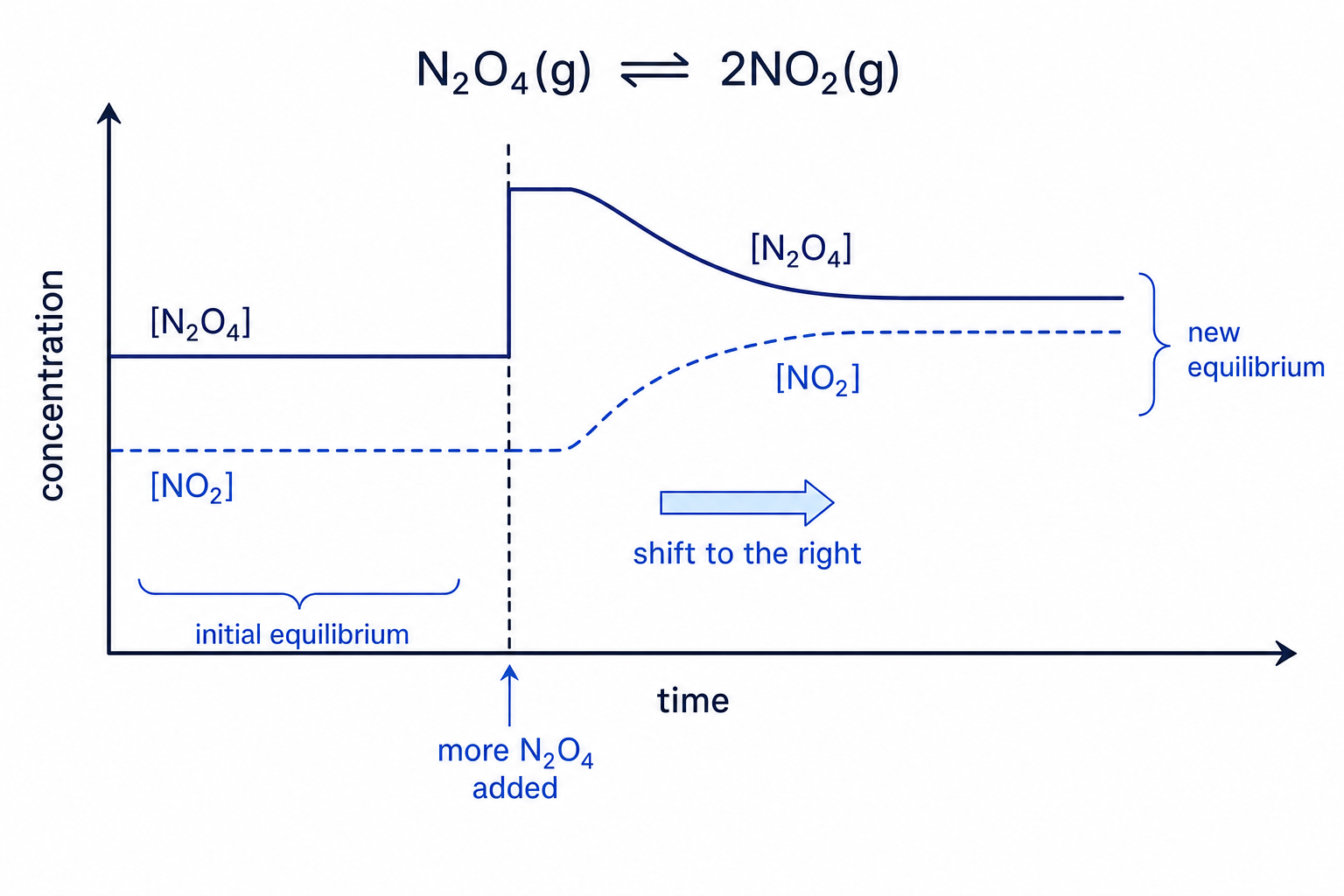
Changing pressure
Pressure changes matter mainly for gaseous equilibria.
- Increasing pressure shifts equilibrium towards the side with fewer moles of gas.
- Decreasing pressure shifts equilibrium towards the side with more moles of gas.
- If both sides have the same total moles of gas, pressure has no effect on equilibrium position.
Changing temperature
Temperature is different because it changes the value of the equilibrium constant.
For an exothermic forward reaction, heat is effectively a product. Increasing temperature favours the reverse, endothermic direction.
For an endothermic forward reaction, heat is effectively a reactant. Increasing temperature favours the forward direction.
Adding a catalyst
A catalyst increases the rate of reaction without being used up. In equilibrium, it speeds up the forward and reverse reactions by the same factor, so equilibrium is reached faster but the equilibrium position is unchanged.
Catalysts do not increase equilibrium yield
A catalyst can increase the rate at which equilibrium is reached, but it does not change the final equilibrium composition or the value of KcK_cKc.
Predicting shifts in the Haber equilibrium
For the Haber process:
N2(g)+3H2(g)⇌2NH3(g)ΔH=−92 kJ mol−1\text{N}_2(g) + 3\text{H}_2(g) \rightleftharpoons 2\text{NH}_3(g) \qquad \Delta H = -92\ \text{kJ mol}^{-1}N2(g)+3H2(g)⇌2NH3(g)ΔH=−92 kJ mol−1- Count gaseous moles for pressure: the left side has 4 mol of gas and the right side has 2 mol of gas.
- Apply a pressure increase: equilibrium shifts to the side with fewer gas moles, so it shifts right and the equilibrium yield of ammonia increases.
- Use the enthalpy change for temperature: the forward reaction is exothermic, so increasing temperature favours the reverse endothermic direction.
- Predict the temperature effect: higher temperature decreases the equilibrium yield of ammonia.
- Add a catalyst: both forward and reverse rates increase, so equilibrium is reached faster but the ammonia yield is unchanged.
4. The equilibrium constant, KcK_cKc
The equilibrium constant gives a quantitative way to describe the position of equilibrium at a fixed temperature.
For a homogeneous equilibrium:
a A+b B⇌c C+d Da\,\text{A} + b\,\text{B} \rightleftharpoons c\,\text{C} + d\,\text{D}aA+bB⇌cC+dDthe concentration equilibrium constant is:
Kc=[C]c[D]d[A]a[B]bK_c = \frac{[\text{C}]^c[\text{D}]^d}{[\text{A}]^a[\text{B}]^b}Kc=[A]a[B]b[C]c[D]dSquare brackets mean equilibrium concentration, usually in mol dm⁻³. The powers come from the balanced equation.
Homogeneous equilibrium
A homogeneous equilibrium is an equilibrium in which all species are in the same physical state, such as all gases or all aqueous solutions.
What Kc tells you
A large KcK_cKc means products are favoured at equilibrium. A small KcK_cKc means reactants are favoured. The value of KcK_cKc is constant at a fixed temperature.
Using initial concentrations
The expression for KcK_cKc must use equilibrium concentrations, not starting concentrations, unless the question explicitly says the starting mixture is already at equilibrium.
Writing a Kc expression and units
For the equilibrium:
2SO2(g)+O2(g)⇌2SO3(g)2\text{SO}_2(g) + \text{O}_2(g) \rightleftharpoons 2\text{SO}_3(g)2SO2(g)+O2(g)⇌2SO3(g)- Put products over reactants:
- Work out the concentration powers: the numerator has two concentration factors, while the denominator has three.
- Substitute units as powers of mol dm⁻³:
- Simplify the units:
5. Calculating KcK_cKc
Most calculation questions follow this route:
- Use the balanced equation to find equilibrium amounts.
- Convert amounts into concentrations using c=nVc = \frac{n}{V}c=Vn.
- Substitute equilibrium concentrations into the KcK_cKc expression.
- Work out the units from the expression.
Use a mole-change structure
If a question gives starting amounts and one equilibrium amount, track the change using the mole ratio from the balanced equation before calculating concentrations.
Calculating Kc from equilibrium moles
Phosphorus pentachloride decomposes:
PCl5(g)⇌PCl3(g)+Cl2(g)\text{PCl}_5(g) \rightleftharpoons \text{PCl}_3(g) + \text{Cl}_2(g)PCl5(g)⇌PCl3(g)+Cl2(g)0.0800 mol of PCl₅ is placed in a 2.00 dm³ container. At equilibrium, 0.0300 mol of Cl₂ is present. Calculate KcK_cKc and its units.
- Use the mole ratio: 1 mol of PCl₅ forms 1 mol of PCl₃ and 1 mol of Cl₂, so forming 0.0300 mol of Cl₂ means 0.0300 mol of PCl₅ decomposed.
- Find equilibrium amounts: PCl₅ remaining is 0.0800 − 0.0300 = 0.0500 mol; PCl₃ formed is 0.0300 mol; Cl₂ formed is 0.0300 mol.
- Convert to concentrations using c=nVc = \frac{n}{V}c=Vn:
- Write the expression:
- Substitute the equilibrium concentrations:
- Work out units: two concentration factors divided by one concentration factor leaves mol dm⁻³, so
6. What changes KcK_cKc?
This is a favourite exam point: changing concentration, pressure or adding a catalyst does not change KcK_cKc, provided temperature is constant.
Only temperature changes KcK_cKc.
- For an exothermic forward reaction, increasing temperature decreases KcK_cKc.
- For an endothermic forward reaction, increasing temperature increases KcK_cKc.
Predicting the effect of temperature on Kc
For:
N2O4(g)⇌2NO2(g)ΔH=+57 kJ mol−1\text{N}_2\text{O}_4(g) \rightleftharpoons 2\text{NO}_2(g) \qquad \Delta H = +57\ \text{kJ mol}^{-1}N2O4(g)⇌2NO2(g)ΔH=+57 kJ mol−1- Identify the forward reaction as endothermic because ΔH\Delta HΔH is positive.
- Increase temperature: the system favours the endothermic direction, so equilibrium shifts to the right.
- Link the shift to the expression:
- A shift right increases the product concentration relative to the reactant concentration, so KcK_cKc increases.
In the exam
- Always decide whether the question asks about equilibrium position or the value of KcK_cKc; they are related but not the same.
- For pressure questions, count only gaseous moles on each side of the balanced equation.
- For KcK_cKc calculations, use equilibrium concentrations in mol dm⁻³ and derive the units from the expression.
Check yourself
- Why can a reaction at equilibrium still be described as dynamic?
- For an exothermic forward reaction, what happens to KcK_cKc when temperature is increased?
- Why does increasing pressure have no effect if both sides of a gaseous equilibrium have the same number of gas moles?