

What you'll learn
- What a buffer solution is, and why it resists pH change.
- How weak acid/conjugate base pairs such as ethanoic acid/ethanoate work.
- How to calculate buffer pH using KaK_aKa and mole ratios.
- How buffers appear in weak acid–strong base titration curves.
Prerequisites: pH and weak acid equilibria
Before buffers, you need the idea of a weak acid. A weak acid only partially dissociates in water, so an equilibrium is set up:
HA(aq)⇌H+(aq)+A−(aq)\mathrm{HA(aq)} \rightleftharpoons \mathrm{H}^{+}\mathrm{(aq)} + \mathrm{A}^{-}\mathrm{(aq)}HA(aq)⇌H+(aq)+A−(aq)For this equilibrium:
Ka=[H+][A−][HA]K_a = \frac{[\mathrm{H}^{+}][\mathrm{A}^{-}]}{[\mathrm{HA}]}Ka=[HA][H+][A−]The pH is linked to hydrogen ion concentration by:
pH=−log[H+]\mathrm{pH} = -\log[\mathrm{H}^{+}]pH=−log[H+]Conjugate acid-base pair
A conjugate acid-base pair differs by one proton, H+\mathrm{H}^{+}H+. In HA/A−\mathrm{HA}/\mathrm{A}^{-}HA/A−, HA\mathrm{HA}HA is the acid and A−\mathrm{A}^{-}A− is its conjugate base.
pKa
pKa=−logKa\mathrm{p}K_a = -\log K_apKa=−logKa. A lower pKa\mathrm{p}K_apKa means a stronger acid. Buffers work best when the desired pH is close to the acid’s pKa\mathrm{p}K_apKa.
What is a buffer?
A buffer solution resists changes in pH when small amounts of acid or alkali are added.
Buffer solution
A buffer solution contains a mixture that can remove added H+\mathrm{H}^{+}H+ and added OH−\mathrm{OH}^{-}OH−, so the hydrogen ion concentration changes only slightly.
The most common A-Level buffer is an acidic buffer, made from:
- a weak acid, HA\mathrm{HA}HA
- a salt containing its conjugate base, A−\mathrm{A}^{-}A−
For example, an ethanoic acid/ethanoate buffer contains:
- ethanoic acid, CH3COOH\mathrm{CH_3COOH}CH3COOH
- sodium ethanoate, CH3COONa\mathrm{CH_3COONa}CH3COONa, which supplies CH3COO−\mathrm{CH_3COO}^{-}CH3COO− ions
The sodium ions are spectator ions; they do not control the pH.
A weak acid alone is not a good buffer
A weak acid solution contains a little conjugate base, but not usually enough to resist added acid effectively. A proper acidic buffer needs significant amounts of both HA\mathrm{HA}HA and A−\mathrm{A}^{-}A−.
How an acidic buffer works
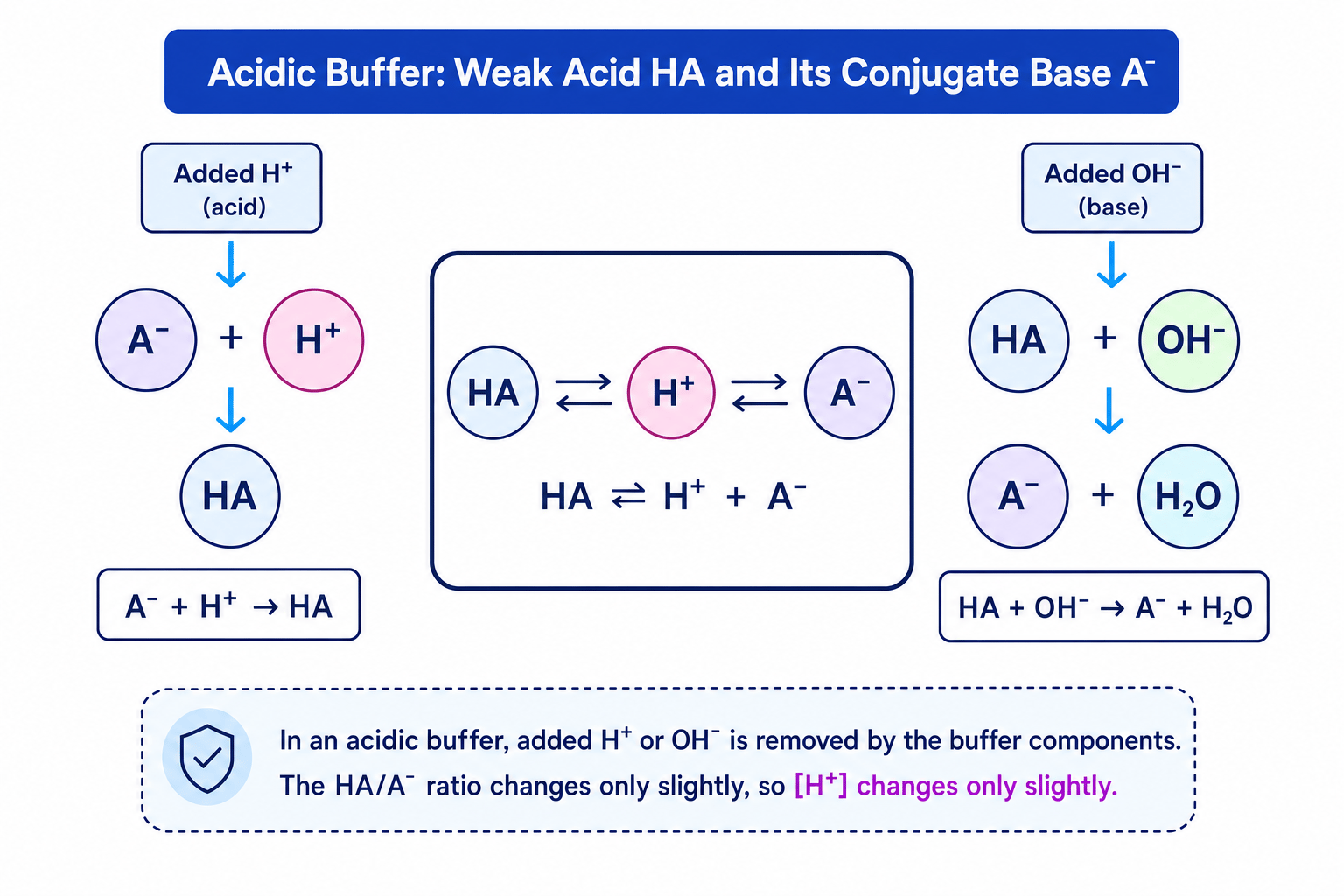
In an acidic buffer, the weak acid and conjugate base act as two “reservoirs”.
If acid is added, the conjugate base removes the added H+\mathrm{H}^{+}H+:
A−(aq)+H+(aq)→HA(aq)\mathrm{A}^{-}\mathrm{(aq)} + \mathrm{H}^{+}\mathrm{(aq)} \to \mathrm{HA(aq)}A−(aq)+H+(aq)→HA(aq)If alkali is added, the weak acid removes the added OH−\mathrm{OH}^{-}OH−:
HA(aq)+OH−(aq)→A−(aq)+H2O(l)\mathrm{HA(aq)} + \mathrm{OH}^{-}\mathrm{(aq)} \to \mathrm{A}^{-}\mathrm{(aq)} + \mathrm{H_2O(l)}HA(aq)+OH−(aq)→A−(aq)+H2O(l)The key point is that the ratio of HA\mathrm{HA}HA to A−\mathrm{A}^{-}A− changes only slightly, so [H+][\mathrm{H}^{+}][H+] and pH change only slightly.
The ratio controls the pH
For an acidic buffer, the pH mainly depends on the ratio of weak acid to conjugate base, not just the total amount present.
The buffer pH equation
Start with the weak acid equilibrium:
Ka=[H+][A−][HA]K_a = \frac{[\mathrm{H}^{+}][\mathrm{A}^{-}]}{[\mathrm{HA}]}Ka=[HA][H+][A−]Rearrange for hydrogen ion concentration:
[H+]=Ka[HA][A−][\mathrm{H}^{+}] = K_a \frac{[\mathrm{HA}]}{[\mathrm{A}^{-}]}[H+]=Ka[A−][HA]Then calculate pH using:
pH=−log[H+]\mathrm{pH} = -\log[\mathrm{H}^{+}]pH=−log[H+]You may also see the same idea written as:
pH=pKa+log([A−][HA])\mathrm{pH} = \mathrm{p}K_a + \log\left(\frac{[\mathrm{A}^{-}]}{[\mathrm{HA}]}\right)pH=pKa+log([HA][A−])This is the Henderson–Hasselbalch form. Edexcel questions often work perfectly using the KaK_aKa rearrangement.
Moles or concentrations?
If HA\mathrm{HA}HA and A−\mathrm{A}^{-}A− are in the same final solution, their final volume is the same, so [HA][A−]=n(HA)n(A−)\frac{[\mathrm{HA}]}{[\mathrm{A}^{-}]} = \frac{n(\mathrm{HA})}{n(\mathrm{A}^{-})}[A−][HA]=n(A−)n(HA). This is why buffer calculations often use moles directly.
Calculating the pH of an acidic buffer
A buffer contains 0.100 mol dm⁻³ ethanoic acid and 0.0800 mol dm⁻³ sodium ethanoate. For ethanoic acid, Ka=1.74×10⁻⁵ mol dm−3K_a = 1.74 \times 10^{-5}\ \mathrm{mol\,dm^{-3}}Ka=1.74×10⁻⁵ moldm−3. Calculate the pH.
-
Identify the weak acid and conjugate base: HA\mathrm{HA}HA is CH3COOH\mathrm{CH_3COOH}CH3COOH and A−\mathrm{A}^{-}A− is CH3COO−\mathrm{CH_3COO}^{-}CH3COO−.
-
Substitute into the buffer equation: [H+]=1.74×10−5×0.1000.0800=2.18×10⁻⁵ mol dm−3[\mathrm{H}^{+}] = 1.74 \times 10^{-5} \times \frac{0.100}{0.0800} = 2.18 \times 10^{-5}\ \mathrm{mol\,dm^{-3}}[H+]=1.74×10−5×0.08000.100=2.18×10⁻⁵ moldm−3.
-
Convert to pH: pH=−log(2.18×10⁻⁵)=4.66\mathrm{pH} = -\log(2.18 \times 10^{-5}) = 4.66pH=−log(2.18×10⁻⁵)=4.66.
Inverting the ratio
In [H+]=Ka[HA][A−][\mathrm{H}^{+}] = K_a \frac{[\mathrm{HA}]}{[\mathrm{A}^{-}]}[H+]=Ka[A−][HA], the acid is on top. In pH=pKa+log[A−][HA]\mathrm{pH} = \mathrm{p}K_a + \log\frac{[\mathrm{A}^{-}]}{[\mathrm{HA}]}pH=pKa+log[HA][A−], the base is on top.
Preparing buffers by partial neutralisation
A buffer can be made by adding some strong alkali to a weak acid. The alkali converts part of the weak acid into its conjugate base:
HA(aq)+OH−(aq)→A−(aq)+H2O(l)\mathrm{HA(aq)} + \mathrm{OH}^{-}\mathrm{(aq)} \to \mathrm{A}^{-}\mathrm{(aq)} + \mathrm{H_2O(l)}HA(aq)+OH−(aq)→A−(aq)+H2O(l)After the reaction, if both HA\mathrm{HA}HA and A−\mathrm{A}^{-}A− remain, you have a buffer.
Preparing a buffer by partial neutralisation
25.0 cm³ of 0.200 mol dm⁻³ ethanoic acid is mixed with 10.0 cm³ of 0.100 mol dm⁻³ sodium hydroxide. Calculate the pH, using Ka=1.74×10⁻⁵ mol dm−3K_a = 1.74 \times 10^{-5}\ \mathrm{mol\,dm^{-3}}Ka=1.74×10⁻⁵ moldm−3.
-
Calculate initial moles using n=cVn = cVn=cV, with volume in dm³: n(CH3COOH)=0.200×0.0250=0.00500 moln(\mathrm{CH_3COOH}) = 0.200 \times 0.0250 = 0.00500\ \mathrm{mol}n(CH3COOH)=0.200×0.0250=0.00500 mol and n(OH−)=0.100×0.0100=0.00100 moln(\mathrm{OH}^{-}) = 0.100 \times 0.0100 = 0.00100\ \mathrm{mol}n(OH−)=0.100×0.0100=0.00100 mol.
-
Use the neutralisation stoichiometry: OH−\mathrm{OH}^{-}OH− is the limiting reagent, so it uses up 0.00100 mol of acid and forms 0.00100 mol of ethanoate. Final moles are n(HA)=0.00400 moln(\mathrm{HA}) = 0.00400\ \mathrm{mol}n(HA)=0.00400 mol and n(A−)=0.00100 moln(\mathrm{A}^{-}) = 0.00100\ \mathrm{mol}n(A−)=0.00100 mol.
-
Use the mole ratio in the buffer equation: [H+]=1.74×10−5×0.004000.00100=6.96×10⁻⁵ mol dm−3[\mathrm{H}^{+}] = 1.74 \times 10^{-5} \times \frac{0.00400}{0.00100} = 6.96 \times 10^{-5}\ \mathrm{mol\,dm^{-3}}[H+]=1.74×10−5×0.001000.00400=6.96×10⁻⁵ moldm−3, so pH=4.16\mathrm{pH} = 4.16pH=4.16.
Adding acid or alkali to a buffer
When strong acid or strong alkali is added to a buffer, deal with the stoichiometric reaction first, then use the buffer equation.
- Added acid decreases A−\mathrm{A}^{-}A− and increases HA\mathrm{HA}HA.
- Added alkali decreases HA\mathrm{HA}HA and increases A−\mathrm{A}^{-}A−.
Adding strong acid to a buffer
1.000 dm³ of a buffer contains 0.100 mol of HA\mathrm{HA}HA and 0.100 mol of A−\mathrm{A}^{-}A−. Then 0.0100 mol of HCl is added. Use Ka=1.74×10⁻⁵ mol dm−3K_a = 1.74 \times 10^{-5}\ \mathrm{mol\,dm^{-3}}Ka=1.74×10⁻⁵ moldm−3.
-
HCl is a strong acid, so it supplies 0.0100 mol of H+\mathrm{H}^{+}H+, which reacts with A−\mathrm{A}^{-}A−: A−+H+→HA\mathrm{A}^{-} + \mathrm{H}^{+} \to \mathrm{HA}A−+H+→HA.
-
Update the moles: n(A−)=0.100−0.0100=0.0900 moln(\mathrm{A}^{-}) = 0.100 - 0.0100 = 0.0900\ \mathrm{mol}n(A−)=0.100−0.0100=0.0900 mol and n(HA)=0.100+0.0100=0.110 moln(\mathrm{HA}) = 0.100 + 0.0100 = 0.110\ \mathrm{mol}n(HA)=0.100+0.0100=0.110 mol.
-
Calculate the new hydrogen ion concentration: [H+]=1.74×10−5×0.1100.0900=2.13×10⁻⁵ mol dm−3[\mathrm{H}^{+}] = 1.74 \times 10^{-5} \times \frac{0.110}{0.0900} = 2.13 \times 10^{-5}\ \mathrm{mol\,dm^{-3}}[H+]=1.74×10−5×0.09000.110=2.13×10⁻⁵ moldm−3.
-
Convert to pH: pH=−log(2.13×10⁻⁵)=4.67\mathrm{pH} = -\log(2.13 \times 10^{-5}) = 4.67pH=−log(2.13×10⁻⁵)=4.67. The pH falls only slightly; the original pH was about 4.76.
When the buffer stops working
The buffer formula is not valid if the added strong acid uses up nearly all the A−\mathrm{A}^{-}A−, or the added strong alkali uses up nearly all the HA\mathrm{HA}HA. At that point, the solution is no longer a buffer.
Buffer capacity
Buffer capacity is how much acid or alkali a buffer can absorb before its pH changes significantly.
Buffer capacity
Buffer capacity increases when the total concentrations of HA\mathrm{HA}HA and A−\mathrm{A}^{-}A− are larger. The pH depends mainly on their ratio; the capacity depends on how much of both is present.
A buffer works best when the concentrations of acid and conjugate base are similar. If [HA]=[A−][\mathrm{HA}] = [\mathrm{A}^{-}][HA]=[A−], then:
[H+]=Ka[\mathrm{H}^{+}] = K_a[H+]=KaSo:
pH=pKa\mathrm{pH} = \mathrm{p}K_apH=pKaA useful rule of thumb is that a buffer is most effective within about one pH unit of its pKa\mathrm{p}K_apKa.
Buffers in titration curves
During a weak acid–strong base titration, a buffer region forms before the equivalence point. For example, when sodium hydroxide is added to ethanoic acid, some ethanoic acid is converted into ethanoate ions. The mixture then contains both CH3COOH\mathrm{CH_3COOH}CH3COOH and CH3COO−\mathrm{CH_3COO}^{-}CH3COO−.
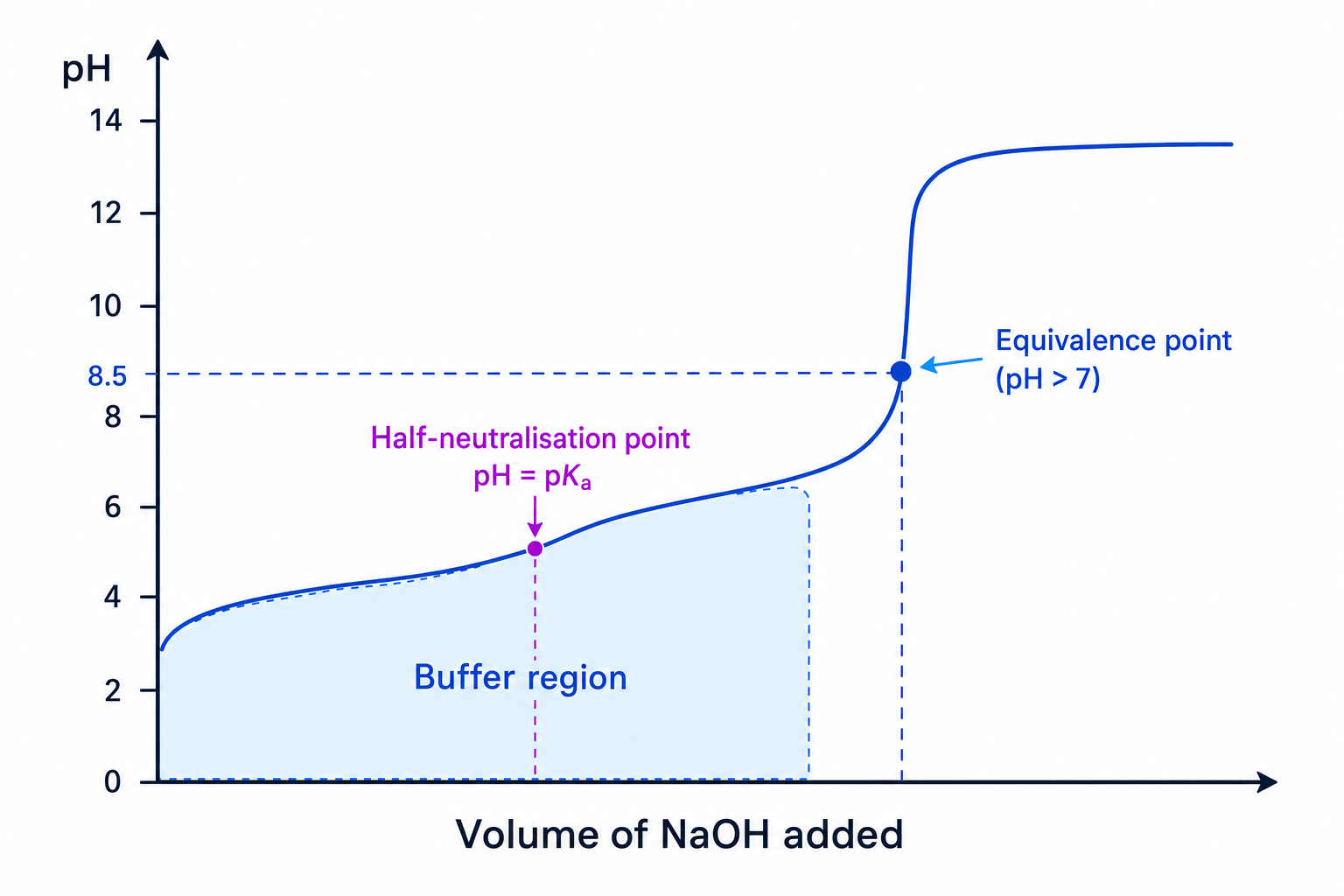
At the half-neutralisation point, exactly half the original weak acid has been converted into conjugate base. Therefore [HA]=[A−][\mathrm{HA}] = [\mathrm{A}^{-}][HA]=[A−], so pH=pKa\mathrm{pH} = \mathrm{p}K_apH=pKa.
Finding pKa from a titration curve
A weak acid is titrated with sodium hydroxide. The equivalence point is at 24.0 cm³ of NaOH added. The pH at 12.0 cm³ is 4.80. Find KaK_aKa.
-
Recognise that 12.0 cm³ is half of 24.0 cm³, so this is the half-neutralisation point.
-
At half-neutralisation, the moles of HA\mathrm{HA}HA and A−\mathrm{A}^{-}A− are equal, so pH=pKa\mathrm{pH} = \mathrm{p}K_apH=pKa.
-
Therefore pKa=4.80\mathrm{p}K_a = 4.80pKa=4.80 and Ka=10−4.80=1.6×10⁻⁵ mol dm−3K_a = 10^{-4.80} = 1.6 \times 10^{-5}\ \mathrm{mol\,dm^{-3}}Ka=10−4.80=1.6×10⁻⁵ moldm−3.
Alkaline buffers
An alkaline buffer contains a weak base and its conjugate acid. A common example is ammonia and ammonium chloride:
- weak base: NH3\mathrm{NH_3}NH3
- conjugate acid: NH4+\mathrm{NH_4}^{+}NH4+
Added acid is removed by ammonia:
NH3(aq)+H+(aq)→NH4+(aq)\mathrm{NH_3(aq)} + \mathrm{H}^{+}\mathrm{(aq)} \to \mathrm{NH_4}^{+}\mathrm{(aq)}NH3(aq)+H+(aq)→NH4+(aq)Added alkali is removed by ammonium ions:
NH4+(aq)+OH−(aq)→NH3(aq)+H2O(l)\mathrm{NH_4}^{+}\mathrm{(aq)} + \mathrm{OH}^{-}\mathrm{(aq)} \to \mathrm{NH_3(aq)} + \mathrm{H_2O(l)}NH4+(aq)+OH−(aq)→NH3(aq)+H2O(l)If you are given the KaK_aKa of the conjugate acid, BH+\mathrm{BH}^{+}BH+, you can treat it like an acid buffer:
pH=pKa(BH+)+log([B][BH+])\mathrm{pH} = \mathrm{p}K_a(\mathrm{BH}^{+}) + \log\left(\frac{[\mathrm{B}]}{[\mathrm{BH}^{+}]}\right)pH=pKa(BH+)+log([BH+][B])In the exam
-
Identify the weak acid/conjugate base pair, then write the relevant equilibrium and KaK_aKa expression.
-
If any strong acid or alkali reacts, calculate the new moles first; do not put initial amounts straight into the buffer equation.
-
Sense-check your answer: adding acid should lower pH slightly, adding alkali should raise pH slightly, and the pH should usually be close to pKa\mathrm{p}K_apKa.
Check yourself
- Why does an ethanoic acid/ethanoate buffer remove added H+\mathrm{H}^{+}H+ ions?
- If a buffer has equal moles of HA\mathrm{HA}HA and A−\mathrm{A}^{-}A−, what is the relationship between pH and pKa\mathrm{p}K_apKa?
- After adding a small amount of sodium hydroxide to an acidic buffer, which component increases and which decreases?
