What you'll learn
- How to use molar gas volume at room temperature and pressure.
- How gas volumes connect to balanced chemical equations.
- How to use the ideal gas equation, pV=nRTpV = nRTpV=nRT, with correct units.
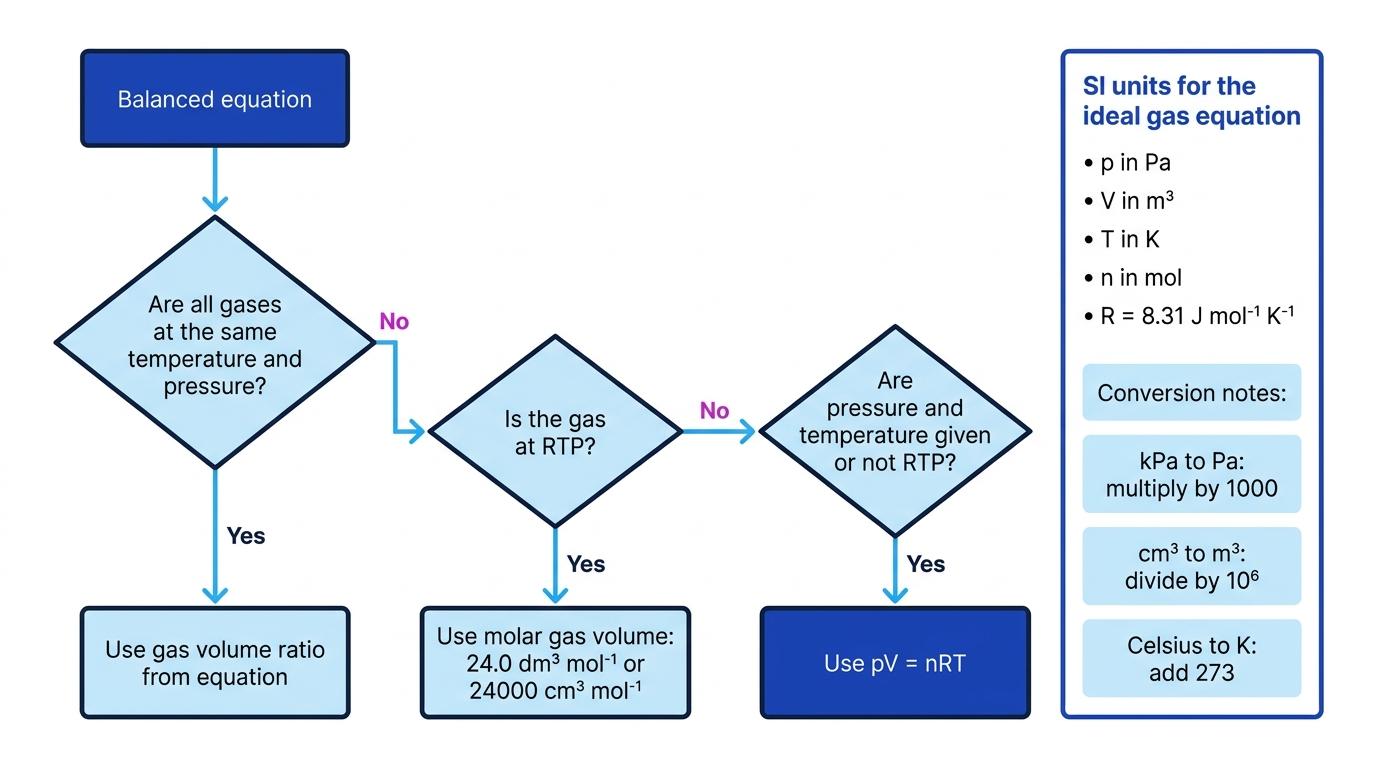
- How to choose between “24.0 dm³ mol⁻¹” and the full ideal gas equation.
Start point: moles and equations
Before gas calculations, you need the idea of amount of substance.
Mole
One mole is an amount of substance containing the Avogadro constant of particles. In calculations, amount is written as nnn and measured in mol.
You already know two key amount equations:
n=mMn = \frac{m}{M}n=Mmwhere mmm is mass in g and MMM is molar mass in g mol⁻¹.
n=cVn = cVn=cVwhere ccc is concentration in mol dm⁻³ and VVV is volume in dm³.
A balanced chemical equation gives mole ratios. For example:
Mg(s) + 2HCl(aq) → MgCl₂(aq) + H₂(g)
This tells you 1 mol of Mg produces 1 mol of H₂.
Gas volume at room temperature and pressure
For many A-Level calculations, gases are assumed to be measured at room temperature and pressure, often shortened to RTP.
Molar gas volume at RTP
At RTP, 1 mol of any gas occupies 24.0 dm³. This is called the molar gas volume.
So, for a gas at RTP:
n=V24.0n = \frac{V}{24.0}n=24.0Vwhere VVV is in dm³.
If the volume is in cm³, use 24000 cm³ mol⁻¹ instead, because 24.0 dm³ = 24000 cm³.
Hydrogen volume from a reacting mass
Magnesium reacts with excess hydrochloric acid:
Mg(s) + 2HCl(aq) → MgCl₂(aq) + H₂(g)
Calculate the volume of H₂ produced at RTP when 0.120 g of Mg reacts completely. Use Ar(Mg)=24.3A_\text{r}(\text{Mg}) = 24.3Ar(Mg)=24.3.
-
Calculate the amount of Mg: n(Mg)=0.12024.3=0.00494 moln(\text{Mg}) = \frac{0.120}{24.3} = 0.00494\text{ mol}n(Mg)=24.30.120=0.00494 mol.
-
Use the balanced equation. The ratio Mg : H₂ is 1 : 1, so n(H2)=0.00494 moln(\text{H}_2) = 0.00494\text{ mol}n(H2)=0.00494 mol.
-
Convert moles of H₂ into volume at RTP: V=0.00494×24.0=0.1185 dm3V = 0.00494 \times 24.0 = 0.1185\text{ dm}^3V=0.00494×24.0=0.1185 dm3.
-
Convert to cm³: 0.1185 dm3=119 cm30.1185\text{ dm}^3 = 119\text{ cm}^30.1185 dm3=119 cm3 to 3 significant figures.
Using 24.0 with the wrong units
The value 24.0 is in dm³ mol⁻¹, not cm³ mol⁻¹. If your volume is in cm³, use 24000 cm³ mol⁻¹ or convert cm³ to dm³ first.
Why gas volume ratios work
At the same temperature and pressure, equal volumes of gases contain equal numbers of particles. This is Avogadro’s law.
Gas volume ratios
For gases measured at the same temperature and pressure, the volume ratio is the same as the mole ratio in the balanced equation.
This means you can sometimes work directly with gas volumes without converting to mol first.
Reacting gas volumes
Nitrogen and hydrogen react to form ammonia:
N₂(g) + 3H₂(g) → 2NH₃(g)
60 cm³ of N₂ is mixed with 150 cm³ of H₂ at the same temperature and pressure. Find the maximum volume of NH₃ formed and the gas left in excess.
-
Compare the ratio N₂ : H₂. The equation needs 1 volume of N₂ for every 3 volumes of H₂, so 60 cm³ of N₂ would need 180 cm³ of H₂.
-
Only 150 cm³ of H₂ is available, so H₂ is the limiting reactant.
-
Use the ratio H₂ : NH₃ = 3 : 2. The volume of NH₃ formed is 150×23=100 cm3150 \times \frac{2}{3} = 100\text{ cm}^3150×32=100 cm3.
-
Work out N₂ used. Since N₂ : H₂ = 1 : 3, 150 cm3150\text{ cm}^3150 cm3 of H₂ reacts with 50 cm350\text{ cm}^350 cm3 of N₂, leaving 10 cm³ of N₂ unreacted.
The ideal gas equation
The simple 24.0 dm³ mol⁻¹ method only works for gases at RTP. If the pressure or temperature is different, use the ideal gas equation.
Ideal gas equation
The ideal gas equation is pV=nRTpV = nRTpV=nRT, where ppp is pressure, VVV is volume, nnn is amount, RRR is the gas constant and TTT is temperature.
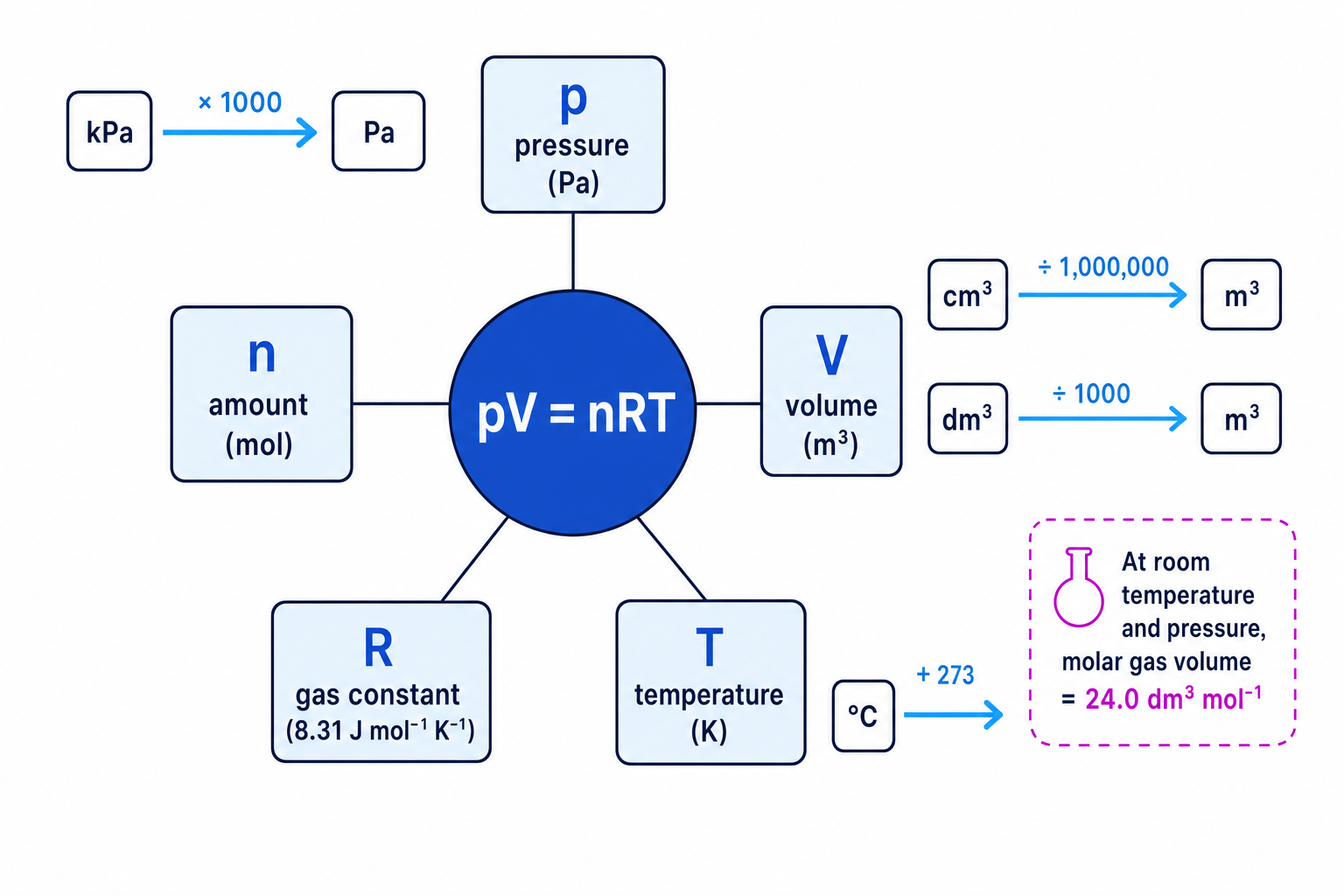
For Edexcel A-Level calculations, use:
- ppp in Pa
- VVV in m³
- nnn in mol
- TTT in K
- R=8.31 J mol−1 K−1R = 8.31\text{ J mol}^{-1}\text{ K}^{-1}R=8.31 J mol−1 K−1
To convert temperature from °C to K:
T(K)=T(∘C)+273T(\text{K}) = T(^{\circ}\text{C}) + 273T(K)=T(∘C)+273Ideal gas
An ideal gas is a model gas whose particles have negligible volume and no intermolecular forces. Real gases behave most ideally at low pressure and high temperature.
Using the ideal gas equation
Calculate the volume occupied by 0.0500 mol of O₂ at 120 kPa and 27 °C.
-
Convert to the units needed for pV=nRTpV = nRTpV=nRT: p=120000 Pap = 120000\text{ Pa}p=120000 Pa and T=27+273=300 KT = 27 + 273 = 300\text{ K}T=27+273=300 K.
-
Rearrange the equation to make volume the subject: V=nRTpV = \frac{nRT}{p}V=pnRT.
-
Substitute the values: V=0.0500×8.31×300120000=0.00104 m3V = \frac{0.0500 \times 8.31 \times 300}{120000} = 0.00104\text{ m}^3V=1200000.0500×8.31×300=0.00104 m3.
-
Convert m³ to dm³: 0.00104 m3=1.04 dm30.00104\text{ m}^3 = 1.04\text{ dm}^30.00104 m3=1.04 dm3.
Using Celsius in the ideal gas equation
Temperature in pV=nRTpV = nRTpV=nRT must be in K, not °C. A temperature of 25 °C should be used as 298 K.
Finding molar mass from gas data
The ideal gas equation can also be used to find the molar mass of a gas or volatile liquid.
The overall route is:
- Use pV=nRTpV = nRTpV=nRT to find nnn.
- Use M=mnM = \frac{m}{n}M=nm to find molar mass.
Molar mass from gas data
A 0.204 g sample of a volatile liquid is vaporised. The vapour occupies 96.0 cm³ at 101 kPa and 373 K. Calculate its molar mass.
-
Convert pressure and volume into SI units: p=101000 Pap = 101000\text{ Pa}p=101000 Pa and V=96.0 cm3=9.60×10⁻⁵ m3V = 96.0\text{ cm}^3 = 9.60 \times 10^{-5}\text{ m}^3V=96.0 cm3=9.60×10⁻⁵ m3.
-
Rearrange the ideal gas equation: n=pVRTn = \frac{pV}{RT}n=RTpV.
-
Substitute the values: n=101000×9.60×10−58.31×373=0.00313 moln = \frac{101000 \times 9.60 \times 10^{-5}}{8.31 \times 373} = 0.00313\text{ mol}n=8.31×373101000×9.60×10−5=0.00313 mol.
-
Calculate molar mass: M=0.2040.00313=65.2 g mol−1M = \frac{0.204}{0.00313} = 65.2\text{ g mol}^{-1}M=0.003130.204=65.2 g mol−1.
Choosing the right method
Which equation should you use?
Use 24.0 dm³ mol⁻¹ only for gases at RTP. Use pV=nRTpV = nRTpV=nRT when pressure and temperature are given or are not RTP.
A good decision route is:
- If the question says at RTP, use 24.0 dm³ mol⁻¹.
- If the question gives pressure and temperature, use pV=nRTpV = nRTpV=nRT.
- If all gases are at the same temperature and pressure, you can use gas volume ratios directly from the balanced equation.
Sanity check
At RTP, 1 mol of gas should have a volume close to 24 dm³. If your answer is 0.024 dm³ or 24000 dm³ for 1 mol, a unit conversion has gone wrong.
Practical gas measurements
In experiments, gas volume is often measured using a gas syringe or an inverted measuring cylinder over water. A gas syringe is usually more accurate because it reduces loss of gas and avoids dissolving the gas in water.
To improve reliability:
- check the apparatus is airtight before starting
- record temperature and pressure if using pV=nRTpV = nRTpV=nRT
- read the gas syringe at eye level
- repeat the experiment and calculate a mean
Gas collected over water
If a gas is collected over water and the vapour pressure of water is supplied, subtract it before using the ideal gas equation: pgas=ptotal−pwater vapourp_{\text{gas}} = p_{\text{total}} - p_{\text{water vapour}}pgas=ptotal−pwater vapour. If no vapour pressure data is given, do not invent a correction.
In the exam
-
Start with the balanced equation, then decide whether you need mole ratios, gas volume ratios, or pV=nRTpV = nRTpV=nRT.
-
Write units beside every value before substituting into an equation, especially Pa, kPa, cm³, dm³, m³ and K.
-
Check whether the gas is at RTP. If it is not, avoid using 24.0 dm³ mol⁻¹ unless the question specifically tells you to.
Check yourself
- When can you use gas volume ratios directly from a balanced equation?
- Why must temperature be converted to K before using pV=nRTpV = nRTpV=nRT?
- A gas volume is given in cm³ for an ideal gas calculation. What conversion is needed before using SI units?