What you'll learn
- How titrations use accurate volumes to find an unknown concentration.
- How to use n=cVn = cVn=cV and balanced equations in titration calculations.
- How to carry out the practical technique carefully and reduce uncertainty.
- How to choose concordant titres and avoid common exam mistakes.
The mole foundations you need
A titration is really a mole calculation with carefully measured volumes. Before the practical details, make sure the basic quantities are secure.
Amount and concentration
The amount of substance, nnn, is measured in mol. The concentration, ccc, of a solution is the amount of solute per unit volume, usually in mol dm⁻³. For solutions:
n=cVn = cVn=cVwhere VVV must be in dm³.
For titrations, volumes are often measured in cm³, but calculations using n=cVn = cVn=cV need dm³:
V(dm3)=V(cm3)1000V(\text{dm}^3) = \frac{V(\text{cm}^3)}{1000}V(dm3)=1000V(cm3)Finding moles in a solution sample
A 25.0 cm³ sample of hydrochloric acid has concentration 0.100 mol dm⁻³. Find the amount of HCl.
-
Convert the volume into dm³:
V=25.01000=0.0250 dm3V = \frac{25.0}{1000} = 0.0250\ \text{dm}^3V=100025.0=0.0250 dm3 -
Substitute into n=cVn = cVn=cV:
n=0.100×0.0250=2.50×10⁻³ moln = 0.100 \times 0.0250 = 2.50 \times 10^{-3}\ \text{mol}n=0.100×0.0250=2.50×10⁻³ mol -
The sample contains 2.50×10−32.50 \times 10^{-3}2.50×10⁻³ mol of HCl.
Using cm³ directly in n = cV
If concentration is in mol dm⁻³, the volume must be in dm³. Forgetting to divide cm³ by 1000 makes your answer 1000 times too large.
What a titration is
Titration
A titration is a quantitative practical technique in which a solution of known concentration is reacted with a measured volume of another solution to determine an unknown concentration or amount.
Some key terms come up again and again:
- A standard solution has an accurately known concentration.
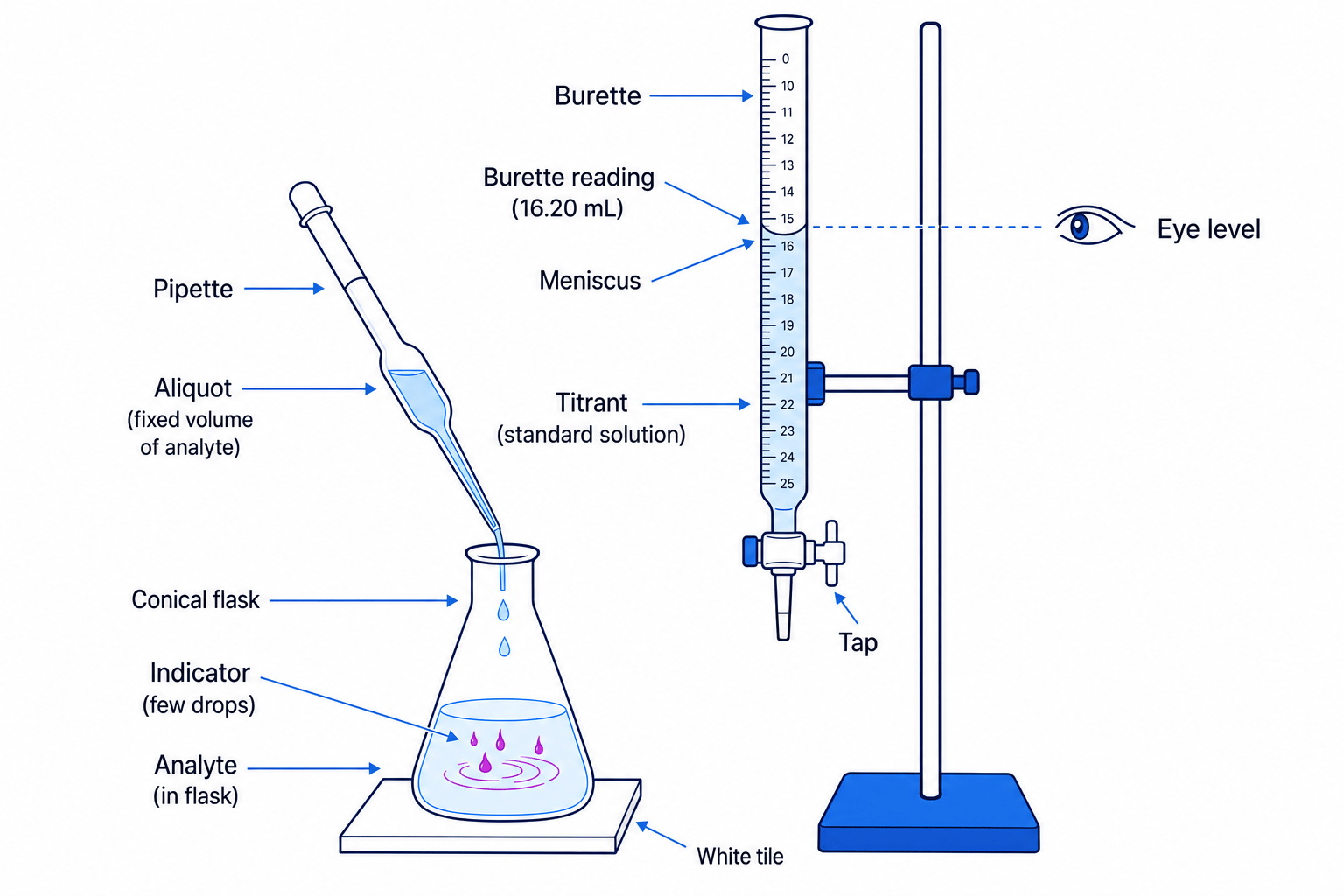
- The titrant is the solution delivered from the burette.
- The analyte is the substance being analysed, usually in the conical flask.
- An aliquot is a fixed measured volume, usually delivered by a volumetric pipette.
- The titre is the volume added from the burette.
- The equivalence point is where the reactants have reacted in the exact mole ratio from the balanced equation.
- The end point is the observed colour change of the indicator.
- Concordant titres are repeat titres that agree closely, usually within 0.10 cm³ unless the question says otherwise.
The balanced equation controls the calculation
The titre is a volume, not automatically a mole amount. You must convert volume to moles, then use the mole ratio from the balanced equation.
Apparatus and practical technique
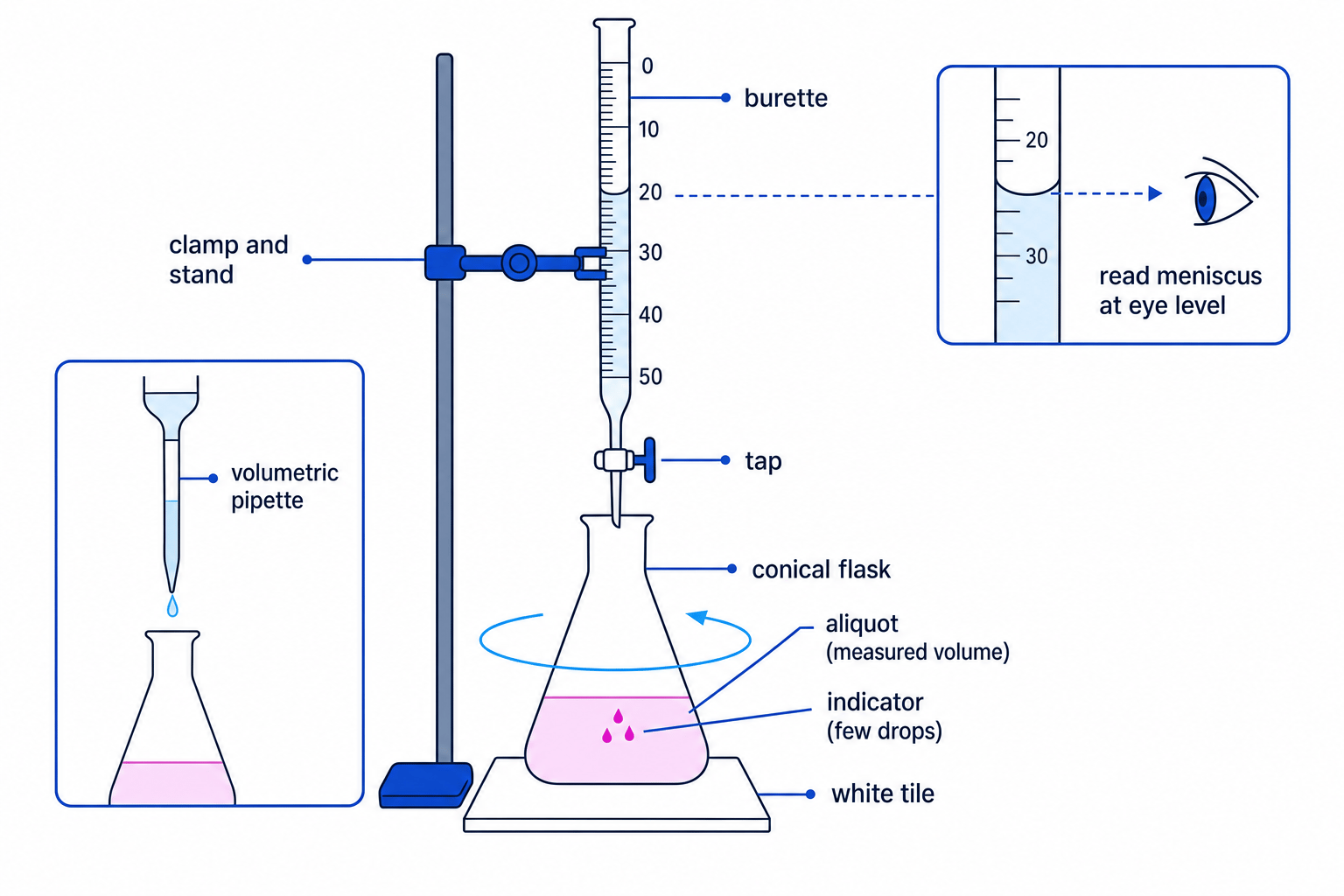
This is a core practical skill in volumetric analysis. The goal is to measure one volume very accurately with a pipette, then find the reacting volume from a burette.
Typical acid-base titration method
-
Rinse the volumetric pipette with the solution it will transfer, then use it to place a fixed aliquot into a conical flask.
-
Add a few drops of a suitable indicator to the flask.
-
Rinse the burette with the solution it will contain, then fill it. Remove any air bubble below the tap.
-
Record the initial burette reading at eye level. Burette readings are usually recorded to the nearest 0.05 cm³.
-
Do a rough titration to find the approximate end point.
-
Repeat accurately, adding solution quickly at first, then dropwise near the end point while swirling the flask.
-
Record the final burette reading. The titre is:
titre=final burette reading−initial burette reading\text{titre} = \text{final burette reading} - \text{initial burette reading}titre=final burette reading−initial burette reading -
Repeat until you have concordant titres, then calculate the mean of the concordant accurate titres only.
Rinsing rules
Rinse the burette and pipette with the solutions they will contain, so the solutions are not diluted. Rinse the conical flask with deionised water only; extra water changes the volume, but not the amount of substance in the aliquot.
Selecting concordant titres
A student records these titres: rough 25.20 cm³, then 24.65 cm³, 24.35 cm³, 24.40 cm³ and 24.45 cm³. Find the mean titre.
-
Ignore the rough titre because it was only used to locate the approximate end point.
-
Compare the accurate titres. The values 24.35 cm³, 24.40 cm³ and 24.45 cm³ are concordant because their range is 0.10 cm³.
-
Exclude 24.65 cm³ because it is not within the concordant cluster.
-
Calculate the mean:
24.35+24.40+24.453=24.40 cm3\frac{24.35 + 24.40 + 24.45}{3} = 24.40\ \text{cm}^3324.35+24.40+24.45=24.40 cm3
Averaging every titre
Do not include the rough titre or an anomalous titre in the mean. Use only concordant accurate titres.
Preparing a standard solution
Sometimes you first make a standard solution from a solid. A suitable solid is often a primary standard: it is pure, stable in air, has a known formula and can be weighed accurately.
The main steps are:
- Weigh the solid accurately, often by difference.
- Dissolve it in deionised water in a beaker.
- Transfer it into a volumetric flask using a funnel.
- Rinse the beaker, stirring rod and funnel into the flask, so all the solute is transferred.
- Make up to the calibration mark with deionised water.
- Stopper and invert several times to mix thoroughly.
The molar mass, MMM, is the mass per mole, in g mol⁻¹. Use m=nMm = nMm=nM to calculate the mass needed.
Calculating mass for a standard solution
Calculate the mass of sodium carbonate, Na₂CO₃, needed to make 250.0 cm³ of 0.100 mol dm⁻³ solution. Use M(Na2CO3)=106.0 g mol−1M(\text{Na}_2\text{CO}_3) = 106.0\ \text{g mol}^{-1}M(Na2CO3)=106.0 g mol−1.
-
Convert the volume:
V=0.2500 dm3V = 0.2500\ \text{dm}^3V=0.2500 dm3 -
Calculate the amount needed:
n=cV=0.100×0.2500=0.0250 moln = cV = 0.100 \times 0.2500 = 0.0250\ \text{mol}n=cV=0.100×0.2500=0.0250 mol -
Convert moles to mass:
m=nM=0.0250×106.0=2.65 gm = nM = 0.0250 \times 106.0 = 2.65\ \text{g}m=nM=0.0250×106.0=2.65 g
Calculating an unknown concentration
Most titration calculations follow the same route:
- Write the balanced equation.
- Calculate the moles of the known substance using n=cVn = cVn=cV.
- Use the mole ratio to find the moles of the unknown substance.
- Use c=nVc = \frac{n}{V}c=Vn to find the unknown concentration.
Finding an alkali concentration
25.0 cm³ of 0.100 mol dm⁻³ sulfuric acid is titrated with sodium hydroxide. The mean titre of NaOH is 20.35 cm³. Find the concentration of NaOH.
-
Write the balanced equation:
H2SO4(aq)+2NaOH(aq)→Na2SO4(aq)+2H2O(l)\text{H}_2\text{SO}_4(aq) + 2\text{NaOH}(aq) \to \text{Na}_2\text{SO}_4(aq) + 2\text{H}_2\text{O}(l)H2SO4(aq)+2NaOH(aq)→Na2SO4(aq)+2H2O(l) -
Calculate the moles of sulfuric acid in the flask:
n(H2SO4)=0.100×0.0250=2.50×10⁻³ moln(\text{H}_2\text{SO}_4) = 0.100 \times 0.0250 = 2.50 \times 10^{-3}\ \text{mol}n(H2SO4)=0.100×0.0250=2.50×10⁻³ mol -
Use the mole ratio. One mole of H₂SO₄ reacts with 2 moles of NaOH:
n(NaOH)=2×2.50×10−3=5.00×10⁻³ moln(\text{NaOH}) = 2 \times 2.50 \times 10^{-3} = 5.00 \times 10^{-3}\ \text{mol}n(NaOH)=2×2.50×10−3=5.00×10⁻³ mol -
Convert the NaOH titre into dm³:
V(NaOH)=20.351000=0.02035 dm3V(\text{NaOH}) = \frac{20.35}{1000} = 0.02035\ \text{dm}^3V(NaOH)=100020.35=0.02035 dm3 -
Calculate the concentration:
c(NaOH)=5.00×10−30.02035=0.2457 mol dm−3c(\text{NaOH}) = \frac{5.00 \times 10^{-3}}{0.02035} = 0.2457\ \text{mol dm}^{-3}c(NaOH)=0.020355.00×10−3=0.2457 mol dm−3To 3 significant figures, the NaOH concentration is 0.246 mol dm⁻³.
Treating coefficients as decoration
The coefficients in the balanced equation are the mole ratio. In this example, using 1:1 instead of 1:2 would halve the calculated NaOH concentration.
Indicators and end points
An indicator is a substance that changes colour over a narrow pH range. In an acid-base titration, the indicator should change colour as close as possible to the equivalence point.
For common acid-base titrations:
- Strong acid with strong alkali: methyl orange or phenolphthalein can both work.
- Weak acid with strong alkali: phenolphthalein is usually suitable.
- Strong acid with weak alkali: methyl orange is usually suitable.
- Weak acid with weak alkali: there is no sharp pH change, so a simple indicator is usually unsuitable.
Endpoint versus equivalence point
The equivalence point is the theoretical stoichiometric point. The end point is what you actually see. A good indicator makes these as close as possible.
Accuracy, uncertainty and evaluation
A burette reading is usually uncertain by ±0.05 cm³. Since a titre uses two readings, the titre uncertainty is usually about ±0.10 cm³.
The percentage uncertainty is:
percentage uncertainty=absolute uncertaintymeasured value×100\text{percentage uncertainty} = \frac{\text{absolute uncertainty}}{\text{measured value}} \times 100percentage uncertainty=measured valueabsolute uncertainty×100Calculating uncertainty in a titre
A mean titre is 24.40 cm³. Estimate the percentage uncertainty from the burette readings.
-
A titre comes from an initial and final reading, so use an absolute uncertainty of ±0.10 cm³.
-
Substitute into the percentage uncertainty expression:
0.1024.40×100=0.410%\frac{0.10}{24.40} \times 100 = 0.410\%24.400.10×100=0.410% -
The percentage uncertainty is about 0.41%. A larger titre gives a smaller percentage uncertainty, which is why very small titres are less reliable.
Other practical points that improve reliability:
- Swirl continuously so the reactants mix fully.
- Add dropwise near the end point to avoid overshooting.
- Use a white tile to see the colour change more clearly.
- Wash down the inside of the conical flask with deionised water if splashes occur.
- Repeat until titres are concordant.
Other titration types
Not all titrations are acid-base titrations. In redox titrations, electrons are transferred and the mole ratio comes from a balanced redox equation. For example, acidified manganate(VII) ions, MnO₄⁻, are purple and can act as their own indicator because they become nearly colourless Mn²⁺ when reduced.
A back titration is used when the direct reaction is too slow, the solid is insoluble, or the end point is difficult to detect. You add a known excess of one reagent, let it react, then titrate the excess left over.
Same calculation, different chemistry
Whether the titration is acid-base, redox or back titration, the calculation still depends on accurate volumes, concentrations and the balanced equation.
In the exam
- Start every titration calculation by writing or checking the balanced equation; the mole ratio is usually where marks are won or lost.
- Convert all cm³ volumes into dm³ before using n=cVn = cVn=cV.
- Use only concordant titres for the mean, and quote burette readings sensibly, usually to the nearest 0.05 cm³.
Check yourself
- Why must the pipette be rinsed with the solution it will transfer, but the conical flask should not be rinsed with that solution?
- What is the difference between an end point and an equivalence point?
- In a titration calculation, when do you use the balanced equation mole ratio?