Organic nomenclature and isomerism
What you'll learn
- How to recognise and use molecular, displayed, structural and skeletal formulae.
- How to name organic molecules using systematic IUPAC rules.
- How to spot structural isomers: chain, position and functional group isomers.
- How to decide whether an alkene can show E/Z stereoisomerism.
The starting point: organic molecules
Organic chemistry is the study of compounds containing carbon. At A-Level, you mainly meet molecules built from carbon chains with hydrogen and sometimes atoms such as oxygen, nitrogen, sulfur, chlorine, bromine or iodine.
A hydrocarbon is an organic compound containing carbon and hydrogen only. For example, methane, ethene and benzene are hydrocarbons; ethanol is not, because it contains oxygen.
Carbon is special because each carbon atom normally forms four covalent bonds, so it can make chains, branches and rings. This is why naming needs clear rules.
Homologous series and functional groups
A homologous series is a family of organic compounds with the same functional group, the same general formula, and similar chemical reactions. Adjacent members differ by CH₂.
Functional group
A functional group is the atom or group of atoms in an organic molecule that gives the molecule its characteristic chemical reactions.
For example, all alcohols contain the -OH functional group, so methanol, ethanol and propan-1-ol react in broadly similar ways.
Common families you should recognise include:
| Family | Functional feature | Example name |
|---|---|---|
| Alkane | C-C single bonds only | propane |
| Alkene | C=C double bond | propene |
| Haloalkane | C-F, C-Cl, C-Br or C-I | 1-bromopropane |
| Alcohol | -OH | propan-1-ol |
| Aldehyde | -CHO at the end of a chain | propanal |
| Ketone | C=O within a chain | propanone |
| Carboxylic acid | -COOH | propanoic acid |
| Ester | -COO- | ethyl ethanoate |
Why functional groups matter
The carbon chain affects properties such as boiling point, but the functional group usually controls the main chemical reactions.
Formulae: different levels of detail
Organic molecules can be shown in several ways. You need to move confidently between them.
Types of formula
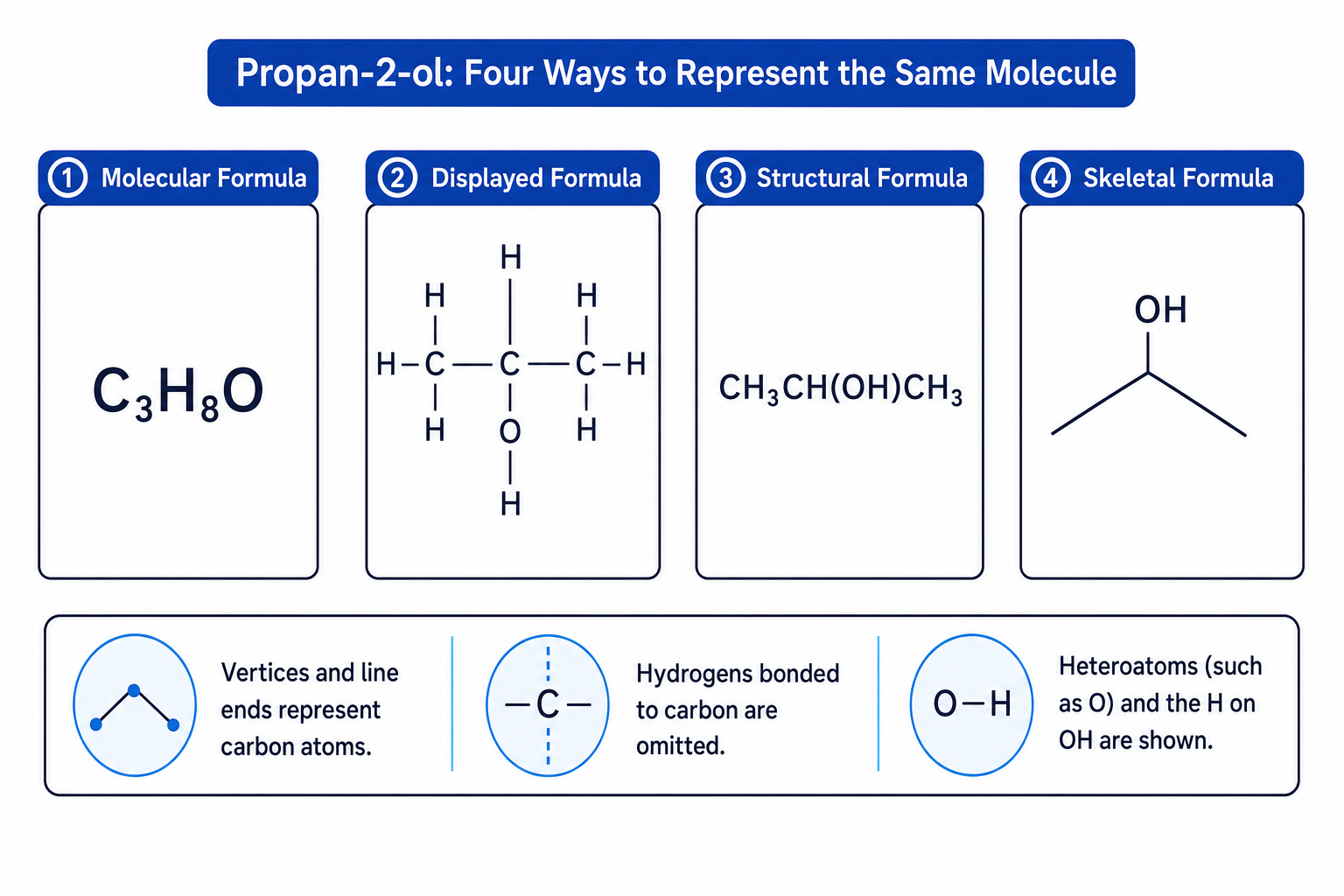
A molecular formula gives the actual number of each atom in one molecule. A displayed formula shows every atom and every bond. A structural formula shows how atoms are connected, often in a shortened form. A skeletal formula shows the carbon skeleton using lines; carbon atoms and most carbon-bonded hydrogens are not written.
The same molecule, propan-2-ol, can be represented in several equivalent ways:
Reading skeletal formulae
In a skeletal formula:
- Each line end or vertex represents a carbon atom.
- Hydrogen atoms bonded to carbon are omitted.
- Heteroatoms such as O, N, Cl and Br are shown.
- Hydrogens bonded to heteroatoms are shown, for example the H in -OH.
Converting a skeletal formula into a molecular formula
Suppose a skeletal formula is a four-carbon zig-zag chain with an -OH group on carbon 2.
-
Count the carbon atoms: the two line ends plus the two vertices give 4 carbon atoms.
-
Identify the functional group: the -OH group contributes 1 oxygen atom and 1 hydrogen atom.
-
Add enough hydrogens so each carbon has four bonds: the structure is CH₃CH(OH)CH₂CH₃.
-
Count atoms from the structural formula: carbon = 4, hydrogen = 10, oxygen = 1, so the molecular formula is C₄H₁₀O.
Naming organic compounds: the IUPAC idea
The systematic naming system used at A-Level is based on IUPAC nomenclature. The aim is that one clear name describes one structure.
The basic naming method
Use this sequence:
- Find the longest carbon chain containing the main functional group and any C=C double bond.
- Choose the stem from the number of carbons: meth-, eth-, prop-, but-, pent-, hex-, hept-, oct-.
- Choose the main suffix: -ane, -ene, -ol, -al, -one, -oic acid, and so on.
- Number the chain to give the main functional group or double bond the lowest possible number.
- Add side groups as prefixes, such as methyl-, ethyl-, fluoro-, chloro-, bromo- or iodo-.
- Use numbers called locants to show positions.
Naming order
Think: chain length → family suffix → numbering → branches/prefixes. Do not start naming from the nearest branch unless the main functional group has already been considered.
Parent chain stems
The most common stems are:
| Carbon atoms | Stem |
|---|---|
| 1 | meth- |
| 2 | eth- |
| 3 | prop- |
| 4 | but- |
| 5 | pent- |
| 6 | hex- |
For alkanes, the general formula is CnH2n+2C_nH_{2n+2}CnH2n+2. For acyclic alkenes with one C=C double bond, the general formula is CnH2nC_nH_{2n}CnH2n.
General formulae have limits
The alkene formula CnH2nC_nH_{2n}CnH2n applies to open-chain molecules with one C=C double bond. Cycloalkanes also have formula CnH2nC_nH_{2n}CnH2n, so the formula alone does not prove a compound is an alkene.
Naming a branched compound
Naming a branched alcohol
Name CH₃CH(CH₃)CH₂CH₂OH.
-
Choose the longest chain containing the -OH group. Starting at the -OH end gives HOCH₂CH₂CH(CH₃)CH₃, so the parent chain has 4 carbons: butan-.
-
Number from the -OH end because the alcohol group needs the lowest possible locant. The -OH group is on carbon 1, so the suffix is butan-1-ol.
-
Locate the branch. The extra CH₃ group is attached to carbon 3, so it is a 3-methyl substituent.
-
Combine the parts with correct punctuation: 3-methylbutan-1-ol.
Numbering from the wrong end
A branch does not usually outrank the main functional group. In alcohols and alkenes, number the chain to give the -OH group or C=C double bond the lowest possible locant.
Isomerism: same formula, different arrangement
Isomers
Isomers are compounds with the same molecular formula but different arrangements of atoms.
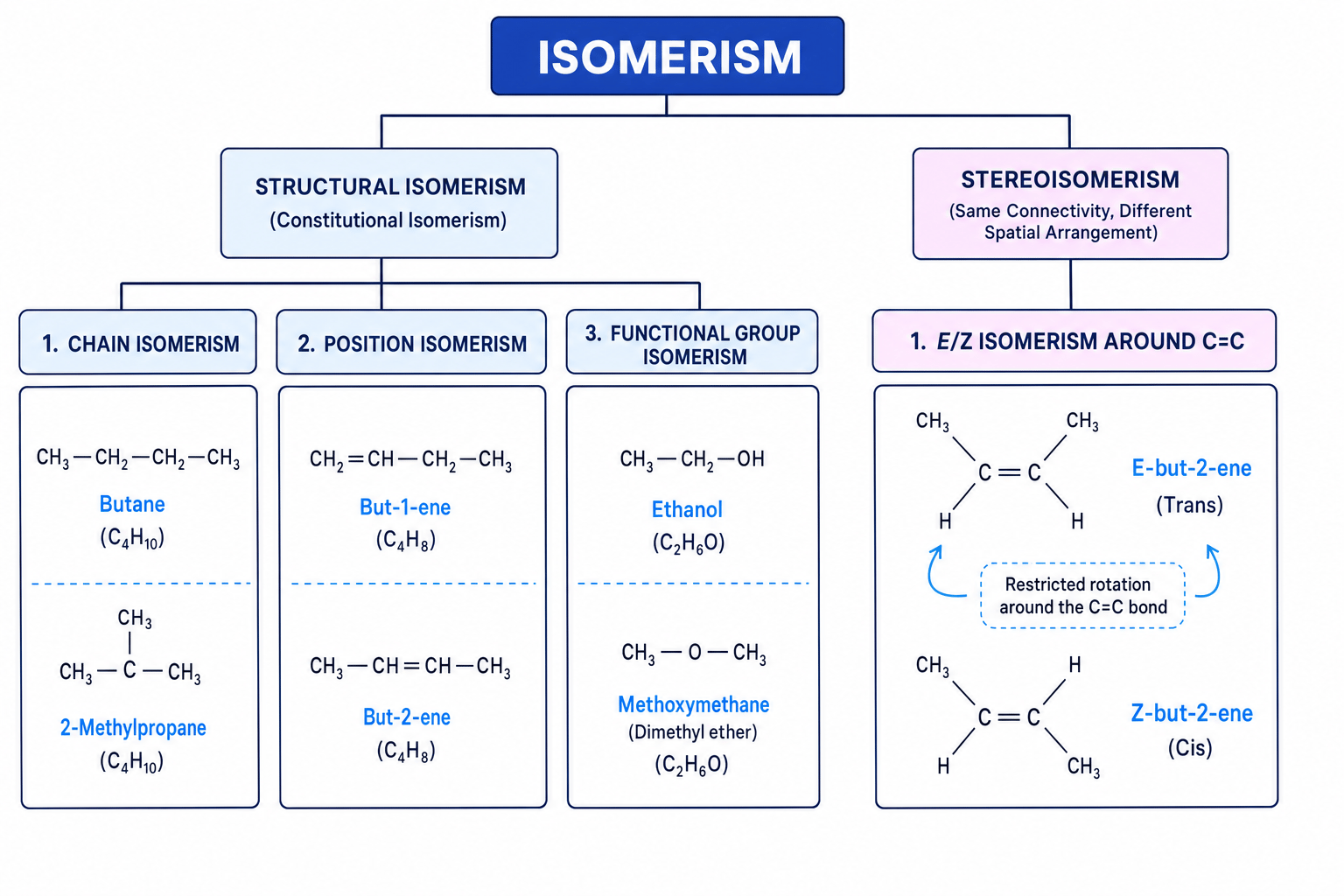
Isomerism is a big reason organic chemistry has so many compounds. A molecular formula such as C₄H₁₀O does not tell you whether the compound is an alcohol or an ether, or whether the carbon chain is straight or branched.
Structural isomerism
Structural isomers
Structural isomers have the same molecular formula but different structural formulae, meaning their atoms are connected in different ways.
There are three structural isomerism types you should know well.
Chain isomerism
Chain isomers have different carbon skeletons. For example, butane and 2-methylpropane both have molecular formula C₄H₁₀, but one is a straight chain and one is branched.
Position isomerism
Position isomers have the same carbon skeleton and functional group, but the functional group, branch or double bond is in a different position. For example, but-1-ene and but-2-ene both have formula C₄H₈.
Functional group isomerism
Functional group isomers have the same molecular formula but different functional groups. For example, ethanol and methoxymethane both have formula C₂H₆O, but ethanol is an alcohol and methoxymethane is an ether.
Classifying structural isomers
Classify the isomerism shown by each pair: butan-1-ol and butan-2-ol; butane and 2-methylpropane; ethanol and methoxymethane.
-
Compare butan-1-ol and butan-2-ol. Both are alcohols with four carbons, but the -OH group moves from carbon 1 to carbon 2, so they are position isomers.
-
Compare butane and 2-methylpropane. Both have molecular formula C₄H₁₀, but the carbon skeleton changes from straight to branched, so they are chain isomers.
-
Compare ethanol and methoxymethane. Both have molecular formula C₂H₆O, but ethanol contains -OH while methoxymethane contains C-O-C, so they are functional group isomers.
Stereoisomerism and E/Z isomerism
Stereoisomers
Stereoisomers have the same structural formula, but a different arrangement of atoms in space.
At this stage, the key type is E/Z isomerism in alkenes. A C=C double bond has restricted rotation, so groups attached to the double bond can be locked in different positions.
For E/Z isomerism to exist:
- There must be a C=C double bond.
- Each carbon atom in the C=C must be bonded to two different groups.
If either carbon in the C=C has two identical groups, E/Z isomerism is not possible.
Assigning E and Z
To decide whether an alkene is E or Z:
- Look at one carbon of the C=C and decide which attached group has the higher priority.
- Do the same for the other carbon of the C=C.
- If the higher-priority groups are on the same side, the isomer is Z.
- If the higher-priority groups are on opposite sides, the isomer is E.
At A-Level, priority is usually decided using atomic number: higher atomic number means higher priority. For example, Br has higher priority than Cl, and Cl has higher priority than C or H.
Remembering E and Z
Z comes from the German zusammen, meaning together: the higher-priority groups are on the same side. E means they are on opposite sides.
Assigning E/Z to an alkene
An alkene has Br and H attached to the left-hand carbon of the C=C, and CH₃ and H attached to the right-hand carbon. Br and CH₃ are drawn on the same side of the double bond.
-
Check that E/Z isomerism is possible. The left carbon has Br and H, and the right carbon has CH₃ and H, so each C=C carbon has two different groups.
-
Assign priority on the left carbon. Br has a higher atomic number than H, so Br is the higher-priority group.
-
Assign priority on the right carbon. The carbon in CH₃ has a higher atomic number than H, so CH₃ is the higher-priority group.
-
Compare the higher-priority groups. Br and CH₃ are on the same side, so the molecule is the Z isomer.
Using cis/trans when it is not enough
Cis/trans works only in simple cases where the same group appears on both carbons of the C=C. E/Z is more general and is the safer A-Level method.
In the exam
-
For naming questions, identify the longest chain containing the main functional group before numbering anything.
-
For isomerism questions, first check the molecular formula is the same, then decide whether connectivity changes or only spatial arrangement changes.
-
For E/Z questions, prove that each C=C carbon has two different groups before assigning E or Z.
Check yourself
- What is the difference between a displayed formula and a structural formula?
- Name CH₃CH₂CH(CH₃)CH₂CH₃ systematically.
- Why can but-2-ene show E/Z isomerism, but but-1-ene cannot?