What you'll learn
- What enthalpy change means, and why the sign of ΔH matters.
- How to interpret exothermic and endothermic reaction profile diagrams.
- The key standard enthalpy changes you need for Edexcel 9CH0.
- How to calculate an enthalpy change from calorimetry data.
The big idea: energy changes in reactions
Chemical reactions involve breaking bonds and making bonds.
- Breaking bonds requires energy, so it is endothermic.
- Making bonds releases energy, so it is exothermic.
The overall energy change depends on the balance between these two processes. If more energy is released making bonds than is taken in breaking bonds, the reaction is exothermic overall. If more energy is taken in than released, the reaction is endothermic overall.
Enthalpy change
The enthalpy change, ΔH, is the heat energy change for a reaction at constant pressure. It is usually measured in kJ mol⁻¹.
At A-Level, you normally do not measure “enthalpy” itself. You measure a temperature change, then use it to calculate the heat transferred.
System and surroundings
The system is the chemicals reacting. The surroundings are everything else, such as the solution, thermometer, cup, air and laboratory.
This distinction is important because the temperature change you observe is usually the temperature change of the surroundings, not the reacting chemicals themselves.
Sign of ΔH
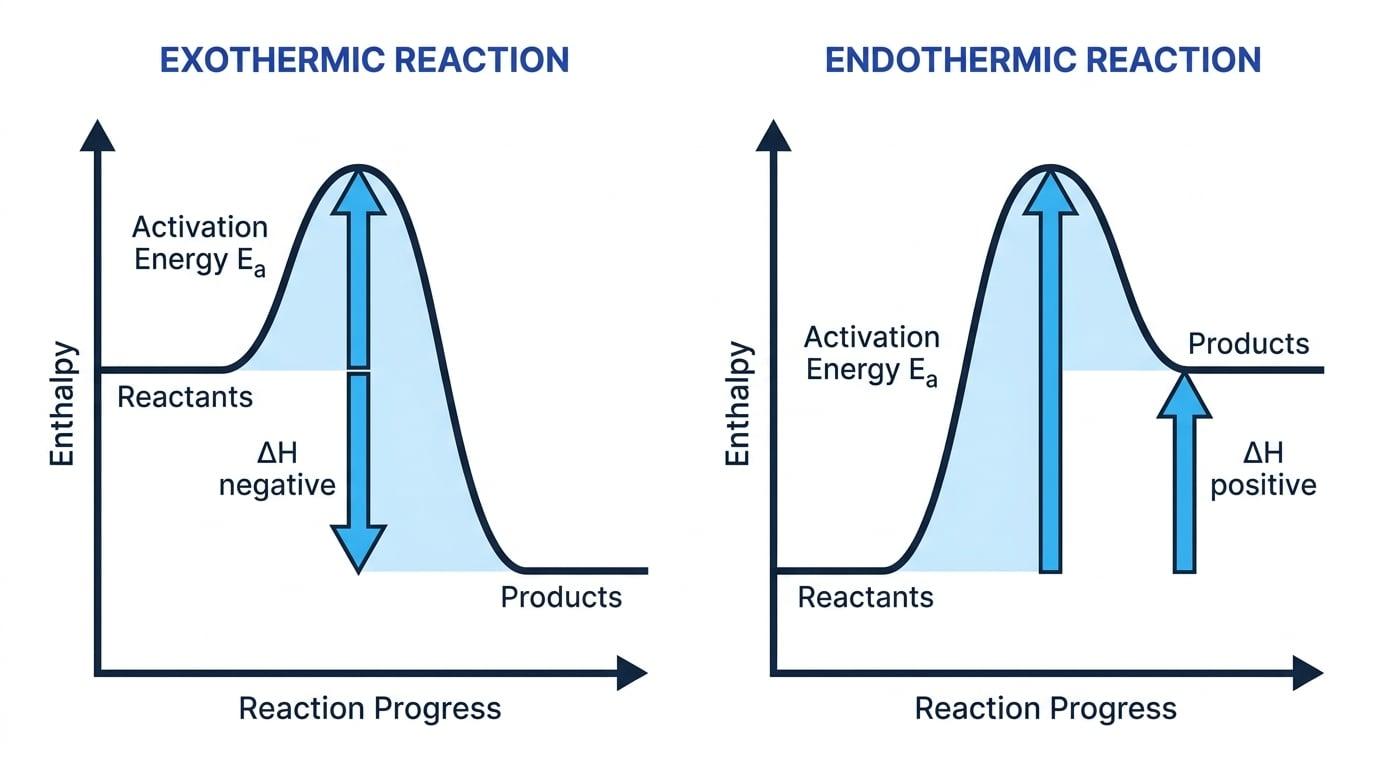
For the reaction system: exothermic reactions have negative ΔH, and endothermic reactions have positive ΔH.
Exothermic reactions
An exothermic reaction transfers heat energy from the system to the surroundings.
You usually observe a temperature rise. Examples include combustion, neutralisation and many oxidation reactions.
For an exothermic reaction:
- products have lower enthalpy than reactants
- ΔH is negative
- the surroundings get warmer
Endothermic reactions
An endothermic reaction transfers heat energy from the surroundings to the system.
You usually observe a temperature fall. Examples include some thermal decompositions and dissolving ammonium nitrate in water.
For an endothermic reaction:
- products have higher enthalpy than reactants
- ΔH is positive
- the surroundings get cooler
Reaction profile diagrams
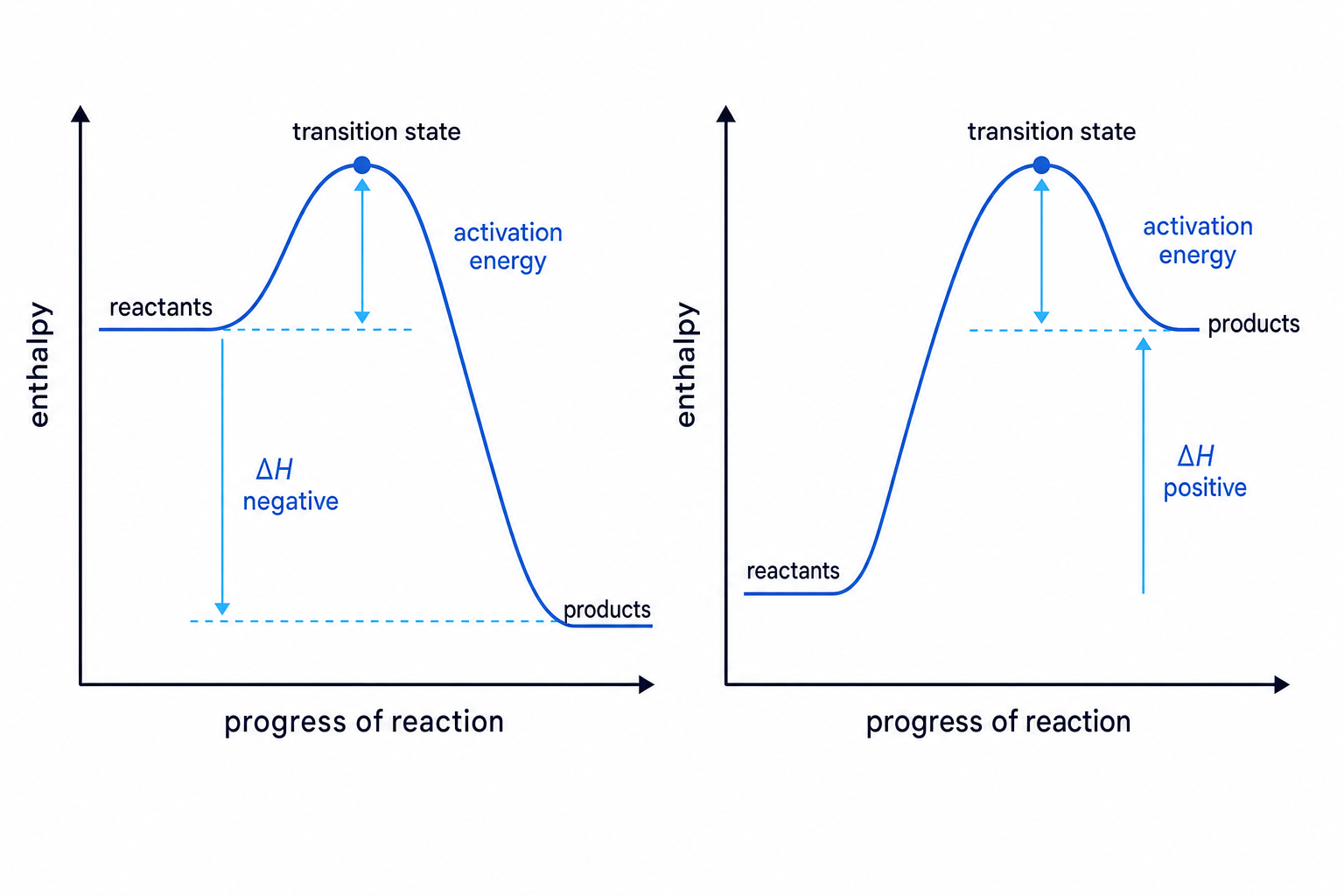
A reaction profile diagram shows how enthalpy changes as reactants become products. The vertical difference between reactants and products is ΔH. The “hump” represents the energy barrier that must be overcome.
Activation energy
The activation energy, EaE_\text{a}Ea, is the minimum energy that reacting particles must have for a successful reaction to occur.
Confusing ΔH with activation energy
ΔH is the energy difference between reactants and products. Activation energy is the energy difference between reactants and the top of the energy barrier. They are not the same thing.
Enthalpy changes are linked to equations
An enthalpy change is tied to the chemical equation exactly as written.
For example:
CH4(g) + 2O2(g) → CO2(g) + 2H2O(l), ΔH = −890 kJ mol⁻¹
This means that when 1 mole of methane reacts completely as shown, 890 kJ of energy is released.
If you double the equation, you double ΔH. If you reverse the equation, you change the sign of ΔH.
Scaling an enthalpy change
For the reaction:
N2(g) + 3H2(g) → 2NH3(g), ΔH = −92.0 kJ mol⁻¹
Find ΔH for making 1 mole of NH3.
-
The equation as written forms 2 mol of NH3, so −92.0 kJ is released for 2 mol of NH3.
-
Divide the whole equation by 2 to make 1 mol of NH3:
½N2(g) + 1½H2(g) → NH3(g)
-
Divide the enthalpy change by 2:
- The enthalpy change for forming 1 mol of NH3 from this equation is −46.0 kJ mol⁻¹.
Standard enthalpy changes
A standard enthalpy change is measured under standard conditions, with substances in their standard states.
Standard conditions and standard states
Standard conditions are usually 100 kPa pressure and a stated temperature, normally 298 K. The standard state of a substance is its physical state under those conditions, such as O2(g), H2O(l) and C(s, graphite).
The standard enthalpy symbol includes a small circle: ΔH°.
Standard enthalpy change of reaction, ΔH°r
The standard enthalpy change of reaction is the enthalpy change when the molar quantities shown in the equation react under standard conditions, with all substances in their standard states.
Standard enthalpy change of formation, ΔH°f
The standard enthalpy change of formation is the enthalpy change when 1 mole of a compound is formed from its elements in their standard states under standard conditions.
Writing a formation equation
Write the formation equation for ethanol, C2H5OH(l).
-
The product must be exactly 1 mole of the compound, so put C2H5OH(l) on the right-hand side.
-
Use the elements in their standard states on the left: carbon as C(s, graphite), hydrogen as H2(g), and oxygen as O2(g).
-
Balance the atoms while keeping exactly 1 mole of ethanol:
2C(s, graphite) + 3H2(g) + ½O2(g) → C2H5OH(l)
Standard enthalpy change of combustion, ΔH°c
The standard enthalpy change of combustion is the enthalpy change when 1 mole of a substance burns completely in oxygen under standard conditions.
Combustion enthalpy changes are usually negative because combustion is exothermic.
Standard enthalpy change of neutralisation, ΔH°neut
The standard enthalpy change of neutralisation is the enthalpy change when an acid and an alkali react to form 1 mole of water under standard conditions.
For a strong acid reacting with a strong alkali, the value is usually close to −57 kJ mol⁻¹ because the ionic equation is essentially:
H+(aq) + OH−(aq) → H2O(l)
Measuring enthalpy changes by calorimetry
Calorimetry is the experimental measurement of heat energy changes. In solution calorimetry, reactions are often carried out in an insulated polystyrene cup.
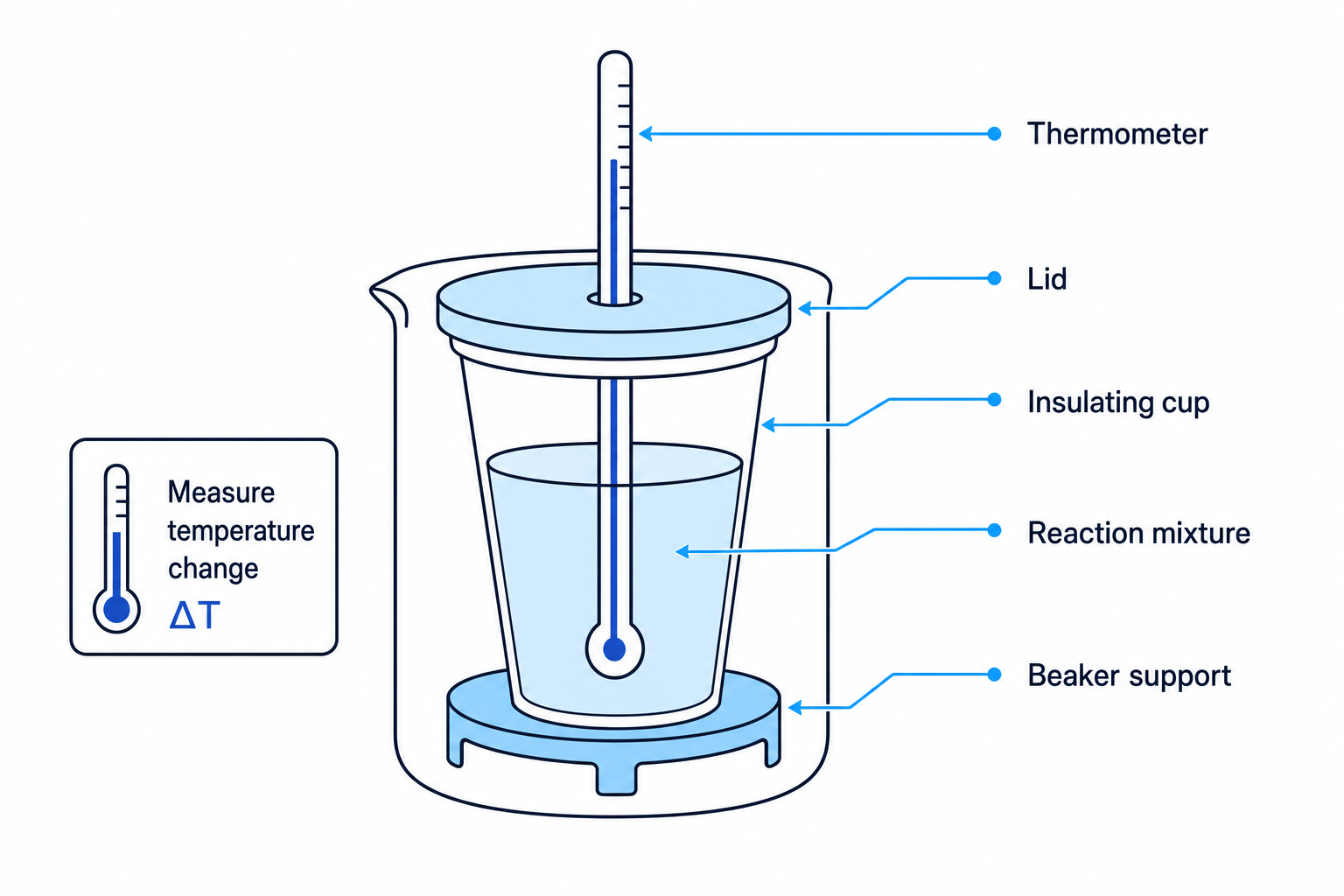
The key equation is:
q=mcΔT q = mc\Delta T q=mcΔTwhere:
- qqq is the heat energy transferred, in J
- mmm is the mass of solution, in g
- ccc is the specific heat capacity, usually 4.18 J g⁻¹ K⁻¹ for aqueous solutions
- ΔT\Delta TΔT is the temperature change, in K or °C
For dilute aqueous solutions, you normally assume:
- density = 1.00 g cm⁻³, so 1.00 cm³ has mass 1.00 g
- specific heat capacity = 4.18 J g⁻¹ K⁻¹
Temperature change units
A temperature change of 6.5 °C is the same size as a temperature change of 6.5 K. You do not need to convert ΔT from °C to K.
Calculating ΔH from calorimetry
The heat change calculated using q=mcΔTq = mc\Delta Tq=mcΔT is for the surroundings, usually the solution.
The reaction enthalpy has the opposite sign:
qreaction=−qsolution q_\text{reaction} = -q_\text{solution} qreaction=−qsolutionThen divide by the amount, in mol, of the substance linked to the enthalpy definition.
Calculating enthalpy of neutralisation
50.0 cm³ of 1.00 mol dm⁻³ HCl is mixed with 50.0 cm³ of 1.00 mol dm⁻³ NaOH. The temperature rises from 20.5 °C to 27.2 °C. Calculate the enthalpy change of neutralisation.
- Calculate the amount of acid and alkali, using volume in dm³:
Both HCl and NaOH have amount 0.0500 mol, so 0.0500 mol of water forms.
-
Calculate the mass of solution. The total volume is 100.0 cm³, so the mass is approximately 100.0 g.
-
Calculate the heat gained by the solution:
This is 2.80 kJ.
- The solution warmed up, so the reaction released heat. Therefore the reaction enthalpy is negative:
- The enthalpy change of neutralisation is −56.0 kJ mol⁻¹, which is close to the expected value for a strong acid and strong alkali.
Using cm³ directly in n = cV
If concentration is in mol dm⁻³, volume must be in dm³. Convert by dividing cm³ by 1000 before using n=cVn = cVn=cV.
Practical accuracy and evaluation
Calorimetry is simple, but it is not perfect. Heat can be lost to the air, absorbed by the cup or thermometer, or transferred before the maximum temperature is recorded.
For solution calorimetry, heat loss usually makes the measured temperature change too small. That makes the calculated enthalpy change less exothermic than the true value.
To improve results:
- use a lid and insulation
- stir the mixture gently and consistently
- record temperatures at regular time intervals
- repeat and calculate a mean
- use a temperature-time graph and extrapolate to estimate the true maximum or minimum temperature
Know what one mole refers to
For ΔH°c, one mole means 1 mole of fuel burned. For ΔH°f, one mole means 1 mole of compound formed. For ΔH°neut, one mole means 1 mole of water formed.
In the exam
-
Check the definition: decide whether the enthalpy change is for a reaction, formation, combustion or neutralisation.
-
Track the sign carefully: temperature rise means the reaction is exothermic, so ΔH is negative.
-
Keep units consistent: use dm³ in n=cVn = cVn=cV, convert J to kJ before giving ΔH in kJ mol⁻¹, and divide by the relevant amount in mol.
Check yourself
- Why is ΔH negative for an exothermic reaction even though the temperature of the solution rises?
- What is the difference between ΔH and activation energy on a reaction profile diagram?
- In a neutralisation calculation, why do you divide by the amount of water formed rather than the total volume mixed?