

What you'll learn
- What Hess’s law says and why it works.
- How to draw and use Hess cycles for formation and combustion data.
- How to calculate an unknown enthalpy change using a cycle.
- How to avoid the common sign, state-symbol and coefficient mistakes.
The energy idea you already need
In Energetics, we often measure or calculate an enthalpy change, written ΔH\Delta HΔH.
Enthalpy change
An enthalpy change, ΔH\Delta HΔH, is the heat energy change for a reaction at constant pressure, usually measured in kJ mol⁻¹.
If ΔH\Delta HΔH is negative, the reaction is exothermic: energy is transferred to the surroundings. If ΔH\Delta HΔH is positive, the reaction is endothermic: energy is taken in from the surroundings.
For Hess cycles, the key point is that an enthalpy change is linked to the initial and final chemical states, not the detailed path between them.
Standard enthalpy changes
Many Hess cycle questions use standard enthalpy changes, shown using the symbol ΔH∘\Delta H^\circΔH∘.
Standard conditions
For Edexcel A-Level Chemistry, standard conditions usually mean 298 K and 100 kPa, with substances in their standard states. For solutions, concentration is usually 1 mol dm⁻³.
A standard state is the physical state of a substance under standard conditions. For example, oxygen is O₂(g), carbon is C(s, graphite), and water is H₂O(l) at 298 K and 100 kPa.
Ignoring state symbols
H₂O(l) and H₂O(g) have different enthalpy values. In Hess cycle calculations, always use the data that matches the state symbols in the equation.
Hess’s law
Hess’s law
Hess’s law states that the total enthalpy change for a reaction is independent of the route taken, provided the initial and final conditions are the same.
This works because enthalpy is a state function. A state function depends only on the current state of the system, not on how the system got there.
So if a reaction can go directly from reactants to products, or indirectly through another set of substances, the total ΔH\Delta HΔH must be the same for both routes.
The big idea
In a Hess cycle, two different routes connect the same starting and finishing substances. The enthalpy changes around the cycle must add up consistently.
What a Hess cycle is
A Hess cycle is a diagram that uses arrows to compare a direct reaction route with an indirect route using known enthalpy changes.
The two most common A-Level cycles use enthalpies of formation or enthalpies of combustion.
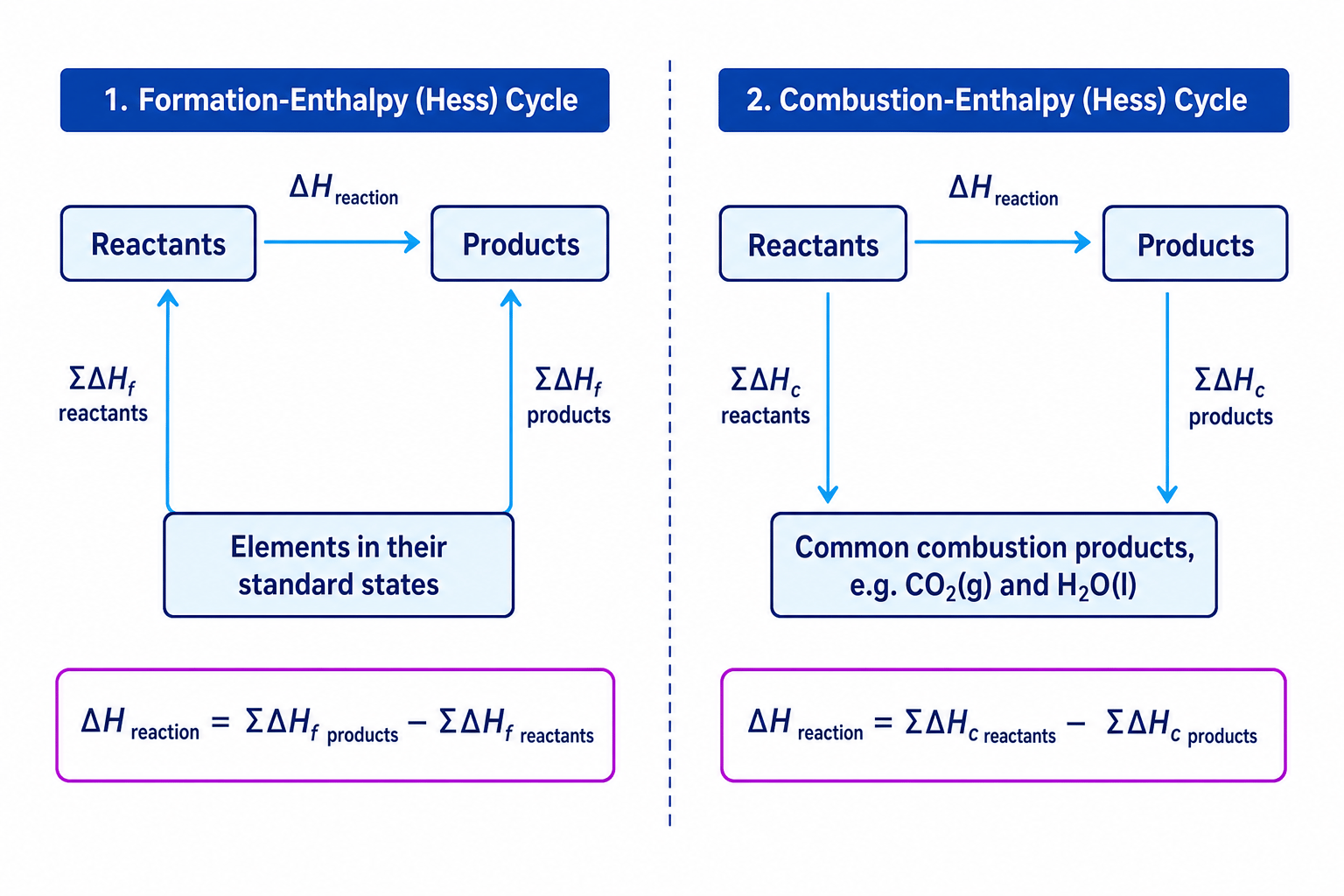
The arrows matter. If you go with an arrow, use the enthalpy value as written. If you go against an arrow, change the sign.
Arrow rule
Following an arrow keeps the sign of ΔH\Delta HΔH. Going against an arrow reverses the sign of ΔH\Delta HΔH.
Enthalpy of formation cycles
Standard enthalpy of formation
The standard enthalpy of formation, ΔHf∘\Delta H_f^\circΔHf∘, is the enthalpy change when one mole of a compound is formed from its elements in their standard states under standard conditions.
For example:
C(s, graphite)+2H2(g)→CH4(g)\text{C(s, graphite)} + 2\text{H}_2\text{(g)} \to \text{CH}_4\text{(g)}C(s, graphite)+2H2(g)→CH4(g)This represents the formation of one mole of methane, so its enthalpy change is ΔHf∘\Delta H_f^\circΔHf∘ for CH₄(g).
Elements in their standard states have ΔHf∘=0\Delta H_f^\circ = 0ΔHf∘=0 kJ mol⁻¹. For example, O₂(g), H₂(g), N₂(g), Cl₂(g), Br₂(l), I₂(s), and C(s, graphite) all have zero standard enthalpy of formation.
The formation formula
For a reaction:
reactants→products\text{reactants} \to \text{products}reactants→productsthe standard enthalpy change of reaction can be found using:
ΔHr∘=∑ΔHf∘(products)−∑ΔHf∘(reactants)\Delta H_r^\circ = \sum \Delta H_f^\circ \text{(products)} - \sum \Delta H_f^\circ \text{(reactants)}ΔHr∘=∑ΔHf∘(products)−∑ΔHf∘(reactants)Remember to multiply each ΔHf∘\Delta H_f^\circΔHf∘ value by the balancing coefficient in the equation.
Using enthalpies of formation
Calculate the standard enthalpy change for:
CH4(g)+2O2(g)→CO2(g)+2H2O(l)\text{CH}_4\text{(g)} + 2\text{O}_2\text{(g)} \to \text{CO}_2\text{(g)} + 2\text{H}_2\text{O(l)}CH4(g)+2O2(g)→CO2(g)+2H2O(l)Use the following standard enthalpies of formation:
- CH₄(g): −74.8 kJ mol⁻¹
- O₂(g): 0 kJ mol⁻¹
- CO₂(g): −393.5 kJ mol⁻¹
- H₂O(l): −285.8 kJ mol⁻¹
-
Calculate the total formation enthalpy of the products, including coefficients:
∑ΔHf∘(products)=−393.5+2(−285.8)=−965.1 kJ mol−1\sum \Delta H_f^\circ \text{(products)} = -393.5 + 2(-285.8) = -965.1 \text{ kJ mol}^{-1}∑ΔHf∘(products)=−393.5+2(−285.8)=−965.1 kJ mol−1 -
Calculate the total formation enthalpy of the reactants:
∑ΔHf∘(reactants)=−74.8+2(0)=−74.8 kJ mol−1\sum \Delta H_f^\circ \text{(reactants)} = -74.8 + 2(0) = -74.8 \text{ kJ mol}^{-1}∑ΔHf∘(reactants)=−74.8+2(0)=−74.8 kJ mol−1 -
Apply products minus reactants:
ΔHr∘=−965.1−(−74.8)=−890.3 kJ mol−1\Delta H_r^\circ = -965.1 - (-74.8) = -890.3 \text{ kJ mol}^{-1}ΔHr∘=−965.1−(−74.8)=−890.3 kJ mol−1
So the reaction is exothermic, with ΔHr∘=−890.3\Delta H_r^\circ = -890.3ΔHr∘=−890.3 kJ mol⁻¹.
Forgetting the coefficient
If the equation contains 2H₂O(l), you must use 2 times the enthalpy value for H₂O(l). The data value is for one mole, but the equation may contain more than one mole.
Enthalpy of combustion cycles
Standard enthalpy of combustion
The standard enthalpy of combustion, ΔHc∘\Delta H_c^\circΔHc∘, is the enthalpy change when one mole of a substance is completely burned in oxygen under standard conditions, with all substances in their standard states.
Combustion cycles are useful when you are given combustion data for the reactants and products of a reaction. In these cycles, both sides are burned to the same final substances, often CO₂(g) and H₂O(l).
For combustion cycles, the formula is:
ΔHr∘=∑ΔHc∘(reactants)−∑ΔHc∘(products)\Delta H_r^\circ = \sum \Delta H_c^\circ \text{(reactants)} - \sum \Delta H_c^\circ \text{(products)}ΔHr∘=∑ΔHc∘(reactants)−∑ΔHc∘(products)Notice this is the opposite order from the formation formula.
Formation vs combustion
Formation cycles use products minus reactants. Combustion cycles use reactants minus products.
Using enthalpies of combustion
Calculate the enthalpy change for the hydrogenation of ethene:
C2H4(g)+H2(g)→C2H6(g)\text{C}_2\text{H}_4\text{(g)} + \text{H}_2\text{(g)} \to \text{C}_2\text{H}_6\text{(g)}C2H4(g)+H2(g)→C2H6(g)Use the following standard enthalpies of combustion:
- C₂H₄(g): −1411 kJ mol⁻¹
- H₂(g): −286 kJ mol⁻¹
- C₂H₆(g): −1560 kJ mol⁻¹
-
Add the combustion enthalpies of the reactants:
∑ΔHc∘(reactants)=−1411+(−286)=−1697 kJ mol−1\sum \Delta H_c^\circ \text{(reactants)} = -1411 + (-286) = -1697 \text{ kJ mol}^{-1}∑ΔHc∘(reactants)=−1411+(−286)=−1697 kJ mol−1 -
Add the combustion enthalpies of the products:
∑ΔHc∘(products)=−1560 kJ mol−1\sum \Delta H_c^\circ \text{(products)} = -1560 \text{ kJ mol}^{-1}∑ΔHc∘(products)=−1560 kJ mol−1 -
Use reactants minus products:
ΔHr∘=−1697−(−1560)=−137 kJ mol−1\Delta H_r^\circ = -1697 - (-1560) = -137 \text{ kJ mol}^{-1}ΔHr∘=−1697−(−1560)=−137 kJ mol−1
So the hydrogenation of ethene has ΔHr∘=−137\Delta H_r^\circ = -137ΔHr∘=−137 kJ mol⁻¹.
Using the formation formula for combustion data
With combustion data, do not do products minus reactants. The cycle arrows go down from both reactants and products to the same combustion products, so the correct shortcut is reactants minus products.
Rearranging Hess cycles to find an unknown
Sometimes the unknown is not ΔHr∘\Delta H_r^\circΔHr∘. You may be asked to find an unknown enthalpy of formation or combustion.
The safest method is to write the normal Hess formula first, then substitute the unknown as a symbol.
Finding an unknown enthalpy of formation
The standard enthalpy of combustion of propane is −2220 kJ mol⁻¹:
C3H8(g)+5O2(g)→3CO2(g)+4H2O(l)\text{C}_3\text{H}_8\text{(g)} + 5\text{O}_2\text{(g)} \to 3\text{CO}_2\text{(g)} + 4\text{H}_2\text{O(l)}C3H8(g)+5O2(g)→3CO2(g)+4H2O(l)Find ΔHf∘\Delta H_f^\circΔHf∘ for C₃H₈(g), using:
- CO₂(g): ΔHf∘=−393.5\Delta H_f^\circ = -393.5ΔHf∘=−393.5 kJ mol⁻¹
- H₂O(l): ΔHf∘=−285.8\Delta H_f^\circ = -285.8ΔHf∘=−285.8 kJ mol⁻¹
- O₂(g): ΔHf∘=0\Delta H_f^\circ = 0ΔHf∘=0 kJ mol⁻¹
-
Let the unknown formation enthalpy of propane be xxx kJ mol⁻¹.
-
Use the formation equation for the combustion reaction:
ΔHr∘=∑ΔHf∘(products)−∑ΔHf∘(reactants)\Delta H_r^\circ = \sum \Delta H_f^\circ \text{(products)} - \sum \Delta H_f^\circ \text{(reactants)}ΔHr∘=∑ΔHf∘(products)−∑ΔHf∘(reactants) -
Substitute the values:
−2220=[3(−393.5)+4(−285.8)]−[x+5(0)]-2220 = \left[3(-393.5) + 4(-285.8)\right] - \left[x + 5(0)\right]−2220=[3(−393.5)+4(−285.8)]−[x+5(0)] -
Calculate and solve:
−2220=−2323.7−xx=−103.7\begin{aligned} -2220 &= -2323.7 - x \\ x &= -103.7 \end{aligned}−2220x=−2323.7−x=−103.7
So ΔHf∘\Delta H_f^\circΔHf∘ for C₃H₈(g) is −103.7 kJ mol⁻¹.
Using equations instead of diagrams
You can also use Hess’s law by manipulating thermochemical equations.
A thermochemical equation is a balanced chemical equation with an enthalpy change attached to it.
The rules are:
- If you reverse an equation, change the sign of ΔH\Delta HΔH.
- If you multiply an equation by a number, multiply ΔH\Delta HΔH by the same number.
- If you add equations, add their enthalpy changes.
This is the same chemistry as a Hess cycle, just written algebraically.
Sanity check
Most combustion enthalpies are negative because combustion is exothermic. If your calculated combustion value comes out positive, check your signs and arrows carefully.
Why Hess cycles are useful
Some enthalpy changes are hard to measure directly. For example, a reaction may be too slow, incomplete, unsafe, or may produce several products.
Hess’s law lets you calculate the desired enthalpy change using reactions that are easier to measure, such as combustion reactions or formation reactions.
In practical energetics, measured values often come from calorimetry using:
- q=mcΔTq = mc\Delta Tq=mcΔT
- n=m/Mn = m/Mn=m/M or n=cVn = cVn=cV
- ΔH=−q/n\Delta H = -q/nΔH=−q/n
The negative sign appears because the heat change of the reaction is opposite to the heat change of the surroundings.
Calorimetry values are often less exothermic
Experimental combustion enthalpies are often less negative than data book values because of heat loss, incomplete combustion, evaporation of fuel, or heating the apparatus as well as the water.
A quick method for any Hess calculation
When you meet a Hess cycle calculation, slow down and be systematic.
- Balance the target equation.
- Identify whether the data are formation, combustion, or other thermochemical equations.
- Multiply each enthalpy value by the balancing coefficient.
- Choose the correct sign using either the cycle arrows or the formula.
- Give the final answer in kJ mol⁻¹ for the reaction as written.
In the exam
- Check whether the data are ΔHf∘\Delta H_f^\circΔHf∘ or ΔHc∘\Delta H_c^\circΔHc∘ before choosing the formula.
- Include coefficients in your sums; enthalpy values are per mole of substance, not per equation automatically.
- Watch state symbols, especially H₂O(l) versus H₂O(g), and quote your final answer with a sign and units.
Check yourself
- Why is ΔHf∘\Delta H_f^\circΔHf∘ for O₂(g) equal to zero, but not necessarily for O₃(g)?
- In a combustion Hess cycle, why is the shortcut reactants minus products?
- What happens to ΔH\Delta HΔH if you reverse a thermochemical equation?
