What you'll learn
- How redox half-equations link to half-cells and electron flow.
- What standard electrode potential, E∘E^\circE∘, means and how it is measured.
- How to calculate Ecell∘E^\circ_\text{cell}Ecell∘ for an electrochemical cell.
- How to use electrode potential data to predict feasible redox reactions.
The redox ideas you need first
A redox reaction is a reaction involving electron transfer. One species loses electrons and another gains electrons.
Oxidation and reduction
Oxidation is loss of electrons. Reduction is gain of electrons. The mnemonic OIL RIG is useful: Oxidation Is Loss, Reduction Is Gain.
Half-equations show only one half of the electron transfer. For example:
Zn(s) → Zn²⁺(aq) + 2e⁻
Cu²⁺(aq) + 2e⁻ → Cu(s)
The first is oxidation because electrons are produced. The second is reduction because electrons are used up.
Combining half-equations
Use the two half-equations above to find the overall reaction.
-
Identify the oxidation half-equation: Zn(s) → Zn²⁺(aq) + 2e⁻.
-
Identify the reduction half-equation: Cu²⁺(aq) + 2e⁻ → Cu(s).
-
Add the half-equations and cancel the electrons, because electrons are transferred internally and do not appear in the overall equation:
Zn(s) + Cu²⁺(aq) → Zn²⁺(aq) + Cu(s)
Half-cells and electrochemical cells
A half-cell contains the oxidised and reduced forms of a redox pair. For example, Cu²⁺(aq) and Cu(s) form a half-cell.
An electrode is a conductor that allows electrons to enter or leave a half-cell. An electrolyte is an ionic solution or molten ionic compound that conducts electricity by ion movement.
When two different half-cells are connected, electrons can flow through an external wire. This forms an electrochemical cell.
Cell potential
The cell potential, also called the electromotive force or emf, is the potential difference between two half-cells. It is measured in volts, V.
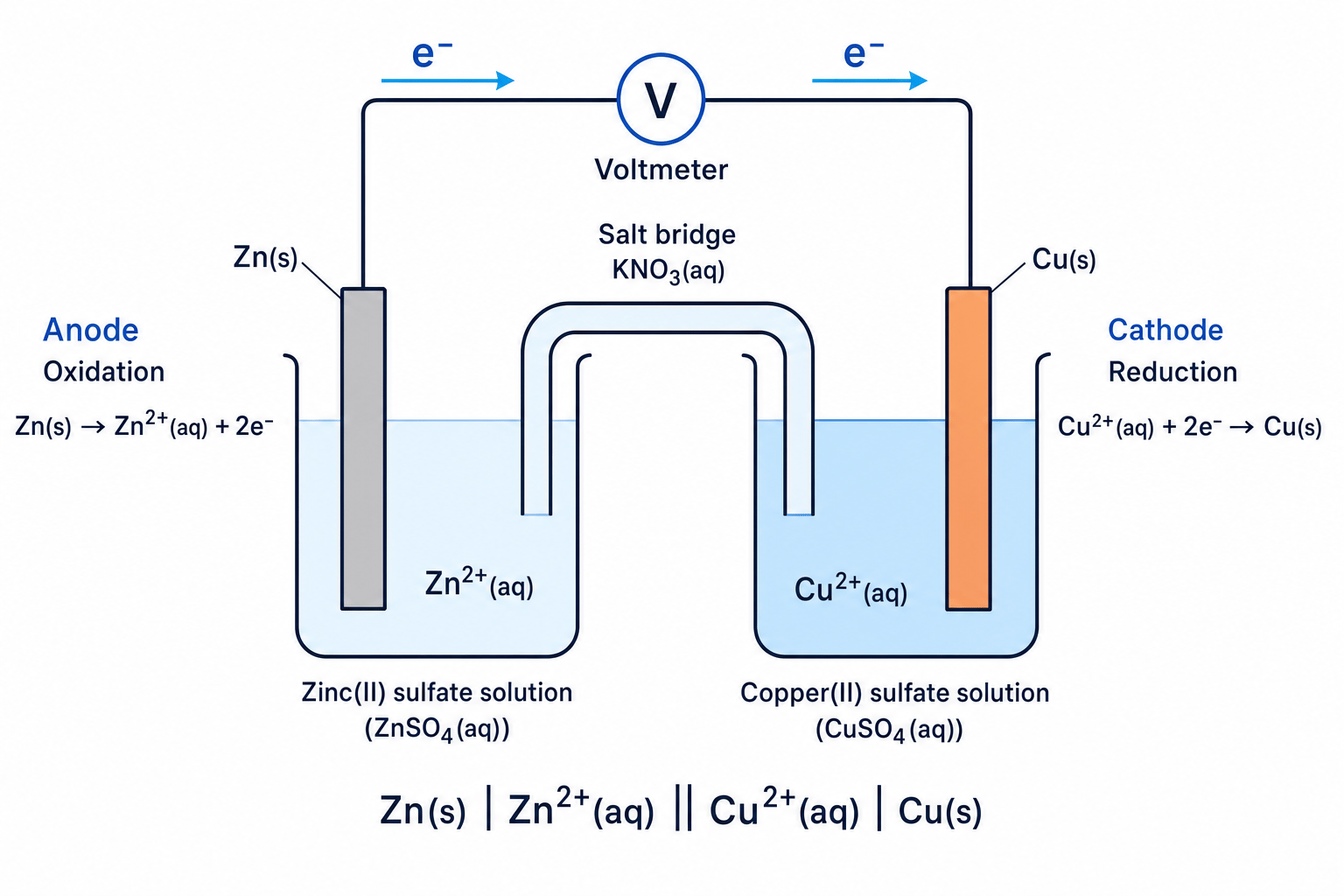
To complete the circuit, the two solutions are joined by a salt bridge, usually filter paper soaked in an inert electrolyte such as KNO₃(aq). The salt bridge lets ions move between solutions so charge does not build up.
Electron flow
Electrons flow from the half-cell where oxidation occurs to the half-cell where reduction occurs. Oxidation happens at the anode; reduction happens at the cathode.
Why a reference electrode is needed
You cannot measure the potential of one half-cell on its own. A voltmeter always measures a difference between two points.
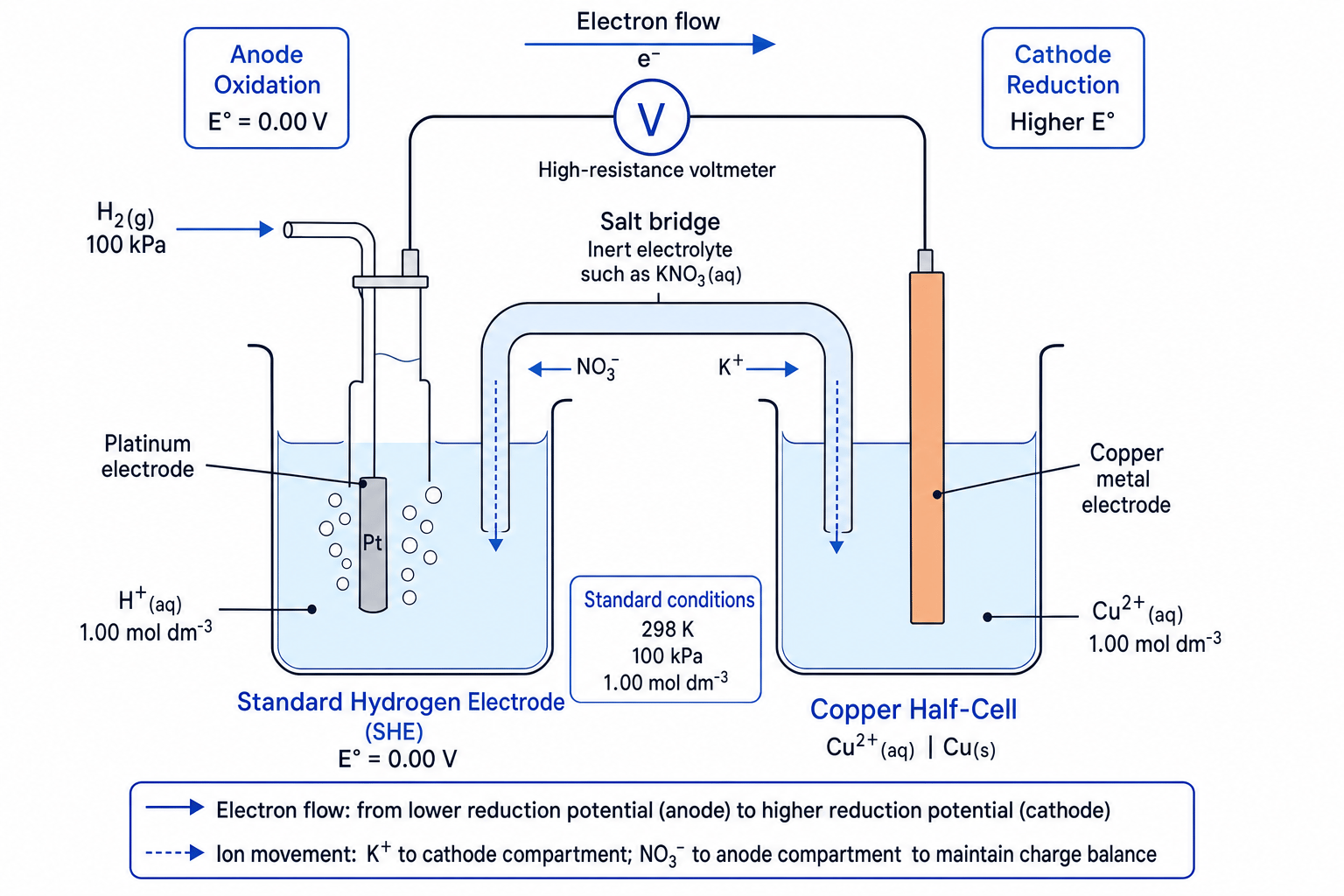
So chemists compare every half-cell with a reference electrode: the standard hydrogen electrode, often shortened to SHE.
Standard hydrogen electrode
The standard hydrogen electrode is assigned an electrode potential of exactly 0.00 V under standard conditions. It contains H₂(g) at 100 kPa, H⁺(aq) at 1.00 mol dm⁻³, and a platinum electrode at 298 K.
The half-equation for the standard hydrogen electrode is written as a reduction:
2H⁺(aq) + 2e⁻ ⇌ H₂(g)
Platinum is used because hydrogen gas and hydrogen ions need a conducting surface for electron transfer. Platinum is inert, meaning it does not take part chemically.
Standard electrode potential, E∘E^\circE∘
Standard electrode potential
The standard electrode potential, E∘E^\circE∘, is the emf of a half-cell connected to the standard hydrogen electrode under standard conditions, with all half-equations written as reductions.
Standard conditions are:
- temperature: 298 K
- solution concentration: 1.00 mol dm⁻³
- gas pressure: 100 kPa
- pure solids and liquids in their standard states
Electrode potential values in data books are listed as reduction potentials. That is why they are usually written with electrons on the left-hand side.
For example:
Cu²⁺(aq) + 2e⁻ ⇌ Cu(s) E∘=+0.34 VE^\circ = +0.34\ \text{V}E∘=+0.34 V
Zn²⁺(aq) + 2e⁻ ⇌ Zn(s) E∘=−0.76 VE^\circ = -0.76\ \text{V}E∘=−0.76 V
Meaning of a more positive value
A more positive E∘E^\circE∘ means the species on the left of the reduction half-equation is more easily reduced. It is therefore a stronger oxidising agent.
A very positive value means the half-cell has a strong tendency to accept electrons. A very negative value means the reduced form has a strong tendency to lose electrons instead.
Calculating Ecell∘E^\circ_\text{cell}Ecell∘
The safest formula is:
Ecell∘=Ecathode∘−Eanode∘E^\circ_\text{cell} = E^\circ_\text{cathode} - E^\circ_\text{anode}Ecell∘=Ecathode∘−Eanode∘The cathode is the half-cell undergoing reduction. The anode is the half-cell undergoing oxidation.
Because data book values are written as reductions, you do not change the sign of the anode value before substituting into the formula. The subtraction already deals with the fact that the anode reaction is reversed.
Calculating the emf of a zinc-copper cell
Calculate Ecell∘E^\circ_\text{cell}Ecell∘ for a cell made from Zn²⁺(aq)/Zn(s) and Cu²⁺(aq)/Cu(s).
Cu²⁺(aq) + 2e⁻ ⇌ Cu(s) E∘=+0.34 VE^\circ = +0.34\ \text{V}E∘=+0.34 V
Zn²⁺(aq) + 2e⁻ ⇌ Zn(s) E∘=−0.76 VE^\circ = -0.76\ \text{V}E∘=−0.76 V
-
Compare the reduction potentials. Cu²⁺/Cu has the more positive value, so Cu²⁺ is reduced at the cathode.
-
Zn/Zn²⁺ must therefore be the anode, where oxidation occurs: Zn(s) → Zn²⁺(aq) + 2e⁻.
-
Substitute into the cell potential equation:
Ecell∘=+0.34−(−0.76)=+1.10 VE^\circ_\text{cell} = +0.34 - (-0.76) = +1.10\ \text{V}Ecell∘=+0.34−(−0.76)=+1.10 V -
Write the overall reaction by combining oxidation and reduction:
Zn(s) + Cu²⁺(aq) → Zn²⁺(aq) + Cu(s)
Multiplying electrode potentials
Never multiply an E∘E^\circE∘ value when you multiply a half-equation to balance electrons. Electrode potential is an intensive value, so it does not depend on the amount of substance reacting.
Cell notation
Electrochemical cells are often written in a compact form called cell notation.
For the zinc-copper cell:
Zn(s) | Zn²⁺(aq) || Cu²⁺(aq) | Cu(s)
The rules are:
- a single vertical line, |, shows a phase boundary
- a double vertical line, ||, shows the salt bridge
- the anode is written on the left
- the cathode is written on the right
So this notation tells you that zinc is oxidised on the left and copper(II) ions are reduced on the right.
Left and right shortcut
If the cell is written in standard cell notation, use:
Ecell∘=Eright∘−Eleft∘E^\circ_\text{cell} = E^\circ_\text{right} - E^\circ_\text{left}Ecell∘=Eright∘−Eleft∘This works because the right-hand side is the cathode and the left-hand side is the anode.
Predicting whether a redox reaction is feasible
A reaction is thermodynamically feasible under standard conditions if the calculated Ecell∘E^\circ_\text{cell}Ecell∘ is positive.
Thermodynamically feasible
A reaction is thermodynamically feasible if it can happen energetically. This does not guarantee that it will happen quickly.
If Ecell∘E^\circ_\text{cell}Ecell∘ is positive, the forward reaction is feasible. If Ecell∘E^\circ_\text{cell}Ecell∘ is negative, the reverse reaction is feasible under standard conditions.
Predicting a halogen displacement reaction
Use the electrode potentials to decide whether chlorine will oxidise bromide ions.
Cl₂(g) + 2e⁻ ⇌ 2Cl⁻(aq) E∘=+1.36 VE^\circ = +1.36\ \text{V}E∘=+1.36 V
Br₂(aq) + 2e⁻ ⇌ 2Br⁻(aq) E∘=+1.07 VE^\circ = +1.07\ \text{V}E∘=+1.07 V
-
Chlorine has the more positive reduction potential, so Cl₂ is more readily reduced to Cl⁻.
-
Bromide ions must be oxidised, so reverse the bromine half-equation: 2Br⁻(aq) → Br₂(aq) + 2e⁻.
-
Calculate the cell potential using the reduction potential for the cathode and the reduction potential for the anode pair:
Ecell∘=+1.36−(+1.07)=+0.29 VE^\circ_\text{cell} = +1.36 - (+1.07) = +0.29\ \text{V}Ecell∘=+1.36−(+1.07)=+0.29 V -
Since Ecell∘E^\circ_\text{cell}Ecell∘ is positive, the reaction is feasible:
Cl₂(g) + 2Br⁻(aq) → 2Cl⁻(aq) + Br₂(aq)
Disproportionation using electrode potentials
A disproportionation reaction is a redox reaction where the same species is both oxidised and reduced.
Disproportionation
Disproportionation occurs when one element in a single oxidation state forms products where that element has been both oxidised and reduced.
Electrode potentials can be used to test whether disproportionation is feasible.
Predicting disproportionation of copper(I) ions
Decide whether Cu⁺(aq) can disproportionate to Cu²⁺(aq) and Cu(s).
Cu²⁺(aq) + e⁻ ⇌ Cu⁺(aq) E∘=+0.15 VE^\circ = +0.15\ \text{V}E∘=+0.15 V
Cu⁺(aq) + e⁻ ⇌ Cu(s) E∘=+0.52 VE^\circ = +0.52\ \text{V}E∘=+0.52 V
-
Reduction of Cu⁺ to Cu has the more positive relevant potential, so use it as the cathode reaction: Cu⁺(aq) + e⁻ → Cu(s).
-
Oxidation of Cu⁺ to Cu²⁺ is the reverse of the first half-equation: Cu⁺(aq) → Cu²⁺(aq) + e⁻.
-
Calculate the cell potential:
Ecell∘=+0.52−(+0.15)=+0.37 VE^\circ_\text{cell} = +0.52 - (+0.15) = +0.37\ \text{V}Ecell∘=+0.52−(+0.15)=+0.37 V -
The value is positive, so disproportionation is feasible:
2Cu⁺(aq) → Cu²⁺(aq) + Cu(s)
Limitations of predictions
Electrode potential predictions are powerful, but they are not perfect predictions of what you will observe in a test tube.
Positive does not always mean fast
A positive Ecell∘E^\circ_\text{cell}Ecell∘ means a reaction is thermodynamically feasible under standard conditions. It may still be very slow if there is a high activation energy or if a protective oxide layer forms on a metal surface.
The value of an electrode potential also changes if conditions are not standard. Concentration, pressure and temperature can all affect the measured emf.
For example, if a solution is not 1.00 mol dm⁻³, the actual cell potential may differ from Ecell∘E^\circ_\text{cell}Ecell∘. At A-Level, you usually use the standard values unless the question explicitly tells you otherwise.
Practical details when measuring emf
In the lab, a high-resistance voltmeter is used so that very little current flows. This helps measure the potential difference without significantly changing the concentrations in the half-cells.
Important practical controls include:
- keeping solutions at the same temperature
- using clean metal electrodes
- using 1.00 mol dm⁻³ solutions for standard measurements
- using an inert salt bridge, such as KNO₃(aq), so the ions do not react with the half-cell chemicals
- ensuring gases, if present, are supplied at 100 kPa
Forgetting the salt bridge
Without a salt bridge, charge builds up in the half-cells and electron flow quickly stops. The voltmeter reading will not represent a proper cell emf.
Summary of the logic
To solve most electrode potential questions:
-
Write or identify the relevant reduction half-equations.
-
The more positive E∘E^\circE∘ value is reduced at the cathode.
-
The less positive E∘E^\circE∘ value is reversed for oxidation at the anode.
-
Calculate Ecell∘E^\circ_\text{cell}Ecell∘ using:
Ecell∘=Ecathode∘−Eanode∘E^\circ_\text{cell} = E^\circ_\text{cathode} - E^\circ_\text{anode}Ecell∘=Ecathode∘−Eanode∘ -
If Ecell∘E^\circ_\text{cell}Ecell∘ is positive, the reaction is feasible under standard conditions.
In the exam
-
Do not flip signs too early. Use the data book reduction potentials directly in Ecathode∘−Eanode∘E^\circ_\text{cathode} - E^\circ_\text{anode}Ecathode∘−Eanode∘.
-
State conditions when asked for standard electrode potential: 298 K, 100 kPa for gases, 1.00 mol dm⁻³ for solutions, and comparison with the standard hydrogen electrode.
-
Separate feasibility from rate. A positive Ecell∘E^\circ_\text{cell}Ecell∘ predicts thermodynamic feasibility, not necessarily an observable fast reaction.
Check yourself
- Why can’t the potential of a single half-cell be measured on its own?
- In a cell with Mg²⁺/Mg and Ag⁺/Ag, which half-cell would be the cathode?
- Why must a salt bridge contain ions that do not react with either half-cell?