

What you'll learn
- What Gibbs free energy change means, and how it links enthalpy and entropy.
- How to use ΔG=ΔH−TΔS\Delta G = \Delta H - T\Delta SΔG=ΔH−TΔS with correct units.
- How temperature can make some reactions feasible or not feasible.
- How to calculate ΔG∘\Delta G^\circΔG∘ from standard Gibbs free energies of formation.
The big idea: reactions need a thermodynamic “driving force”
In Energetics II, you move beyond simply asking whether a reaction is exothermic. Some endothermic reactions happen, and some exothermic reactions do not happen unless conditions are right.
To predict whether a reaction is thermodynamically feasible, you need to consider both:
- enthalpy change, ΔH\Delta HΔH
- entropy change, ΔS\Delta SΔS
Gibbs free energy combines these into one value: ΔG\Delta GΔG.
Thermodynamically feasible
A reaction is thermodynamically feasible under given conditions if its Gibbs free energy change is negative: ΔG<0\Delta G < 0ΔG<0. This means the reaction is energetically possible, but it does not mean it will happen quickly.
Prerequisite 1: enthalpy change
Enthalpy change
The enthalpy change, ΔH\Delta HΔH, is the heat energy change of a reaction at constant pressure. Exothermic reactions have ΔH<0\Delta H < 0ΔH<0; endothermic reactions have ΔH>0\Delta H > 0ΔH>0.
For example, combustion reactions are usually exothermic, so their ΔH\Delta HΔH values are negative. Thermal decompositions are often endothermic, so their ΔH\Delta HΔH values are positive.
Enthalpy alone is not enough to predict feasibility. A reaction can absorb heat and still be feasible if it causes a large enough increase in entropy.
Prerequisite 2: entropy change
Entropy
Entropy, SSS, is a measure of how dispersed the energy and particles are in a system. A higher entropy means more possible arrangements of particles and energy.
For A-Level Chemistry, the most useful trends are:
- gases usually have much higher entropy than liquids or solids
- more moles of gas usually means higher entropy
- dissolving or mixing often increases entropy
- a more complex molecule often has higher entropy than a simpler molecule
The entropy change of a reaction, ΔS\Delta SΔS, is calculated from standard entropy values:
ΔS∘=∑S∘(products)−∑S∘(reactants)\Delta S^\circ = \sum S^\circ(\text{products}) - \sum S^\circ(\text{reactants})ΔS∘=∑S∘(products)−∑S∘(reactants)Remember to multiply each entropy value by its balancing coefficient.
Elements still have entropy
Standard entropies, S∘S^\circS∘, of elements are not zero. This is different from standard enthalpies of formation and standard Gibbs free energies of formation, which are zero for elements in their standard states.
Calculating an entropy change
Calcium carbonate decomposes when heated:
CaCO₃(s) → CaO(s) + CO₂(g)
Standard entropy values:
- CaCO₃(s): 92.9 J K⁻¹ mol⁻¹
- CaO(s): 39.8 J K⁻¹ mol⁻¹
- CO₂(g): 213.7 J K⁻¹ mol⁻¹
-
Use products minus reactants, including the 1:1:1 molar ratio:
ΔS∘=[39.8+213.7]−[92.9]\Delta S^\circ = [39.8 + 213.7] - [92.9]ΔS∘=[39.8+213.7]−[92.9] -
Calculate the entropy change:
ΔS∘=253.5−92.9=160.6 J K−1 mol−1\Delta S^\circ = 253.5 - 92.9 = 160.6\ \text{J K}^{-1}\text{ mol}^{-1}ΔS∘=253.5−92.9=160.6 J K−1 mol−1 -
Interpret the sign: ΔS∘\Delta S^\circΔS∘ is positive because one mole of gas is produced from a solid, so the particles become more dispersed.
Gibbs free energy change
Gibbs free energy change
The Gibbs free energy change, ΔG\Delta GΔG, combines enthalpy, entropy and temperature to predict whether a reaction is thermodynamically feasible at constant temperature and pressure.
The key equation is:
ΔG=ΔH−TΔS\Delta G = \Delta H - T\Delta SΔG=ΔH−TΔSwhere:
- ΔG\Delta GΔG is the Gibbs free energy change, usually in kJ mol⁻¹
- ΔH\Delta HΔH is the enthalpy change, usually in kJ mol⁻¹
- TTT is the temperature in K
- ΔS\Delta SΔS is the entropy change, usually first given in J K⁻¹ mol⁻¹
The sign of ΔG decides feasibility
- If ΔG<0\Delta G < 0ΔG<0, the reaction is thermodynamically feasible.
- If ΔG=0\Delta G = 0ΔG=0, the system is at equilibrium under those conditions.
- If ΔG>0\Delta G > 0ΔG>0, the reaction is not thermodynamically feasible as written.
Why the equation makes sense
Entropy change of the universe decides whether a process is feasible. The universe means:
- the system: the reacting chemicals
- the surroundings: everything outside the reacting chemicals
Gibbs free energy is useful because it lets you focus on the system only. It includes the entropy effect of the surroundings through the enthalpy term.
The essential unit conversion
This is the most common calculation trap in this topic.
ΔH\Delta HΔH is usually given in kJ mol⁻¹, but ΔS\Delta SΔS is usually given in J K⁻¹ mol⁻¹.
Before using ΔG=ΔH−TΔS\Delta G = \Delta H - T\Delta SΔG=ΔH−TΔS, convert entropy into kJ K⁻¹ mol⁻¹:
ΔS in kJ K−1 mol−1=ΔS in J K−1 mol−11000\Delta S\text{ in kJ K}^{-1}\text{ mol}^{-1} = \frac{\Delta S\text{ in J K}^{-1}\text{ mol}^{-1}}{1000}ΔS in kJ K−1 mol−1=1000ΔS in J K−1 mol−1Forgetting to convert entropy units
Do not substitute ΔS=160.6 J K−1 mol−1\Delta S = 160.6\ \text{J K}^{-1}\text{ mol}^{-1}ΔS=160.6 J K−1 mol−1 directly next to ΔH=178 kJ mol−1\Delta H = 178\ \text{kJ mol}^{-1}ΔH=178 kJ mol−1. Convert it to 0.1606 kJ K−1 mol−10.1606\ \text{kJ K}^{-1}\text{ mol}^{-1}0.1606 kJ K−1 mol−1 first.
Calculating Gibbs free energy
For the decomposition of calcium carbonate:
CaCO₃(s) → CaO(s) + CO₂(g)
Use ΔH∘=+178.3 kJ mol−1\Delta H^\circ = +178.3\ \text{kJ mol}^{-1}ΔH∘=+178.3 kJ mol−1 and ΔS∘=+160.6 J K−1 mol−1\Delta S^\circ = +160.6\ \text{J K}^{-1}\text{ mol}^{-1}ΔS∘=+160.6 J K−1 mol−1 at 298 K.
-
Convert the entropy change into kJ K⁻¹ mol⁻¹:
ΔS∘=160.61000=0.1606 kJ K−1 mol−1\Delta S^\circ = \frac{160.6}{1000} = 0.1606\ \text{kJ K}^{-1}\text{ mol}^{-1}ΔS∘=1000160.6=0.1606 kJ K−1 mol−1 -
Substitute into the Gibbs equation:
ΔG∘=178.3−(298)(0.1606)\Delta G^\circ = 178.3 - (298)(0.1606)ΔG∘=178.3−(298)(0.1606) -
Calculate the value:
ΔG∘=178.3−47.9=+130.4 kJ mol−1\Delta G^\circ = 178.3 - 47.9 = +130.4\ \text{kJ mol}^{-1}ΔG∘=178.3−47.9=+130.4 kJ mol−1 -
Decide feasibility: ΔG∘\Delta G^\circΔG∘ is positive, so the decomposition is not thermodynamically feasible under standard conditions at 298 K.
How temperature affects feasibility
The temperature term is TΔST\Delta STΔS, so temperature only affects ΔG\Delta GΔG if there is an entropy change.
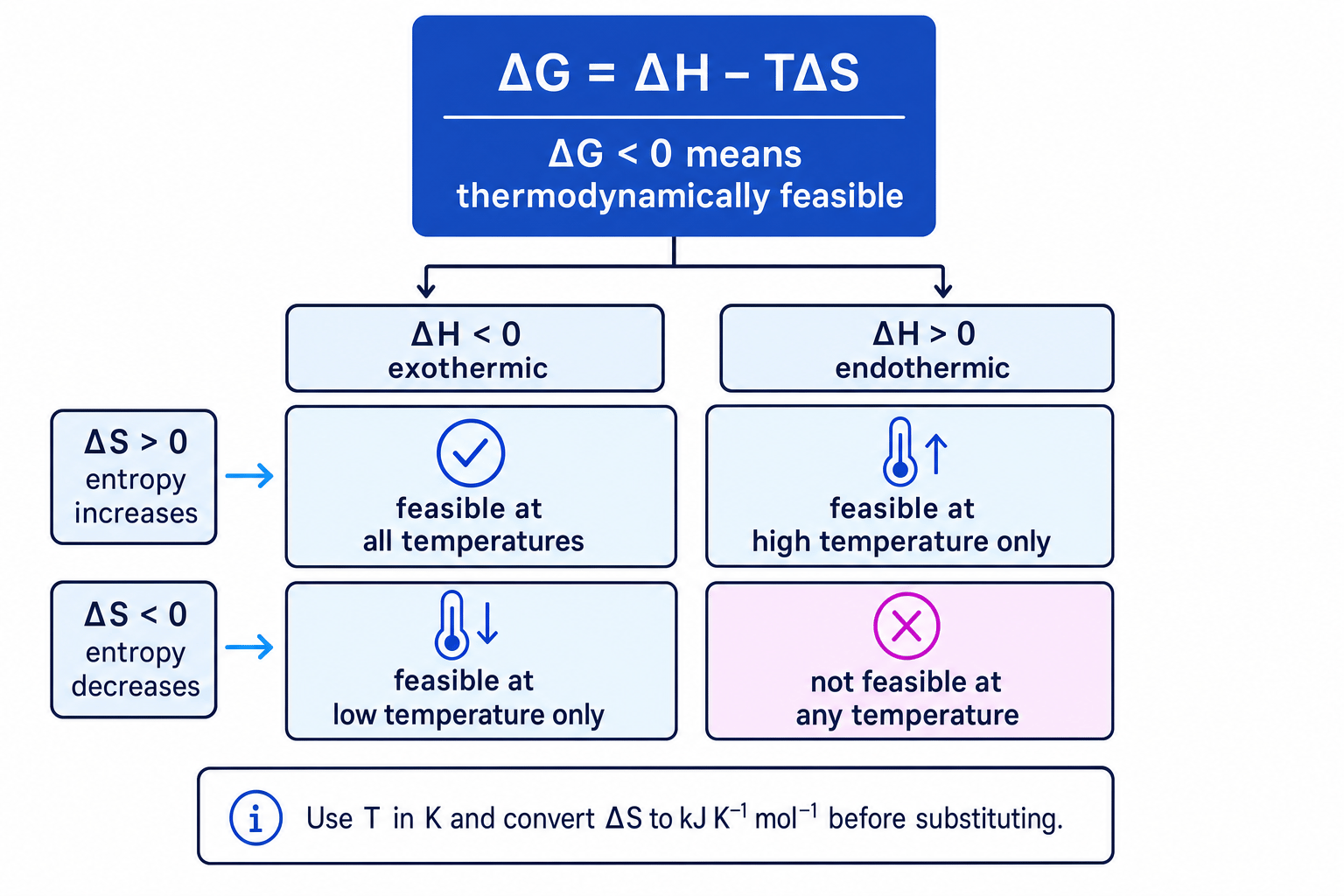
The sign pattern is easiest to remember as a grid: combine whether the reaction is exothermic or endothermic with whether entropy increases or decreases.
The four cases
- ΔH<0\Delta H < 0ΔH<0 and ΔS>0\Delta S > 0ΔS>0: feasible at all temperatures.
- ΔH>0\Delta H > 0ΔH>0 and ΔS<0\Delta S < 0ΔS<0: not feasible at any temperature.
- ΔH<0\Delta H < 0ΔH<0 and ΔS<0\Delta S < 0ΔS<0: feasible at low temperature only.
- ΔH>0\Delta H > 0ΔH>0 and ΔS>0\Delta S > 0ΔS>0: feasible at high temperature only.
Temperature logic
If ΔS\Delta SΔS is positive, increasing temperature makes −TΔS-T\Delta S−TΔS more negative, so high temperature helps feasibility. If ΔS\Delta SΔS is negative, increasing temperature makes −TΔS-T\Delta S−TΔS more positive, so high temperature works against feasibility.
Finding the temperature for feasibility
For CaCO₃(s) → CaO(s) + CO₂(g), use:
- ΔH∘=+178.3 kJ mol−1\Delta H^\circ = +178.3\ \text{kJ mol}^{-1}ΔH∘=+178.3 kJ mol−1
- ΔS∘=+0.1606 kJ K−1 mol−1\Delta S^\circ = +0.1606\ \text{kJ K}^{-1}\text{ mol}^{-1}ΔS∘=+0.1606 kJ K−1 mol−1
Find the temperature where the reaction just becomes feasible.
-
At the boundary between feasible and not feasible, set ΔG=0\Delta G = 0ΔG=0:
0=ΔH−TΔS0 = \Delta H - T\Delta S0=ΔH−TΔS -
Rearrange for temperature:
T=ΔHΔST = \frac{\Delta H}{\Delta S}T=ΔSΔH -
Substitute the values, keeping units consistent:
T=178.30.1606=1110 KT = \frac{178.3}{0.1606} = 1110\ \text{K}T=0.1606178.3=1110 K -
Interpret the result: because ΔH\Delta HΔH is positive and ΔS\Delta SΔS is positive, the reaction becomes feasible above about 1110 K.
Threshold temperatures are approximate
Calculations like T=ΔHΔST = \frac{\Delta H}{\Delta S}T=ΔSΔH assume that ΔH\Delta HΔH and ΔS\Delta SΔS stay constant as temperature changes. In reality they can vary with temperature, but this approximation is normally expected at A-Level.
Standard conditions and standard Gibbs changes
A superscript ° means standard conditions. In A-Level Chemistry this usually means:
- temperature of 298 K, unless stated otherwise
- pressure of 100 kPa
- solutions at concentration 1.00 mol dm⁻³
- substances in their standard states
So ΔG∘\Delta G^\circΔG∘ means the standard Gibbs free energy change.
Using standard Gibbs free energies of formation
Standard Gibbs free energy of formation
The standard Gibbs free energy of formation, ΔGf∘\Delta G_f^\circΔGf∘, is the Gibbs free energy change when one mole of a compound is formed from its elements in their standard states under standard conditions.
You can calculate a reaction’s standard Gibbs free energy change using:
ΔG∘=∑ΔGf∘(products)−∑ΔGf∘(reactants)\Delta G^\circ = \sum \Delta G_f^\circ(\text{products}) - \sum \Delta G_f^\circ(\text{reactants})ΔG∘=∑ΔGf∘(products)−∑ΔGf∘(reactants)Elements in their standard states have ΔGf∘=0\Delta G_f^\circ = 0ΔGf∘=0.
Using Gibbs formation values
Calculate ΔG∘\Delta G^\circΔG∘ for the hydrogenation of ethene:
C₂H₄(g) + H₂(g) → C₂H₆(g)
Use:
- ΔGf∘\Delta G_f^\circΔGf∘ of C₂H₄(g) = +68.1 kJ mol⁻¹
- ΔGf∘\Delta G_f^\circΔGf∘ of H₂(g) = 0 kJ mol⁻¹
- ΔGf∘\Delta G_f^\circΔGf∘ of C₂H₆(g) = −32.9 kJ mol⁻¹
-
Apply products minus reactants:
ΔG∘=[−32.9]−[68.1+0]\Delta G^\circ = [-32.9] - [68.1 + 0]ΔG∘=[−32.9]−[68.1+0] -
Calculate the Gibbs free energy change:
ΔG∘=−101.0 kJ mol−1\Delta G^\circ = -101.0\ \text{kJ mol}^{-1}ΔG∘=−101.0 kJ mol−1 -
Interpret the sign: the value is negative, so the hydrogenation of ethene is thermodynamically feasible under standard conditions.
Feasible does not always mean observable
A negative ΔG\Delta GΔG tells you a reaction is thermodynamically possible. It does not tell you about the rate.
A reaction may be feasible but extremely slow if it has a high activation energy. For example, many fuels are thermodynamically feasible to burn in oxygen, but they do not ignite without a spark or flame.
Confusing thermodynamics with kinetics
Gibbs free energy predicts whether a reaction is possible. It does not predict how fast it happens. Rate depends on activation energy, catalysts, concentration, temperature and other kinetic factors.
In the exam
- Check the units before substituting: ΔH\Delta HΔH and ΔG\Delta GΔG are usually in kJ mol⁻¹, while ΔS\Delta SΔS is usually in J K⁻¹ mol⁻¹.
- Always use temperature in K, not °C.
- After calculating ΔG\Delta GΔG, state the sign and link it clearly to feasibility under the stated conditions.
Check yourself
- Why can an endothermic reaction become feasible at high temperature?
- What unit conversion is usually needed before using ΔG=ΔH−TΔS\Delta G = \Delta H - T\Delta SΔG=ΔH−TΔS?
- What is the difference between a reaction being thermodynamically feasible and being fast?
