What you'll learn
- What the carbonyl group is, and how aldehydes and ketones differ.
- Why the C=O bond is polar and reactive towards nucleophiles.
- How aldehydes and ketones react in oxidation, reduction and HCN addition.
- How to identify carbonyl compounds using 2,4-DNPH, Tollens’, Fehling’s and iodoform tests.
The carbonyl group
A functional group is the atom or group of atoms that gives an organic molecule its characteristic reactions. In this topic, the key functional group is C=O.
Carbonyl group
A carbonyl group is a carbon atom double-bonded to an oxygen atom: C=O. In A-Level carbonyl chemistry, the main carbonyl compounds are aldehydes and ketones.
An R group means a hydrocarbon group such as CH₃–, CH₃CH₂– or a ring.
- An aldehyde has the carbonyl group at the end of the chain: RCHO.
- A ketone has the carbonyl group within the chain: RCOR′, so the carbonyl carbon is bonded to two carbon groups.
Naming aldehydes and ketones
For aldehydes, use the suffix -al. The carbonyl carbon is automatically carbon 1, so you usually do not need a number: ethanal, propanal, butanal.
For ketones, use the suffix -one and number the chain to give the C=O carbon the lowest possible number: propanone, butan-2-one, pentan-3-one.
Spotting the family
Aldehydes have a terminal -CHO group. Ketones have a C=O group with carbon atoms on both sides, so the carbonyl group is “in the middle” of the carbon skeleton.
Naming a carbonyl compound
Name CH₃CH₂COCH₃.
- Choose the longest chain containing the C=O group: there are four carbons, so the parent name is based on butanone.
- Number from the end giving the carbonyl carbon the lower number: the C=O is on carbon 2, not carbon 3.
- Add the locant before the suffix: the name is butan-2-one.
Why carbonyl compounds react
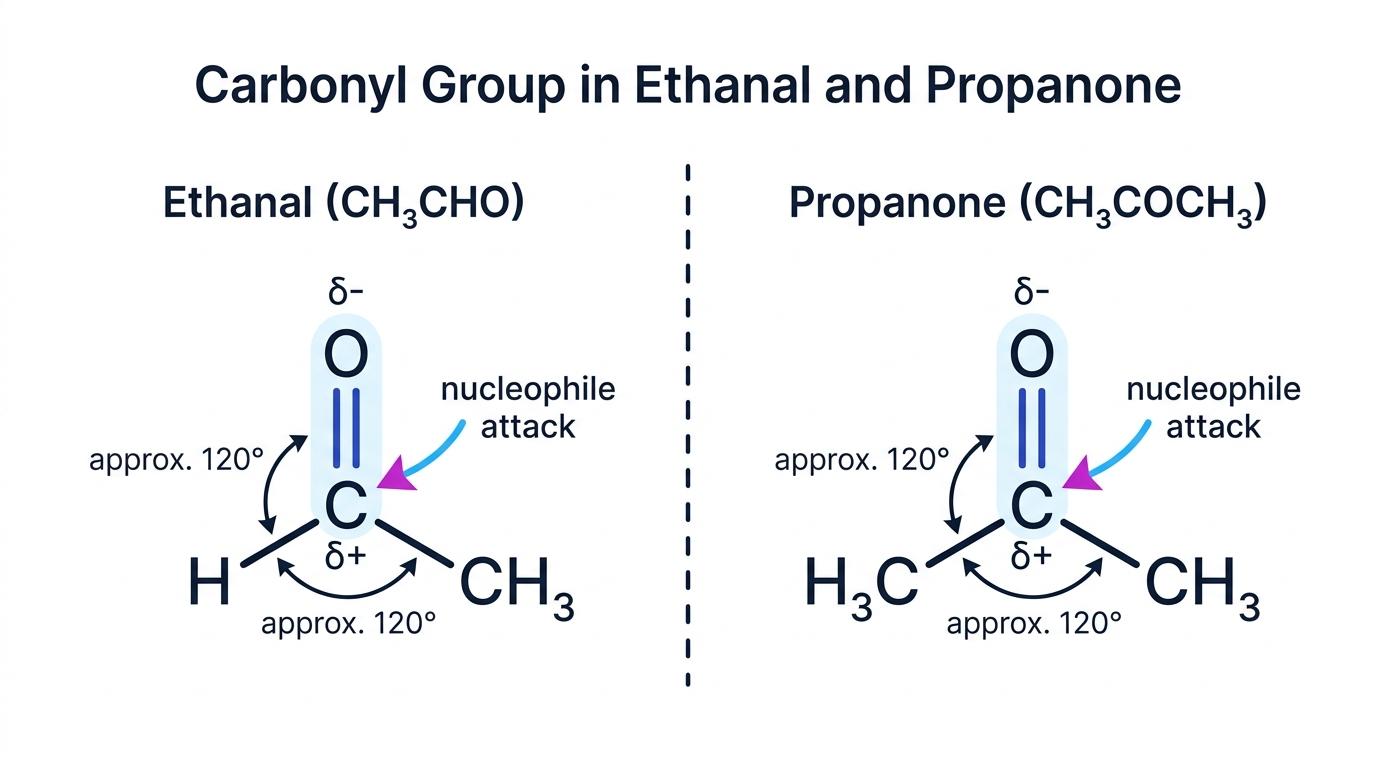
Oxygen is more electronegative than carbon, so the C=O bond is polar. The oxygen is δ− and the carbonyl carbon is δ+.
The carbonyl carbon is also trigonal planar, with bond angles of about 120°. This flat shape matters because attacking species can approach from either side of the C=O group.
Nucleophile
A nucleophile is an electron-pair donor. It forms a covalent bond by donating a lone pair or bonding pair to an electron-deficient atom.
The carbonyl reaction pattern
Many carbonyl reactions begin with a nucleophile attacking the δ+ carbonyl carbon. The C=O π bond then breaks, with the electron pair moving onto oxygen.
Small aldehydes and ketones can form hydrogen bonds to water because the oxygen has lone pairs, so they are fairly soluble. However, they cannot hydrogen bond to each other as strongly as alcohols because they do not contain an O–H bond.
Making aldehydes and ketones from alcohols
You met this in alcohol chemistry, but it is very important here.
From primary alcohols
A primary alcohol can be oxidised to an aldehyde, then further to a carboxylic acid.
To make an aldehyde, use acidified potassium dichromate(VI), K₂Cr₂O₇/H₂SO₄, and distil the aldehyde as it forms:
CH₃CH₂OH + [O] → CH₃CHO + H₂O
The orange dichromate(VI) ions are reduced to green chromium(III) ions.
From secondary alcohols
A secondary alcohol is oxidised to a ketone:
CH₃CH(OH)CH₃ + [O] → CH₃COCH₃ + H₂O
Use acidified potassium dichromate(VI) under reflux. Ketones are not normally oxidised further under these conditions.
Distillation vs reflux
To make an aldehyde from a primary alcohol, distil the product off as it forms. If you reflux a primary alcohol with excess oxidising agent, the aldehyde is further oxidised to a carboxylic acid.
Choosing conditions for oxidation
You want to prepare propanal from propan-1-ol.
- Propan-1-ol is a primary alcohol, so oxidation can give an aldehyde first and then a carboxylic acid if the reaction continues.
- Choose acidified potassium dichromate(VI), but use distillation so propanal leaves the reaction mixture before further oxidation.
- The target equation is: CH₃CH₂CH₂OH + [O] → CH₃CH₂CHO + H₂O.
Oxidation and reduction of carbonyl compounds
Oxidation
Aldehydes are readily oxidised to carboxylic acids:
RCHO + [O] → RCOOH
Ketones are resistant to oxidation by common A-Level oxidising agents such as acidified potassium dichromate(VI).
Reduction
Reduction adds hydrogen across the C=O group. The usual reagent is sodium tetrahydridoborate(III), NaBH₄, often called sodium borohydride.
-
Aldehyde → primary alcohol
RCHO + 2[H] → RCH₂OH -
Ketone → secondary alcohol
RCOR′ + 2[H] → RCH(OH)R′
In mechanism terms, NaBH₄ provides H⁻, a hydride ion, which acts as a nucleophile.
Predicting redox products
Predict the products when propanal and propanone are separately treated with NaBH₄.
- Classify the carbonyl compounds: propanal is an aldehyde, while propanone is a ketone.
- Apply the reduction rule: aldehydes reduce to primary alcohols; ketones reduce to secondary alcohols.
- Therefore propanal forms propan-1-ol, CH₃CH₂CH₂OH, and propanone forms propan-2-ol, CH₃CH(OH)CH₃.
Nucleophilic addition of HCN
An addition reaction is one where two reactants combine to form one main product. Aldehydes and ketones react with hydrogen cyanide, HCN, to form hydroxynitriles.
The useful nucleophile is CN⁻. It attacks the δ+ carbonyl carbon, then the negatively charged oxygen is protonated to form an alcohol group. The diagram shows the full mechanism for ethanal.
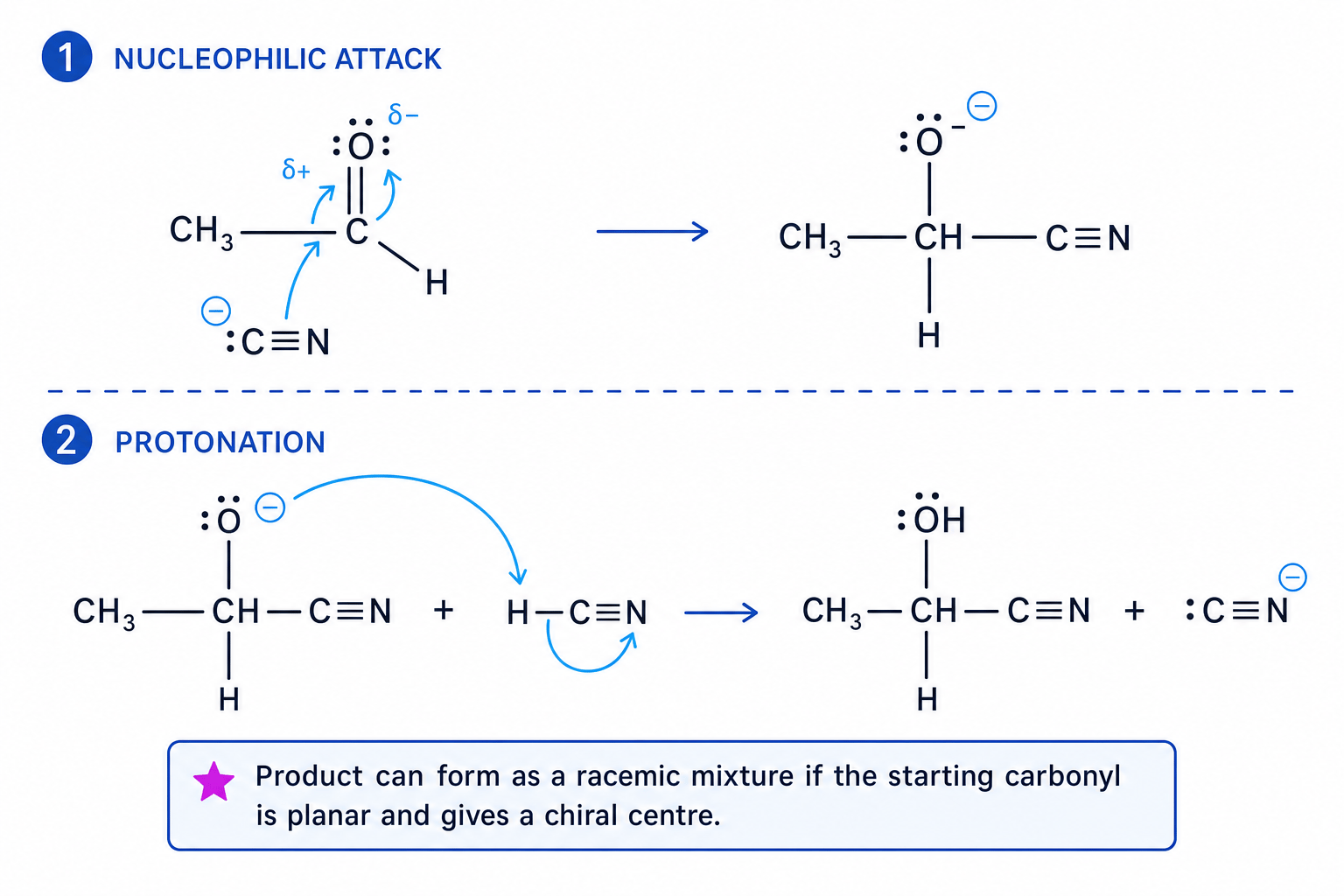
For ethanal:
CH₃CHO + HCN → CH₃CH(OH)CN
The product is 2-hydroxypropanenitrile. Notice that the nitrile carbon is included in the longest chain when naming the product.
Hydrogen cyanide safety
HCN and cyanide salts are highly toxic. In practical work they require strict control, but in exams you still need to know the reagent system and the mechanism.
Forming and naming a hydroxynitrile
Propanal reacts with HCN. Predict and name the product.
- Add CN to the carbonyl carbon and H to the oxygen: CH₃CH₂CHO becomes CH₃CH₂CH(OH)CN.
- For naming, include the nitrile carbon as carbon 1 of the main chain: the product has four carbons, so the parent is butanenitrile.
- The OH group is on carbon 2, so the product is 2-hydroxybutanenitrile.
Optical isomerism in HCN addition
A chiral centre is a carbon atom bonded to four different groups. If HCN addition creates a chiral centre, the product may form as a racemic mixture, meaning a 50:50 mixture of two enantiomers.
This happens because the carbonyl group is planar, so CN⁻ can attack from either side with equal probability.
Racemate only if a chiral centre forms
Do not automatically write “racemic mixture” for every carbonyl addition. Propanone plus HCN gives (CH₃)₂C(OH)CN, where the central carbon has two identical CH₃ groups, so it is not chiral.
Tests for aldehydes and ketones
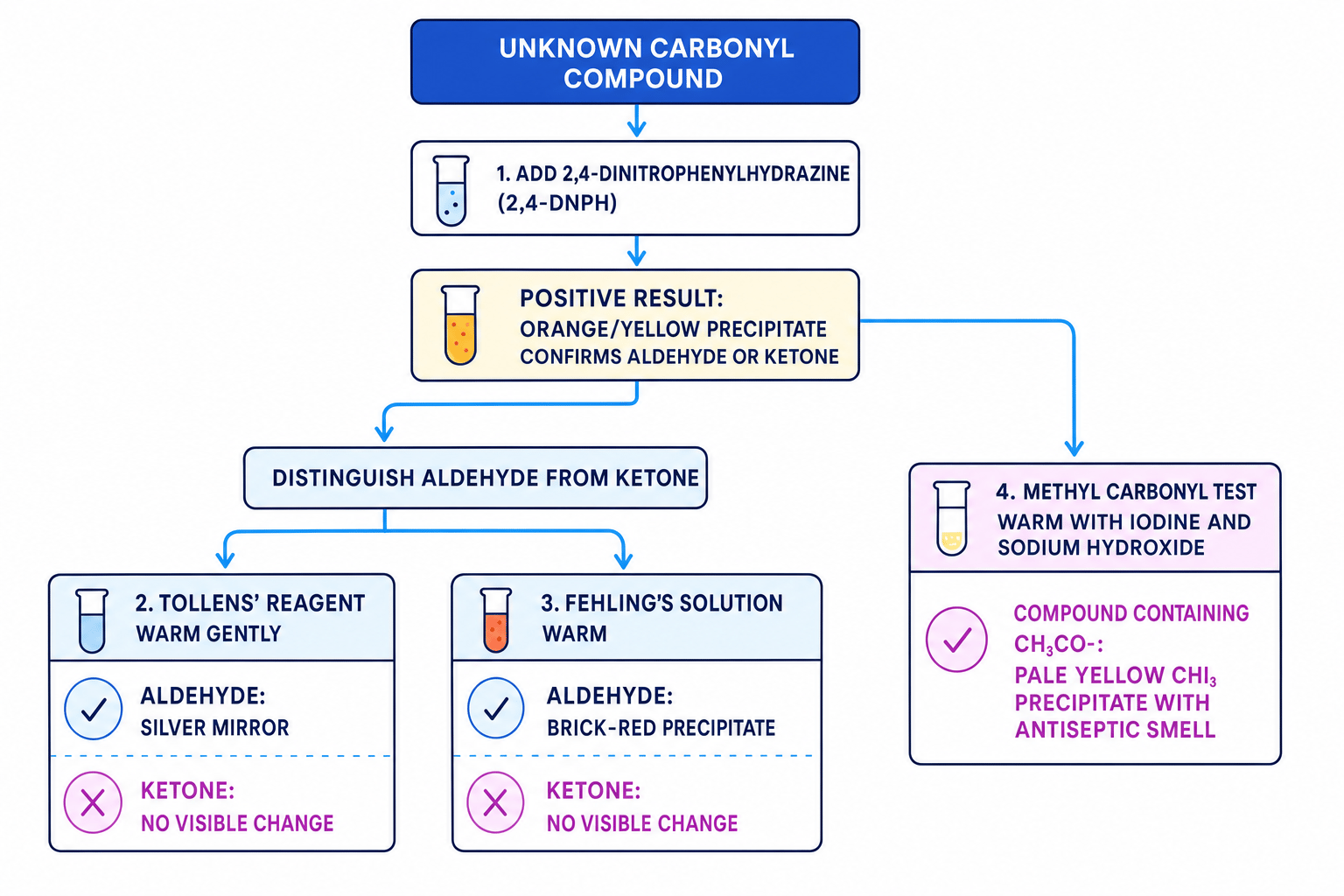
In practical questions, you often need to identify whether an unknown contains a carbonyl group and then decide whether it is an aldehyde or ketone. This flowchart summarises the key tests.
2,4-DNPH test
2,4-Dinitrophenylhydrazine, often shortened to 2,4-DNPH or Brady’s reagent, reacts with aldehydes and ketones to give an orange or yellow precipitate.
This confirms a carbonyl compound, but it does not distinguish aldehydes from ketones. The solid derivative can be purified and its melting temperature compared with data book values to identify the exact compound.
2,4-DNPH is not enough
A positive 2,4-DNPH test tells you the compound is likely to be an aldehyde or ketone. You still need Tollens’ reagent or Fehling’s solution to decide which one.
Tollens’ reagent
Tollens’ reagent contains the complex ion [Ag(NH₃)₂]⁺. Warm gently with the unknown.
- Aldehyde: silver mirror forms.
- Ketone: no visible change.
The aldehyde is oxidised, while Ag⁺ is reduced to Ag(s).
Fehling’s solution
Fehling’s solution contains Cu²⁺ complex ions and is blue. Warm with the unknown.
- Aldehyde: brick-red precipitate of Cu₂O forms.
- Ketone: no visible change.
Iodoform test
Warm the compound with iodine and sodium hydroxide.
A positive test gives a pale yellow precipitate of CHI₃ with an antiseptic smell. This indicates a methyl carbonyl group, CH₃CO–, so ethanal and methyl ketones give positive results.
Identifying an unknown carbonyl
An unknown compound has formula C₃H₆O. It gives an orange precipitate with 2,4-DNPH, a silver mirror with Tollens’ reagent, and no yellow precipitate in the iodoform test. Identify it.
- The orange precipitate with 2,4-DNPH shows the compound is an aldehyde or ketone.
- The silver mirror with Tollens’ reagent shows it is an aldehyde, not a ketone.
- The C₃ aldehyde is propanal, CH₃CH₂CHO. The negative iodoform test supports this because propanal is not ethanal and does not contain CH₃CO–.
In the exam
- Classify the molecule first: aldehyde, ketone, primary alcohol or secondary alcohol. The reagent outcome depends on this.
- For mechanisms, start curly arrows at electron pairs: from CN⁻ or H⁻ to the carbonyl carbon, and from the C=O π bond to oxygen.
- For tests, give both the reagent and the observation: for example, “Tollens’ reagent, warm gently, silver mirror forms.”
- When naming HCN addition products, remember that the nitrile carbon counts as carbon 1 of the main chain.
Check yourself
- Why is the carbonyl carbon attacked by nucleophiles?
- How would you distinguish propanal from propanone using chemical tests?
- What product forms when butan-2-one reacts with HCN, and would it be chiral?