What you'll learn
- How the –COOH group makes carboxylic acids weak acids.
- How to name and predict products of esters, acyl chlorides, acid anhydrides and amides.
- Why acyl derivatives react by nucleophilic addition–elimination.
- Which reagents and conditions convert one carboxylic acid derivative into another.
Starting point: the carboxyl group
A carbonyl group is a C=O group. In carboxylic acids, the carbonyl is joined to an –OH group on the same carbon.
Carboxylic acid
A carboxylic acid contains the carboxyl group, –COOH, usually written as RCOOH. The acidic hydrogen is the hydrogen on the O–H bond, not a hydrogen on the carbon chain.
Examples include methanoic acid, HCOOH, ethanoic acid, CH₃COOH, and benzoic acid, C₆H₅COOH.
The C=O bond is polar: oxygen is more electronegative than carbon, so the carbonyl carbon is δ⁺. This matters because nucleophiles can attack that carbon in many acid derivatives.
The carboxylic acid “family”
A carboxylic acid derivative is made when the –OH part of –COOH is replaced by another group.
Acyl derivative
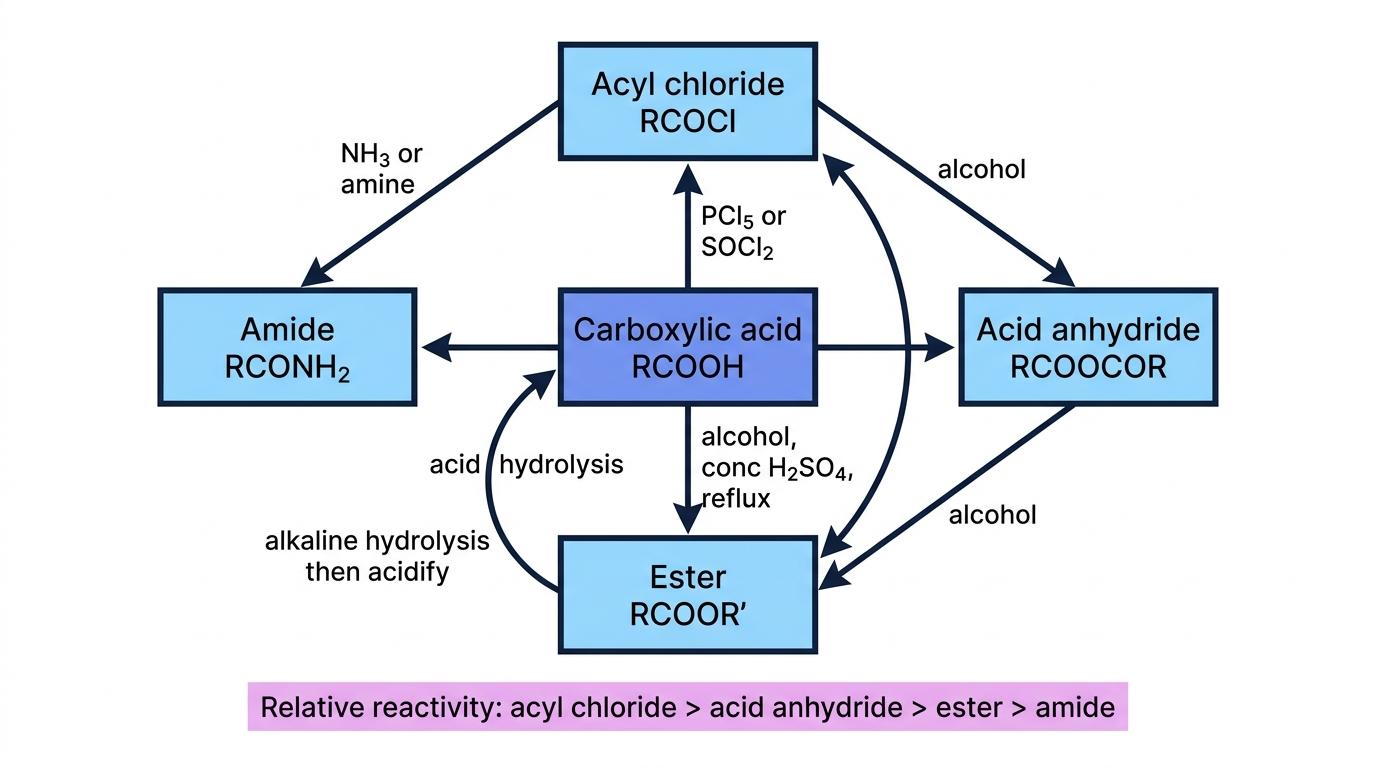
An acyl derivative contains the acyl group RCO– joined to a replaceable group. Common examples are acyl chlorides RCOCl, esters RCOOR′, acid anhydrides RCOOCOR, and amides RCONH₂ or RCONHR′.
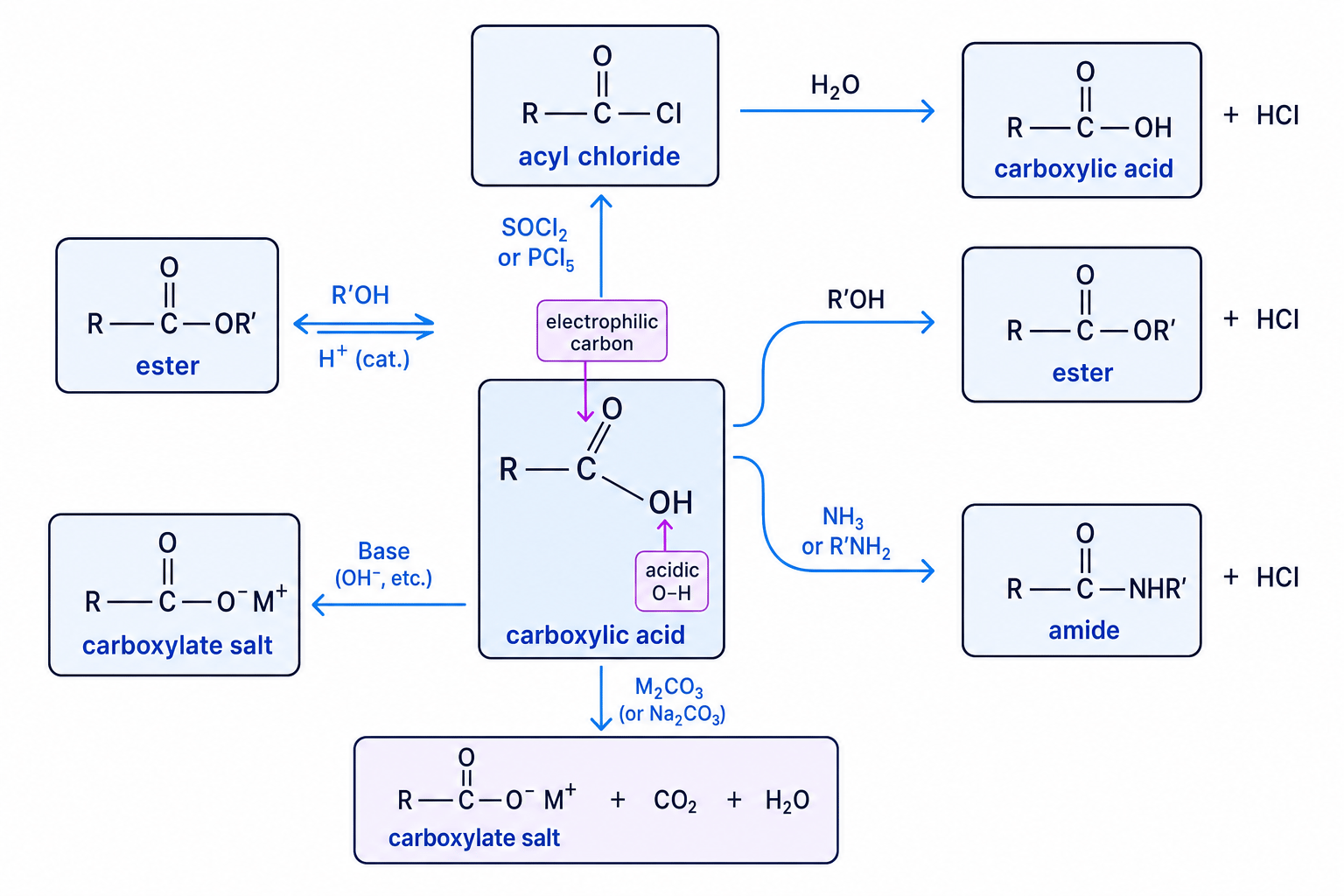
This reaction map shows the main interconversions you need to recognise.
Naming esters
An ester has the group RCOOR′. Its name has two parts:
- the alkyl part comes from the alcohol, R′OH
- the alkanoate part comes from the carboxylic acid, RCOOH
So CH₃COOCH₂CH₃ is ethyl ethanoate.
Naming an ester product
- For CH₃CH₂COOH + CH₃CH₂OH, identify the acid fragment. CH₃CH₂COOH has three carbons including the carbonyl carbon, so it gives the propanoate part.
- Identify the alcohol fragment. CH₃CH₂OH contributes an ethyl group attached through oxygen.
- Combine alcohol part first, then acid part: the ester is ethyl propanoate, formed by CH₃CH₂COOH + CH₃CH₂OH ⇌ CH₃CH₂COOCH₂CH₃ + H₂O.
Acidity of carboxylic acids
Carboxylic acids are weak acids, meaning they only partially dissociate in water:
RCOOH(aq) + H₂O(l) ⇌ RCOO⁻(aq) + H₃O⁺(aq)
The ion RCOO⁻ is called a carboxylate ion. It is relatively stable because the negative charge is delocalised over two oxygen atoms.
Why carboxylic acids are acidic
Carboxylic acids lose H⁺ from the –COOH group to form resonance-stabilised carboxylate ions, RCOO⁻.
Reactions with bases and carbonates
Carboxylic acids form salts in neutralisation reactions:
- With alkalis: RCOOH(aq) + NaOH(aq) → RCOONa(aq) + H₂O(l)
- With carbonates: 2RCOOH(aq) + Na₂CO₃(aq) → 2RCOONa(aq) + CO₂(g) + H₂O(l)
- With hydrogencarbonates: RCOOH(aq) + NaHCO₃(aq) → RCOONa(aq) + CO₂(g) + H₂O(l)
A positive test-style observation is effervescence from CO₂. The CO₂ turns limewater milky.
Calculating molar mass from carbon dioxide
A 0.240 g sample of a pure monocarboxylic acid reacts completely with excess sodium carbonate to produce 48.0 cm³ of CO₂ at room temperature and pressure. Find the molar mass.
- Convert the gas volume into amount of CO₂ using Vm=24.0 dm3 mol−1V_m=24.0\ \text{dm}^{3}\ \text{mol}^{-1}Vm=24.0 dm3 mol−1:
n(CO2)=0.0480 dm324.0 dm3 mol−1=0.00200 moln(\text{CO}_2)=\frac{0.0480\ \text{dm}^{3}}{24.0\ \text{dm}^{3}\ \text{mol}^{-1}}=0.00200\ \text{mol}n(CO2)=24.0 dm3 mol−10.0480 dm3=0.00200 mol. - Use the balanced carbonate equation. The ratio of monocarboxylic acid to CO₂ is 2 to 1, so n(acid)=2×0.00200=0.00400 moln(\text{acid})=2 \times 0.00200=0.00400\ \text{mol}n(acid)=2×0.00200=0.00400 mol.
- Calculate molar mass: M=mn=0.240 g0.00400 mol=60.0 g mol−1M=\frac{m}{n}=\frac{0.240\ \text{g}}{0.00400\ \text{mol}}=60.0\ \text{g mol}^{-1}M=nm=0.00400 mol0.240 g=60.0 g mol−1.
Carbonate ratios
With CO₃²⁻, two acid molecules are needed per CO₂. With HCO₃⁻, one acid molecule is needed per CO₂.
Making esters from carboxylic acids
Carboxylic acids react with alcohols to form esters in a reversible reaction called esterification.
CH₃COOH + CH₃CH₂OH ⇌ CH₃COOCH₂CH₃ + H₂O
Typical conditions:
- concentrated H₂SO₄ as an acid catalyst
- heat under reflux
- often excess alcohol or removal of water to improve yield
Reflux
Reflux means heating a reaction mixture with a condenser so vapours condense and return to the flask. It allows heating without losing volatile reactants or products.
Esters often have sweet or fruity smells, but smell is never a safe identification method on its own.
Hydrolysis of esters
Hydrolysis means breaking a bond by reaction with water.
- Acid hydrolysis: ester + water ⇌ carboxylic acid + alcohol, using dilute acid and reflux.
- Alkaline hydrolysis: ester + NaOH → carboxylate salt + alcohol, using aqueous alkali and reflux.
Alkaline hydrolysis is effectively irreversible because the carboxylic acid product is converted into a carboxylate salt. To obtain the carboxylic acid afterwards, add dilute acid.
Forgetting the equilibrium
Direct esterification using a carboxylic acid and alcohol is reversible. Acyl chlorides and acid anhydrides usually give esters more readily because their reactions are much less reversible.
Acyl chlorides: very reactive derivatives
An acyl chloride has the group RCOCl. For example, CH₃COCl is ethanoyl chloride.
Carboxylic acids can be converted into acyl chlorides using reagents such as phosphorus(V) chloride or sulfur dichloride oxide:
CH₃COOH + PCl₅ → CH₃COCl + POCl₃ + HCl
CH₃COOH + SOCl₂ → CH₃COCl + SO₂ + HCl
Acyl chlorides react vigorously because Cl⁻ is a good leaving group and the carbonyl carbon is strongly δ⁺.
Important reactions:
- With water: CH₃COCl + H₂O → CH₃COOH + HCl
- With alcohols: CH₃COCl + CH₃OH → CH₃COOCH₃ + HCl
- With ammonia: CH₃COCl + 2NH₃ → CH₃CONH₂ + NH₄Cl
- With primary amines: CH₃COCl + 2CH₃NH₂ → CH₃CONHCH₃ + CH₃NH₃Cl
Acyl chloride fumes
Acyl chlorides hydrolyse in moist air and release steamy HCl fumes. In practical work they are handled carefully, usually in a fume cupboard.
Predicting an acyl chloride reaction
Predict the organic product when propanoyl chloride reacts with excess ammonia.
- Keep the acyl part unchanged: propanoyl chloride contains CH₃CH₂CO–.
- Replace Cl by –NH₂ because ammonia is the nucleophile, giving CH₃CH₂CONH₂.
- Account for the acid formed: HCl reacts with extra NH₃, so the overall equation is CH₃CH₂COCl + 2NH₃ → CH₃CH₂CONH₂ + NH₄Cl. The organic product is propanamide.
Nucleophilic addition–elimination
Nucleophile, electrophile and leaving group
A nucleophile donates an electron pair. An electrophile accepts an electron pair. A leaving group is an atom or group that departs with a pair of electrons during a reaction.
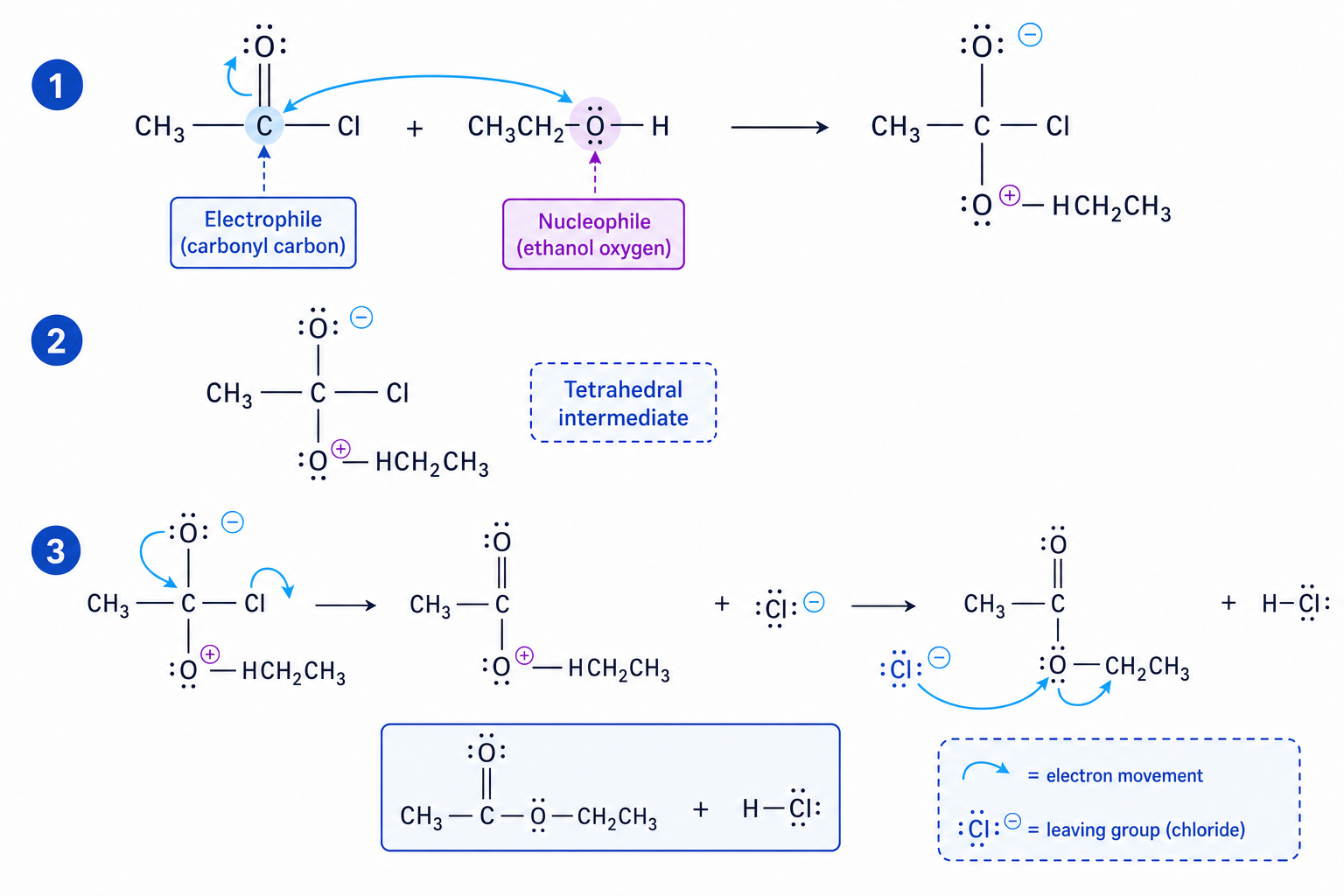
Acyl derivatives react by nucleophilic addition–elimination:
- The nucleophile attacks the δ⁺ carbonyl carbon.
- The C=O π bond opens to form a tetrahedral intermediate.
- The C=O bond reforms and the leaving group is expelled.
The diagram shows this for ethanoyl chloride reacting with ethanol to form ethyl ethanoate.
Confusing carbonyl mechanisms
Aldehydes and ketones usually undergo nucleophilic addition only. Acyl derivatives undergo addition followed by elimination because they have a leaving group attached to the carbonyl carbon.
Acid anhydrides and amides
An acid anhydride has the group RCOOCOR. Ethanoic anhydride is (CH₃CO)₂O. Acid anhydrides are less reactive than acyl chlorides but still useful acylating agents.
For example:
(CH₃CO)₂O + CH₃CH₂OH → CH₃COOCH₂CH₃ + CH₃COOH
In aspirin synthesis, 2-hydroxybenzoic acid reacts with ethanoic anhydride to form aspirin and ethanoic acid. The product can be purified by recrystallisation and checked using melting point: a sharp melting range suggests higher purity.
An amide contains –CONH₂, –CONHR or –CONR₂. Amides are much less reactive than acyl chlorides and esters because the nitrogen lone pair delocalises into the carbonyl system, making the carbonyl carbon less electrophilic.
Amine plus carboxylic acid
A carboxylic acid and an amine usually form an ammonium carboxylate salt first, not an amide directly. Acyl chlorides or acid anhydrides are much better reagents for making amides.
Relative reactivity of acid derivatives
A useful order is:
acyl chlorides > acid anhydrides > esters > amides
This order mainly depends on two ideas:
- how δ⁺ the carbonyl carbon is
- how easily the leaving group can leave
One pattern, many reactions
For carboxylic acid derivatives, focus on the acyl group RCO–. In many reactions, the incoming nucleophile replaces the group attached to the carbonyl carbon.
In the exam
- Identify the functional group first: carboxylic acid, ester, acyl chloride, acid anhydride or amide.
- For carbonate and hydrogencarbonate questions, balance the CO₂ stoichiometry before calculating moles.
- In mechanisms, start curly arrows at a lone pair or bond, show the tetrahedral intermediate, then show the leaving group departing.
Check yourself
- Why does sodium carbonate effervesce when added to ethanoic acid?
- What organic product forms when ethanoyl chloride reacts with methylamine?
- Which conditions would you choose to convert ethyl propanoate into propanoic acid?