What you'll learn
- What an arene is, using benzene as the key example.
- How benzene’s delocalised π electron system explains its unusual stability.
- The main evidence for the delocalised model of benzene.
- Why benzene reacts mainly by electrophilic substitution, including nitration and halogenation.
What is an arene?
Arenes are based on the benzene ring. Benzene has molecular formula C₆H₆: six carbon atoms in a ring, with one hydrogen bonded to each carbon.
Arene
An arene is an aromatic hydrocarbon: it contains at least one benzene ring and only carbon and hydrogen. Benzene and methylbenzene are arenes. Many non-hydrocarbon benzene derivatives, such as nitrobenzene, are described more generally as aromatic compounds.
A benzene ring can also act as a substituent. If C₆H₆ loses one hydrogen, the group C₆H₅– is called a phenyl group.
Phenyl is not benzyl
Phenyl is C₆H₅–. Benzyl is C₆H₅CH₂–. That extra CH₂ group changes the structure and reactivity.
Bonding in benzene
Each carbon atom in benzene forms three σ bonds: two to neighbouring carbon atoms and one to hydrogen. A σ bond is a covalent bond formed by overlap along the line between two nuclei.
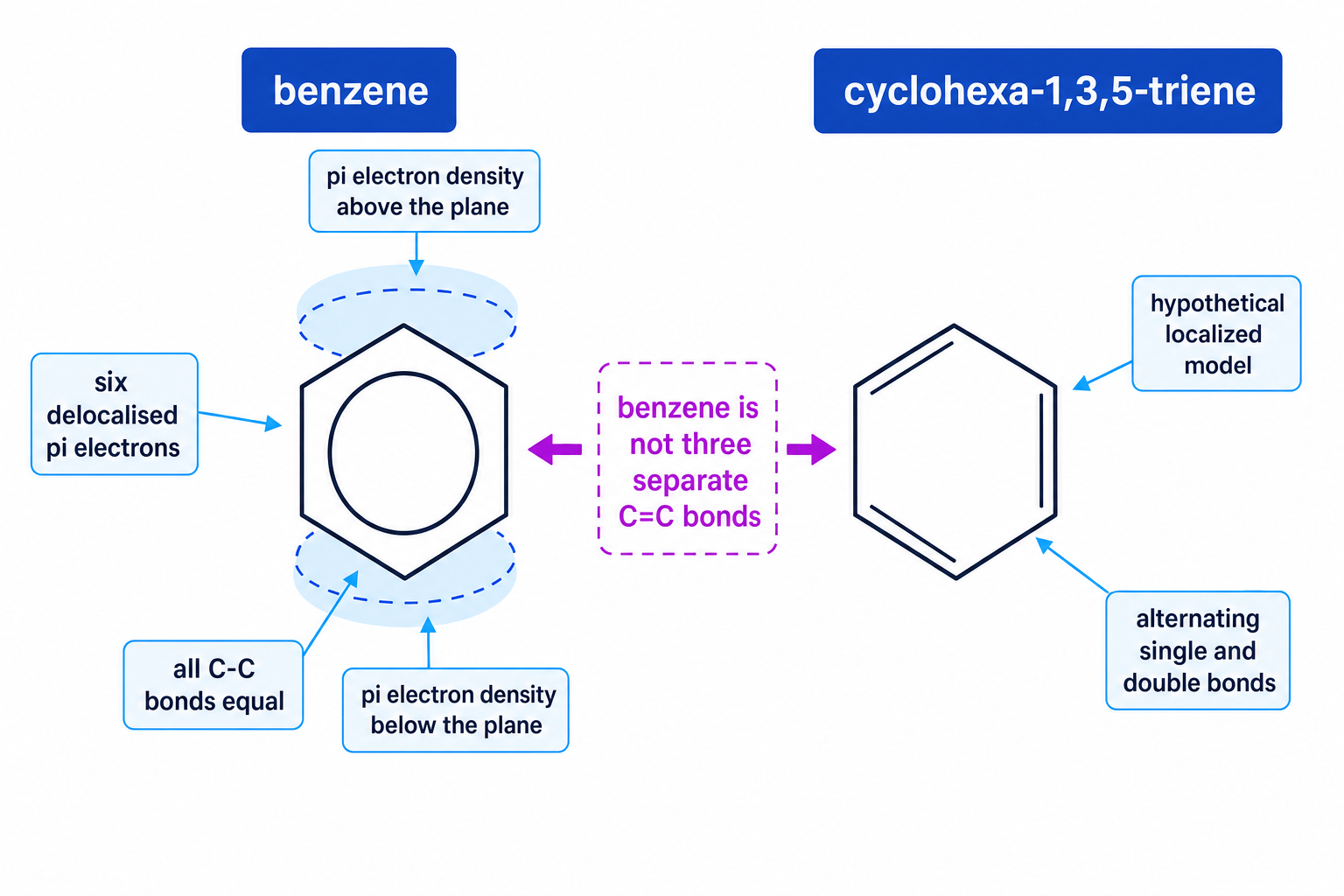
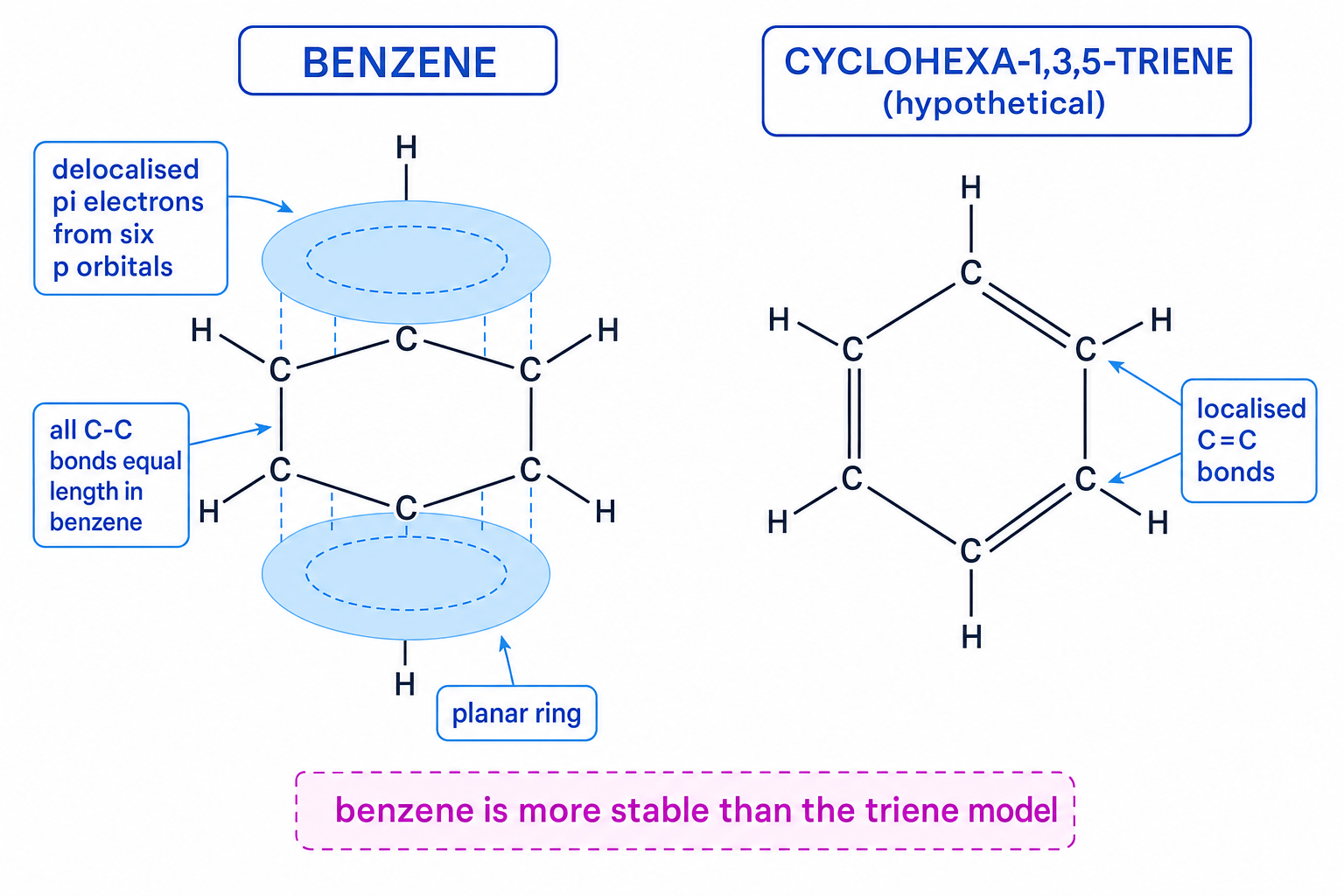
Each carbon also has one unhybridised p orbital. These six p orbitals overlap sideways around the whole ring, forming a continuous π system above and below the plane of the ring.
Delocalised electrons
Delocalised electrons are electrons that are spread over more than two atoms, rather than being fixed between one pair of atoms.
In benzene, the six π electrons are delocalised over all six carbon atoms. This makes all six carbon-carbon bonds identical.
Benzene is not three ordinary double bonds
Benzene is best represented as a hexagon with a circle inside. The circle shows the delocalised π electron system. A Kekulé structure with alternating double bonds is sometimes used for mechanisms, but it is not the true bonding model.
Evidence for the delocalised model
There are three important pieces of evidence.
1. Equal bond lengths
X-ray diffraction shows that all six C–C bonds in benzene have the same length, about 0.139 nm. This is between a typical C–C single bond, about 0.154 nm, and a typical C=C double bond, about 0.134 nm.
If benzene really had alternating single and double bonds, you would expect two different bond lengths.
2. Enthalpy of hydrogenation
Hydrogenation means adding hydrogen across unsaturated bonds. Cyclohexene hydrogenates to cyclohexane with an enthalpy change of about −120 kJ mol⁻¹.
If benzene behaved like cyclohexa-1,3,5-triene with three separate C=C bonds, you might expect its hydrogenation enthalpy to be about three times this value. Experimentally, benzene is much less exothermic to hydrogenate.
Calculating benzene stabilisation energy
Cyclohexene has enthalpy of hydrogenation −120 kJ mol⁻¹. Benzene has experimental enthalpy of hydrogenation −208 kJ mol⁻¹.
-
Predict the value for a hypothetical molecule with three separate C=C bonds:
ΔHpredicted=3×(−120)=−360 kJ mol−1\Delta H_\text{predicted} = 3 \times (-120) = -360\ \text{kJ mol}^{-1}ΔHpredicted=3×(−120)=−360 kJ mol−1 -
Compare this with the experimental value for benzene:
difference=(−208)−(−360)=+152 kJ mol−1\text{difference} = (-208) - (-360) = +152\ \text{kJ mol}^{-1}difference=(−208)−(−360)=+152 kJ mol−1 -
Interpret the sign and size: benzene is 152 kJ mol⁻¹ more stable than the hypothetical triene model, so its hydrogenation is much less exothermic.
3. Chemical reactivity
Alkenes usually undergo electrophilic addition. For example, bromine water is decolourised by alkenes.
Benzene does not readily decolourise bromine water at room temperature. Addition would destroy the stable delocalised π system, so benzene tends to undergo substitution instead.
Treating benzene like an alkene
Benzene has π electrons, but it is not simply an alkene. It resists addition because addition would break the aromatic delocalisation.
Electrophilic substitution
Electrophilic substitution
An electrophile is an electron-pair acceptor. Electrophilic substitution is a reaction in which an electrophile replaces an atom or group, usually H, on an aromatic ring.
The benzene ring is electron-rich, so it can attract electrophiles. However, the key difference from an alkene is what happens next:
- The benzene π system donates an electron pair to the electrophile.
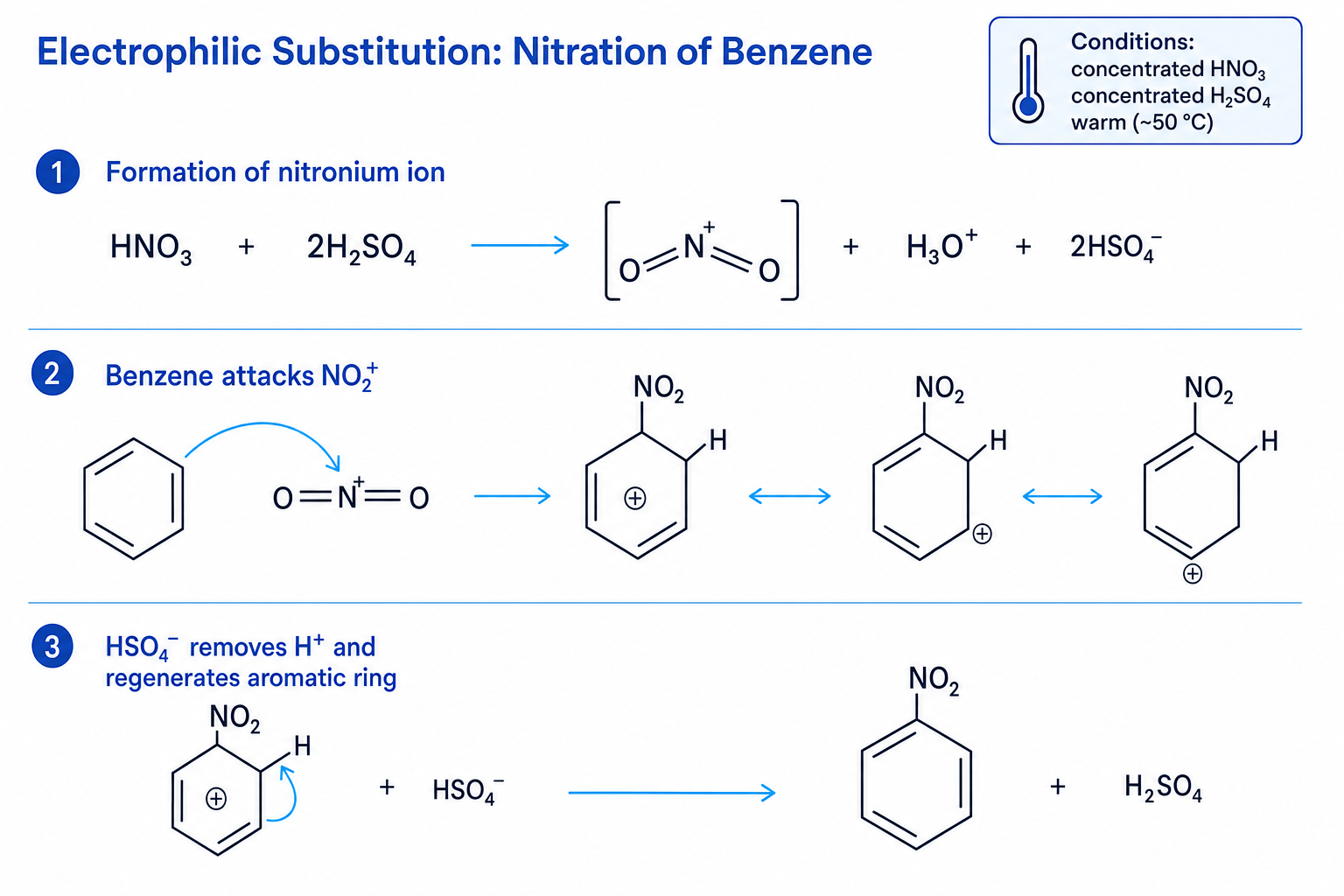
- A temporary positively charged intermediate forms. This is called an arenium ion or σ complex.
- A base removes H⁺ from the carbon that bonded to the electrophile.
- The delocalised π system is restored.
Why substitution wins
The final deprotonation step restores aromatic stability. That is why benzene usually substitutes H for an electrophile rather than adding two new groups across the ring.
Nitration of benzene
Nitration introduces the nitro group, –NO₂, onto the benzene ring.
Reagents and conditions:
- concentrated nitric acid, HNO₃
- concentrated sulfuric acid, H₂SO₄
- warm, about 50–55 °C
The overall equation is:
C₆H₆ + HNO₃ → C₆H₅NO₂ + H₂O
The electrophile is the nitronium ion, NO₂⁺. It is generated by the acid mixture:
HNO₃ + 2H₂SO₄ → NO₂⁺ + H₃O⁺ + 2HSO₄⁻
The scheme below shows how nitration fits the general electrophilic substitution pattern.
Control the nitration temperature
If the mixture is heated too strongly, further nitration can occur, giving dinitrobenzene products. For mononitration, keep to about 50–55 °C.
Halogenation of benzene
Benzene reacts with chlorine or bromine only in the presence of a halogen carrier, such as AlCl₃, AlBr₃, FeCl₃ or FeBr₃.
For bromination:
C₆H₆ + Br₂ → C₆H₅Br + HBr
Conditions:
- bromine, Br₂
- halogen carrier such as FeBr₃ or AlBr₃
- room temperature is often sufficient
The halogen carrier helps polarise the Br–Br bond and generates a much stronger electrophile, often represented as Br⁺.
Making bromobenzene from benzene
You want to convert benzene into bromobenzene.
-
Identify the change: one H on the benzene ring is replaced by Br, so the reaction is electrophilic substitution, not addition.
-
Choose conditions that make a strong enough electrophile: Br₂ alone is not sufficient for benzene, so use a halogen carrier such as FeBr₃ or AlBr₃.
-
Write the organic product and the small molecule formed from the displaced hydrogen:
C₆H₆ + Br₂ → C₆H₅Br + HBr
Other electrophilic substitution reactions
You may also meet these arene reactions.
| Reaction | Typical reagents and conditions | Electrophile | Product type |
|---|---|---|---|
| Nitration | concentrated HNO₃ and concentrated H₂SO₄, 50–55 °C | NO₂⁺ | nitrobenzene |
| Halogenation | Cl₂ or Br₂ with AlCl₃, AlBr₃, FeCl₃ or FeBr₃ | Cl⁺ or Br⁺ | halogenoarene |
| Friedel-Crafts alkylation | chloroalkane with anhydrous AlCl₃ | carbocation, R⁺ | alkylbenzene |
| Friedel-Crafts acylation | acyl chloride with anhydrous AlCl₃ | acylium ion, RCO⁺ | phenyl ketone |
| Sulfonation | fuming sulfuric acid, containing SO₃ | SO₃ or protonated SO₃ | benzenesulfonic acid |
In Friedel-Crafts reactions, anhydrous conditions matter because aluminium chloride reacts with water.
Spotting electrophilic substitution products
For benzene, imagine replacing one ring H with the incoming electrophile-derived group: NO₂, Br, alkyl, acyl or SO₃H. The ring normally remains intact.
Methylbenzene and substituted rings
Methylbenzene is more reactive than benzene towards electrophilic substitution because the methyl group donates electron density into the ring. It tends to form mainly 2-substituted and 4-substituted products.
For example, nitration of methylbenzene gives a mixture containing mainly 2-nitromethylbenzene and 4-nitromethylbenzene.
You do not need to think of the benzene ring as “opening up”. The reaction is still substitution on the aromatic ring.
In the exam
-
When explaining benzene’s structure, mention planar ring, six delocalised π electrons, and equal C–C bond lengths.
-
For evidence questions, use at least one quantitative point: bond length data or the enthalpy of hydrogenation difference of about 152 kJ mol⁻¹.
-
For mechanisms, start curly arrows from an electron pair: the π system attacks the electrophile, then a base removes H⁺ to restore the aromatic ring.
-
Always give precise reagents and conditions: concentrated HNO₃/H₂SO₄ for nitration, and a halogen carrier for halogenation.
Check yourself
- Why is benzene more stable than the hypothetical cyclohexa-1,3,5-triene structure?
- What electrophile reacts with benzene during nitration, and how is it formed?
- Why does benzene undergo substitution with bromine only when a halogen carrier is present?