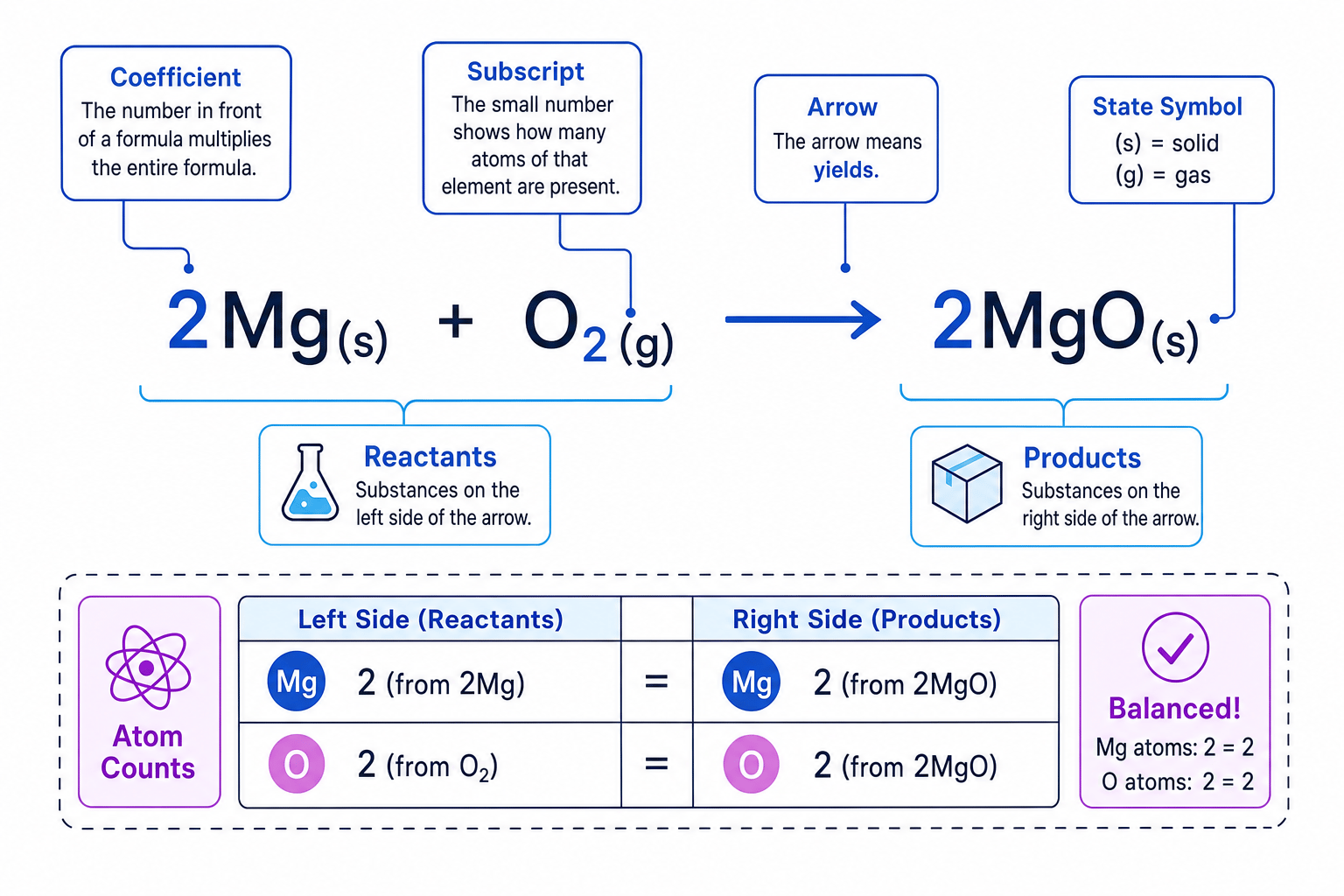
What you'll learn
- How chemical formulae show the atoms or ions present in a substance.
- How to write formulae for ionic compounds using charges.
- How to calculate relative formula mass and work out empirical or molecular formulae.
- How to balance full equations and write ionic equations with state symbols.
Why formulae and equations matter
Chemistry is a quantitative subject: formulae and equations are the “language” that lets you count particles, compare reacting amounts, and predict products. Before you can do mole calculations confidently, you need to be fluent in what each symbol in an equation means.
Chemical formula
A chemical formula shows the elements present in a substance and the number or ratio of atoms or ions present. For example, H₂O contains hydrogen and oxygen in a 2:1 atom ratio.
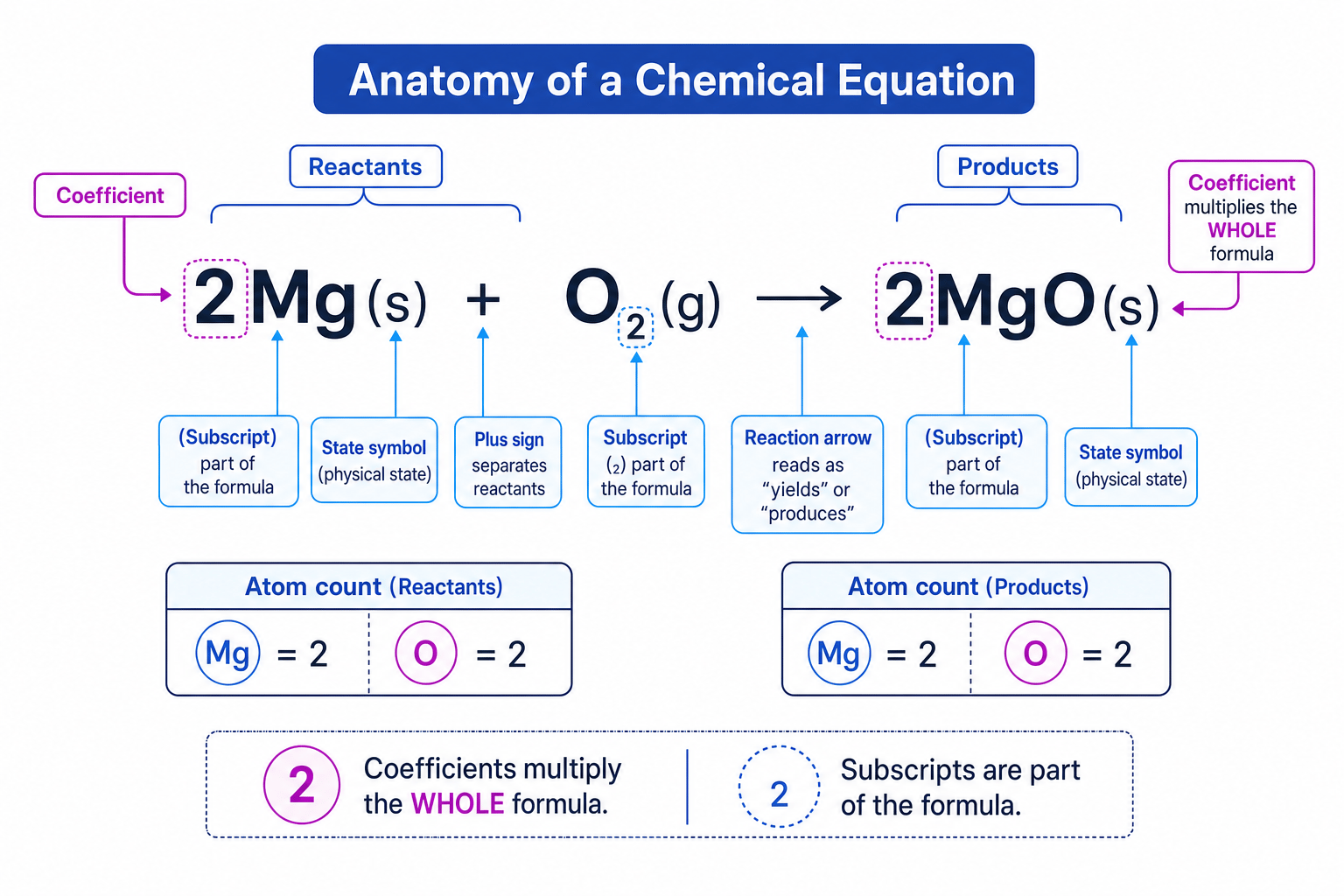
A reactant is a substance you start with. A product is a substance formed. A chemical equation shows reactants changing into products.
The diagram below shows the key parts of a balanced chemical equation.
The big rule
You may change coefficients when balancing an equation, but you must not change subscripts inside formulae. Subscripts are part of the identity of the substance.
Formulae of elements and compounds
An element contains only one type of atom. Some elements exist as single atoms, such as helium, He. Others exist as molecules, such as oxygen, O₂, chlorine, Cl₂, and sulfur, S₈.
A compound contains atoms or ions of two or more elements chemically combined in fixed proportions. For example, magnesium oxide is MgO, not Mg₂O or MgO₂.
Molecular and ionic formulae
A molecule is a small group of atoms covalently bonded together. A molecular formula shows the actual number of atoms in one molecule, such as C₂H₆ for ethane.
An ionic compound is made from positive ions and negative ions arranged in a giant ionic lattice. Its formula shows the simplest whole-number ratio of ions, called a formula unit. For example, sodium chloride is NaCl because the ratio of Na⁺ ions to Cl⁻ ions is 1:1.
Ion
An ion is an atom or group of atoms with an electrical charge. A positive ion is a cation; a negative ion is an anion.
Writing formulae from ion charges
Ionic compounds are electrically neutral overall. This means the total positive charge must equal the total negative charge.
Common charges you should recognise include Group 1 ions as +1, Group 2 ions as +2, aluminium as Al³⁺, oxide as O²⁻, chloride as Cl⁻, hydroxide as OH⁻, nitrate as NO₃⁻, sulfate as SO₄²⁻, carbonate as CO₃²⁻, and ammonium as NH₄⁺.
Charge-balancing shortcut
For ionic formulae, use the ion charges to find the smallest whole-number ratio that gives zero overall charge. Brackets are used when you need more than one polyatomic ion, such as Ca(OH)₂.
Writing a formula from ions
Write the formula of aluminium sulfate.
-
Identify the ions and their charges: aluminium forms Al³⁺ and sulfate is SO₄²⁻.
-
Find the smallest combination with equal total positive and negative charge. The lowest common multiple of 3 and 2 is 6, so you need two Al³⁺ ions and three SO₄²⁻ ions.
-
Write the formula using brackets around sulfate because it is a polyatomic ion being repeated: Al₂(SO₄)₃.
Changing the ion itself
Do not change SO₄²⁻ into S₃O₁₂ or alter the atoms inside a polyatomic ion. The whole sulfate ion is repeated as a group, so aluminium sulfate is Al₂(SO₄)₃.
Relative formula mass, Mr
The relative atomic mass, ArA_rAr, is the weighted mean mass of an atom of an element compared with one twelfth of the mass of a carbon-12 atom.
The relative formula mass, MrM_rMr, is the sum of the relative atomic masses of all the atoms shown in a formula. For molecular substances, you may also see relative molecular mass used.
Relative formula mass
MrM_rMr is found by adding the ArA_rAr values for every atom in the formula. It has no units, although the numerically equal molar mass is written in g mol⁻¹.
Calculating relative formula mass
Calculate MrM_rMr for calcium nitrate, Ca(NO₃)₂. Use ArA_rAr values: Ca = 40.1, N = 14.0, O = 16.0.
-
Count the atoms carefully. Ca(NO₃)₂ contains one Ca atom, two N atoms, and six O atoms because the ₂ outside the brackets multiplies everything inside.
-
Substitute the ArA_rAr values into the expression:
- Calculate the total:
Empirical and molecular formulae
The empirical formula is the simplest whole-number ratio of atoms of each element in a compound. The molecular formula gives the actual number of atoms of each element in one molecule.
For example, glucose has molecular formula C₆H₁₂O₆, but its empirical formula is CH₂O because 6:12:6 simplifies to 1:2:1.
Finding empirical and molecular formulae
A compound contains 40.0% carbon, 6.7% hydrogen and 53.3% oxygen by mass. Its relative molecular mass is 180. Find its empirical and molecular formulae. Use ArA_rAr values: C = 12.0, H = 1.0, O = 16.0.
-
Assume you have 100 g of the compound, so the masses are 40.0 g C, 6.7 g H and 53.3 g O.
-
Convert each mass to amount in mol using n=mMn = \frac{m}{M}n=Mm:
-
Divide by the smallest amount to get the simplest ratio: C:H:O is 1:2:1, so the empirical formula is CH₂O.
-
Find the empirical formula mass: 12.0+2(1.0)+16.0=30.012.0 + 2(1.0) + 16.0 = 30.012.0+2(1.0)+16.0=30.0.
-
Compare with the molecular mass: 18030.0=6\frac{180}{30.0} = 630.0180=6, so multiply every subscript in CH₂O by 6. The molecular formula is C₆H₁₂O₆.
Balancing chemical equations
A balanced equation has the same number of atoms of each element on both sides. This follows from conservation of mass: atoms are rearranged during a reaction, not created or destroyed.
A number placed in front of a formula is a stoichiometric coefficient. It multiplies the whole formula. For example, 3CO₂ contains three carbon atoms and six oxygen atoms.
Balancing an equation
Balance the equation for iron(III) oxide reacting with carbon monoxide:
Fe₂O₃ + CO → Fe + CO₂
-
Balance iron first. Fe₂O₃ contains two Fe atoms, so place a coefficient of 2 before Fe on the product side:
Fe₂O₃ + CO → 2Fe + CO₂
-
Let the same coefficient be used for CO and CO₂ because carbon appears in both. Oxygen atoms on the left are 3 from Fe₂O₃ plus the oxygen atoms in CO. To make this match CO₂, use three CO molecules and three CO₂ molecules.
-
Write the balanced equation and check each element:
Fe₂O₃ + 3CO → 2Fe + 3CO₂
Fe: 2 on each side; C: 3 on each side; O: 6 on each side.
Balancing by altering formulae
Never change CO₂ into CO₃ to balance oxygen. That would describe a different substance. Balance by changing coefficients only.
State symbols
State symbols show the physical state of each substance:
- (s) means solid
- (l) means liquid
- (g) means gas
- (aq) means aqueous, meaning dissolved in water
They are especially important in precipitation reactions, enthalpy changes, equilibria and ionic equations.
For example:
NaOH(aq) + HCl(aq) → NaCl(aq) + H₂O(l)
Here, water is written as (l), not (aq), because it is the liquid product, not a solute dissolved in water.
Ionic equations
An ionic equation shows only the particles that actually change in a reaction. Ions that are present but unchanged are called spectator ions.
Ionic equations must balance both atoms and charge.
Writing an ionic equation
Write the ionic equation for the precipitation reaction between barium chloride solution and sodium sulfate solution.
-
Write the balanced full equation with state symbols:
BaCl₂(aq) + Na₂SO₄(aq) → BaSO₄(s) + 2NaCl(aq)
-
Split aqueous ionic substances into ions, but keep the solid precipitate together:
Ba²⁺(aq) + 2Cl⁻(aq) + 2Na⁺(aq) + SO₄²⁻(aq) → BaSO₄(s) + 2Na⁺(aq) + 2Cl⁻(aq)
-
Cancel spectator ions that appear unchanged on both sides. Na⁺ and Cl⁻ cancel, leaving:
Ba²⁺(aq) + SO₄²⁻(aq) → BaSO₄(s)
Ionic equation check
A correct ionic equation has the same atoms and the same overall charge on both sides. For Ba²⁺ + SO₄²⁻ → BaSO₄, the total charge is zero on both sides.
Reversible equations
Some reactions can proceed in both directions. These use the reversible arrow, ⇌, instead of a one-way arrow.
For example, in the Haber process:
N₂(g) + 3H₂(g) ⇌ 2NH₃(g)
This means nitrogen and hydrogen form ammonia, while ammonia can also decompose back into nitrogen and hydrogen. You will use this notation much more when studying equilibria.
Arrow meanings
Use → for reactions treated as going to completion. Use ⇌ for reversible reactions and equilibria. Do not use them interchangeably in exam answers.
In the exam
-
Check formulae before balancing: correct charges and correct common ions matter more than rushing into coefficients.
-
Balance using coefficients only, then check every element and the overall charge if it is an ionic equation.
-
Include state symbols when asked, especially for ionic equations, precipitation reactions, gases, and neutralisation equations.
Check yourself
- Why is magnesium oxide MgO rather than Mg₂O₂?
- What is the difference between an empirical formula and a molecular formula?
- Which ions are spectators in AgNO₃(aq) + NaCl(aq) → AgCl(s) + NaNO₃(aq)?