

What you'll learn
- What “weak” means for acids and bases in aqueous solution.
- How to write a KaK_aKa expression for a weak acid.
- How to calculate pH from KaK_aKa and concentration, and calculate KaK_aKa from pH.
- How to convert between KaK_aKa and pKapK_apKa, including the half-neutralisation method.
The prerequisites: acids, bases and pH
A Brønsted–Lowry acid is a proton donor. A Brønsted–Lowry base is a proton acceptor. A proton is a hydrogen ion, written as H+\text{H}^+H+.
In aqueous solution, H+\text{H}^+H+ does not really float around alone — it bonds to water to form H3O+\text{H}_3\text{O}^+H3O+. At A-Level, we usually write H+\text{H}^+H+ as a shorthand.
pH
pH is a logarithmic measure of hydrogen ion concentration:
pH=−log10[H+]\text{pH}=-\log_{10}[\text{H}^+]pH=−log10[H+]In calculations, use the numerical value of [H+][\text{H}^+][H+] in mol dm⁻³.
Because pH is logarithmic, a change of 1 pH unit means a factor of 10 change in [H+][\text{H}^+][H+].
Converting pH into hydrogen ion concentration
A solution has pH 3.25. Find [H+][\text{H}^+][H+].
-
Rearrange the pH equation by reversing the log:
[H+]=10−pH[\text{H}^+]=10^{-\text{pH}}[H+]=10−pH -
Substitute the pH value:
[H+]=10−3.25[\text{H}^+]=10^{-3.25}[H+]=10−3.25 -
Evaluate and include units:
[H+]=5.62×10⁻⁴ mol dm−3[\text{H}^+]=5.62 \times 10^{-4}\ \text{mol dm}^{-3}[H+]=5.62×10⁻⁴ mol dm−3
Strong, weak, concentrated and dilute
Dissociation means a substance separates into ions in solution. An aqueous solution is a solution in water.
A strong acid dissociates completely in water. For example, hydrochloric acid effectively produces one mole of H+\text{H}^+H+ for every mole of HCl dissolved.
A weak acid dissociates only slightly in water. Most acid particles remain as undissociated molecules.
Weak acid
A weak acid is an acid that only partially dissociates in aqueous solution, setting up a reversible equilibrium between the acid and its ions.
A weak base also forms ions only slightly in aqueous solution. For example, ammonia reacts only partially with water:
NH3(aq)+H2O(l)⇌NH4+(aq)+OH−(aq)\text{NH}_3\text{(aq)}+\text{H}_2\text{O(l)} \rightleftharpoons \text{NH}_4^+\text{(aq)}+\text{OH}^-\text{(aq)}NH3(aq)+H2O(l)⇌NH4+(aq)+OH−(aq)This section focuses mainly on KaK_aKa, the equilibrium constant for weak acids.
Weak does not mean dilute
Weak describes the extent of dissociation. Dilute describes low concentration. You can have a concentrated weak acid, or a dilute strong acid.
The weak acid equilibrium
Most A-Level weak acid calculations use a general weak monoprotic acid, HA. Monoprotic means each acid molecule can donate one proton.
The equilibrium is:
HA(aq)⇌H+(aq)+A−(aq)\text{HA(aq)} \rightleftharpoons \text{H}^+\text{(aq)}+\text{A}^-\text{(aq)}HA(aq)⇌H+(aq)+A−(aq)The ion A−\text{A}^-A− is the conjugate base of HA. A conjugate base is what remains after an acid has donated a proton.
An equilibrium is a dynamic situation where the forward and reverse reactions continue, but the concentrations of substances stay constant.
Weak acids are equilibrium systems
For a weak acid, HA, both undissociated acid molecules and ions are present at equilibrium. You must use equilibrium concentrations in KaK_aKa expressions.
The acid dissociation constant, KaK_aKa
The acid dissociation constant, KaK_aKa, measures how far a weak acid dissociates in water.
For:
HA(aq)⇌H+(aq)+A−(aq)\text{HA(aq)} \rightleftharpoons \text{H}^+\text{(aq)}+\text{A}^-\text{(aq)}HA(aq)⇌H+(aq)+A−(aq)the expression is:
Ka=[H+][A−][HA]K_a=\frac{[\text{H}^+][\text{A}^-]}{[\text{HA}]}Ka=[HA][H+][A−]Square brackets mean concentration in mol dm⁻³ at equilibrium.
For this type of expression, the units of KaK_aKa are:
(mol dm−3)(mol dm−3)mol dm−3=mol dm−3\frac{(\text{mol dm}^{-3})(\text{mol dm}^{-3})}{\text{mol dm}^{-3}}=\text{mol dm}^{-3}mol dm−3(mol dm−3)(mol dm−3)=mol dm−3Constructing a Ka expression
Write the KaK_aKa expression for ethanoic acid.
-
Write the dissociation equilibrium:
CH3COOH(aq)⇌H+(aq)+CH3COO−(aq)\text{CH}_3\text{COOH(aq)} \rightleftharpoons \text{H}^+\text{(aq)}+\text{CH}_3\text{COO}^-\text{(aq)}CH3COOH(aq)⇌H+(aq)+CH3COO−(aq) -
Put the product concentrations on the top and the undissociated acid concentration on the bottom:
Ka=[H+][CH3COO−][CH3COOH]K_a=\frac{[\text{H}^+][\text{CH}_3\text{COO}^-]}{[\text{CH}_3\text{COOH}]}Ka=[CH3COOH][H+][CH3COO−] -
Work out the units from the concentration terms:
Ka=mol dm−3K_a=\text{mol dm}^{-3}Ka=mol dm−3
Calculating the pH of a weak acid
Suppose the initial concentration of a weak acid HA is ccc mol dm⁻³.
At equilibrium, let the concentration that dissociates be xxx mol dm⁻³.
So:
- [H+]=x[\text{H}^+]=x[H+]=x
- [A−]=x[\text{A}^-]=x[A−]=x
- [HA]=c−x[\text{HA}]=c-x[HA]=c−x
The exact expression is:
Ka=x2c−xK_a=\frac{x^2}{c-x}Ka=c−xx2For a weak acid, only a small amount dissociates, so xxx is usually much smaller than ccc. This lets you use the approximation:
c−x≈cc-x \approx cc−x≈cSo:
Ka≈x2cK_a \approx \frac{x^2}{c}Ka≈cx2and therefore:
[H+]≈Kac[\text{H}^+] \approx \sqrt{K_a c}[H+]≈KacThe square-root shortcut
For a weak monoprotic acid of concentration ccc, if dissociation is small:
[H+]≈Kac[\text{H}^+] \approx \sqrt{K_a c}[H+]≈KacThen use pH=−log10[H+]\text{pH}=-\log_{10}[\text{H}^+]pH=−log10[H+].
Calculating pH from Ka and concentration
Ethanoic acid has Ka=1.74×10⁻⁵ mol dm−3K_a=1.74 \times 10^{-5}\ \text{mol dm}^{-3}Ka=1.74×10⁻⁵ mol dm−3. Calculate the pH of 0.100 mol dm⁻³ ethanoic acid.
-
Use the weak acid approximation:
[H+]≈Kac[\text{H}^+] \approx \sqrt{K_a c}[H+]≈Kac -
Substitute the values:
[H+]≈(1.74×10⁻⁵)(0.100)[\text{H}^+] \approx \sqrt{(1.74 \times 10^{-5})(0.100)}[H+]≈(1.74×10⁻⁵)(0.100) -
Calculate the hydrogen ion concentration:
[H+]≈1.74×10−6=1.32×10⁻³ mol dm−3[\text{H}^+] \approx \sqrt{1.74 \times 10^{-6}}=1.32 \times 10^{-3}\ \text{mol dm}^{-3}[H+]≈1.74×10−6=1.32×10⁻³ mol dm−3 -
Convert to pH:
pH=−log10(1.32×10⁻³)=2.88\text{pH}=-\log_{10}(1.32 \times 10^{-3})=2.88pH=−log10(1.32×10⁻³)=2.88 -
Check the approximation is sensible:
1.32×10−30.100×100=1.32%\frac{1.32 \times 10^{-3}}{0.100} \times 100=1.32\%0.1001.32×10−3×100=1.32%Only a small percentage dissociated, so the approximation is reasonable.
Using the starting concentration as [H+]
For a weak acid, the initial acid concentration ccc is not the hydrogen ion concentration. Only a small fraction dissociates, so [H+][\text{H}^+][H+] must be found using KaK_aKa.
When the shortcut may not work
If the acid is not very weak, or the solution is extremely dilute, c−x≈cc-x \approx cc−x≈c may be a poor approximation. Then use the exact expression Ka=x2c−xK_a=\frac{x^2}{c-x}Ka=c−xx2 instead.
Calculating KaK_aKa from pH
If you know the pH and the initial concentration of a weak acid, you can work backwards.
First convert pH into [H+][\text{H}^+][H+]. For a weak monoprotic acid:
[A−]=[H+][\text{A}^-]=[\text{H}^+][A−]=[H+]Then substitute into:
Ka=[H+][A−][HA]K_a=\frac{[\text{H}^+][\text{A}^-]}{[\text{HA}]}Ka=[HA][H+][A−]Calculating Ka from pH
A 0.0500 mol dm⁻³ weak monoprotic acid has pH 3.10. Calculate KaK_aKa.
-
Convert pH to hydrogen ion concentration:
[H+]=10−3.10=7.94×10⁻⁴ mol dm−3[\text{H}^+]=10^{-3.10}=7.94 \times 10^{-4}\ \text{mol dm}^{-3}[H+]=10−3.10=7.94×10⁻⁴ mol dm−3 -
Use the weak acid relationships:
[A−]=7.94×10⁻⁴ mol dm−3[\text{A}^-]=7.94 \times 10^{-4}\ \text{mol dm}^{-3}[A−]=7.94×10⁻⁴ mol dm−3and, using the small dissociation approximation:
[HA]≈0.0500 mol dm−3[\text{HA}] \approx 0.0500\ \text{mol dm}^{-3}[HA]≈0.0500 mol dm−3 -
Substitute into the KaK_aKa expression:
Ka=(7.94×10⁻⁴)(7.94×10⁻⁴)0.0500K_a=\frac{(7.94 \times 10^{-4})(7.94 \times 10^{-4})}{0.0500}Ka=0.0500(7.94×10⁻⁴)(7.94×10⁻⁴) -
Calculate:
Ka=1.26×10⁻⁵ mol dm−3K_a=1.26 \times 10^{-5}\ \text{mol dm}^{-3}Ka=1.26×10⁻⁵ mol dm−3
pKapK_apKa
pKapK_apKa is another way of expressing acid strength. It is especially useful because many KaK_aKa values are very small numbers written in standard form.
pKa
pKapK_apKa is defined as:
pKa=−log10KapK_a=-\log_{10}K_apKa=−log10KaIt has no units.
To convert back:
Ka=10−pKaK_a=10^{-pK_a}Ka=10−pKaA larger KaK_aKa means a stronger weak acid. A smaller pKapK_apKa also means a stronger weak acid.
Comparing acid strength
Think: large KaK_aKa, low pKapK_apKa, strong acid.
Converting between Ka and pKa
Convert between KaK_aKa and pKapK_apKa.
-
For Ka=6.3×10⁻⁵ mol dm−3K_a=6.3 \times 10^{-5}\ \text{mol dm}^{-3}Ka=6.3×10⁻⁵ mol dm−3:
pKa=−log10(6.3×10⁻⁵)=4.20pK_a=-\log_{10}(6.3 \times 10^{-5})=4.20pKa=−log10(6.3×10⁻⁵)=4.20 -
For pKa=3.50pK_a=3.50pKa=3.50:
Ka=10−3.50=3.16×10⁻⁴ mol dm−3K_a=10^{-3.50}=3.16 \times 10^{-4}\ \text{mol dm}^{-3}Ka=10−3.50=3.16×10⁻⁴ mol dm−3 -
Compare the two acids: the acid with pKa=3.50pK_a=3.50pKa=3.50 is stronger because it has the larger KaK_aKa.
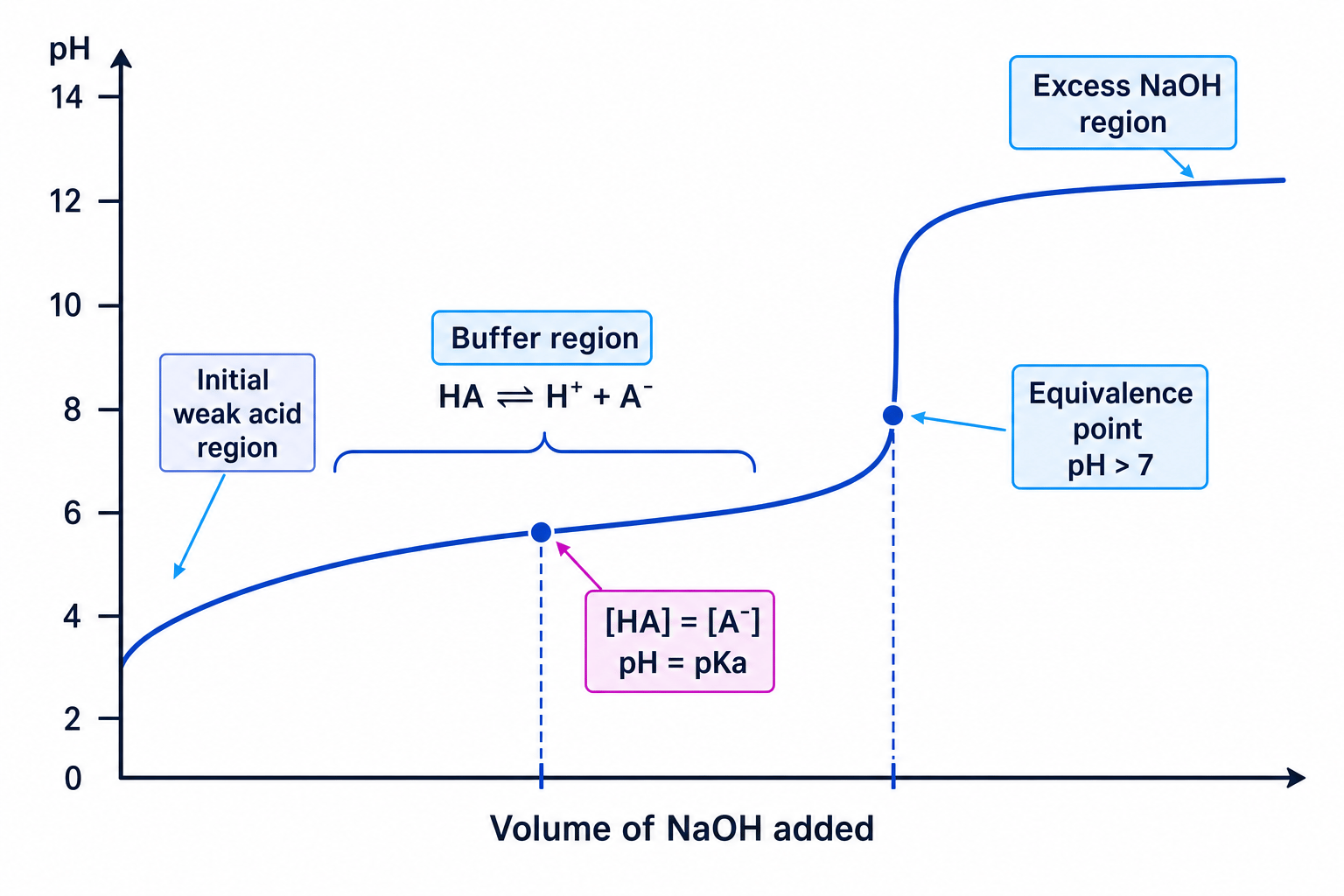
Finding KaK_aKa from half-neutralisation
The half-neutralisation point is the point in a titration where exactly half the original acid has been neutralised by the added base.
For a weak acid HA titrated with a strong alkali such as NaOH:
HA+OH−→A−+H2O\text{HA}+\text{OH}^- \to \text{A}^-+\text{H}_2\text{O}HA+OH−→A−+H2OAt half-neutralisation, half of the original HA has been converted into A−\text{A}^-A−. Therefore:
[HA]=[A−][\text{HA}]=[\text{A}^-][HA]=[A−]Substitute this into the KaK_aKa expression:
Ka=[H+][A−][HA]K_a=\frac{[\text{H}^+][\text{A}^-]}{[\text{HA}]}Ka=[HA][H+][A−]Since [A−]=[HA][\text{A}^-]=[\text{HA}][A−]=[HA], they cancel:
Ka=[H+]K_a=[\text{H}^+]Ka=[H+]So:
pH=pKa\text{pH}=pK_apH=pKaThis is why measuring the pH at half-neutralisation is a practical method for finding KaK_aKa of a weak acid.
Using half-neutralisation to find Ka
A weak monoprotic acid is titrated with NaOH. The equivalence point occurs after 30.0 cm³ of NaOH is added. At 15.0 cm³, the measured pH is 4.76. Calculate KaK_aKa.
-
Identify the half-neutralisation volume:
30.02=15.0 cm3\frac{30.0}{2}=15.0\ \text{cm}^3230.0=15.0 cm3 -
At half-neutralisation, use the relationship:
pH=pKa\text{pH}=pK_apH=pKaso:
pKa=4.76pK_a=4.76pKa=4.76 -
Convert pKapK_apKa into KaK_aKa:
Ka=10−4.76K_a=10^{-4.76}Ka=10−4.76 -
Calculate:
Ka=1.74×10⁻⁵ mol dm−3K_a=1.74 \times 10^{-5}\ \text{mol dm}^{-3}Ka=1.74×10⁻⁵ mol dm−3
In the exam
- Decide what the question gives you: KaK_aKa and concentration usually means find pH; pH and concentration usually means find KaK_aKa; pKapK_apKa means use logs.
- For weak acid pH calculations, start from Ka=[H+][A−][HA]K_a=\frac{[\text{H}^+][\text{A}^-]}{[\text{HA}]}Ka=[HA][H+][A−] and use [H+]=[A−][\text{H}^+]=[\text{A}^-][H+]=[A−] for a monoprotic acid.
- Give units carefully: KaK_aKa is usually mol dm⁻³ for HA calculations, while pH and pKapK_apKa have no units.
Check yourself
- Why does 0.100 mol dm⁻³ ethanoic acid have a higher pH than 0.100 mol dm⁻³ hydrochloric acid?
- A weak acid has concentration 0.200 mol dm⁻³ and Ka=4.0×10⁻⁶ mol dm−3K_a=4.0 \times 10^{-6}\ \text{mol dm}^{-3}Ka=4.0×10⁻⁶ mol dm−3. How would you estimate its pH?
- Why is pH equal to pKapK_apKa at half-neutralisation?
