

What you'll learn
- Why transition metals can exist in multiple stable oxidation states.
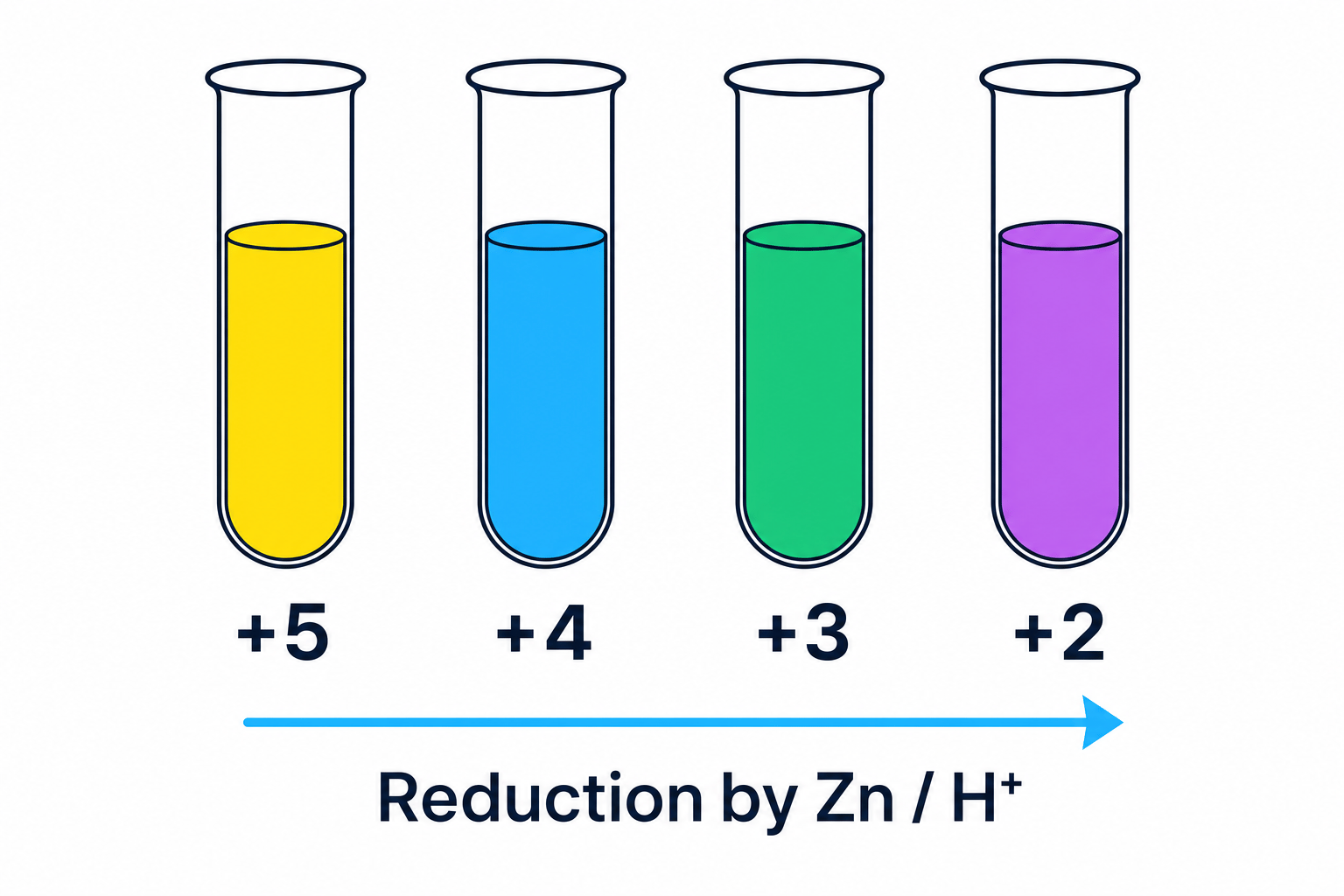
- The colours and formulas of the vanadium ions as they are sequentially reduced from +5+5+5 to +2+2+2.
- How pH and different ligands alter the redox potential of a transition metal ion.
- How to write equations and perform calculations for redox titrations involving manganate(VII).
Why do transition metals have variable oxidation states?
One of the defining features of transition metals is their ability to form compounds with the metal in various oxidation states.
Variable oxidation state
A property of transition metals where they can lose varying numbers of electrons to form stable ions with different charges. This occurs because the 4s4\text{s}4s and 3d3\text{d}3d sub-levels are very similar in energy.
When a transition metal forms an ion, it loses its 4s4\text{s}4s electrons first, followed by one or more 3d3\text{d}3d electrons. Because the energy required to remove successive 3d3\text{d}3d electrons increases gradually rather than in massive jumps, transition metals can reach a variety of stable oxidation states.
The colourful reduction of vanadium
A classic demonstration of variable oxidation states is the reduction of vanadium. In acidic solution, zinc metal is a sufficiently strong reducing agent to reduce vanadium sequentially from an oxidation state of +5+5+5 all the way down to +2+2+2.
As the oxidation state changes, the d-orbital electron configuration changes, which leads to a sequence of distinct colour changes.
- Oxidation state +5: The reaction starts with the yellow dioxovanadium(V) ion, VO2+\text{VO}_2^+VO2+.
- Oxidation state +4: Zinc reduces this to the blue oxovanadium(IV) ion, VO2+\text{VO}^{2+}VO2+.
- Oxidation state +3: Further reduction produces the green vanadium(III) ion, V3+\text{V}^{3+}V3+.
- Oxidation state +2: The final reduction step yields the violet vanadium(II) ion, V2+\text{V}^{2+}V2+.
Confusing the vanadium ions
Students frequently mix up the +5+5+5 and +4+4+4 vanadium ions because their formulas look very similar. Pay close attention to where the "2" is placed!
- VO2+\text{VO}_2^+VO2+ has two oxygens and a single positive charge (oxidation state +5+5+5).
- VO2+\text{VO}^{2+}VO2+ has one oxygen and a two-positive charge (oxidation state +4+4+4).
Remembering the vanadium colours
To remember the sequence of colours as the oxidation state decreases from +5+5+5 to +2+2+2, use the mnemonic "You Better Get Vanadium":
- Yellow (+5+5+5)
- Blue (+4+4+4)
- Green (+3+3+3)
- Violet (+2+2+2)
Factors influencing redox potentials
We measure the tendency of an ion to change from a higher to a lower oxidation state using its redox potential (standard electrode potential, E⊖E^\ominusE⊖). A more positive E⊖E^\ominusE⊖ value means the species is more easily reduced (it is a better oxidising agent).
For transition metals, this potential is not a single fixed number; it can be heavily influenced by the chemical environment.
1. The effect of pH
Many redox half-equations involving transition metals also feature hydrogen ions (H+\text{H}^+H+) or hydroxide ions (OH−\text{OH}^-OH−). For example, the reduction of the yellow vanadium(V) ion:
VO2++2H++e−⇌VO2++H2O \text{VO}_2^+ + 2\text{H}^+ + \text{e}^- \rightleftharpoons \text{VO}^{2+} + \text{H}_2\text{O} VO2++2H++e−⇌VO2++H2OAccording to Le Chatelier's principle, increasing the concentration of H+\text{H}^+H+ (lowering the pH) pushes the equilibrium to the right. Therefore, acidic conditions generally increase the redox potential, making it easier to reduce the transition metal from a higher to a lower oxidation state.
2. The effect of ligands
Transition metal ions form complex ions surrounded by ligands. Changing the ligands changes the stability of the complex. If a specific ligand stabilises the higher oxidation state more than the lower one, the redox potential will decrease (it becomes harder to reduce). If the ligand stabilises the lower oxidation state, the redox potential increases.
Modifying redox behavior
The redox potential for a transition metal ion changing from a higher to a lower oxidation state is uniquely sensitive to both the pH of the solution and the type of ligand bonded to the metal center.
Tollens' reagent: A transition metal test
You have likely used Tollens' reagent in organic chemistry to distinguish between aldehydes and ketones. This test is fundamentally a transition metal redox reaction!
Tollens' reagent contains the diamminesilver(I) complex, [Ag(NH3)2]+[\text{Ag}(\text{NH}_3)_2]^+[Ag(NH3)2]+.
- Aldehydes are gentle reducing agents. They can reduce the silver(I) ion in the complex down to metallic silver (Ag\text{Ag}Ag), forming a silver mirror on the inside of the test tube.
- Ketones cannot be oxidised easily, so they do not reduce the silver complex, and no mirror forms.
The redox half-equation for the transition metal complex is:
[Ag(NH3)2]++e−→Ag+2NH3 [\text{Ag}(\text{NH}_3)_2]^+ + \text{e}^- \to \text{Ag} + 2\text{NH}_3 [Ag(NH3)2]++e−→Ag+2NH3Redox titrations with manganate(VII)
Redox titrations are used to find the unknown concentration of a reducing agent by titrating it against a standard solution of an oxidising agent. The most common oxidising agent used at A-level is potassium manganate(VII), KMnO4\text{KMnO}_4KMnO4.
Manganate(VII) ions (MnO4−\text{MnO}_4^-MnO4−) are deep purple. As they are reduced to manganese(II) ions (Mn2+\text{Mn}^{2+}Mn2+), the solution becomes virtually colourless. This means the titration is self-indicating; the end-point is identified by the first permanent pale pink colour when a tiny excess of unreacted MnO4−\text{MnO}_4^-MnO4− remains in the flask.
These titrations must be carried out in strongly acidic conditions (usually using dilute sulfuric acid) to ensure the MnO4−\text{MnO}_4^-MnO4− is fully reduced to Mn2+\text{Mn}^{2+}Mn2+.
Iron(II) and Manganate(VII)
When titrating Fe2+\text{Fe}^{2+}Fe2+ ions (for example, to find the percentage of iron in an iron tablet or steel wire), the two half-equations combine to give an overall reacting ratio of 1:51 : 51:5.
- Reduction: MnO4−+8H++5e−→Mn2++4H2O\text{MnO}_4^- + 8\text{H}^+ + 5\text{e}^- \to \text{Mn}^{2+} + 4\text{H}_2\text{O}MnO4−+8H++5e−→Mn2++4H2O
- Oxidation: Fe2+→Fe3++e−\text{Fe}^{2+} \to \text{Fe}^{3+} + \text{e}^-Fe2+→Fe3++e−
- Overall: MnO4−+8H++5Fe2+→Mn2++4H2O+5Fe3+\text{MnO}_4^- + 8\text{H}^+ + 5\text{Fe}^{2+} \to \text{Mn}^{2+} + 4\text{H}_2\text{O} + 5\text{Fe}^{3+}MnO4−+8H++5Fe2+→Mn2++4H2O+5Fe3+
Ethanedioate and Manganate(VII)
Ethanedioate ions (C2O42−\text{C}_2\text{O}_4^{2-}C2O42−) can also be titrated with manganate(VII). This reaction requires heating at the start because the initial rate is very slow. The combined equation gives a reacting ratio of 2:52 : 52:5.
- Reduction: MnO4−+8H++5e−→Mn2++4H2O\text{MnO}_4^- + 8\text{H}^+ + 5\text{e}^- \to \text{Mn}^{2+} + 4\text{H}_2\text{O}MnO4−+8H++5e−→Mn2++4H2O
- Oxidation: C2O42−→2CO2+2e−\text{C}_2\text{O}_4^{2-} \to 2\text{CO}_2 + 2\text{e}^-C2O42−→2CO2+2e−
- Overall: 2MnO4−+16H++5C2O42−→2Mn2++8H2O+10CO22\text{MnO}_4^- + 16\text{H}^+ + 5\text{C}_2\text{O}_4^{2-} \to 2\text{Mn}^{2+} + 8\text{H}_2\text{O} + 10\text{CO}_22MnO4−+16H++5C2O42−→2Mn2++8H2O+10CO2
Calculating the percentage of iron in an iron tablet
A student dissolved an iron tablet weighing 1.50 g1.50 \text{ g}1.50 g in dilute sulfuric acid and made the solution up to 250 cm3250 \text{ cm}^3250 cm3 in a volumetric flask. They titrated 25.0 cm325.0 \text{ cm}^325.0 cm3 portions of this solution against 0.0200 mol dm−30.0200 \text{ mol dm}^{-3}0.0200 mol dm−3 potassium manganate(VII) solution. The mean titre was 21.30 cm321.30 \text{ cm}^321.30 cm3. Calculate the percentage by mass of iron in the tablet. The molar mass of iron is 55.8 g mol−155.8 \text{ g mol}^{-1}55.8 g mol−1.
- Calculate the moles of MnO4−\text{MnO}_4^-MnO4− used in the mean titre using n=c×Vn = c \times Vn=c×V.
- Use the 1:51 : 51:5 stoichiometric ratio from the balanced equation (MnO4−≡5Fe2+\text{MnO}_4^- \equiv 5\text{Fe}^{2+}MnO4−≡5Fe2+) to find the moles of Fe2+\text{Fe}^{2+}Fe2+ present in the 25.0 cm325.0 \text{ cm}^325.0 cm3 titration sample.
- Scale this amount up to find the total moles of Fe2+\text{Fe}^{2+}Fe2+ in the original 250 cm3250 \text{ cm}^3250 cm3 volumetric flask.
- Convert the total moles of iron into a mass using m=n×Mm = n \times Mm=n×M.
- Calculate the percentage by mass of iron relative to the whole 1.50 g1.50 \text{ g}1.50 g tablet.
Acid choice in manganate titrations
You must only use dilute sulfuric acid to acidify the solution. If you use hydrochloric acid, the powerful MnO4−\text{MnO}_4^-MnO4− ions will oxidise the Cl−\text{Cl}^-Cl− ions to highly toxic Cl2\text{Cl}_2Cl2 gas, which ruins the titration stoichiometry. If you use nitric acid or a weak acid like ethanoic acid, the reaction will not proceed completely or cleanly.
In the exam
- Watch out for scaling: The most frequently dropped mark in a redox titration calculation is forgetting to scale up from the pipette volume (usually 25.0 cm325.0 \text{ cm}^325.0 cm3) to the volumetric flask volume (usually 250 cm3250 \text{ cm}^3250 cm3). Always check your volumes.
- Learn the stoichiometric ratios: You will save valuable exam time if you instantly know that MnO4−\text{MnO}_4^-MnO4− reacts with Fe2+\text{Fe}^{2+}Fe2+ in a 1:51:51:5 ratio, and with C2O42−\text{C}_2\text{O}_4^{2-}C2O42− in a 2:52:52:5 ratio.
- Be precise with colours: When describing the endpoint of a manganate(VII) titration, write "colourless to pale pink". Saying "clear to pink" or "purple to colourless" will often lose you the mark.
Check yourself
- What are the formulas and colours of the four vanadium ions produced sequentially by reducing vanadate(V) with zinc?
- Why do acidic conditions generally increase the redox potential for the reduction of transition metal oxyanions?
- What is the overall balanced equation for the redox reaction between manganate(VII) ions and ethanedioate ions?
- Why doesn't Tollens' reagent produce a silver mirror when mixed with a ketone?
