

Welcome to the world of advanced catalysis. In earlier topics, you learned that a catalyst speeds up a reaction without being used up. Now, we are going to look under the hood to see how they actually do this, and why transition metals are the undisputed kings of catalysis.
What you'll learn:
- The difference between heterogeneous and homogeneous catalysts.
- How transition metals make uniquely effective catalysts due to their variable oxidation states.
- Specific, examinable equations for key industrial processes (like the Contact process).
- How autocatalysis works, where a newly formed product turns around and speeds up its own reaction.
The Role of Transition Metals
Why are transition metals such good catalysts? They have partially filled d-orbitals and variable oxidation states. This flexibility allows them to easily lend electrons to, or accept electrons from, reactant molecules. By changing their oxidation state back and forth, they can form temporary intermediate compounds, providing an alternative reaction pathway with a lower activation energy (EaE_aEa).
Heterogeneous Catalysis
Heterogeneous Catalyst
A catalyst that is in a different phase (state) from the reactants. Usually, the catalyst is a solid, and the reactants are liquids or gases.
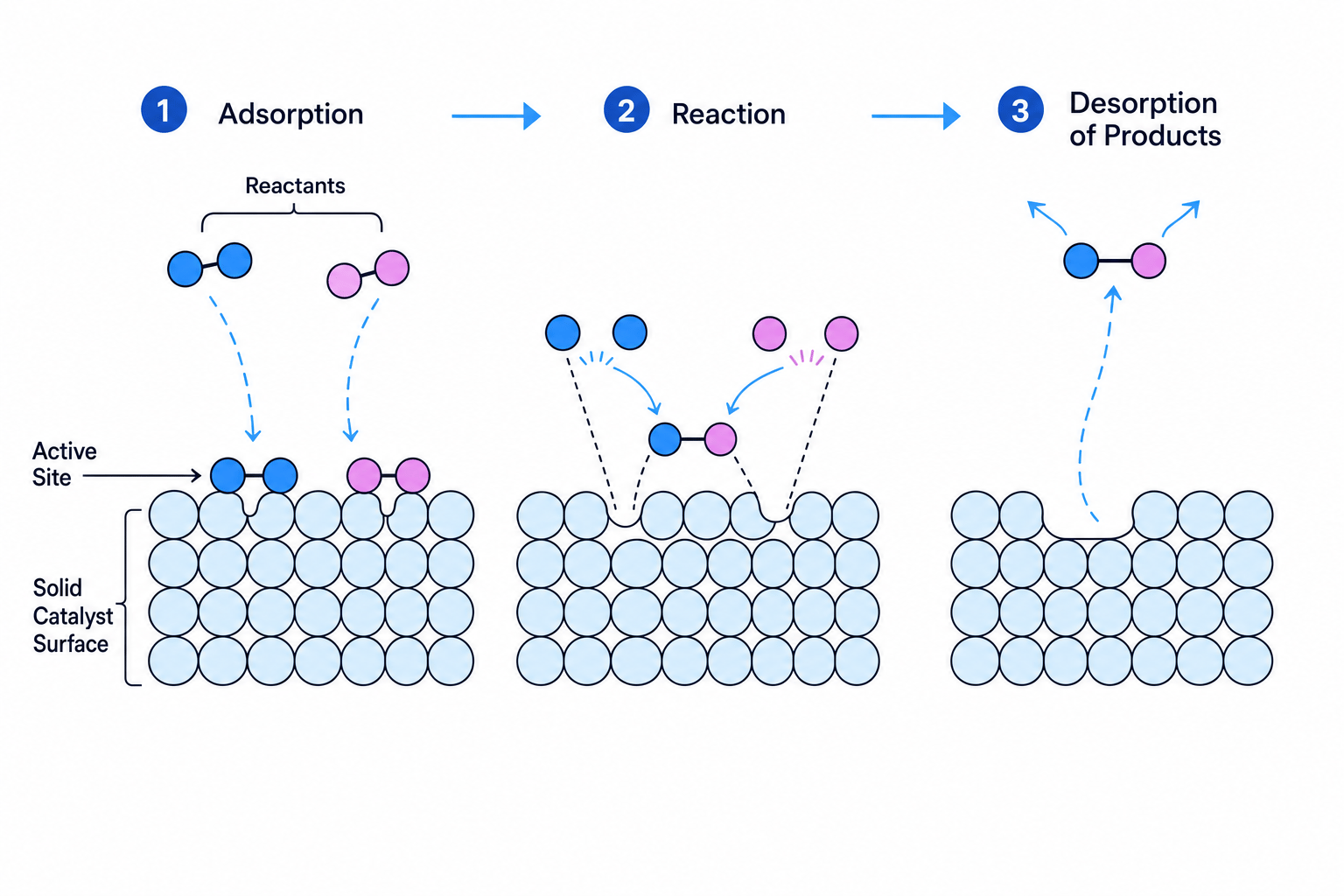
How does it work? It relies entirely on surface chemistry:
- Adsorption: Reactant molecules bind to active sites on the solid catalyst's surface. This process weakens the chemical bonds inside the reactant molecules and holds them close together in the correct orientation.
- Reaction: The weakened bonds break and new bonds form to create the products.
- Desorption: The product molecules leave the surface, freeing up the active sites so the cycle can repeat with new reactants.
Absorption vs Adsorption
Don't mix up absorption (where something soaks into the bulk of a material, like water into a sponge) with adsorption (where molecules stick onto the surface of a material). In heterogeneous catalysis, it's always adsorption.
Maximising Efficiency and Minimising Cost
Transition metals like platinum, palladium, and rhodium are highly effective catalysts, but they are incredibly expensive. To minimise cost, they are often coated very thinly onto a support medium (like a ceramic honeycomb). This creates a massive surface area with a minimal amount of metal, getting the best possible "bang for your buck".
Catalyst Poisoning
Over time, heterogeneous catalysts can lose their efficiency. Impurities in the reactant mixture may bind strongly to the active sites on the catalyst surface and refuse to desorb. This is called poisoning. The blocked active sites can no longer catalyse the reaction, which slows the process down and costs companies money, as the catalyst must eventually be cleaned or completely replaced.
- For example, lead poisons the catalytic converters in cars (which is why we use unleaded petrol).
- Sulfur impurities poison the solid iron catalyst used in the Haber process.
Key Heterogeneous Examples
You need to know two specific industrial examples:
- The Haber Process: Makes ammonia. Uses solid iron (Fe\text{Fe}Fe) as the catalyst. Reactants are N2\text{N}_2N2 and H2\text{H}_2H2 gases.
- The Contact Process: Makes sulfuric acid. Uses solid vanadium(V) oxide (V2O5\text{V}_2\text{O}_5V2O5) to catalyse the oxidation of sulfur dioxide.
Deriving the Contact process equations
In the Contact process, SO2\text{SO}_2SO2 gas reacts with O2\text{O}_2O2 gas to form SO3\text{SO}_3SO3 gas. Solid V2O5\text{V}_2\text{O}_5V2O5 acts as a heterogeneous catalyst. Vanadium's ability to change its oxidation state from +5 to +4 makes this possible. Show how the catalyst provides an alternative pathway and prove it remains unchanged overall.
- Write the first step (reduction of the catalyst): The SO2\text{SO}_2SO2 reacts with the V2O5\text{V}_2\text{O}_5V2O5. The vanadium is reduced from +5 to +4, and SO2\text{SO}_2SO2 is oxidised to SO3\text{SO}_3SO3.
- Write the second step (regeneration of the catalyst): The intermediate V2O4\text{V}_2\text{O}_4V2O4 must be oxidised back to V2O5\text{V}_2\text{O}_5V2O5 by the other reactant, O2\text{O}_2O2. Since each O2\text{O}_2O2 molecule provides two oxygen atoms, you need two V2O4\text{V}_2\text{O}_4V2O4 molecules:
- Combine to find the overall equation: Multiply the first equation by 2 so the intermediate (V2O4\text{V}_2\text{O}_4V2O4) cancels out easily:
Add the two steps together:
2SO2+2V2O5+2V2O4+O2→2SO3+2V2O4+2V2O5 2\text{SO}_2 + 2\text{V}_2\text{O}_5 + 2\text{V}_2\text{O}_4 + \text{O}_2 \to 2\text{SO}_3 + 2\text{V}_2\text{O}_4 + 2\text{V}_2\text{O}_5 2SO2+2V2O5+2V2O4+O2→2SO3+2V2O4+2V2O5- Simplify: Cancel the species that appear on both sides (V2O4\text{V}_2\text{O}_4V2O4 and V2O5\text{V}_2\text{O}_5V2O5) to reveal the overall reaction:
Because V2O5\text{V}_2\text{O}_5V2O5 goes in and comes out completely unchanged, it proves it acts as a catalyst!
Homogeneous Catalysis
Homogeneous Catalyst
A catalyst that is in the same phase as the reactants. Typically, the reactants and the catalyst are all aqueous ions in solution.
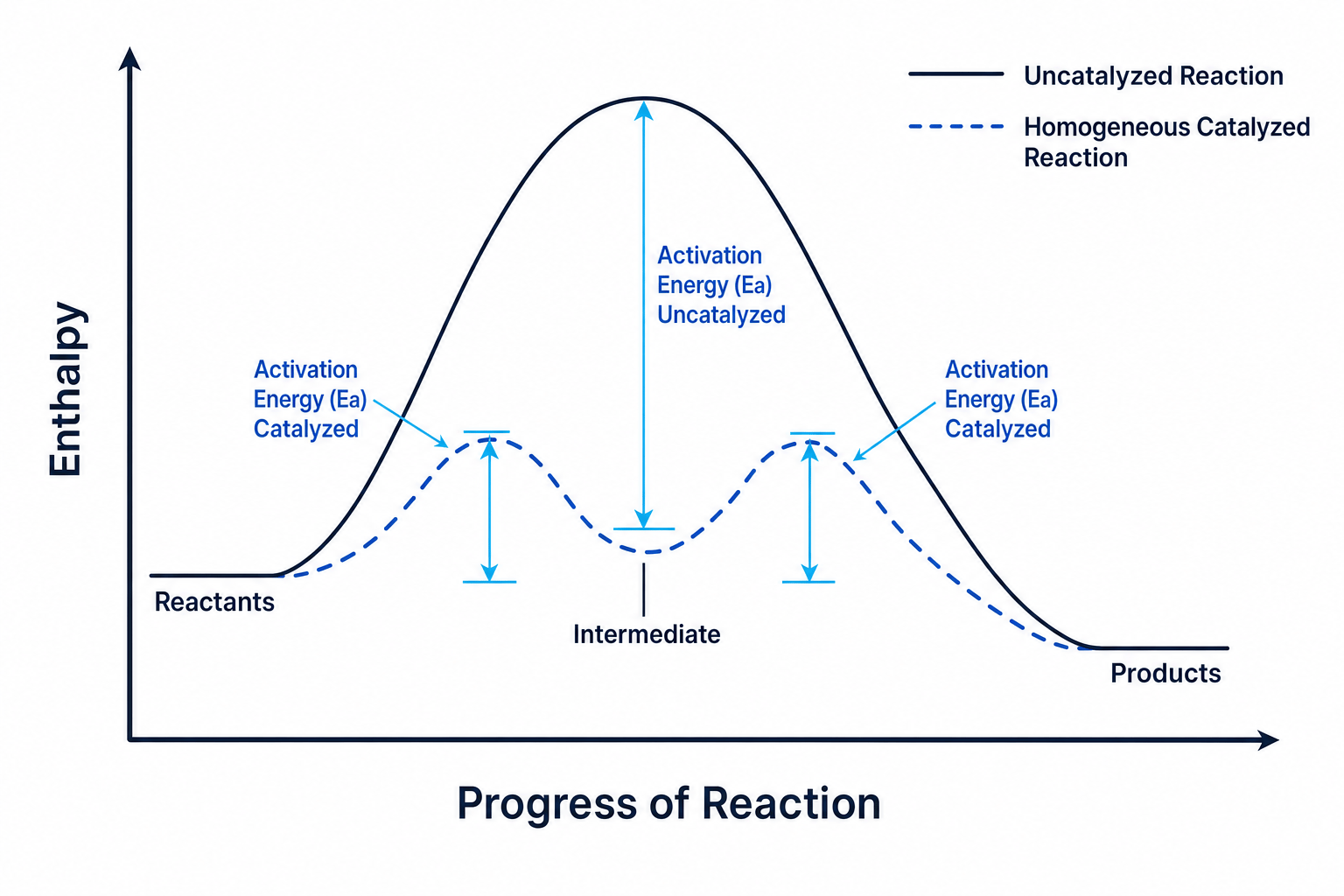
When the catalyst and reactants are in the same phase, the reaction proceeds through an intermediate species. The catalyst reacts with one reactant to form the intermediate, which then reacts with the other reactant to give the final product and regenerate the catalyst.
Because the reaction is broken down into two simpler steps, the energy profile diagram for a homogeneously catalysed reaction features two activation energy peaks with a 'dip' in the middle representing the intermediate. Both peaks are lower than the large activation energy of the uncatalysed route.
The Peroxydisulfate and Iodide Reaction
A classic homogeneous example is the reaction between aqueous peroxydisulfate ions (S2O82−\text{S}_2\text{O}_8^{2-}S2O82−) and iodide ions (I−\text{I}^-I−):
S2O82−+2I−→2SO42−+I2 \text{S}_2\text{O}_8^{2-} + 2\text{I}^- \to 2\text{SO}_4^{2-} + \text{I}_2 S2O82−+2I−→2SO42−+I2Without a catalyst, this reaction is extremely slow. Why? Because both reactant ions are negatively charged. They repel each other, meaning a huge amount of collision energy is needed to overcome the electrostatic repulsion (giving it a very high EaE_aEa).
We can catalyse it by adding aqueous iron(II) ions (Fe2+\text{Fe}^{2+}Fe2+). Notice how the catalyst introduces a pathway where positively charged ions react with negatively charged ions, completely side-stepping the repulsion!
- Step 1: Fe2+\text{Fe}^{2+}Fe2+ reduces the S2O82−\text{S}_2\text{O}_8^{2-}S2O82− (and is oxidised to Fe3+\text{Fe}^{3+}Fe3+ in the process).
- Step 2: The intermediate Fe3+\text{Fe}^{3+}Fe3+ oxidises the I−\text{I}^-I− (and is reduced back to Fe2+\text{Fe}^{2+}Fe2+).
Does it matter if you start with Iron(II) or Iron(III)?
No! You could start with Fe3+\text{Fe}^{3+}Fe3+ instead. If you do, Step 2 happens first (creating Fe2+\text{Fe}^{2+}Fe2+ and I2\text{I}_2I2), and then Step 1 happens second. The cycle is identical either way.
Autocatalysis
Autocatalysis
A reaction in which one of the products acts as a catalyst for the reaction.
In an autocatalysed reaction, the rate starts incredibly slowly because there is no catalyst present at the beginning. As the uncatalysed reaction proceeds, a little bit of the product is formed. Because this product is a catalyst, the reaction suddenly speeds up. Eventually, as the reactants are used up, the rate drops off again.
The Manganate(VII) and Ethanedioate Reaction
You need to memorise the autocatalysis between acidified potassium manganate(VII) (MnO4−\text{MnO}_4^-MnO4−) and ethanedioate ions (C2O42−\text{C}_2\text{O}_4^{2-}C2O42−).
The overall equation is:
2MnO4−+16H++5C2O42−→2Mn2++8H2O+10CO2 2\text{MnO}_4^- + 16\text{H}^+ + 5\text{C}_2\text{O}_4^{2-} \to 2\text{Mn}^{2+} + 8\text{H}_2\text{O} + 10\text{CO}_2 2MnO4−+16H++5C2O42−→2Mn2++8H2O+10CO2Like our previous homogeneous example, this is a reaction between two negative ions (MnO4−\text{MnO}_4^-MnO4− and C2O42−\text{C}_2\text{O}_4^{2-}C2O42−), so the initial uncatalysed rate is practically zero due to electrostatic repulsion.
However, as soon as a few Mn2+\text{Mn}^{2+}Mn2+ ions are produced, they act as an autocatalyst. The Mn2+\text{Mn}^{2+}Mn2+ ions react with the MnO4−\text{MnO}_4^-MnO4− to form Mn3+\text{Mn}^{3+}Mn3+ intermediates, which then easily react with the C2O42−\text{C}_2\text{O}_4^{2-}C2O42−.
The catalytic cycle is:
- Formation of intermediate:
- Reaction of intermediate:
Variable oxidation states are the key
Notice the recurring theme: transition metals flip between oxidation states (like V +5/+4, Fe +2/+3, Mn +2/+3) to act as an electron 'bridge'. They allow reactions to occur without forcing two negatively charged ions to collide directly.
In the exam
- Learn the equations: You are explicitly required to know the full equations for the Contact process (V2O5\text{V}_2\text{O}_5V2O5), the I−\text{I}^-I−/S2O82−\text{S}_2\text{O}_8^{2-}S2O82− reaction (Fe2+\text{Fe}^{2+}Fe2+), and the manganate/ethanedioate autocatalysis (Mn2+\text{Mn}^{2+}Mn2+). Practice writing them out from memory.
- Check the charges: When writing homogeneous catalysis steps, always quickly tally the charges on both sides to ensure your intermediate equation is balanced.
- Spotting autocatalysis: If a question shows you a concentration-time graph that starts with a shallow gradient, gets much steeper in the middle, and then levels off at the end, it is almost certainly testing autocatalysis.
Check yourself
- Can you clearly define the difference between a heterogeneous and a homogeneous catalyst?
- Why does the uncatalysed reaction between S2O82−\text{S}_2\text{O}_8^{2-}S2O82− and I−\text{I}^-I− have such a high activation energy?
- What are the three stages of heterogeneous catalysis on a solid surface?
- How is the catalyst V2O5\text{V}_2\text{O}_5V2O5 regenerated in the Contact process? (Try writing the equation).
