

What you'll learn
- How an incomplete d sub-level explains the behaviour of transition metals.
- Why the AQA focus is on the Period 4 metals Ti to Cu.
- What ligands, complexes and co-ordination number mean.
- How transition metals show coloured ions, variable oxidation states and catalytic activity.
The big idea
This is an A-Level-only part of the course. You are now looking at metals where the outer electron structure is more complicated than the Group 1, Group 2 and Period 3 patterns you met earlier.
The key Period 4 transition metals in this section are:
Ti, V, Cr, Mn, Fe, Co, Ni and Cu.
They show a family of characteristic properties because their atoms or ions have an incomplete d sub-level.
d sub-levels and the transition metal definition
An orbital is a region around the nucleus that can hold up to two electrons. A sub-level is a set of orbitals of the same type. A d sub-level contains five d orbitals, so it can hold up to 10 electrons.
An incomplete d sub-level means it contains between d¹ and d⁹ electrons. Empty d⁰ and full d¹⁰ are not incomplete.
Transition metal
A transition metal is a d-block element that forms at least one stable ion with an incomplete d sub-level.
When forming ions from Period 4 transition metals, remember that 4s electrons are removed before 3d electrons, even though 4s fills before 3d in neutral atoms.
Removing the wrong electrons first
When writing electron configurations of transition metal ions, remove electrons from 4s before 3d. For example, Fe is [Ar] 3d⁶ 4s², but Fe²⁺ is [Ar] 3d⁶, not [Ar] 3d⁴ 4s².
Checking copper and zinc
Copper is classed as a transition metal, but zinc is not. Here is the reasoning.
-
Start with the relevant ions. Copper forms Cu²⁺, while zinc commonly forms Zn²⁺.
-
Remove 4s electrons first. Cu is [Ar] 3d¹⁰ 4s¹, so Cu²⁺ is [Ar] 3d⁹. Zn is [Ar] 3d¹⁰ 4s², so Zn²⁺ is [Ar] 3d¹⁰.
-
Compare the d sub-levels. Cu²⁺ has d⁹, which is incomplete, so copper fits the transition metal definition. Zn²⁺ has d¹⁰, which is full, so zinc is not usually classed as a transition metal.
Why Ti to Cu matter
The characteristic transition metal properties arise from incomplete d sub-levels in atoms or ions. This is why Ti to Cu show much more varied chemistry than simple s-block metals.
Variable oxidation states
An oxidation state is a number assigned to an atom in a compound or ion, showing the charge it would have if bonding were treated as fully ionic.
Transition metals often have variable oxidation states, meaning the same element can form ions or compounds with different oxidation states. For example:
- iron forms Fe²⁺ and Fe³⁺
- copper forms Cu⁺ and Cu²⁺
- manganese can show several oxidation states, including +2, +4 and +7
This happens because the 4s and 3d electrons are close in energy, so different numbers of electrons can be lost or used in bonding.
Finding a metal oxidation state
Find the oxidation state of copper in [CuCl₄]²⁻.
-
Let the oxidation state of copper be xxx. Each chloride ligand, Cl⁻, has charge -1.
-
Add the contributions and set them equal to the overall charge of the complex ion:
- Solve the equation:
So x=+2x = +2x=+2. The copper is in the +2 oxidation state, so the complex contains copper(II).
Complex formation
Transition metal ions commonly form complexes because ligands can donate lone pairs into empty orbitals on the metal ion.
A lone pair is a pair of outer-shell electrons not used in bonding. A co-ordinate bond, also called a dative covalent bond, is a covalent bond in which both electrons in the shared pair come from the same atom or ion.
Ligand
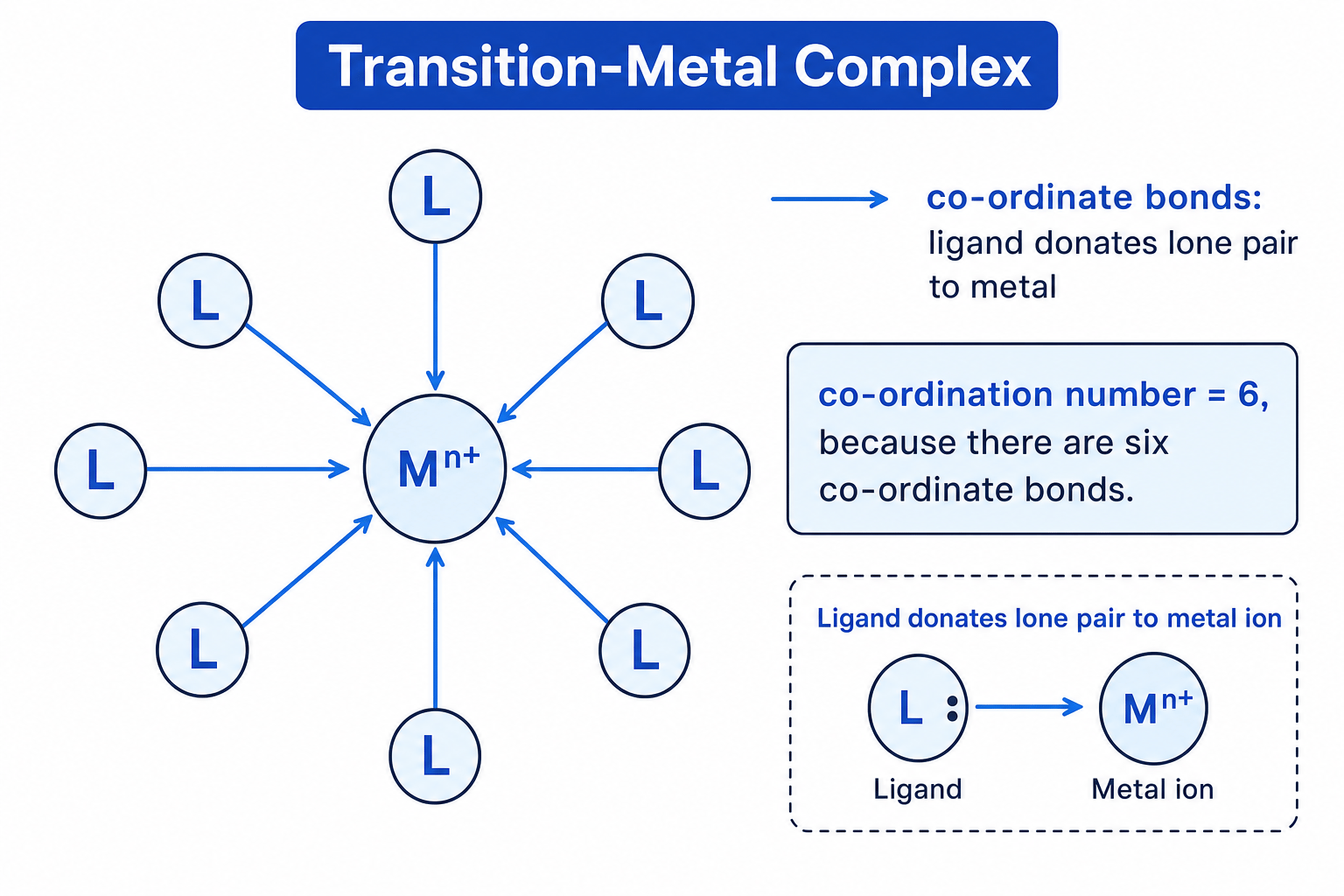
A ligand is a molecule or ion that forms a co-ordinate bond with a transition metal by donating a pair of electrons.
Common ligands include H₂O, NH₃ and Cl⁻.
Complex
A complex is a central metal atom or ion surrounded by ligands.
Co-ordination number
The co-ordination number is the number of co-ordinate bonds to the central metal atom or ion.
The diagram shows a metal ion surrounded by six ligands. Each ligand donates a lone pair to form one co-ordinate bond, so the co-ordination number is 6.
Finding co-ordination number
Find the co-ordination number in [Fe(H₂O)₆]³⁺.
-
Identify the central metal ion: Fe³⁺ is in the centre of the complex.
-
Count the ligands attached to the metal. There are six H₂O ligands.
-
Each H₂O ligand forms one co-ordinate bond to the metal, so there are six co-ordinate bonds. The co-ordination number is 6.
Counting ligands instead of bonds
Co-ordination number means the number of co-ordinate bonds, not always just the number of ligand particles. This distinction becomes important when you meet ligands that can form more than one co-ordinate bond.
Formation of coloured ions
Many transition metal ions are coloured. This is linked to their incomplete d sub-levels.
When ligands surround a transition metal ion, the d orbitals no longer all have exactly the same energy. Visible light can be absorbed to promote an electron from a lower-energy d orbital to a higher-energy d orbital. The wavelengths not absorbed are what you see as the colour of the ion or solution.
The colour depends on several factors:
- the metal ion
- the oxidation state of the metal
- the ligand attached
- the co-ordination number and shape of the complex
For example, many copper(II) complexes are blue or blue-green, while many iron(III) solutions appear yellow or brown.
Do not overstate the colour rule
Not every transition metal ion is strongly coloured, and full d¹⁰ or empty d⁰ ions are often colourless. At A-Level, the key link is that many coloured transition metal ions involve electron movement between split d orbitals.
Catalytic activity
A catalyst increases the rate of a reaction without being used up overall. It works by providing an alternative reaction route with a lower activation energy, EaE_aEa. The activation energy is the minimum energy particles need for a successful reaction.
Transition metals and their compounds are often good catalysts for two main reasons.
First, they can change oxidation state during a reaction. This allows them to take part in temporary electron transfer steps, then be regenerated.
Second, solid transition metals can adsorb reactants onto their surface. Adsorption means particles stick to a surface. This can weaken bonds in reactant molecules and bring them close together in the correct orientation.
Examples include:
- iron in the Haber process
- vanadium(V) oxide, V₂O₅, in the Contact process
- nickel in hydrogenation reactions
Explaining a redox catalyst
Vanadium(V) oxide catalyses the oxidation of sulfur dioxide to sulfur trioxide in the Contact process.
-
Sulfur dioxide is oxidised to sulfur trioxide. During one step, V₂O₅ gives up oxygen and is reduced to V₂O₄:
SO₂ + V₂O₅ → SO₃ + V₂O₄
-
Oxygen then re-oxidises V₂O₄ back to V₂O₅:
V₂O₄ + ½O₂ → V₂O₅
-
The vanadium compound is regenerated, so it is not used up overall. Its ability to switch between oxidation states makes it effective as a catalyst.
Bringing the properties together
The characteristic properties of transition metals are connected, not random.
- Complex formation happens because ligands can donate lone pairs to metal ions.
- Coloured ions arise because d electrons can absorb visible light when d orbitals are split by ligands.
- Variable oxidation states are possible because 4s and 3d electrons are close in energy.
- Catalytic activity often depends on variable oxidation states or adsorption onto a metal surface.
In the exam
-
When asked why transition metals have characteristic properties, link your answer to an incomplete d sub-level in atoms or ions.
-
For electron configurations of ions, remove 4s electrons before 3d electrons.
-
For co-ordination number, count the number of co-ordinate bonds to the central metal atom or ion.
-
For oxidation states in complexes, add ligand charges and set the total equal to the overall charge of the complex ion.
Check yourself
- Why is Cu classed as a transition metal even though a copper atom has a full 3d sub-level?
- What is the difference between a ligand, a complex and co-ordination number?
- How can variable oxidation states help transition metal compounds act as catalysts?
