

What you'll learn
- What chemists mean by amount of substance and the mole.
- How the Avogadro constant links moles to numbers of particles.
- How to convert between mass, molar mass and amount in mol.
- How to use concentration in mol dm⁻³ with solution volumes.
Why chemists use the mole
Atoms, ions and molecules are far too small to count one by one in the lab. Instead, chemists count them in very large “packets” called moles.
This is a bit like counting eggs in dozens: you rarely want one egg number at a time, so you use a convenient counting unit. A mole is the chemist’s counting unit — just much, much bigger.
Amount of substance
Amount of substance is the quantity that counts how many chemical particles are present. Its symbol is nnn, and its unit is the mole, abbreviated to mol.
The word particle here means the entity you have chosen to count: atoms, molecules, ions, electrons, or formula units.
A formula unit is the simplest whole-number ratio represented by an ionic formula. For example, one formula unit of NaCl represents one Na⁺ ion and one Cl⁻ ion.
The mole and the Avogadro constant
The mole and the Avogadro constant
One mole of a substance contains the Avogadro constant number of specified particles. The Avogadro constant is usually written as NAN_ANA and has units mol⁻¹.
In calculations, you may see:
NA≈6.022×10²³ mol−1N_A \approx 6.022 \times 10^{23}\ \text{mol}^{-1}NA≈6.022×10²³ mol−1That means 1 mol contains about 602 200 000 000 000 000 000 000 particles.
You do not need to memorise the value
For this specification, you are not expected to recall the numerical value of the Avogadro constant. You do need to know what it means and how to use it when it is given.
What can one mole apply to?
A mole can be used for different types of chemical particles:
- 1 mol of helium atoms contains NAN_ANA helium atoms.
- 1 mol of water molecules contains NAN_ANA H₂O molecules.
- 1 mol of chloride ions contains NAN_ANA Cl⁻ ions.
- 1 mol of electrons contains NAN_ANA electrons.
- 1 mol of MgCl₂ formula units contains NAN_ANA MgCl₂ formula units.
Always say what you are counting
A mole is not automatically “a mole of atoms”. It is a mole of whatever particle is specified: atoms, molecules, ions, electrons, or formula units.
Using the Avogadro constant
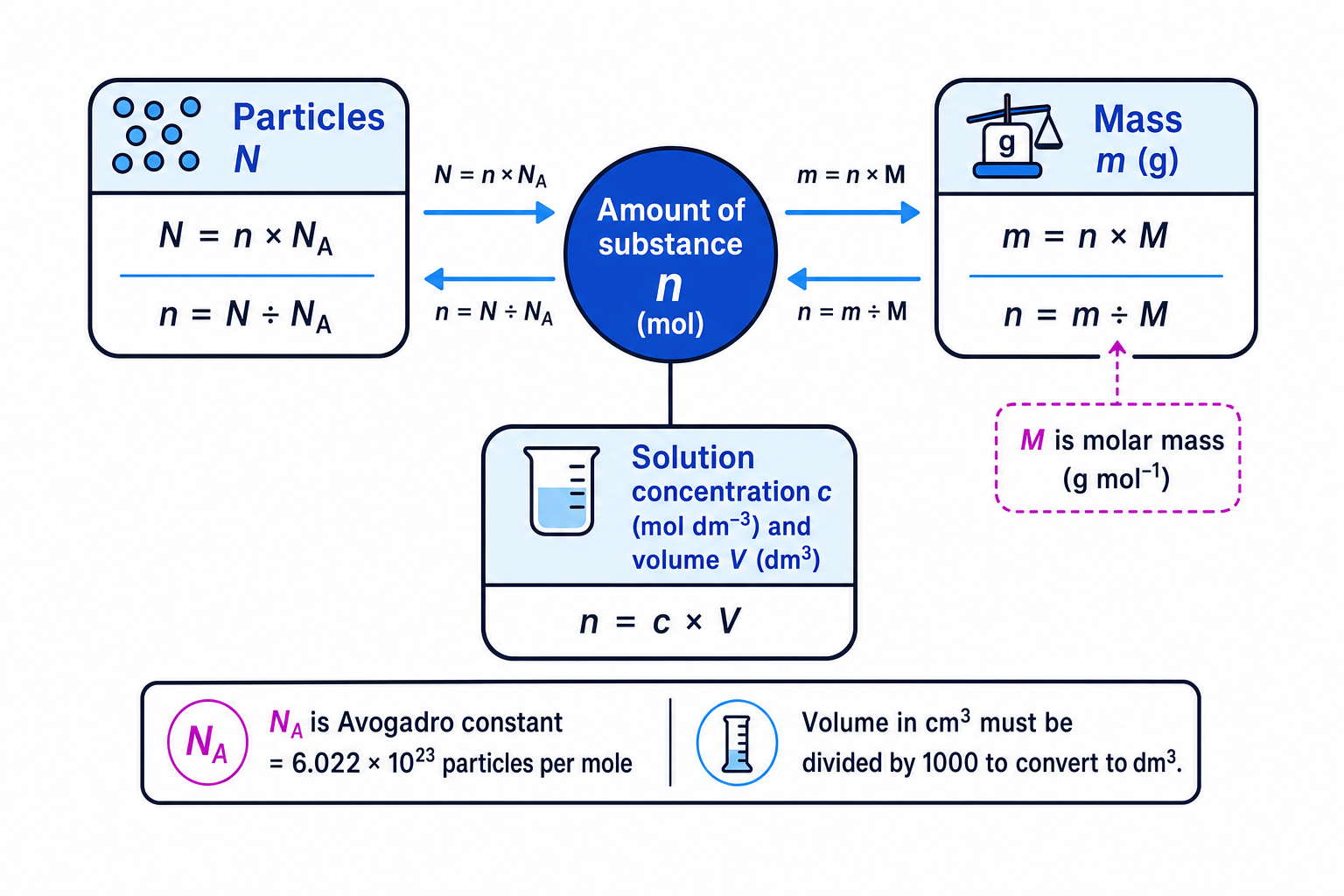
The relationship between number of particles, NNN, and amount in mol, nnn, is:
N=nNAn=NNA\begin{aligned} N &= nN_A \\ n &= \frac{N}{N_A} \end{aligned}Nn=nNA=NANHere, NNN is the number of particles and has no unit, although you should name the particle in your answer.
Counting ions from moles
0.250 mol of MgCl₂ is present. Calculate the number of chloride ions. Use NA=6.022×10²³ mol−1N_A = 6.022 \times 10^{23}\ \text{mol}^{-1}NA=6.022×10²³ mol−1.
-
Use the formula to connect MgCl₂ formula units to chloride ions: each MgCl₂ formula unit contains two Cl⁻ ions, so the amount of chloride ions is 2×0.250=0.500 mol2 \times 0.250 = 0.500\ \text{mol}2×0.250=0.500 mol.
-
Convert moles of chloride ions into number of chloride ions:
N=nNA=0.500×6.022×1023N = nN_A = 0.500 \times 6.022 \times 10^{23}N=nNA=0.500×6.022×1023 -
Calculate and round appropriately:
N=3.01×10²³N = 3.01 \times 10^{23}N=3.01×10²³So there are 3.01×10233.01 \times 10^{23}3.01×10²³ chloride ions.
Forgetting subscripts in formulas
In MgCl₂, 1 mol of MgCl₂ formula units contains 2 mol of Cl⁻ ions. The subscript ₂ changes the number of ions present.
Moles in chemical equations
A balanced chemical equation shows the reacting ratio in particles, but because moles are proportional to particles, it also shows the reacting ratio in moles.
For example:
2H₂ + O₂ → 2H₂O
This means:
- 2 mol of H₂ reacts with 1 mol of O₂.
- 2 mol of H₂O is formed.
- The mole ratio H₂ : O₂ : H₂O is 2 : 1 : 2.
Using a mole ratio
For the reaction 2Al + 3Cl₂ → 2AlCl₃, calculate the amount of AlCl₃ formed when 0.600 mol of Cl₂ reacts completely.
-
Compare the coefficients for Cl₂ and AlCl₃: 3 mol of Cl₂ forms 2 mol of AlCl₃.
-
Convert from Cl₂ to AlCl₃ using the ratio:
n(AlCl3)=0.600×23n(\text{AlCl}_3) = 0.600 \times \frac{2}{3}n(AlCl3)=0.600×32 -
Calculate the amount formed:
n(AlCl3)=0.400 moln(\text{AlCl}_3) = 0.400\ \text{mol}n(AlCl3)=0.400 mol
From mass to moles
In the lab, you usually measure mass, not individual particles. To convert mass into moles, you use molar mass.
Relative mass and molar mass
The relative molecular mass or relative formula mass, MrM_rMr, is found by adding the relative atomic masses, ArA_rAr, in a formula. The molar mass, MMM, is the mass of 1 mol of a substance, usually in g mol⁻¹. Its numerical value is the same as MrM_rMr.
For example, CO₂ has:
M=12.0+(2×16.0)=44.0 g mol−1M = 12.0 + (2 \times 16.0) = 44.0\ \text{g mol}^{-1}M=12.0+(2×16.0)=44.0 g mol−1So 1 mol of CO₂ has a mass of 44.0 g.
The key equations are:
n=mMm=nM\begin{aligned} n &= \frac{m}{M} \\ m &= nM \end{aligned}nm=Mm=nMwhere mmm is mass in g, MMM is molar mass in g mol⁻¹, and nnn is amount in mol.
Calculating moles from mass
Calculate the amount, in mol, in 4.86 g of MgO. Use Ar(Mg)=24.3A_r(\text{Mg}) = 24.3Ar(Mg)=24.3 and Ar(O)=16.0A_r(\text{O}) = 16.0Ar(O)=16.0.
-
Calculate the molar mass of MgO:
M=24.3+16.0=40.3 g mol−1M = 24.3 + 16.0 = 40.3\ \text{g mol}^{-1}M=24.3+16.0=40.3 g mol−1 -
Substitute into n=mMn = \frac{m}{M}n=Mm:
n=4.8640.3n = \frac{4.86}{40.3}n=40.34.86 -
Calculate the amount:
n=0.121 moln = 0.121\ \text{mol}n=0.121 mol
Mixing kg with g mol⁻¹
If your molar mass is in g mol⁻¹, your mass must be in g. If a question gives mass in kg, convert it to g first.
Concentration in solution
A solution is formed when a solute dissolves in a solvent. For example, in sodium chloride solution, sodium chloride is the solute and water is the solvent.
Concentration
The concentration of a substance in solution is the amount of solute per unit volume of solution. In this topic, concentration is measured in mol dm⁻³.
The key equation is:
c=nVc = \frac{n}{V}c=Vnwhich can be rearranged to:
n=cVn = cVn=cVwhere:
- ccc is concentration in mol dm⁻³
- nnn is amount in mol
- VVV is volume in dm³
The volume must be in dm³ when using mol dm⁻³.
V(dm3)=V(cm3)1000V(\text{dm}^3) = \frac{V(\text{cm}^3)}{1000}V(dm3)=1000V(cm3)Using cm³ directly
If you put 25.0 cm³ straight into n=cVn = cVn=cV, your answer will be 1000 times too large. Convert first: 25.0 cm³ = 0.0250 dm³.
The diagram below shows the three main mole calculation routes: particles, mass and solution concentration.
Finding concentration after dissolving a solid
5.30 g of anhydrous Na₂CO₃ is dissolved in water and made up to 250.0 cm³ of solution. Calculate the concentration in mol dm⁻³.
-
Calculate the molar mass of Na₂CO₃:
M=(2×23.0)+12.0+(3×16.0)=106.0 g mol−1M = (2 \times 23.0) + 12.0 + (3 \times 16.0) = 106.0\ \text{g mol}^{-1}M=(2×23.0)+12.0+(3×16.0)=106.0 g mol−1 -
Convert mass into amount:
n=mM=5.30106.0=0.0500 moln = \frac{m}{M} = \frac{5.30}{106.0} = 0.0500\ \text{mol}n=Mm=106.05.30=0.0500 mol -
Convert the solution volume into dm³:
V=250.01000=0.2500 dm3V = \frac{250.0}{1000} = 0.2500\ \text{dm}^3V=1000250.0=0.2500 dm3 -
Calculate the concentration:
c=nV=0.05000.2500=0.200 mol dm−3c = \frac{n}{V} = \frac{0.0500}{0.2500} = 0.200\ \text{mol dm}^{-3}c=Vn=0.25000.0500=0.200 mol dm−3
Standard form and significant figures
The Avogadro constant is very large, so particle numbers are usually written in standard form, such as 3.01×10233.01 \times 10^{23}3.01×10²³.
For measured quantities, your final answer should usually be given to an appropriate number of significant figures. A calculated result cannot be more precise than the least precise measurement used to calculate it.
A quick precision check
If the data in the question are mostly given to three significant figures, a final answer to three significant figures is usually sensible unless the question says otherwise.
In the exam
-
Decide exactly what is being counted: atoms, molecules, ions, electrons, or formula units.
-
Choose the correct route: particles and NAN_ANA, mass and molar mass, or concentration and volume.
-
Convert cm³ to dm³ before using c=nVc = \frac{n}{V}c=Vn or n=cVn = cVn=cV.
-
Use balanced equation coefficients as mole ratios, then convert to the units the question asks for.
-
Include units for mass, amount and concentration; for particle numbers, name the particle instead.
Check yourself
- Why does 1 mol of MgCl₂ contain 2 mol of Cl⁻ ions?
- Calculate the amount in mol in 3.20 g of O₂.
- What volume unit must be used with concentration in mol dm⁻³?
