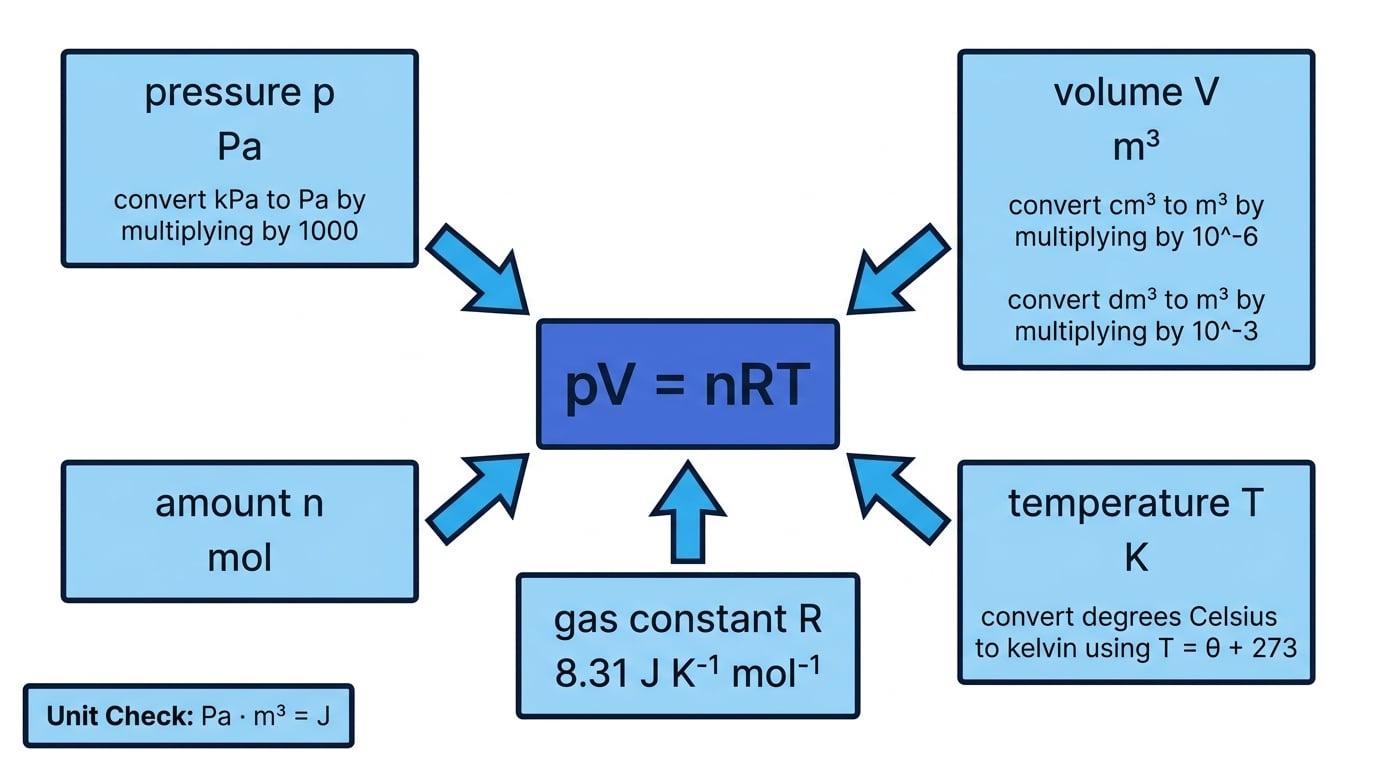
What you'll learn
- What each symbol means in pV=nRTpV=nRTpV=nRT.
- How to convert common laboratory units into the required SI units.
- How to rearrange and use the ideal gas equation in calculations.
- How gas measurements can be used to find the MrM_rMr of a volatile liquid.
The big idea
Gases are very spread out compared with solids and liquids, so their behaviour depends strongly on pressure, volume, temperature and amount of substance.
The ideal gas equation links all four:
pV=nRTpV=nRTpV=nRTIt is one of the most unit-sensitive equations in A-Level Chemistry. Most mistakes are not chemistry mistakes — they are usually unit conversion mistakes.
The variables you need
Amount of substance, nnn
The amount of substance tells you how many particles you have, measured in moles, mol.
Amount of substance
The amount of substance, nnn, is measured in mol. One mole contains the Avogadro constant number of particles.
You have already met:
n=mMn=\frac{m}{M}n=Mmwhere mmm is mass and MMM is molar mass. In gas questions, you may calculate nnn using the ideal gas equation, then connect it to mass or molar mass.
Pressure, ppp
Pressure is the force exerted per unit area. In a gas, pressure comes from gas particles colliding with the walls of the container.
For this specification, pressure must be in pascals, Pa, when using pV=nRTpV=nRTpV=nRT.
Volume, VVV
Volume is the space occupied by the gas.
For pV=nRTpV=nRTpV=nRT, volume must be in cubic metres, m³ — not cm³ or dm³.
Temperature, TTT
Temperature must be in kelvin, K. Kelvin temperature is also called absolute temperature.
Kelvin temperature
The kelvin scale starts at absolute zero, so it must be used in gas calculations. Convert from degrees Celsius using T=θ+273T=\theta+273T=θ+273, where θ\thetaθ is the temperature in °C.
The gas constant, RRR
RRR is the gas constant. Its value connects the units on both sides of the equation.
A common value is:
R=8.31 J K−1 mol−1R=8.31\ \text{J K}^{-1}\text{ mol}^{-1}R=8.31 J K−1 mol−1In AQA questions, you are not expected to recall the value of RRR; it will be given.
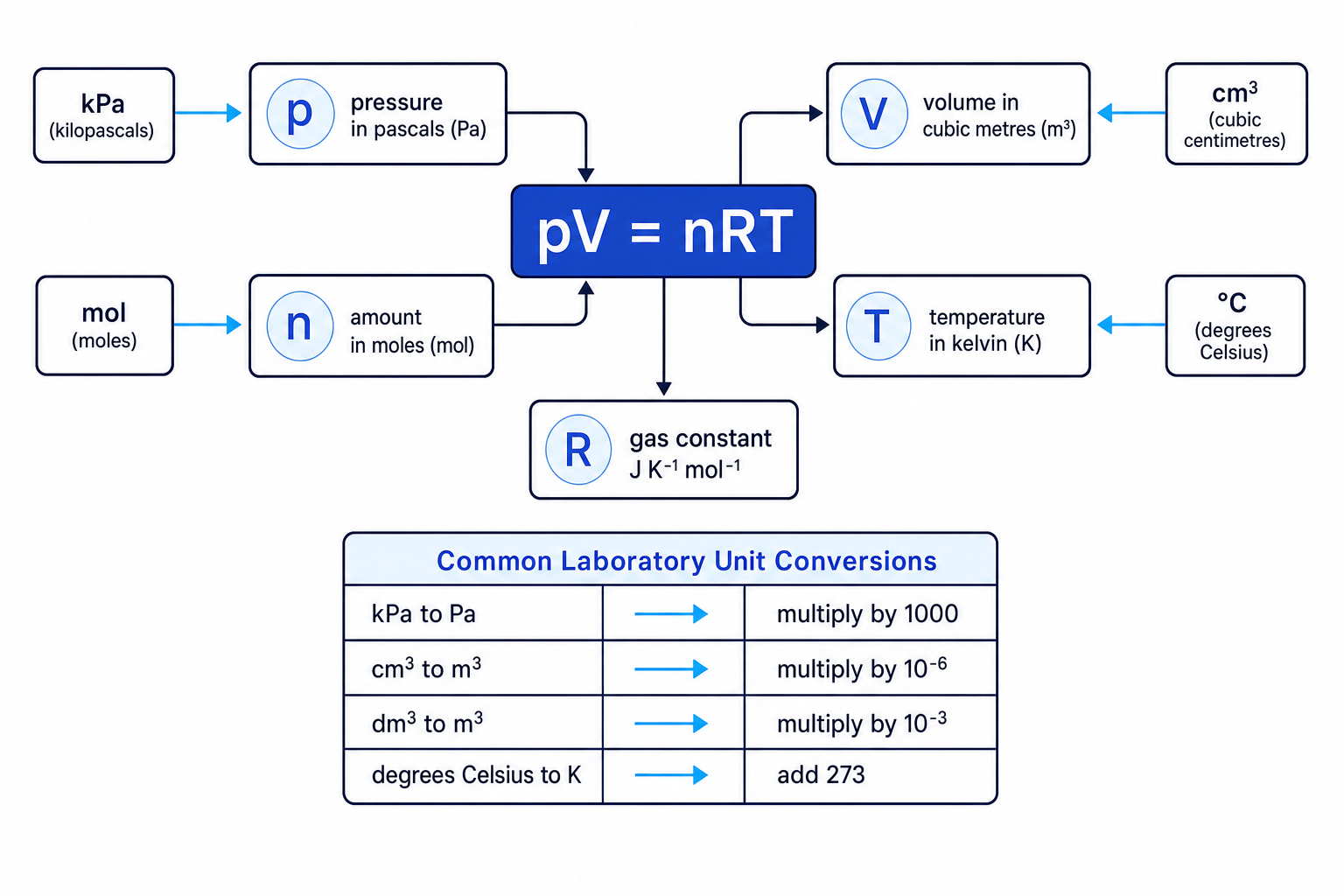
The diagram below summarises the symbols and the unit conversions you should think about before substituting numbers into the equation.
SI units are not optional
For pV=nRTpV=nRTpV=nRT in this specification, use pressure in Pa, volume in m³, amount in mol and temperature in K. If one value is in the wrong unit, the final answer will usually be wrong by a factor of 1000 or more.
The ideal gas equation
The equation is:
pV=nRTpV=nRTpV=nRTwhere:
- ppp = pressure in Pa
- VVV = volume in m³
- nnn = amount of gas in mol
- RRR = gas constant, usually given as 8.31 J K−1 mol−18.31\ \text{J K}^{-1}\text{ mol}^{-1}8.31 J K−1 mol−1
- TTT = temperature in K
Ideal gas
An ideal gas is a model gas whose particles have negligible volume and no intermolecular forces. Real gases often behave close to ideal gases at relatively low pressure and high temperature.
A useful unit check is that pressure multiplied by volume has units of energy:
Pa m3=J\text{Pa}\ \text{m}^3=\text{J}Pa m3=JSo the left-hand side, pVpVpV, has units of J. The right-hand side also has units of J because:
mol×J K−1 mol−1×K=J\text{mol}\times \text{J K}^{-1}\text{ mol}^{-1}\times \text{K}=\text{J}mol×J K−1 mol−1×K=JThis is why the units of RRR only work properly when you use the correct units for ppp, VVV and TTT.
Converting units before using the equation
Here are the most common conversions:
- kPa to Pa: multiply by 1000
- cm³ to m³: multiply by 10−610^{-6}10−6
- dm³ to m³: multiply by 10−310^{-3}10−3
- °C to K: add 273
Using laboratory units directly
Do not substitute kPa, cm³, dm³ or °C directly into pV=nRTpV=nRTpV=nRT. Convert first, then calculate.
Preparing values for the equation
A gas has a pressure of 98.0 kPa, a volume of 250 cm³ and a temperature of 21 °C. Convert these values for use in pV=nRTpV=nRTpV=nRT.
-
Convert pressure into Pa: 98.0 kPa=98.0×1000=9.80×10⁴ Pa98.0\ \text{kPa}=98.0\times 1000=9.80\times 10^4\ \text{Pa}98.0 kPa=98.0×1000=9.80×10⁴ Pa.
-
Convert volume into m³: 250 cm3=250×10−6=2.50×10⁻⁴ m3250\ \text{cm}^3=250\times 10^{-6}=2.50\times 10^{-4}\ \text{m}^3250 cm3=250×10−6=2.50×10⁻⁴ m3.
-
Convert temperature into K: T=21+273=294 KT=21+273=294\ \text{K}T=21+273=294 K.
Rearranging pV=nRTpV=nRTpV=nRT
You may need to calculate any one of the variables. Rearrange before substituting numbers.
For amount of gas:
n=pVRTn=\frac{pV}{RT}n=RTpVFor pressure:
p=nRTVp=\frac{nRT}{V}p=VnRTFor volume:
V=nRTpV=\frac{nRT}{p}V=pnRTFor temperature:
T=pVnRT=\frac{pV}{nR}T=nRpVRearrange first
Rearrange the equation symbolically before putting numbers in. This reduces calculator errors and makes your working much easier to follow.
Calculating amount of gas
A gas syringe contains 200 cm³ of gas at 100 kPa and 25 °C. Calculate the amount of gas in mol. Use R=8.31 J K−1 mol−1R=8.31\ \text{J K}^{-1}\text{ mol}^{-1}R=8.31 J K−1 mol−1.
-
Convert the measurements into SI units: p=100×1000=1.00×10⁵ Pap=100\times 1000=1.00\times 10^5\ \text{Pa}p=100×1000=1.00×10⁵ Pa, V=200×10−6=2.00×10⁻⁴ m3V=200\times 10^{-6}=2.00\times 10^{-4}\ \text{m}^3V=200×10−6=2.00×10⁻⁴ m3, and T=25+273=298 KT=25+273=298\ \text{K}T=25+273=298 K.
-
Rearrange the equation to make nnn the subject: n=pVRTn=\frac{pV}{RT}n=RTpV.
-
Substitute and calculate:
Finding the MrM_rMr of a volatile liquid
A volatile liquid is a liquid that evaporates easily. If you vaporise a known mass of the liquid and measure the gas volume, pressure and temperature, you can calculate the amount of vapour using pV=nRTpV=nRTpV=nRT.
Then use:
M=mnM=\frac{m}{n}M=nmIf mass is in g and amount is in mol, MMM is in g mol⁻¹. The numerical value is the relative molecular mass, MrM_rMr, which has no units.
Finding the Mr of a volatile liquid
A 0.342 g sample of a volatile liquid is vaporised. The vapour occupies 100 cm³ at 101 kPa and 95 °C. Calculate the MrM_rMr of the liquid. Use R=8.31 J K−1 mol−1R=8.31\ \text{J K}^{-1}\text{ mol}^{-1}R=8.31 J K−1 mol−1.
-
Convert the gas measurements into SI units: p=101×1000=1.01×10⁵ Pap=101\times 1000=1.01\times 10^5\ \text{Pa}p=101×1000=1.01×10⁵ Pa, V=100×10−6=1.00×10⁻⁴ m3V=100\times 10^{-6}=1.00\times 10^{-4}\ \text{m}^3V=100×10−6=1.00×10⁻⁴ m3, and T=95+273=368 KT=95+273=368\ \text{K}T=95+273=368 K.
-
Calculate the amount of vapour:
- Use the mass and amount to find the molar mass:
- State the relative molecular mass: Mr≈104M_r\approx 104Mr≈104.
When the ideal model is weakest
Real gases deviate most from ideal behaviour at high pressure and low temperature, because particle volume and intermolecular forces become more important. In A-Level calculations, assume ideal behaviour unless the question tells you otherwise.
Quick sense checks
At around room temperature and pressure, 1 mol of gas occupies about 24 dm³. This is not a replacement for pV=nRTpV=nRTpV=nRT, but it is a useful check.
For example, if you calculate that 200 cm³ of gas contains several moles, something has gone badly wrong: 200 cm³ is only 0.200 dm³, much smaller than 24 dm³.
Spotting impossible answers
For gas samples measured in a syringe, amounts are often small, such as 10−310^{-3}10−3 to 10−210^{-2}10−2 mol. Very large answers usually mean the volume was left in cm³ or the pressure was left in kPa.
In the exam
-
Convert all values before substitution: kPa to Pa, cm³ or dm³ to m³, and °C to K.
-
Rearrange pV=nRTpV=nRTpV=nRT first, then substitute numbers with units shown in your working.
-
For MrM_rMr questions, calculate nnn from the gas data, then use M=mnM=\frac{m}{n}M=nm and give MrM_rMr with no units.
Check yourself
- Why must temperature be converted to kelvin before using the ideal gas equation?
- What values of ppp, VVV and TTT would you substitute for 150 cm³ of gas at 99.0 kPa and 20 °C?
- How could you use the mass of a vaporised liquid and its gas measurements to find its MrM_rMr?