What you'll learn
- Why atomic masses are measured on a relative scale rather than in grams.
- How to define relative atomic mass, ArA_rAr, using carbon-12.
- How to define and calculate relative molecular mass, MrM_rMr.
- When to use the term relative formula mass for ionic compounds.
Why do we need a relative mass scale?
Atoms are incredibly small. The mass of one atom in grams is so tiny that it is inconvenient to use directly in ordinary chemistry calculations.
Instead, chemists compare atomic masses with a fixed standard. This is called a relative scale: it tells you how heavy something is compared with a chosen reference.
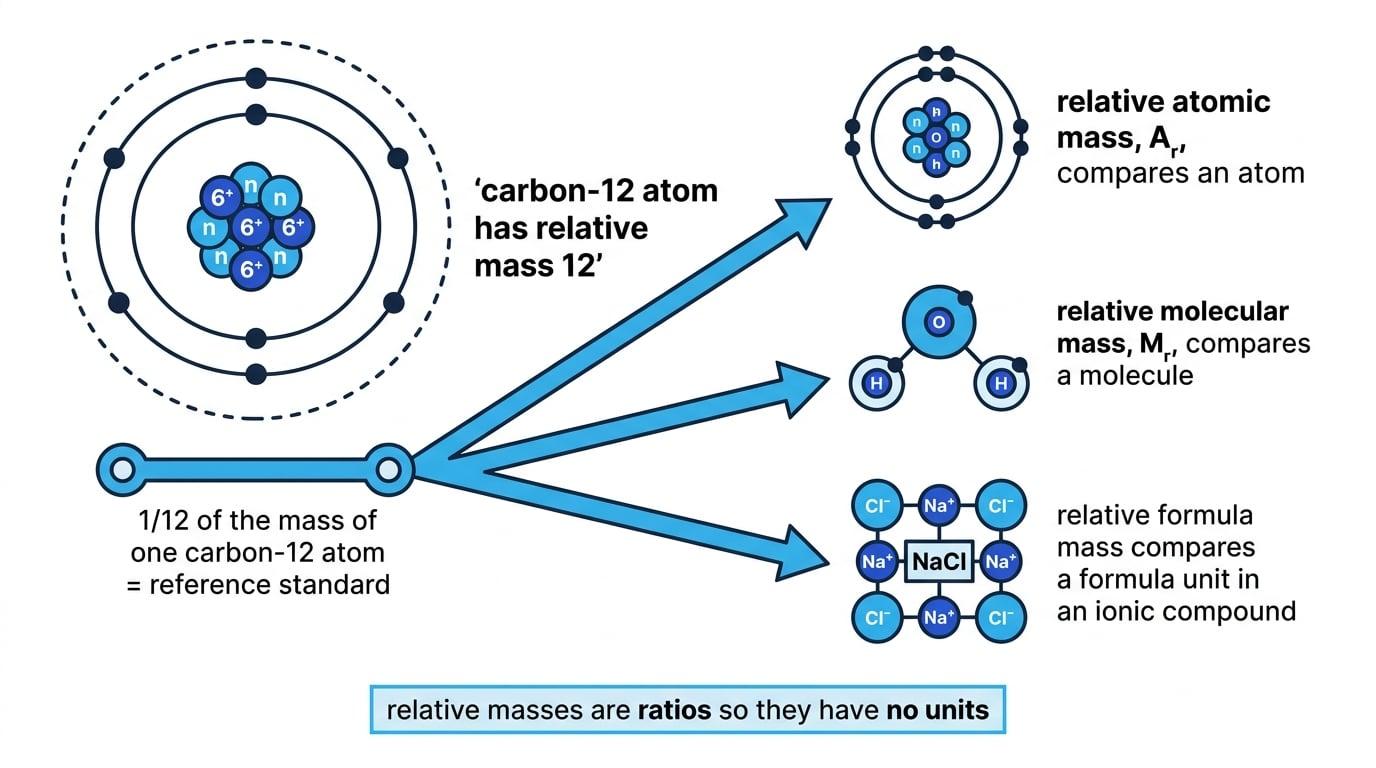
The reference used in A-Level Chemistry is one twelfth of the mass of one atom of carbon-12.
Carbon-12 reference
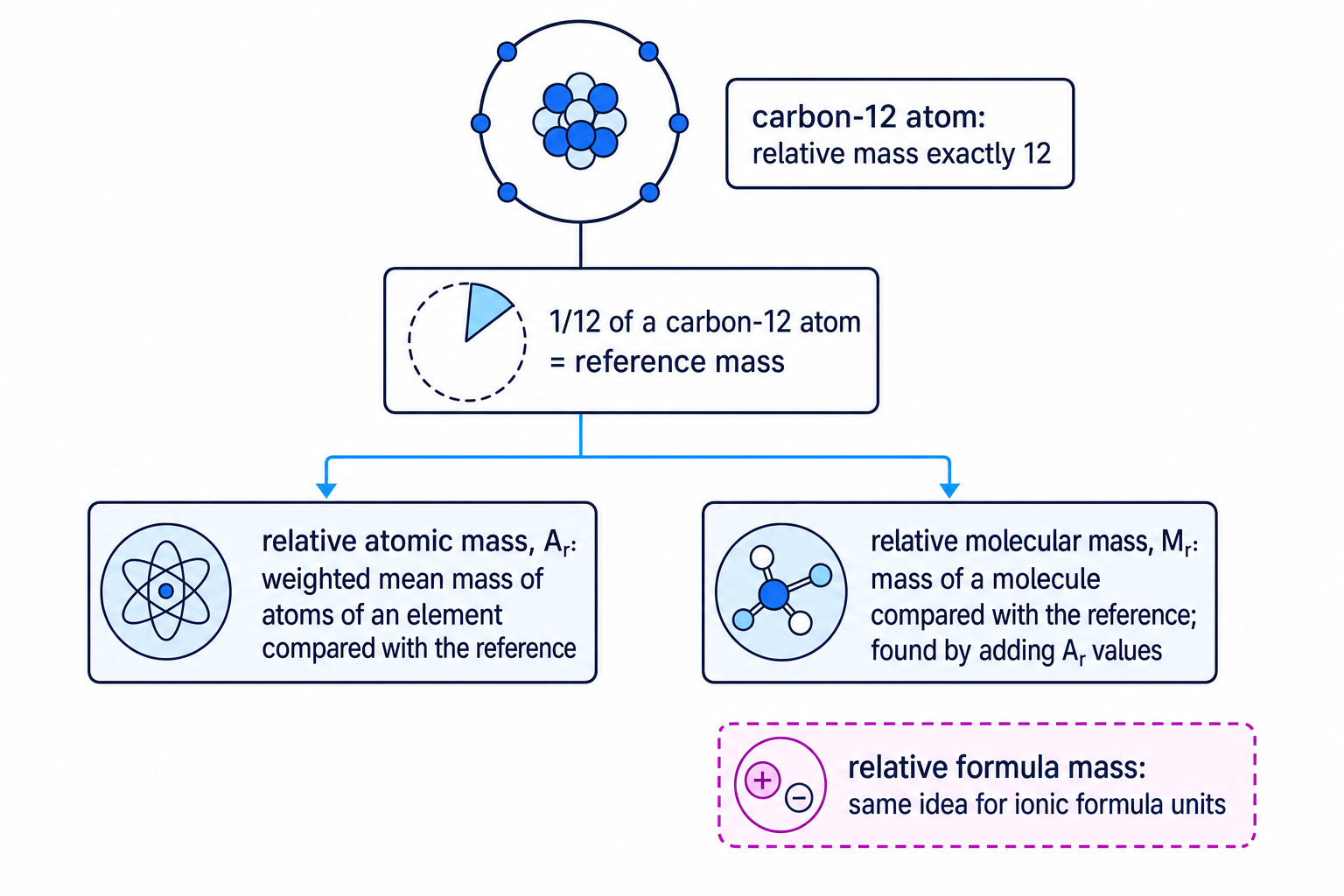
Carbon-12 is an isotope of carbon whose atoms are assigned a relative mass of exactly 12. The reference mass for relative atomic and molecular masses is one twelfth of the mass of one carbon-12 atom.
Because these masses are relative, they have no units. They are ratios: one mass divided by another mass.
Comparing an atom with the carbon-12 reference
An oxygen atom has a mass of about 2.66×10⁻²⁶ kg2.66 \times 10^{-26}\ \text{kg}2.66×10⁻²⁶ kg. The carbon-12 reference mass is about 1.661×10⁻²⁷ kg1.661 \times 10^{-27}\ \text{kg}1.661×10⁻²⁷ kg. Find the relative mass of this oxygen atom.
- Use the idea that a relative mass compares the atom’s mass with the carbon-12 reference mass: relative mass=mass of atomreference massrelative\ mass = \frac{\text{mass of atom}}{\text{reference mass}}relative mass=reference massmass of atom.
- Substitute the two masses: relative mass=2.66×10−261.661×10−27=16.0relative\ mass = \frac{2.66 \times 10^{-26}}{1.661 \times 10^{-27}} = 16.0relative mass=1.661×10−272.66×10−26=16.0.
- The kg units cancel in the ratio, so the oxygen atom has relative mass 16.0, with no unit.
Isotopes and weighted means
Before defining relative atomic mass properly, you need two small ideas.
Isotope
Isotopes are atoms of the same element with the same number of protons but different numbers of neutrons.
For example, chlorine exists mainly as chlorine-35 and chlorine-37. These are both chlorine atoms, but they have different masses.
A mean is an average. A weighted mean is an average that takes account of how common each value is. If one isotope is more abundant, it affects the average more strongly.
Relative atomic mass, ArA_rAr
Relative atomic mass
The relative atomic mass, ArA_rAr, of an element is the weighted mean mass of an atom of that element compared with one twelfth of the mass of an atom of carbon-12.
This definition has several important parts:
- weighted mean: it accounts for the natural abundance of isotopes
- atom of that element: it refers to atoms, not molecules
- compared with one twelfth of carbon-12: this is the reference standard
- relative: it has no units
Why many Ar values are decimals
An element’s ArA_rAr is often not a whole number because it is a weighted mean of the masses of its naturally occurring isotopes.
For example, chlorine has an ArA_rAr of about 35.5. That does not mean chlorine atoms have half a neutron. It means natural chlorine is a mixture, mainly of chlorine-35 and chlorine-37.
Finding a weighted mean relative atomic mass
A sample of chlorine contains 75.0% chlorine-35 and 25.0% chlorine-37. Estimate the relative atomic mass of chlorine.
- Weight each isotope by its percentage abundance: chlorine-35 contributes 35.0×75.035.0 \times 75.035.0×75.0, and chlorine-37 contributes 37.0×25.037.0 \times 25.037.0×25.0.
- Divide by the total percentage, 100.0: Ar=(35.0×75.0)+(37.0×25.0)100.0=35.5A_r = \frac{(35.0 \times 75.0) + (37.0 \times 25.0)}{100.0} = 35.5Ar=100.0(35.0×75.0)+(37.0×25.0)=35.5.
- The answer, 35.5, is closer to 35 than 37 because chlorine-35 is the more abundant isotope.
Mixing up Ar and mass number
The mass number is for one specific isotope and is a whole number. The relative atomic mass, ArA_rAr, is a weighted mean for the element and may be a decimal.
Relative molecular mass, MrM_rMr
A molecule is a group of atoms covalently bonded together. Examples include H2O, CO2, O2 and CH4.
Relative molecular mass
The relative molecular mass, MrM_rMr, of a substance is the weighted mean mass of a molecule compared with one twelfth of the mass of an atom of carbon-12.
In practice, you normally calculate MrM_rMr by adding up the ArA_rAr values of all the atoms in the molecular formula.
For example, H2O contains two hydrogen atoms and one oxygen atom, so its MrM_rMr is based on two lots of hydrogen plus one lot of oxygen.
Calculating Mr
To calculate MrM_rMr, count each type of atom in the formula, multiply by its ArA_rAr, then add the results.
Calculating relative molecular mass
Calculate the relative molecular mass of H2SO4. Use ArA_rAr values: H = 1.0, S = 32.1, O = 16.0.
- Count the atoms in the formula: H2SO4 contains 2 H atoms, 1 S atom and 4 O atoms.
- Multiply each number of atoms by its ArA_rAr: hydrogen contributes 2×1.0=2.02 \times 1.0 = 2.02×1.0=2.0, sulfur contributes 32.1, and oxygen contributes 4×16.0=64.04 \times 16.0 = 64.04×16.0=64.0.
- Add the contributions: Mr=2.0+32.1+64.0=98.1M_r = 2.0 + 32.1 + 64.0 = 98.1Mr=2.0+32.1+64.0=98.1. The relative molecular mass is 98.1, with no unit.
A quick sanity check
For most A-Level calculations, your MrM_rMr should be roughly the sum of the mass numbers you would expect from the formula. If your answer is wildly too small, you may have missed a subscript or bracket.
Relative formula mass for ionic compounds
Ionic compounds, such as sodium chloride, magnesium oxide and calcium nitrate, do not usually exist as separate molecules. Instead, they form giant ionic lattices made from many positive and negative ions.
So for ionic compounds, AQA uses the term relative formula mass rather than relative molecular mass.
Relative formula mass
The relative formula mass of an ionic compound is found by adding the ArA_rAr values of all the atoms shown in its formula unit.
A formula unit is the simplest whole-number ratio of ions in an ionic compound. For example, NaCl represents a 1:1 ratio of Na+ ions to Cl− ions, not one separate NaCl molecule.
The calculation method is the same as for MrM_rMr: count atoms, multiply by ArA_rAr, add.
Calculating relative formula mass with brackets
Calculate the relative formula mass of Ca(NO3)2. Use ArA_rAr values: Ca = 40.1, N = 14.0, O = 16.0.
- Interpret the brackets carefully: Ca(NO3)2 contains 1 Ca atom, 2 N atoms and 6 O atoms.
- Multiply each atom count by its ArA_rAr: calcium contributes 40.1, nitrogen contributes 2×14.0=28.02 \times 14.0 = 28.02×14.0=28.0, and oxygen contributes 6×16.0=96.06 \times 16.0 = 96.06×16.0=96.0.
- Add the contributions: relative formula mass = 40.1+28.0+96.0=164.140.1 + 28.0 + 96.0 = 164.140.1+28.0+96.0=164.1.
Calling ionic compounds molecules
Avoid saying “the molecule of NaCl” in definitions. Ionic compounds have formula units in a lattice, so use relative formula mass for ionic compounds.
Relative mass and molar mass
Later in amount of substance calculations, you will use molar mass.
Molar mass
Molar mass is the mass of one mole of a substance, usually given in g mol⁻¹.
The useful link is:
- relative atomic mass of Mg = 24.3, so molar mass of Mg = 24.3 g mol⁻¹
- relative molecular mass of H2O = 18.0, so molar mass of H2O = 18.0 g mol⁻¹
- relative formula mass of NaCl = 58.5, so molar mass of NaCl = 58.5 g mol⁻¹
The number is the same, but the unit changes. Relative masses have no units; molar masses have units of g mol⁻¹.
In the exam
- For the definition of ArA_rAr, include all three key phrases: weighted mean mass, atom of an element, and compared with one twelfth of the mass of a carbon-12 atom.
- For the definition of MrM_rMr, make sure you say molecule, not just “substance” or “compound”.
- In calculations, count atoms from subscripts and brackets before adding ArA_rAr values, and use relative formula mass for ionic compounds.
Check yourself
- Why does relative atomic mass have no units?
- Why is chlorine’s ArA_rAr about 35.5 rather than exactly 35 or exactly 37?
- What is the relative formula mass of Mg(OH)2 using Mg = 24.3, O = 16.0 and H = 1.0?