

What you'll learn
- What empirical formula and molecular formula mean.
- How to calculate an empirical formula from masses or percentages.
- How to handle awkward ratios such as 1.5 or 1.33.
- How to use empirical formula and relative molecular mass to find molecular formula.
Before formulae: masses, moles and atom ratios
An amount of substance, nnn, tells you how many particles are present. It is measured in moles, mol.
In empirical formula questions, you compare how many atoms of each element are present. You cannot compare masses directly, because different atoms have different masses. For example, 12.0 g of carbon and 1.0 g of hydrogen both contain one mole of atoms, even though the masses are very different.
The key calculation is:
n=mMn = \frac{m}{M}n=Mmwhere nnn is amount in mol, mmm is mass in g, and MMM is molar mass in g mol⁻¹. For an element, the numerical value of MMM is usually its relative atomic mass, ArA_rAr.
A subscript is the small number in a formula that shows how many atoms of that element are present. For example, in H2O, the subscript 2 means two hydrogen atoms.
Moles reveal atom ratios
Empirical formula calculations are always mole-ratio calculations. Convert masses to moles first, then compare the mole amounts.
Empirical formula
Empirical formula
The empirical formula is the simplest whole-number ratio of atoms of each element in a compound.
“Simplest” means the ratio has been reduced as far as possible. For example, the ratio 6:12:6 simplifies to 1:2:1.
Simplifying a formula
Glucose has molecular formula C6H12O6. Find its empirical formula.
-
Treat the subscripts as an atom ratio: C:H:O is 6:12:6.
-
Divide every part of the ratio by the highest common factor, 6:
C:H:O=1:2:1\text{C:H:O} = 1 : 2 : 1C:H:O=1:2:1 -
Use the simplest ratio as the formula subscripts, so the empirical formula is CH2O.
The calculation route
Composition by mass tells you the mass of each element in a compound. Percentage by mass tells you the mass of each element in every 100 g of compound.
The whole calculation is the same every time: turn mass information into amounts in moles, then turn mole amounts into the simplest whole-number ratio.
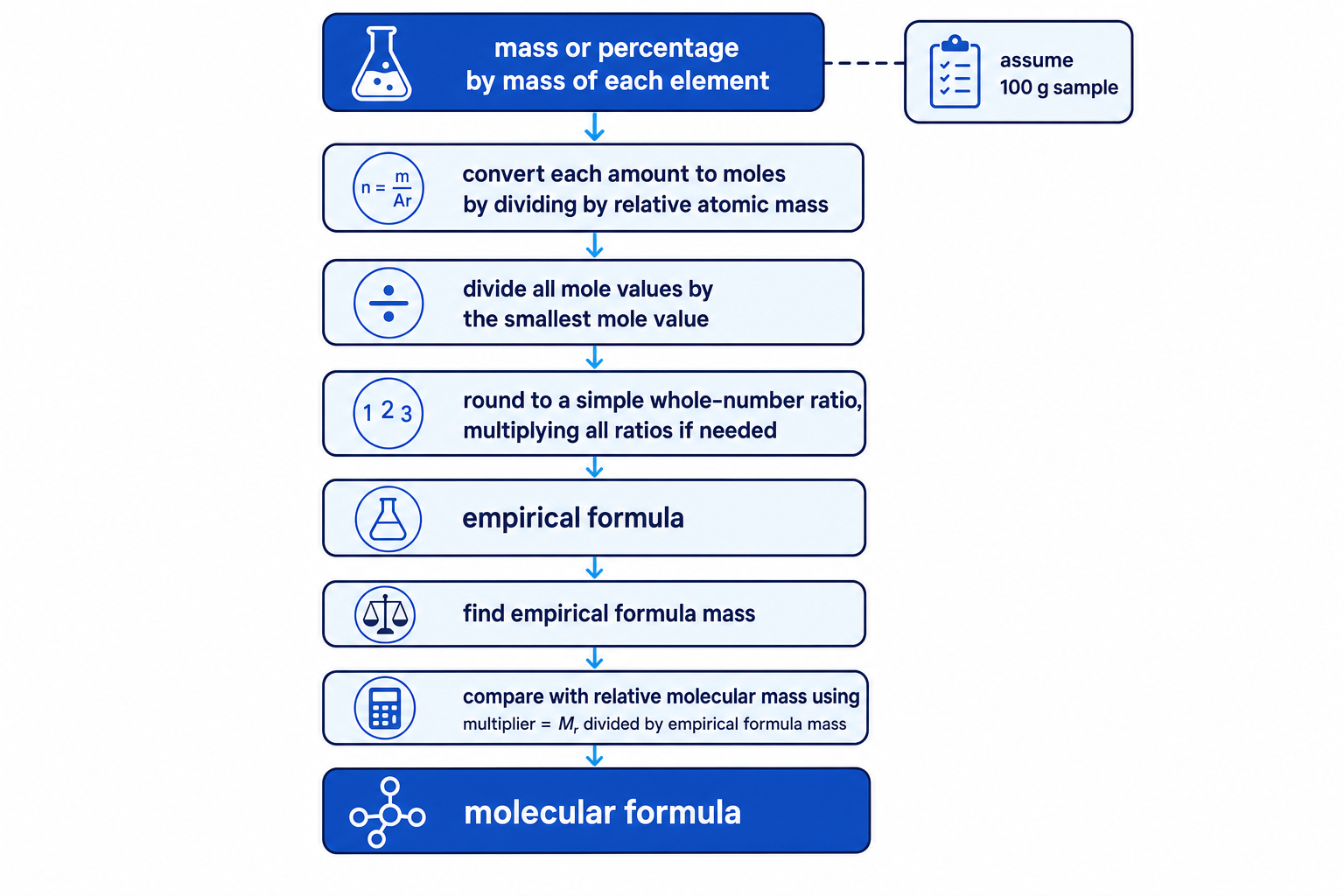
Calculating empirical formula from percentage by mass
If percentages are given, assume you have a 100 g sample. This makes the percentage numbers become masses in grams.
Percentage data
For percentage composition, assume 100 g of compound. So 40.0% carbon becomes 40.0 g carbon, 6.7% hydrogen becomes 6.7 g hydrogen, and so on.
Calculating an empirical formula from percentages
A compound contains 52.2% carbon, 13.0% hydrogen and 34.8% oxygen by mass. Calculate its empirical formula. Use ArA_rAr: C = 12.0, H = 1.0, O = 16.0.
-
Assume 100 g of compound, so the masses are carbon = 52.2 g, hydrogen = 13.0 g and oxygen = 34.8 g.
-
Convert each mass to moles by dividing by the relevant ArA_rAr:
n(C)=52.2 g12.0 g mol−1=4.35 moln(H)=13.0 g1.0 g mol−1=13.0 moln(O)=34.8 g16.0 g mol−1=2.175 mol\begin{aligned} n(\text{C}) &= \frac{52.2\ \text{g}}{12.0\ \text{g mol}^{-1}} = 4.35\ \text{mol} \\ n(\text{H}) &= \frac{13.0\ \text{g}}{1.0\ \text{g mol}^{-1}} = 13.0\ \text{mol} \\ n(\text{O}) &= \frac{34.8\ \text{g}}{16.0\ \text{g mol}^{-1}} = 2.175\ \text{mol} \end{aligned}n(C)n(H)n(O)=12.0 g mol−152.2 g=4.35 mol=1.0 g mol−113.0 g=13.0 mol=16.0 g mol−134.8 g=2.175 mol -
Divide all mole amounts by the smallest mole amount, 2.175 mol:
C:H:O=4.352.175:13.02.175:2.1752.175\text{C:H:O} = \frac{4.35}{2.175} : \frac{13.0}{2.175} : \frac{2.175}{2.175}C:H:O=2.1754.35:2.17513.0:2.1752.175 C:H:O=2.00:5.98:1.00\text{C:H:O} = 2.00 : 5.98 : 1.00C:H:O=2.00:5.98:1.00 -
Round the ratio to sensible whole numbers. Since 5.98 is very close to 6, the ratio is 2:6:1, so the empirical formula is C2H6O.
Handling awkward ratios
After dividing by the smallest mole value, you should get numbers close to whole numbers. Sometimes you get a simple fraction instead.
Common patterns:
- 1.5 means multiply every part of the ratio by 2.
- 1.33 means multiply every part of the ratio by 3.
- 1.25 means multiply every part of the ratio by 4.
For example, a ratio of 1:1.5 is not rounded to 1:2. Instead, multiply both parts by 2 to get 2:3.
Rounding too early
Do not round mole values after the first calculation. Keep at least 3 significant figures until the final ratio, otherwise you may change the empirical formula.
Calculating empirical formula from experimental mass data
You may be asked about finding the empirical formula of a metal oxide. In this type of experiment, a metal is heated in air, reacts with oxygen, and forms a metal oxide.
The mass of oxygen is not measured directly. It is found by difference:
mass of oxygen=mass of metal oxide−mass of metal\text{mass of oxygen} = \text{mass of metal oxide} - \text{mass of metal}mass of oxygen=mass of metal oxide−mass of metalIn practical work, heating to constant mass means heating, cooling and reweighing until the mass stops changing. This helps show the reaction is complete.
Finding a metal oxide formula
A sample of magnesium has mass 0.486 g. After heating in air to form magnesium oxide, the final mass is 0.806 g. Find the empirical formula of the oxide. Use ArA_rAr: Mg = 24.3, O = 16.0.
-
Find the mass of oxygen by difference:
mass of oxygen=0.806 g−0.486 g=0.320 g\text{mass of oxygen} = 0.806\ \text{g} - 0.486\ \text{g} = 0.320\ \text{g}mass of oxygen=0.806 g−0.486 g=0.320 g -
Convert the masses of magnesium and oxygen to moles:
n(Mg)=0.486 g24.3 g mol−1=0.0200 moln(O)=0.320 g16.0 g mol−1=0.0200 mol\begin{aligned} n(\text{Mg}) &= \frac{0.486\ \text{g}}{24.3\ \text{g mol}^{-1}} = 0.0200\ \text{mol} \\ n(\text{O}) &= \frac{0.320\ \text{g}}{16.0\ \text{g mol}^{-1}} = 0.0200\ \text{mol} \end{aligned}n(Mg)n(O)=24.3 g mol−10.486 g=0.0200 mol=16.0 g mol−10.320 g=0.0200 mol -
Compare the mole amounts:
Mg:O=0.0200:0.0200=1:1\text{Mg:O} = 0.0200 : 0.0200 = 1 : 1Mg:O=0.0200:0.0200=1:1 -
Use the ratio as the formula subscripts, so the empirical formula is MgO.
Using the oxide mass as oxygen
The mass of the oxide is the total mass of metal plus oxygen. For a metal oxide question, calculate the oxygen mass by subtracting the original metal mass from the final oxide mass.
Molecular formula
Molecular formula
The molecular formula is the actual number of atoms of each element in one molecule of a compound.
The molecular formula is always a whole-number multiple of the empirical formula. Sometimes the multiplier is 1, meaning the empirical formula and molecular formula are the same.
Empirical formula mass
The empirical formula mass is the sum of the relative atomic masses in one empirical formula unit.
To find the multiplier:
k=Mrempirical formula massk = \frac{M_r}{\text{empirical formula mass}}k=empirical formula massMrwhere kkk is the number you multiply every empirical formula subscript by.
Finding a molecular formula
A compound has empirical formula CH2O and relative molecular mass Mr=180.0M_r = 180.0Mr=180.0. Find its molecular formula. Use ArA_rAr: C = 12.0, H = 1.0, O = 16.0.
-
Calculate the empirical formula mass:
empirical formula mass=12.0+(2×1.0)+16.0=30.0\text{empirical formula mass} = 12.0 + (2 \times 1.0) + 16.0 = 30.0empirical formula mass=12.0+(2×1.0)+16.0=30.0 -
Find the multiplier by comparing MrM_rMr with the empirical formula mass:
k=180.030.0=6k = \frac{180.0}{30.0} = 6k=30.0180.0=6 -
Multiply every empirical formula subscript by 6: CH2O becomes C6H12O6.
In the exam
- If data are percentages, assume 100 g; if data are masses, use them directly.
- Convert masses to moles before comparing elements — never use mass ratios as atom ratios.
- Divide all mole amounts by the smallest, then multiply the whole ratio if you get fractions like 1.5, 1.33 or 1.25.
- For molecular formula, calculate empirical formula mass first, then use k=Mrempirical formula massk = \frac{M_r}{\text{empirical formula mass}}k=empirical formula massMr and multiply every subscript by kkk.
Check yourself
- Why must you convert masses to moles before finding an empirical formula?
- A compound is 40.0% carbon, 6.7% hydrogen and 53.3% oxygen by mass. What is its empirical formula?
- A compound has empirical formula CH2 and Mr=56.0M_r = 56.0Mr=56.0. What is its molecular formula?
