

What you'll learn:
- How the size of a ligand dictates whether the coordination number changes during a substitution reaction.
- Why substitution is sometimes incomplete, resulting in a mixed-ligand complex.
- The role of multidentate ligands in biological molecules like haemoglobin.
- How to explain the exceptional stability of complexes with multidentate ligands using the 'chelate effect' and entropy.
Transition metal complexes aren't permanently fixed. Ligands can swap places with other ligands in a process called ligand substitution (or ligand exchange). Whether the complex changes shape, charge, or coordination number during this swap depends almost entirely on the size and charge of the incoming ligands.
1. Monodentate ligands of similar size
Water (H2O\text{H}_2\text{O}H2O) and ammonia (NH3\text{NH}_3NH3) are both small, uncharged, monodentate ligands. Because they are practically identical in size, swapping one for the other does not cause any overcrowding around the central metal ion.
When exchange occurs between these similarly sized ligands, there is no change in coordination number and no change in the shape of the complex. An octahedral complex will remain octahedral.
Complete substitution
In some cases, all six water ligands can be replaced by ammonia. For example, with cobalt(II) ions:
[Co(H2O)6]2++6NH3→[Co(NH3)6]2++6H2O [\text{Co}(\text{H}_2\text{O})_6]^{2+} + 6\text{NH}_3 \rightarrow [\text{Co}(\text{NH}_3)_6]^{2+} + 6\text{H}_2\text{O} [Co(H2O)6]2++6NH3→[Co(NH3)6]2++6H2OHere, both the reactant and the product are octahedral complexes with a coordination number of 666.
Incomplete substitution
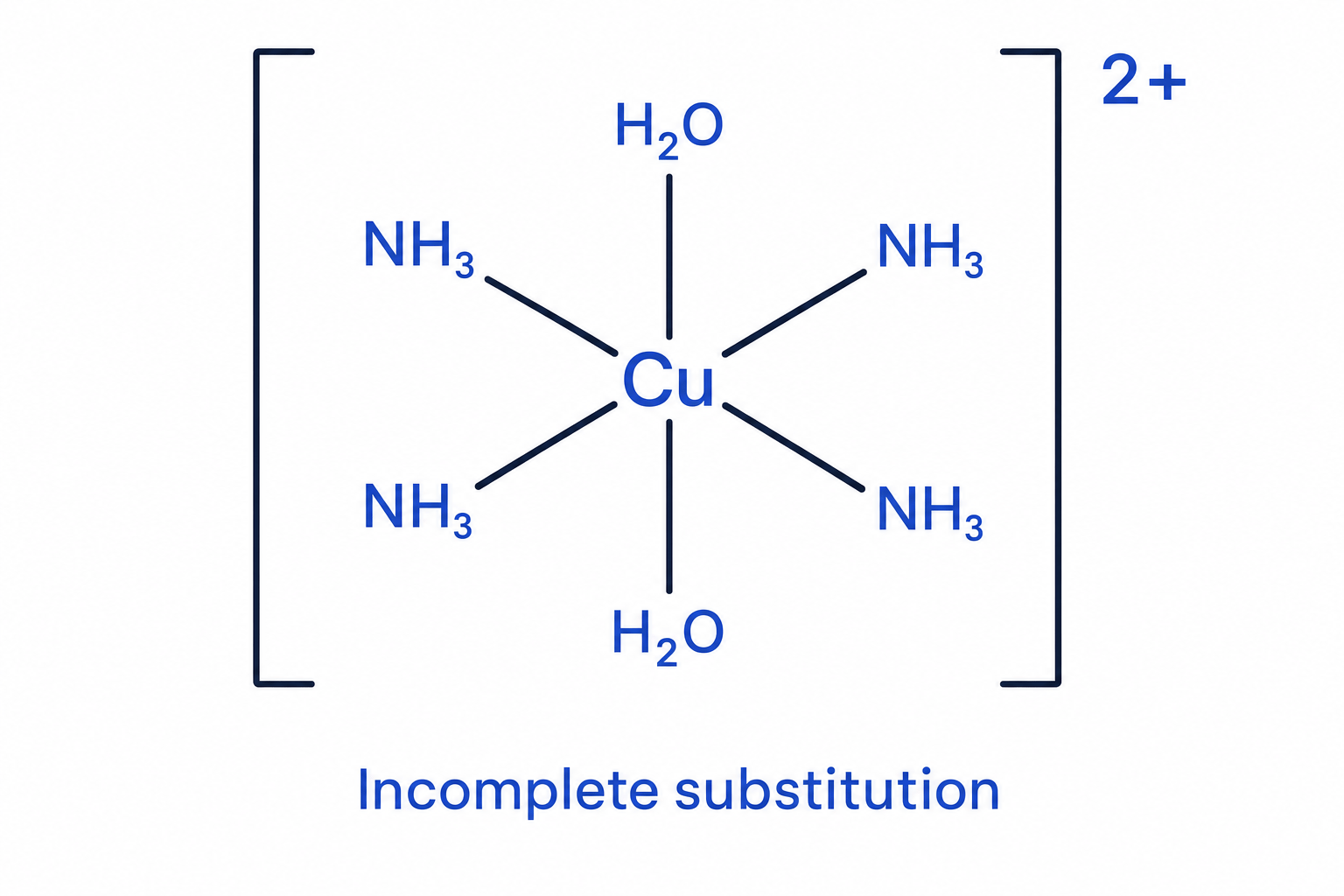
Sometimes, the substitution doesn't go all the way to completion. Copper(II) ions are the classic A-level example of this. When excess concentrated ammonia is added to a solution containing hexaaquacopper(II) ions, only four of the six water molecules are replaced.
[Cu(H2O)6]2++4NH3→[Cu(NH3)4(H2O)2]2++4H2O [\text{Cu}(\text{H}_2\text{O})_6]^{2+} + 4\text{NH}_3 \rightarrow [\text{Cu}(\text{NH}_3)_4(\text{H}_2\text{O})_2]^{2+} + 4\text{H}_2\text{O} [Cu(H2O)6]2++4NH3→[Cu(NH3)4(H2O)2]2++4H2OThis forms a distinctively deep blue solution. The coordination number remains 666, and the shape remains octahedral.
2. Monodentate ligands of different sizes
The chloride ion (Cl−\text{Cl}^-Cl−) is much larger than both H2O\text{H}_2\text{O}H2O and NH3\text{NH}_3NH3. It is also negatively charged, so the ligands repel each other more strongly.
Because of this increased size and repulsion, you cannot fit six chloride ions around a central transition metal ion. Only four will fit. Therefore, exchanging water ligands for chloride ligands involves a change of coordination number (from 666 to 444) and a change of shape (from octahedral to tetrahedral).
This happens with metal ions like Co2+\text{Co}^{2+}Co2+, Cu2+\text{Cu}^{2+}Cu2+, and Fe3+\text{Fe}^{3+}Fe3+ when concentrated hydrochloric acid is added.
[Cu(H2O)6]2++4Cl−⇌[CuCl4]2−+6H2O [\text{Cu}(\text{H}_2\text{O})_6]^{2+} + 4\text{Cl}^- \rightleftharpoons [\text{CuCl}_4]^{2-} + 6\text{H}_2\text{O} [Cu(H2O)6]2++4Cl−⇌[CuCl4]2−+6H2O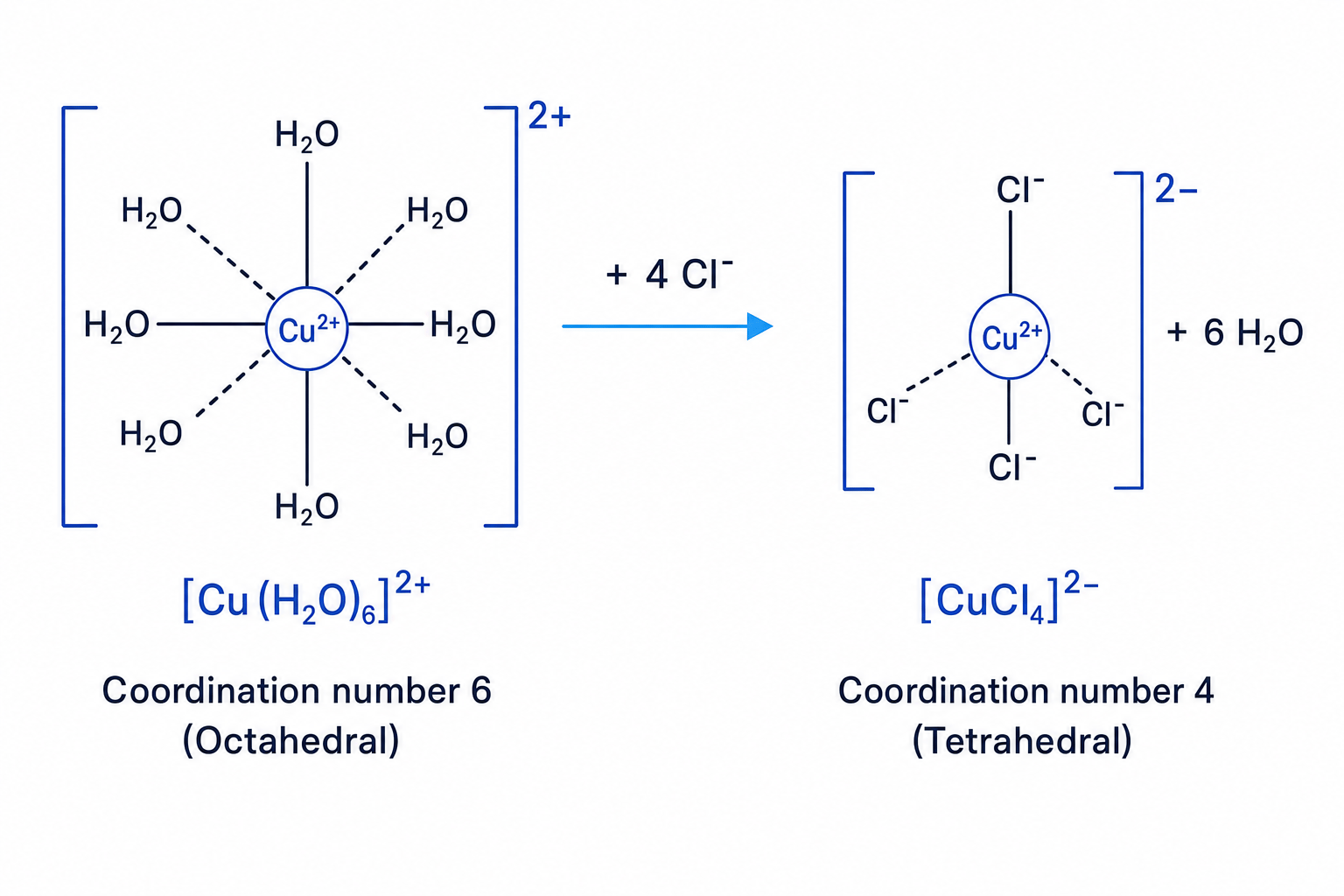
Forgetting the change in overall charge
When neutral ligands (like H2O\text{H}_2\text{O}H2O) are replaced by charged ligands (like Cl−\text{Cl}^-Cl−), the overall charge of the complex ion must change. If a Cu2+\text{Cu}^{2+}Cu2+ ion binds to four Cl−\text{Cl}^-Cl− ions, the overall charge is +2+(4×−1)=−2+2 + (4 \times -1) = -2+2+(4×−1)=−2.
3. Bidentate and multidentate ligands
Ligands don't just have to form one coordinate bond.
Bidentate and Multidentate Ligands
- Bidentate ligand: A molecule or ion that can form two coordinate bonds to a central metal ion.
- Multidentate ligand: A molecule or ion that can form more than two coordinate bonds to a central metal ion.
You need to know specific examples of these:
- Ethane-1,2-diamine (H2NCH2CH2NH2\text{H}_2\text{NCH}_2\text{CH}_2\text{NH}_2H2NCH2CH2NH2, often abbreviated to 'en'): A neutral bidentate ligand. The lone pairs are on the two nitrogen atoms.
- Ethanedioate (C2O42−\text{C}_2\text{O}_4^{2-}C2O42−): A bidentate ligand with a −2-2−2 charge. The lone pairs are on the negatively charged oxygen atoms.
- EDTA4−^{4-}4−: A hexadentate ligand. It can form six coordinate bonds to a single central metal ion, entirely wrapping around it to form an exceptionally stable octahedral complex.
Haem and carbon monoxide poisoning
Haem is a naturally occurring multidentate complex found in blood. It consists of an iron(II) (Fe2+\text{Fe}^{2+}Fe2+) central ion coordinated to a multidentate ligand called a porphyrin ring (which forms four coordinate bonds to the iron). A protein chain (globin) provides a fifth coordinate bond.
This leaves exactly one coordinate bond position free. Oxygen (O2\text{O}_2O2) forms a coordinate bond to this vacant site on the Fe2+\text{Fe}^{2+}Fe2+ ion in haemoglobin, allowing oxygen to be transported around the body in the blood.
Carbon monoxide (CO\text{CO}CO) is incredibly toxic because it can undergo a ligand substitution reaction with the oxygen in haemoglobin. The CO\text{CO}CO molecule is a much better ligand than oxygen and binds to the Fe2+\text{Fe}^{2+}Fe2+ ion irreversibly (or at least, much more strongly). This permanently replaces the oxygen, preventing the haemoglobin from transporting any more oxygen to your tissues.
4. The Chelate Effect
When a bidentate or multidentate ligand replaces a monodentate ligand, the resulting complex is remarkably stable. This is known as the chelate effect.
To explain why this happens, we must look at the thermodynamics of the substitution reaction, specifically focusing on the balance between enthalpy (ΔH\Delta HΔH) and entropy (ΔS\Delta SΔS) changes.
Consider the substitution of water ligands by EDTA4−\text{EDTA}^{4-}EDTA4−:
[Cu(H2O)6]2+(aq)+EDTA4−(aq)→[Cu(EDTA)]2−(aq)+6H2O(l) [\text{Cu}(\text{H}_2\text{O})_6]^{2+}(\text{aq}) + \text{EDTA}^{4-}(\text{aq}) \rightarrow [\text{Cu}(\text{EDTA})]^{2-}(\text{aq}) + 6\text{H}_2\text{O}(\text{l}) [Cu(H2O)6]2+(aq)+EDTA4−(aq)→[Cu(EDTA)]2−(aq)+6H2O(l)Evaluating the feasibility of a chelation reaction
We can use the Gibbs free energy equation, ΔG=ΔH−TΔS\Delta G = \Delta H - T\Delta SΔG=ΔH−TΔS, to explain why this reaction goes essentially to completion.
- Evaluate the enthalpy change (ΔH\Delta HΔH): We are breaking six Cu-O\text{Cu-O}Cu-O bonds (in the water complex) and making six new bonds (a mix of Cu-O\text{Cu-O}Cu-O and Cu-N\text{Cu-N}Cu-N bonds in the EDTA complex). Because the bonds being broken and the bonds being made have similar strengths, the overall enthalpy change is very small (ΔH≈0\Delta H \approx 0ΔH≈0).
- Determine the sign of the entropy change (ΔS\Delta SΔS): Count the particles in the equation. We start with 222 species on the left (the aqua complex and the EDTA ion) and produce 777 species on the right (the new complex and 666 water molecules). An increase from 222 particles to 777 particles causes a massive increase in disorder, so ΔS\Delta SΔS is large and positive.
- Substitute into the Gibbs equation: Since ΔH\Delta HΔH is roughly zero, the equation simplifies to ΔG≈−TΔS\Delta G \approx -T\Delta SΔG≈−TΔS.
- Determine feasibility: Temperature (TTT) is always positive (in Kelvin), and ΔS\Delta SΔS is large and positive. Therefore, −TΔS-T\Delta S−TΔS will be a large negative number. This means ΔG\Delta GΔG is highly negative (ΔG<0\Delta G < 0ΔG<0), making the substitution reaction highly feasible and practically irreversible.
Thermodynamics of the Chelate Effect
The chelate effect is primarily driven by a large, positive entropy change (ΔS\Delta SΔS), because replacing monodentate ligands with multidentate ligands dramatically increases the total number of particles in the solution.
Counting particles for entropy
Whenever an exam question asks you to explain the chelate effect, explicitly write down the number of moles of particles on the left versus the right side of the chemical equation. Stating "2 moles→7 moles2 \text{ moles} \rightarrow 7 \text{ moles}2 moles→7 moles" is the clearest way to justify your claim that entropy increases.
In the exam
- When writing equations for ligand substitution, always double-check the overall charge of the complex ion on the right-hand side. Sum the charge of the central metal ion and all the newly attached ligands.
- If asked why a complex changes shape upon substitution (e.g. from H2O\text{H}_2\text{O}H2O to Cl−\text{Cl}^-Cl−), state clearly that the incoming ligand is larger and repels more strongly, so fewer can fit around the metal ion.
- For chelate effect explanations, hit three key phrases: "enthalpy change is negligible as similar bonds are broken and made", "large increase in the number of particles causes a large increase in entropy (ΔS\Delta SΔS is positive)", and "ΔG\Delta GΔG is therefore negative".
- Remember that carbon monoxide poisoning is a ligand substitution reaction where CO\text{CO}CO replaces O2\text{O}_2O2 by forming a coordinate bond to the Fe2+\text{Fe}^{2+}Fe2+ central ion in haem.
Check yourself
- Write the balanced equation for the incomplete substitution of hexaaquacopper(II) with ammonia.
- Why does the coordination number change when Cl−\text{Cl}^-Cl− replaces H2O\text{H}_2\text{O}H2O in a transition metal complex?
- What are the charges on the bidentate ligands ethane-1,2-diamine and ethanedioate?
- Explain the chelate effect in terms of ΔH\Delta HΔH and ΔS\Delta SΔS.
