What you'll learn
- How ligands bond to transition metal ions to form complex ions.
- How to predict and draw octahedral, tetrahedral, square planar and linear complexes.
- How to recognise cis-trans isomerism in octahedral and square planar complexes.
- How bidentate ligands can produce optical isomerism in octahedral complexes.
The essential starting point: complexes and ligands
Transition metal ions often form complex ions because they can accept lone pairs from surrounding species.
Complex ion, ligand and coordinate bond
A complex ion contains a central metal ion surrounded by ligands. A ligand is an ion or molecule that donates a lone pair of electrons to the metal ion to form a coordinate bond; this is a covalent bond where both electrons in the shared pair come from the same atom.
Common ligands in this topic include H2O, NH3 and Cl-. Water and ammonia are neutral ligands, while chloride is a negative ligand.
A monodentate ligand forms one coordinate bond to the metal ion. H2O, NH3 and Cl- are monodentate. A bidentate ligand forms two coordinate bonds to the same metal ion using two donor atoms.
Coordination number
The coordination number is the number of coordinate bonds formed between the central metal ion and its ligands.
Finding a coordination number
For [Cu(H2O)6]2+:
- Each H2O ligand is monodentate, so each water molecule forms one coordinate bond to Cu2+.
- There are six water ligands, so the total number of coordinate bonds is six.
- The coordination number is therefore 6, which usually gives an octahedral shape with small ligands.
Common shapes of complex ions
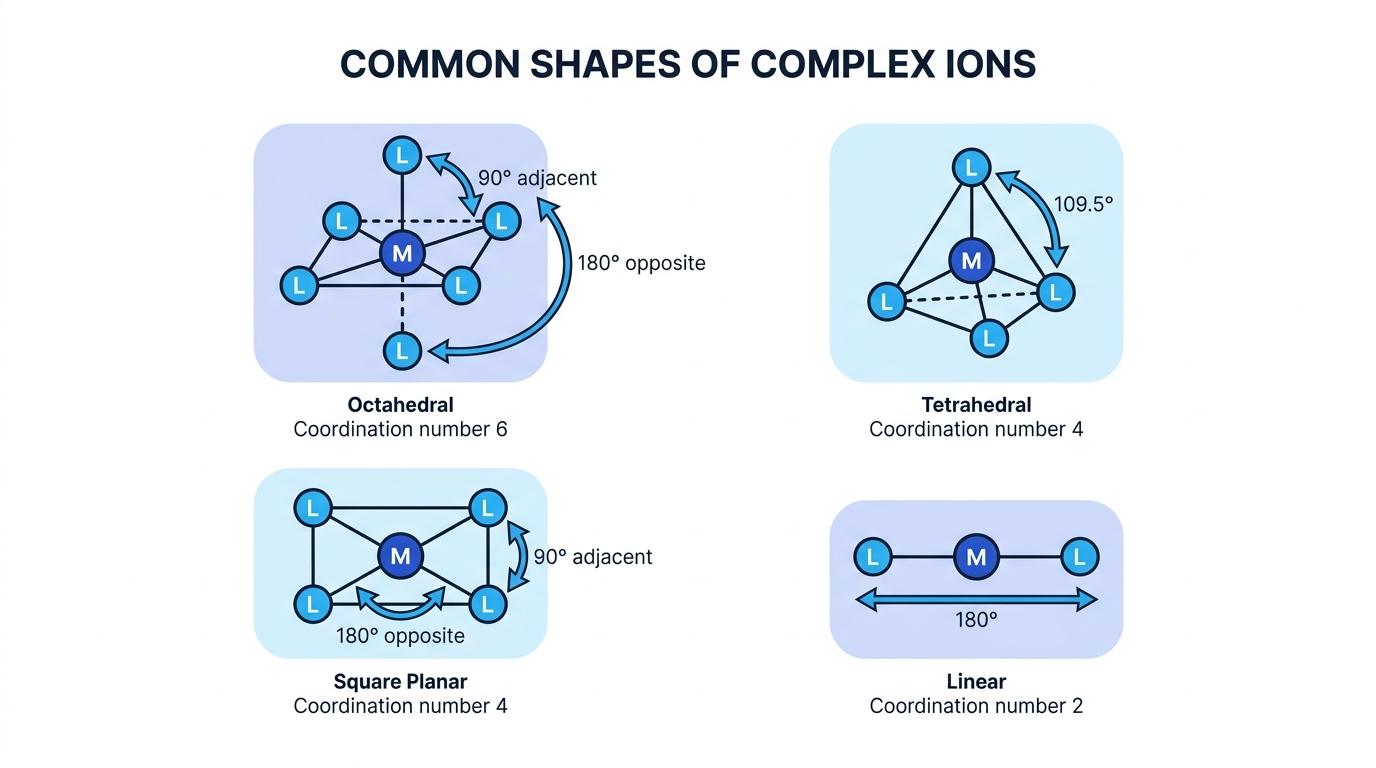
The shape depends mainly on the coordination number, but also on the size of the ligand and the metal ion involved. This part is A-level only: you are expected to draw the shapes, not just name them.
Octahedral complexes: coordination number 6
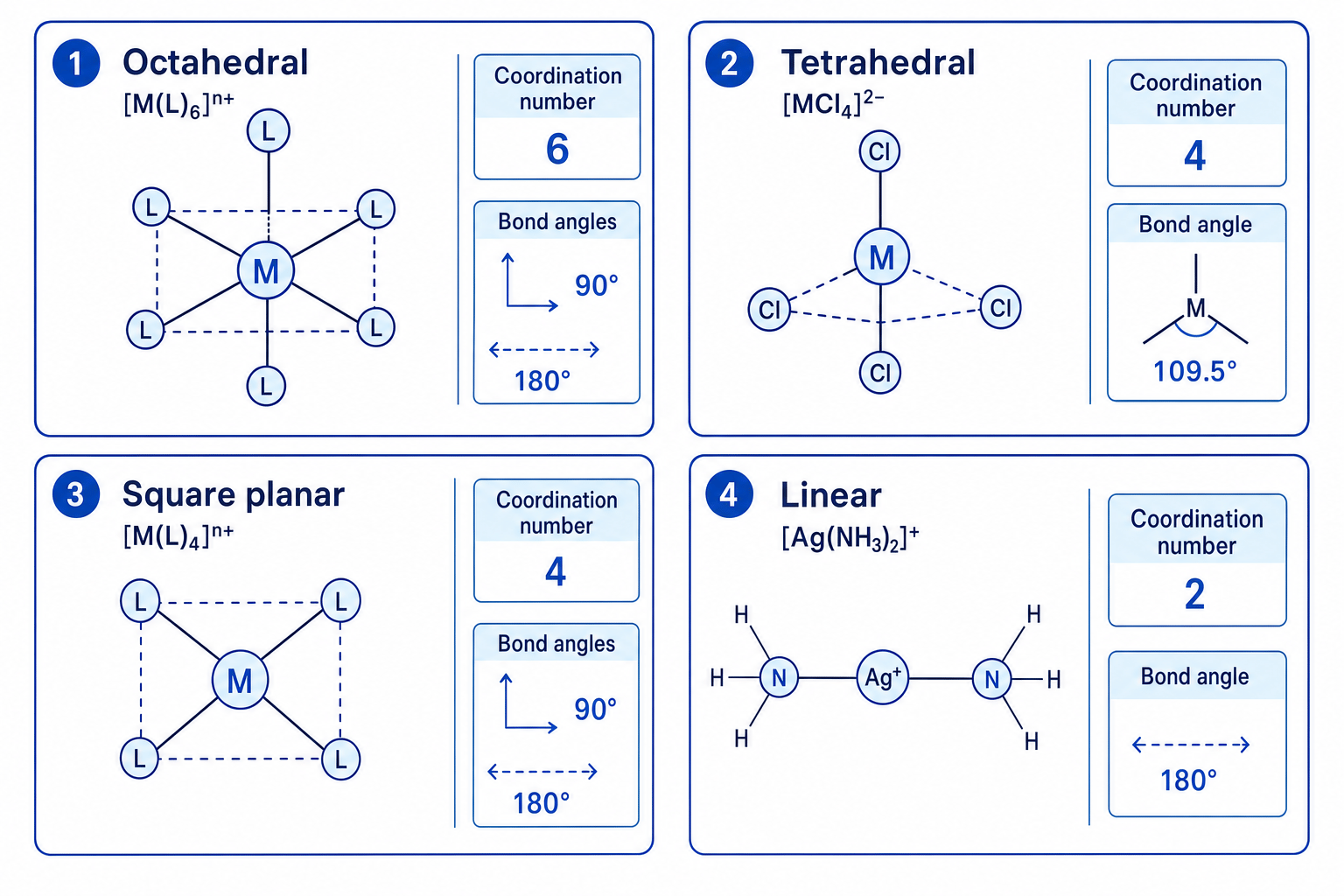
Transition metal ions commonly form octahedral complexes with small ligands such as H2O and NH3.
In an octahedral complex:
- six ligands surround the metal ion
- bond angles are 90° between adjacent ligands
- opposite ligands are 180° apart
Typical examples include [Cu(H2O)6]2+, [Fe(H2O)6]3+ and [Co(NH3)6]3+.
Tetrahedral complexes: coordination number 4
Transition metal ions commonly form tetrahedral complexes with larger ligands, especially Cl-. Chloride ions are relatively large, so fewer can fit around the metal ion.
In a tetrahedral complex:
- four ligands surround the metal ion
- all ligand positions are equivalent
- bond angles are about 109.5°
A common example is [CoCl4]2-.
Square planar complexes: coordination number 4
Some complexes with coordination number 4 are square planar, not tetrahedral. In a square planar complex, the four ligands lie in one plane around the metal ion.
Square planar complexes have:
- four ligands in a flat square arrangement
- 90° angles between adjacent ligands
- 180° angles between opposite ligands
Platinum(II) complexes are especially important examples. Cisplatin, [Pt(NH3)2Cl2], is square planar. Although cisplatin is a neutral complex rather than a complex ion, it is tested using the same shape ideas.
Linear complexes: coordination number 2
Ag+ forms the linear complex [Ag(NH3)2]+, which is present in Tollens’ reagent.
The N atoms in the two NH3 ligands donate lone pairs to Ag+, giving a bond angle of 180°.
Shape follows coordinate bonds
Count the coordinate bonds first. Coordination number 6 usually gives octahedral; coordination number 4 may be tetrahedral or square planar; coordination number 2 is linear in [Ag(NH3)2]+.
Assuming all coordination number 4 complexes are tetrahedral
Coordination number 4 can mean tetrahedral, especially with large Cl- ligands, but square planar complexes also have coordination number 4. Look for examples such as platinum(II) complexes.
Choosing a complex shape
Decide the likely shapes of [Co(NH3)6]3+ and [CoCl4]2-.
- In [Co(NH3)6]3+, each NH3 ligand is monodentate, so six ligands give coordination number 6.
- Small neutral ligands such as NH3 commonly form octahedral complexes with transition metal ions.
- So [Co(NH3)6]3+ is octahedral.
- In [CoCl4]2-, each Cl- ligand is monodentate, so four ligands give coordination number 4.
- Chloride ions are large ligands, so [CoCl4]2- is commonly tetrahedral rather than square planar.
Stereoisomerism in complex ions
Stereoisomers
Stereoisomers have the same atoms bonded to each other, but a different three-dimensional arrangement of those atoms.
Complexes often show stereoisomerism because the ligand positions are fixed around the metal ion. Cis-trans isomerism is a special case of E-Z isomerism: the key idea is that groups are held in different relative positions and cannot simply rotate freely into each other.
Cis-trans isomerism
In complex ions:
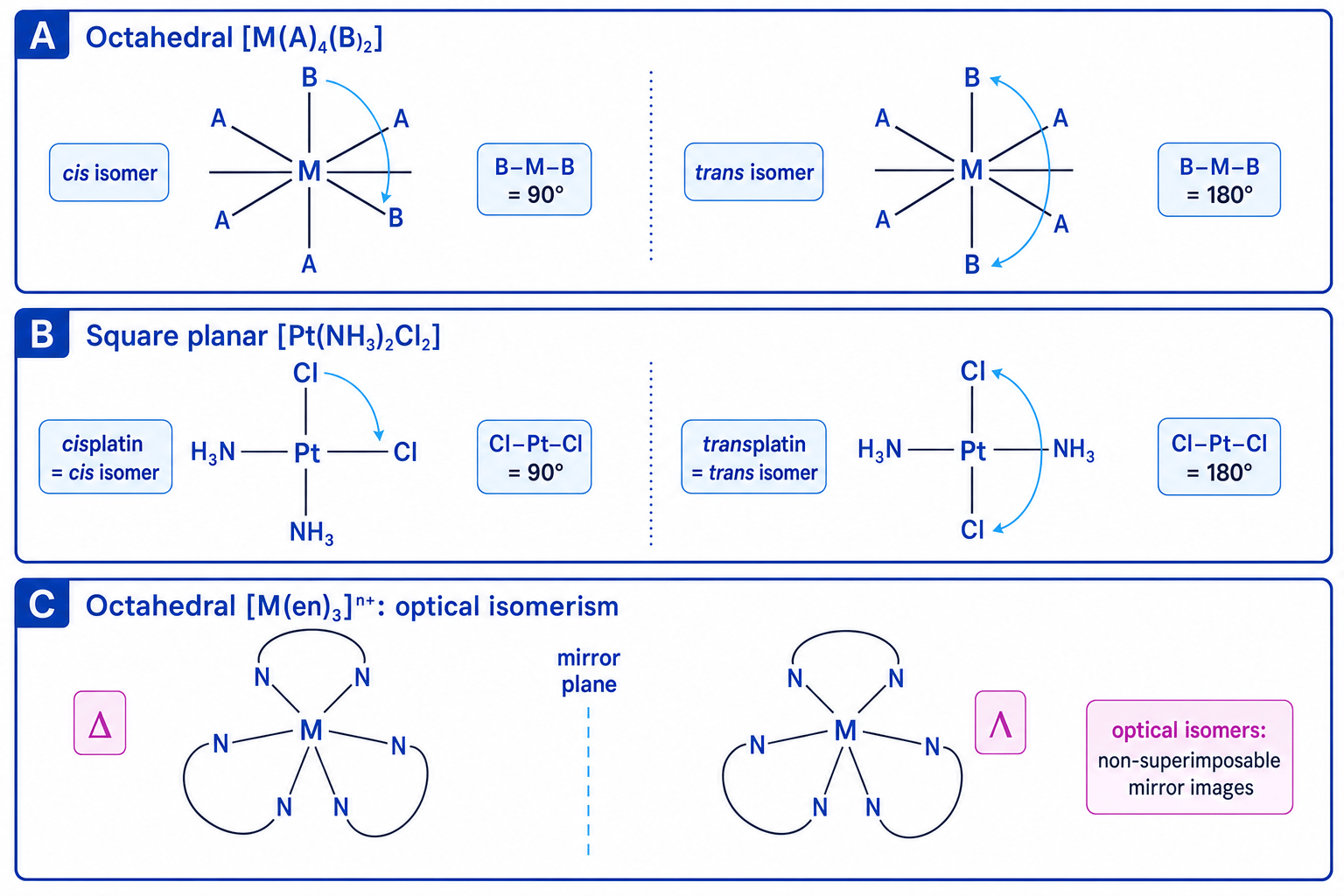
- cis means the two relevant ligands are adjacent, usually 90° apart
- trans means the two relevant ligands are opposite, 180° apart
Octahedral cis-trans isomerism
Octahedral complexes can display cis-trans isomerism with monodentate ligands. For example, in [Co(NH3)4Cl2]+, the two chloride ligands can be adjacent or opposite.
Classifying cis and trans arrangements
For [Co(NH3)4Cl2]+:
- The complex has six monodentate ligands around cobalt, so it is octahedral.
- The two Cl ligands can occupy adjacent positions, giving a Cl–Co–Cl angle of 90°.
- That arrangement is the cis isomer.
- The two Cl ligands can instead occupy opposite positions, giving a Cl–Co–Cl angle of 180°.
- That arrangement is the trans isomer.
Square planar cis-trans isomerism
Square planar complexes can also show cis-trans isomerism because they have adjacent and opposite positions in a plane.
The key example is cisplatin, [Pt(NH3)2Cl2]. In cisplatin, the two chloride ligands are adjacent, so it is the cis isomer. The trans isomer is called transplatin.
Spotting cis and trans quickly
If the two identical ligands are next to each other, call it cis. If they are directly opposite each other, call it trans. This works for both octahedral and square planar complexes.
Giving tetrahedral complexes cis-trans isomers
Simple tetrahedral complexes do not show cis-trans isomerism because all four positions are equivalent; there is no true pair of opposite ligand positions at 180°.
Optical isomerism with bidentate ligands
Optical isomerism occurs when two structures are non-superimposable mirror images. These mirror-image isomers are called enantiomers.
Octahedral complexes with bidentate ligands can show optical isomerism. A bidentate ligand “grips” the metal ion at two points, often forming a ring called a chelate ring. The rings can twist around the metal in two mirror-image arrangements.
A common bidentate ligand is ethane-1,2-diamine, often abbreviated as en. It has two nitrogen atoms, each with a lone pair that can bond to the metal ion.
Recognising optical isomerism
Consider [Ni(en)3]2+.
- Each en ligand is bidentate, so each ligand forms two coordinate bonds to Ni2+.
- Three en ligands therefore form six coordinate bonds, giving an octahedral complex.
- The three chelate rings can wrap around the metal ion in two opposite “twists”.
- These two arrangements are mirror images and cannot be superimposed, so [Ni(en)3]2+ shows optical isomerism.
Bidentate does not automatically mean optical
Bidentate ligands often make optical isomerism possible, but the final complex must have non-superimposable mirror images. If the complex has a plane of symmetry, it will not be optically active.
Drawing expectations
In exams, your drawings do not need to be beautiful, but they must show the geometry clearly.
For octahedral complexes, show two ligands on a vertical line and four around the middle. For tetrahedral complexes, use wedge/dashed or 3D-style bonds if possible. For square planar complexes, keep all four ligands in one flat cross or square arrangement. For optical isomers, draw one structure and its mirror image; do not accidentally draw the same structure twice by rotation.
In the exam
- Identify the ligand denticity, then count coordinate bonds to get the coordination number.
- For coordination number 6, draw octahedral; for coordination number 4, decide between tetrahedral with large Cl- ligands and square planar with Pt(II)-type examples.
- For cis-trans questions, focus on the two ligands being compared: 90° means cis, while 180° means trans.
- For optical isomerism, look for bidentate ligands in an octahedral complex and check for non-superimposable mirror images.
- Remember the named examples: cisplatin is the cis isomer, and [Ag(NH3)2]+ is linear in Tollens’ reagent.
Check yourself
- Why do [Co(NH3)6]3+ and [CoCl4]2- have different shapes?
- In [Co(NH3)4Cl2]+, what distinguishes the cis isomer from the trans isomer?
- Why can [M(en)3]n+ show optical isomerism?