

What you'll learn
- What makes alkenes unsaturated hydrocarbons.
- How the carbon–carbon double bond is built from sigma and pi bonding.
- Why the double bond is a centre of high electron density.
- How alkene bonding explains their characteristic reactivity.
Starting point: hydrocarbons and saturation
Before alkenes, you need two foundation ideas: hydrocarbons and saturation.
A hydrocarbon is a compound containing carbon and hydrogen only. Alkanes and alkenes are both hydrocarbons.
A molecule is saturated if its carbon chain contains only carbon–carbon single bonds. It has the maximum number of hydrogen atoms possible for that carbon skeleton.
A molecule is unsaturated if it contains at least one carbon–carbon multiple bond, such as a carbon–carbon double bond. This means more atoms can be added across that multiple bond.
Alkene
An alkene is an unsaturated hydrocarbon containing at least one carbon–carbon double covalent bond, written as C=C\text{C}=\text{C}C=C.
The C=C\text{C}=\text{C}C=C double bond is the functional group of alkenes. A functional group is the atom or group of atoms responsible for the characteristic reactions of a homologous series.
The general formula of simple alkenes
For an open-chain alkene with exactly one carbon–carbon double bond, the general formula is:
CnH2n\text{C}_n\text{H}_{2n}CnH2nHere, nnn is the number of carbon atoms.
This is two fewer hydrogens than the corresponding alkane, which has formula CnH2n+2\text{C}_n\text{H}_{2n+2}CnH2n+2. The reason is that making a double bond between two carbon atoms reduces the number of hydrogens that can be attached.
Checking whether a formula could be an alkene
A hydrocarbon has molecular formula C5H10\text{C}_5\text{H}_{10}C5H10. Could it be an open-chain alkene with one double bond?
-
Use the general formula for an open-chain monoalkene: CnH2n\text{C}_n\text{H}_{2n}CnH2n.
-
Substitute n=5n=5n=5, so the expected number of hydrogens is 2n=2×5=102n = 2 \times 5 = 102n=2×5=10.
-
The formula C5H10\text{C}_5\text{H}_{10}C5H10 matches CnH2n\text{C}_n\text{H}_{2n}CnH2n, so it could be an open-chain alkene such as pent-1-ene.
-
The formula alone does not prove it is an alkene, because a cycloalkane such as cyclopentane also has formula C5H10\text{C}_5\text{H}_{10}C5H10.
Formula matches are not proof
The formula CnH2n\text{C}_n\text{H}_{2n}CnH2n suggests an open-chain alkene with one double bond, but it can also fit cycloalkanes. To prove a molecule is an alkene, you need structural evidence for a C=C\text{C}=\text{C}C=C bond or a chemical test for unsaturation.
What is a double covalent bond?
A covalent bond is a pair of electrons shared between two atoms. A double covalent bond contains two shared pairs of electrons between the same two atoms.
In an alkene, the carbon–carbon double bond is not simply “two ordinary single bonds”. It has two different parts:
- one sigma bond
- one pi bond
Sigma and pi bonds
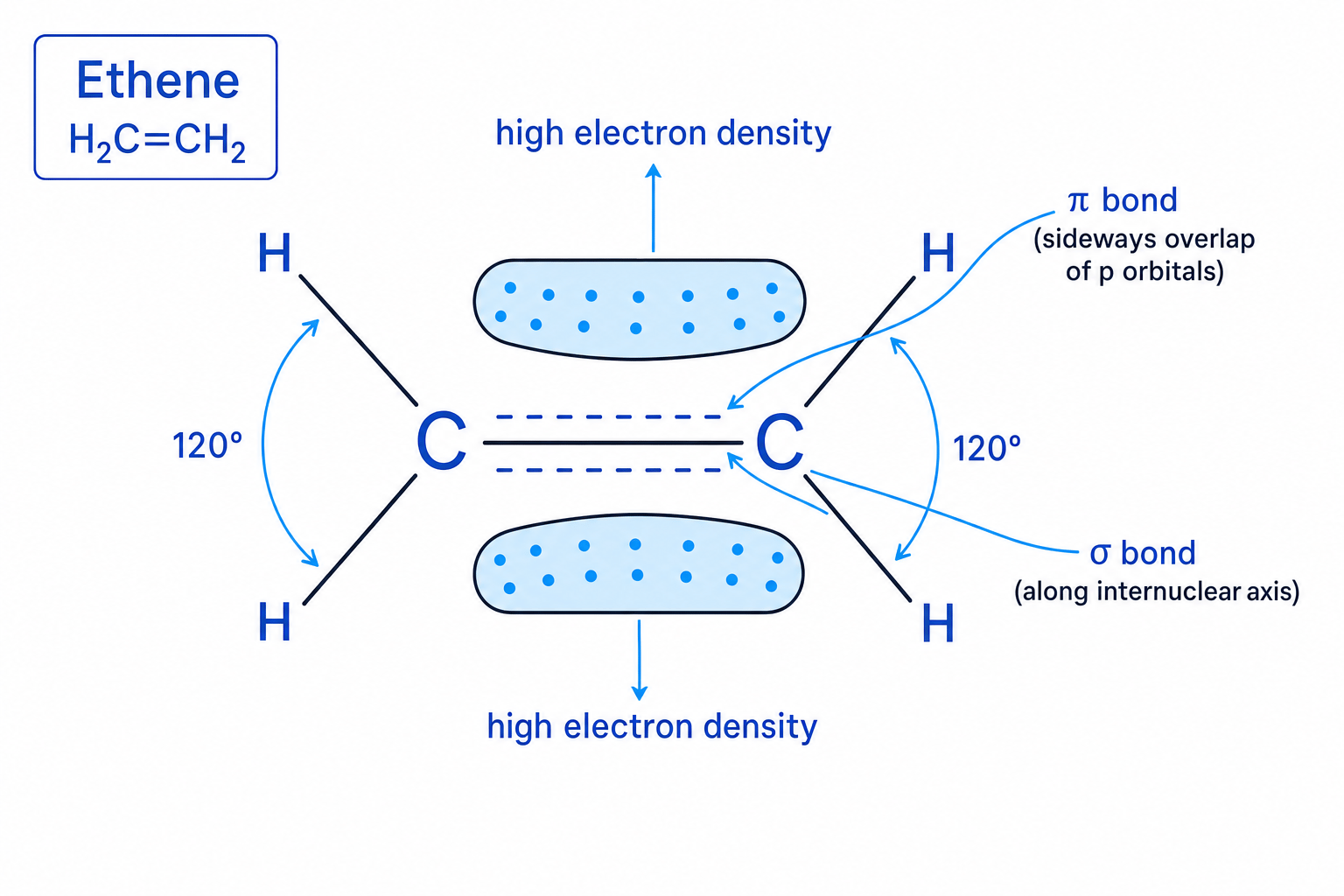
A sigma bond is a covalent bond formed by overlap directly along the line between two nuclei. A pi bond is a covalent bond formed by sideways overlap of p orbitals, with electron density above and below the line between the nuclei.
Ethene, H2C=CH2\text{H}_2\text{C}=\text{CH}_2H2C=CH2, is the simplest alkene. Each carbon atom is bonded to two hydrogen atoms and to the other carbon atom. Around each carbon in the double bond, the atoms are arranged approximately trigonal planar, with bond angles close to 120°.
What the double bond really means
A carbon–carbon double bond is made from one sigma bond and one pi bond. The pi bond has electron density above and below the plane of the molecule, making the double bond an electron-rich region.
Because the pi bond depends on sideways overlap of p orbitals, rotation around a carbon–carbon double bond is restricted. If the molecule rotated freely, the p orbitals would no longer overlap properly and the pi bond would be broken.
This restricted rotation becomes important later when you meet E/Z isomerism, where different groups can be locked on different sides of the double bond.
Counting sigma and pi bonds in ethene
How many sigma and pi bonds are present in ethene, H2C=CH2\text{H}_2\text{C}=\text{CH}_2H2C=CH2?
-
Count the carbon–hydrogen single bonds. Ethene has four C–H bonds, and every single bond is a sigma bond.
-
Look at the carbon–carbon double bond. A C=C\text{C}=\text{C}C=C bond contains one sigma bond and one pi bond.
-
Add the sigma bonds: 4+1=54 + 1 = 54+1=5. Ethene therefore contains five sigma bonds and one pi bond.
Treating the double bond as two identical single bonds
A C=C\text{C}=\text{C}C=C bond is stronger than a C–C single bond overall, but the pi part is more exposed and more easily involved in reactions. This is why alkenes are generally more reactive than alkanes.
Why alkenes are reactive
The double bond in an alkene is described as a centre of high electron density.
Electron density means how concentrated electrons are in a region of a molecule. In alkenes, the C=C\text{C}=\text{C}C=C bond contains four bonding electrons in total, and the pi electron cloud sits above and below the carbon skeleton. This makes it accessible to species that are attracted to electrons.
Electrophile
An electrophile is an electron-pair acceptor. It is attracted to regions of high electron density, such as the carbon–carbon double bond in an alkene.
This explains the typical reactions of alkenes: they often undergo addition reactions. In an addition reaction, atoms add across the double bond and one product is formed.
During addition, the pi bond breaks and new sigma bonds form. The carbon skeleton usually becomes more saturated because the carbon–carbon double bond is converted into a carbon–carbon single bond.
Bonding explains reactivity
Alkenes react because the exposed pi electrons in the C=C\text{C}=\text{C}C=C bond attract electrophiles. Most alkene reactions start at the double bond.
Example: why bromine reacts with ethene
Bromine, Br2\text{Br}_2Br2, is often used to show the presence of a carbon–carbon double bond. Orange bromine water is decolourised when it reacts with an alkene.
Explaining the reaction of ethene with bromine
Explain why ethene reacts with bromine.
-
Identify the electron-rich region in ethene. The C=C\text{C}=\text{C}C=C double bond contains a pi bond, so there is high electron density above and below the molecule.
-
As a bromine molecule approaches, the electrons in the alkene repel the electrons in Br2\text{Br}_2Br2. This induces a dipole, making the nearer bromine atom partially positive.
-
The partially positive bromine atom acts as an electrophile because it can accept an electron pair from the alkene’s pi bond.
-
The pi bond breaks and bromine atoms add across the double bond, forming 1,2-dibromoethane, CH2BrCH2Br\text{CH}_2\text{BrCH}_2\text{Br}CH2BrCH2Br.
A useful reaction sentence
For many alkene questions, a strong explanation is: “The C=C\text{C}=\text{C}C=C double bond has high electron density, so it attracts electrophiles and undergoes addition reactions.”
Linking structure to properties
You should be able to move fluently from structure to reactivity:
- Alkenes contain a carbon–carbon double bond.
- The double bond contains one sigma bond and one pi bond.
- The pi bond creates a region of high electron density.
- Electron-rich regions attract electrophiles.
- Therefore, alkenes tend to undergo addition reactions at the double bond.
That chain of reasoning is exactly what examiners are usually looking for in this section.
In the exam
-
Define alkenes precisely as unsaturated hydrocarbons containing a carbon–carbon double bond.
-
When explaining reactivity, always link the C=C\text{C}=\text{C}C=C bond to high electron density and attraction of electrophiles.
-
If using CnH2n\text{C}_n\text{H}_{2n}CnH2n, say it applies to open-chain alkenes with one double bond, and remember the formula alone does not prove unsaturation.
Check yourself
-
What is meant by an unsaturated hydrocarbon?
-
Why is the carbon–carbon double bond described as a centre of high electron density?
-
In one sentence, why are alkenes generally more reactive than alkanes?
