

In many areas of chemistry, from forensic science to pharmaceutical testing, you will end up with a mixture of compounds. Finding out exactly what is in that mixture requires separating it first.
What you'll learn in this topic:
- The fundamental principles underlying all forms of chromatography.
- How thin-layer (TLC), column (CC), and gas chromatography (GC) work.
- How to calculate and use RfR_fRf values and retention times.
- How gas chromatography is combined with mass spectrometry (GC-MS) for absolute identification.
The basic principles of chromatography
All types of chromatography share the same core mechanism: they separate a mixture by passing it over or through another material. To describe this, we use two specific terms.
Stationary and Mobile Phases
- Stationary phase: A substance that does not move. It is usually a solid or a liquid supported on a solid.
- Mobile phase: A substance that moves through or over the stationary phase. It is always a fluid (a liquid or a gas).
The components in your mixture separate because they distribute themselves differently between the two phases.
If a component is highly soluble in the mobile phase, it will spend more time moving and travel further or faster. If a component strongly binds or adsorbs to the stationary phase, it will spend less time moving and travel shorter distances or slower.
The Golden Rule of Separation
Separation depends entirely on the balance between solubility in the moving phase and retention by the stationary phase.
Thin-Layer Chromatography (TLC)
Thin-layer chromatography is a quick, inexpensive method used to separate small amounts of mixtures, such as amino acids, analgesics, or transition metal ions. It is the focus of Required Practical 12.
The phases in TLC
In TLC, the stationary phase is a thin layer of a solid (usually silica gel or alumina) coated onto a flat piece of glass, metal, or plastic.
The mobile phase is a liquid solvent.
How TLC works
You start by drawing a pencil line near the bottom of the plate (the baseline). You place a small drop of the mixture on this line and stand the plate vertically in a beaker containing a shallow pool of the solvent.
The solvent must be below the pencil line so the mixture doesn't just dissolve into the bulk liquid. The solvent is then drawn up the plate by capillary action. As the solvent moves up, it carries the components of the mixture with it at different rates.
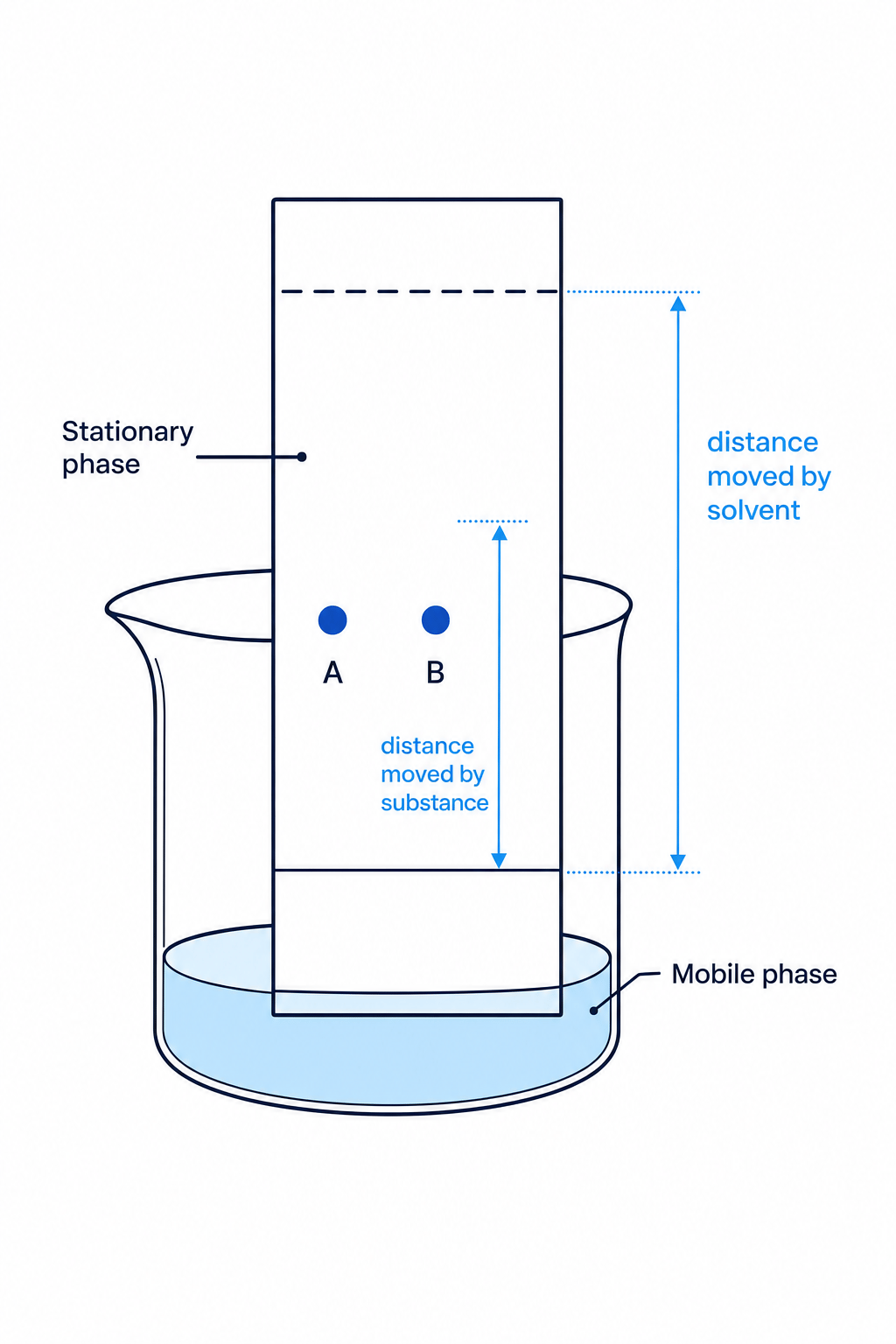
Once the solvent has almost reached the top, you remove the plate and mark the final height the solvent reached. This line is called the solvent front.
If the spots are colourless (like amino acids), you need a way to see them. You might shine ultraviolet (UV) light on the plate, or spray it with a locating agent like ninhydrin, which turns amino acids purple.
Why pencil?
Always use a pencil for the baseline. Pencil lead is made of graphite, which is insoluble in the solvent and will not move or interfere with your chromatogram. If you use ink, the dyes in the ink will separate and ruin your results!
Calculating RfR_fRf values
To identify the substances on the plate, you calculate a retention factor, known as the RfR_fRf value, for each spot.
Rf=distance moved by substancedistance moved by solvent R_f = \frac{\text{distance moved by substance}}{\text{distance moved by solvent}} Rf=distance moved by solventdistance moved by substanceBecause you are dividing a distance by a distance, the RfR_fRf value has no units.
Calculating an Rf value
A student carries out TLC on a mixture of analgesics. The solvent moves 7.50 cm7.50 \text{ cm}7.50 cm up the plate from the baseline. One of the spots moves 3.15 cm3.15 \text{ cm}3.15 cm from the baseline. Calculate the RfR_fRf value for this spot to two significant figures.
- State the formula for the calculation:
- Substitute the measured distances into the formula:
- Compute the final value:
Rf values greater than 1
Your RfR_fRf value can never be greater than 111. The substance cannot travel further than the solvent front that is carrying it. If you get a value greater than 111, you have put the fraction upside down!
Once you have calculated the RfR_fRf values, you compare them with known standard values measured under the exact same conditions (same solvent, same temperature, same stationary phase) to identify the substances.
Column Chromatography (CC)
TLC is great for analysis, but what if you actually want to collect the separated chemicals to use later? For bulk separation, we use column chromatography.
- Stationary phase: A solid powder (like silica or alumina) packed into a vertical glass column.
- Mobile phase: A liquid solvent that is poured into the top of the column and moves down through the solid powder.
Instead of the solvent moving up by capillary action, it flows down under gravity or under slight pressure. As the mixture travels down, components with a stronger retention by the stationary phase travel more slowly. The components emerge from the bottom of the column at different times, allowing you to collect them in separate flasks.
Gas Chromatography (GC)
Gas chromatography is used to separate mixtures of volatile liquids or gases.
- Stationary phase: A solid, or a solid coated by a viscous liquid, packed inside a long, coiled tube (the column).
- Mobile phase: An unreactive "carrier gas" (usually nitrogen or helium).
The mixture is injected into the column, which is housed inside a high-temperature oven. The mixture evaporates and the carrier gas pushes it through.
Here, the separation depends on the differing affinities for the stationary phase, but it also strongly depends on the boiling points of the components. A component with a low boiling point will spend more time as a gas in the mobile phase, so it will travel through the column much faster.
Retention time
In gas chromatography, we do not measure a physical distance like we do in TLC. Instead, we measure the time it takes for a substance to travel all the way through the column and reach the detector.
Retention Time
The time taken for a substance to pass through a chromatography column from the moment of injection to the moment it reaches the detector.
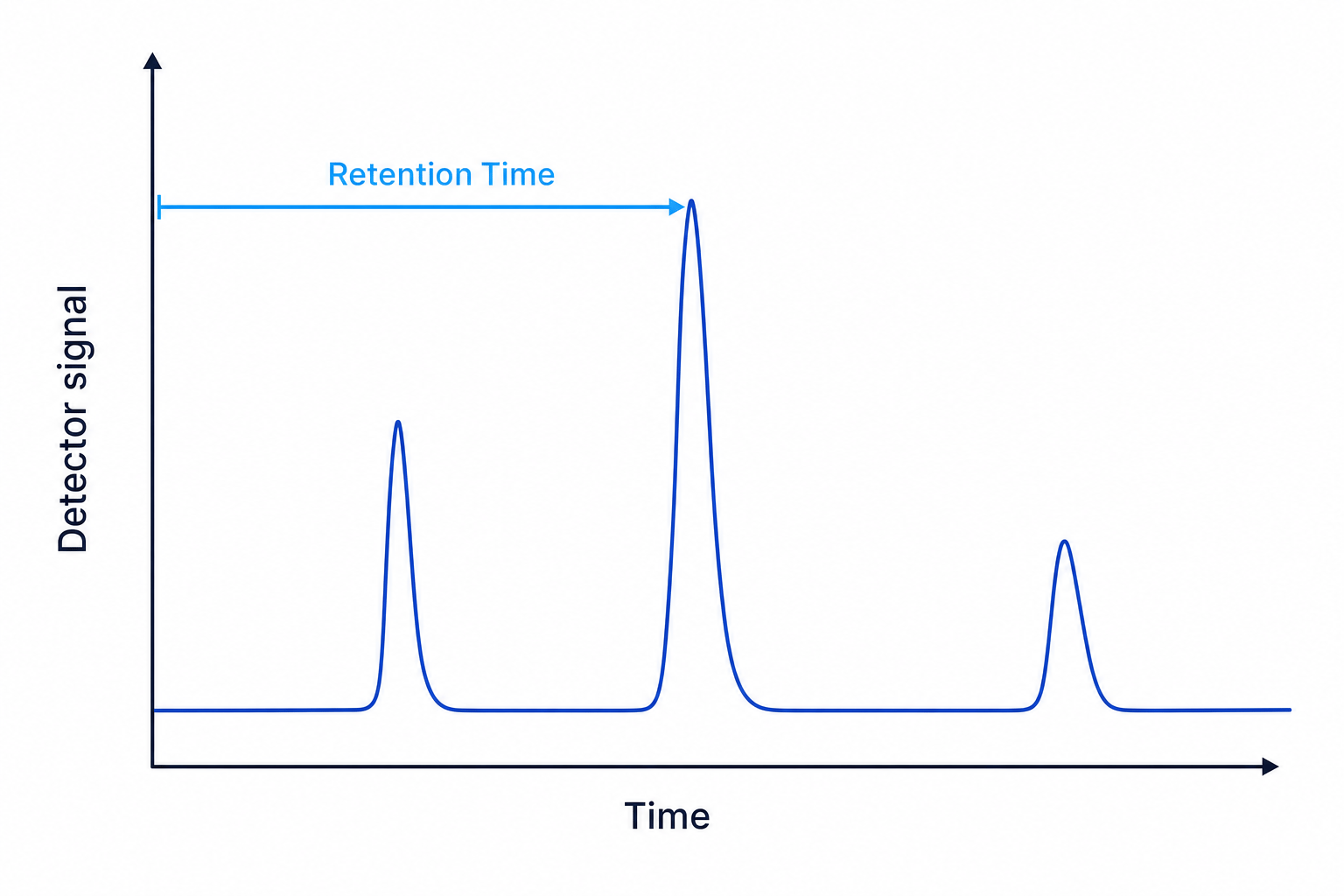
The detector produces a graph called a chromatogram. Each peak represents a different component. By comparing the retention times of the peaks against the retention times of known pure substances run under the same conditions (temperature, pressure, carrier gas flow rate), you can identify what is in the mixture. The area under each peak tells you the relative amount of each substance.
Gas Chromatography - Mass Spectrometry (GC-MS)
Sometimes, comparing retention times isn't enough to identify a substance, especially if you have a completely unknown compound or two compounds happen to share the same retention time.
To solve this, gas chromatography is frequently coupled with mass spectrometry.
- The mixture is separated into its individual components by the GC column.
- As each pure component emerges from the GC column, it is fed directly into a mass spectrometer.
- The mass spectrometer produces a mass spectrum for each individual component.
You can then use the fragmentation patterns and exact mass peaks in the mass spectra to definitively identify the structures of the components, often by comparing the spectra automatically to a vast computer database.
In the exam
- Never just say "solubility". When explaining why compounds separate, you must explicitly refer to the balance between "solubility in the mobile phase" and "retention by the stationary phase".
- If asked to calculate an RfR_fRf value from a printed diagram, always measure from the baseline to the centre of the spot.
- In GC questions, remember that increasing the oven temperature will decrease the retention times across the board, because all components will spend more time as a gas in the mobile phase.
Check yourself
- What determines how far a substance travels in thin-layer chromatography?
- Why must the baseline on a TLC plate be drawn in pencil rather than ink?
- What are the states of the mobile and stationary phases in gas chromatography?
- How is the RfR_fRf value calculated, and why does it not have units?
