

Here's what you'll learn in this topic:
- Why the carbon-carbon double bond makes alkenes highly reactive.
- The step-by-step electrophilic addition mechanisms for reacting alkenes with HBr, Br2, and H2SO4.
- How to test for unsaturation in the laboratory.
- Why unsymmetrical alkenes form a mixture of products, and how to predict the major product using carbocation stability.
Why do alkenes react?
Alkenes are unsaturated hydrocarbons containing a carbon-carbon double bond (C=C). This double bond consists of a standard single bond (a sigma bond) and a second bond (a pi bond) where the electrons are spread out above and below the plane of the atoms.
Because there are four electrons shared between two carbon atoms, the double bond is a region of high electron density. This makes it incredibly attractive to electrophiles.
Electrophile and Addition
An electrophile is an electron pair acceptor. It is typically a species with a positive charge or a partial positive (δ+\delta+δ+) charge that is attracted to electron-rich areas.
An addition reaction is a reaction where two or more molecules combine to form a single product. When an electrophile attacks an alkene, the double bond opens up, and new atoms are added to the carbon skeleton.
The electrophilic addition mechanism
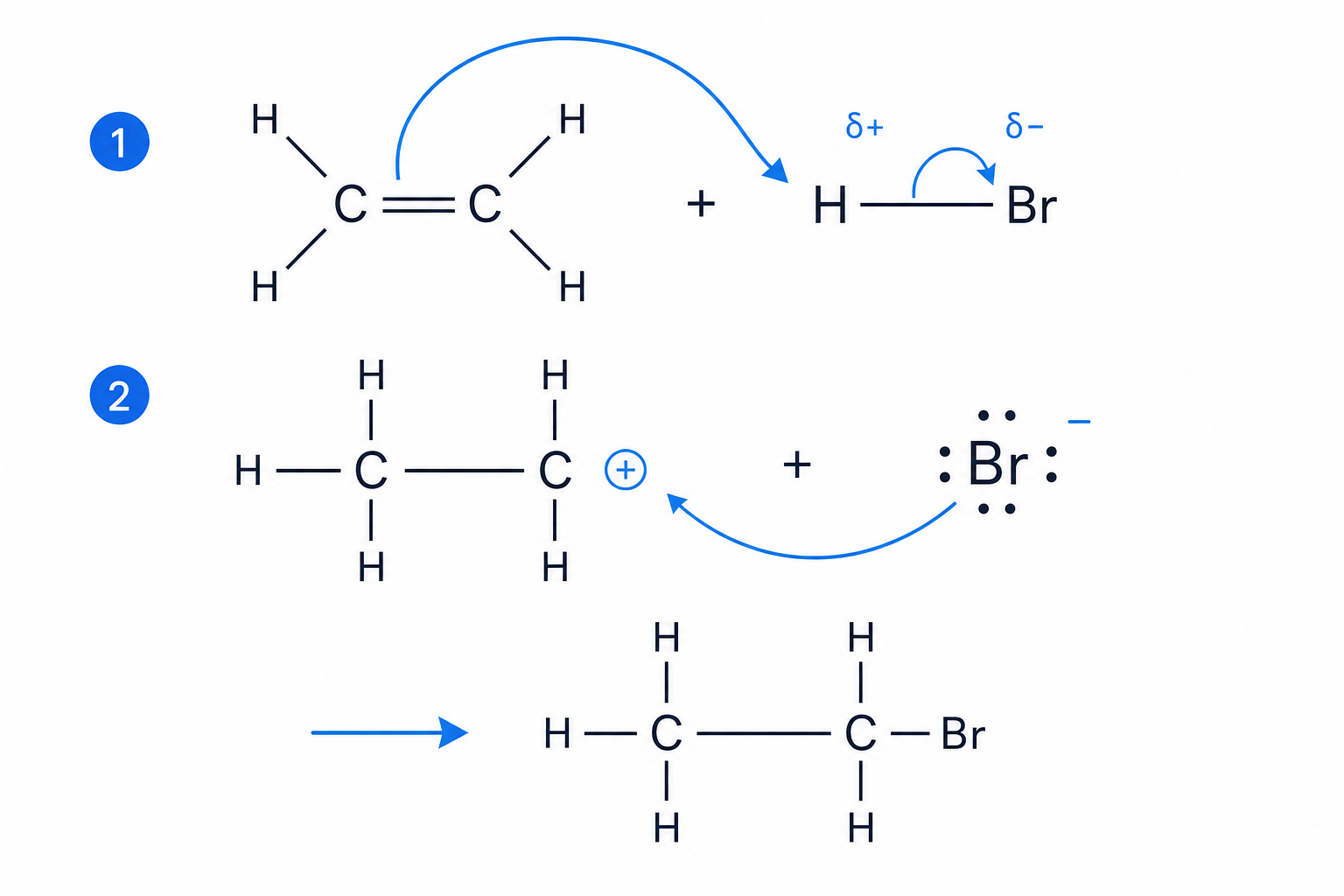
The mechanism for electrophilic addition always follows the same logical sequence. We will use the reaction between ethene and hydrogen bromide (HBr) as our standard example.
Hydrogen bromide is a polar molecule. Bromine is more electronegative than hydrogen, so the H–Br bond has a permanent dipole: the hydrogen atom is δ+\delta+δ+ and the bromine atom is δ−\delta-δ−.
- Attack of the electrophile: The highly electron-dense C=C double bond attracts the δ+\delta+δ+ hydrogen atom. A pair of electrons from the double bond moves out to form a new covalent bond with the hydrogen atom.
- Breaking the H–Br bond: Because hydrogen can only form one bond, the existing H–Br bond breaks. Both electrons from the bond move to the bromine atom, forming a bromide ion (Br−).
- The carbocation intermediate: The carbon atom that did not bond with the hydrogen has lost a share of the double bond's electrons. It now has a full positive charge. We call this intermediate a carbocation.
- Attack of the nucleophile: The negatively charged bromide ion (Br−), which has a lone pair of electrons, acts as a nucleophile. It attacks the positively charged carbon atom, forming a new C–Br bond and completing the addition product (bromoethane).
Drawing curly arrows
In organic mechanisms, a curly arrow always shows the movement of a pair of electrons. It must start exactly from an electron source (a bond or a lone pair) and point exactly to the atom that will receive the electrons. Sloppy arrows cost marks!
Reaction with bromine (Br2)
You might wonder how Br2 can act as an electrophile when it is completely non-polar (both atoms have the same electronegativity).
When a Br2 molecule approaches an alkene, the intense negative charge of the C=C double bond repels the electrons in the Br–Br bond. This pushes the electrons towards the further bromine atom, creating an induced dipole. The closer bromine atom becomes δ+\delta+δ+ (acting as the electrophile), and the further bromine becomes δ−\delta-δ−.
From here, the mechanism is identical to the HBr example. The double bond attacks the δ+\delta+δ+ bromine, the Br–Br bond breaks to form a Br− ion, a carbocation forms, and the Br− ion attacks the positive carbon to form a dihalogenoalkane (e.g., 1,2-dibromoethane).
The test for unsaturation
This reaction is the basis for the classic laboratory test for alkenes. If you add bromine water (an orange/brown solution) to an alkene and shake it, the solution will rapidly turn colourless as the bromine reacts across the double bond.
Reaction with sulfuric acid (H2SO4)
Alkenes also undergo electrophilic addition with cold, concentrated sulfuric acid to form alkyl hydrogensulfates.
The structure of sulfuric acid can be thought of as H–OSO3H. The mechanism follows the exact same pattern:
- The δ+\delta+δ+ hydrogen is attacked by the double bond.
- The H–O bond breaks, leaving a hydrogensulfate ion (OSO3H−).
- The intermediate carbocation is attacked by a lone pair on the negatively charged oxygen of the hydrogensulfate ion.
(Note: If you later warm the resulting alkyl hydrogensulfate with water, it undergoes hydrolysis to form an alcohol, regenerating the sulfuric acid. This makes sulfuric acid a catalyst for the hydration of alkenes!)
Unsymmetrical alkenes and carbocation stability
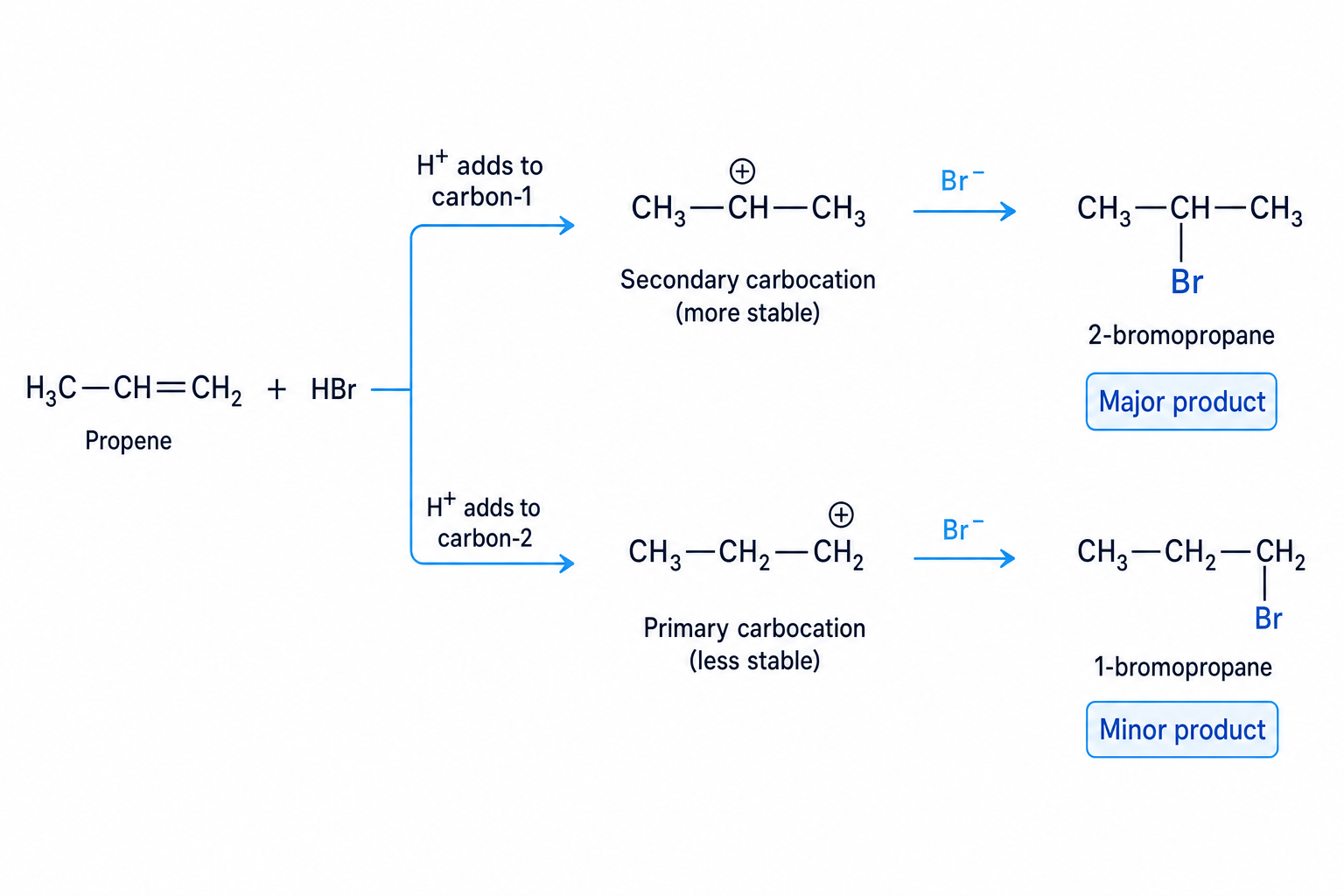
Things get more complicated when both the alkene and the attacking molecule are unsymmetrical (e.g., propene reacting with HBr). The hydrogen could add to either carbon of the double bond, creating two different possible carbocations and leading to two different products.
We call these the major and minor products. To predict which is which, we must look at the stability of the carbocation intermediate.
Carbocations are classified by how many alkyl groups (like methyl or ethyl groups) are directly attached to the positively charged carbon atom:
- Primary (1∘1^\circ1∘) carbocation: Positively charged carbon is attached to 1 alkyl group.
- Secondary (2∘2^\circ2∘) carbocation: Positively charged carbon is attached to 2 alkyl groups.
- Tertiary (3∘3^\circ3∘) carbocation: Positively charged carbon is attached to 3 alkyl groups.
Alkyl groups are weakly electron-releasing. They push electron density towards the positively charged carbon atom, spreading out the charge and stabilising the ion. This is known as the positive inductive effect. Because tertiary carbocations have three alkyl groups pushing electron density toward the positive centre, they are the most stable.
Stability: Tertiary (3∘3^\circ3∘) > Secondary (2∘2^\circ2∘) > Primary (1∘1^\circ1∘)
When an electrophile adds to an unsymmetrical alkene, the reaction will overwhelmingly follow the pathway that forms the most stable carbocation intermediate.
Confusing 'clear' and 'colourless'
When describing the bromine water test in an exam, never write that the solution goes "clear". Water is clear, but so is apple juice! "Clear" means you can see through it (transparent). You must use the word colourless to describe the loss of the orange hue.
Predicting the major product
Predict the major product formed when 2-methylbut-2-ene reacts with hydrogen bromide (HBr).
- Identify the double bond and attached groups. The double bond is between carbon-2 and carbon-3. Carbon-2 is bonded to two methyl groups. Carbon-3 is bonded to one methyl group and one hydrogen atom.
- Determine the possible carbocations. If the H+ adds to carbon-3, a tertiary carbocation is formed (the positive charge is on carbon-2, which is attached to three carbons). If the H+ adds to carbon-2, a secondary carbocation is formed (the positive charge is on carbon-3, which is attached to two carbons).
- Compare stability. The tertiary carbocation is more stable than the secondary carbocation due to a greater positive inductive effect from three electron-releasing alkyl groups.
- Determine the major product. The reaction predominantly proceeds via the more stable tertiary carbocation. The bromide ion then attacks carbon-2, making the major product 2-bromo-2-methylbutane.
In the exam
- When drawing a mechanism, ensure your curly arrow starts precisely from the centre of the double bond (or from a drawn lone pair) and points explicitly to the target atom.
- Always draw the full partial charges (δ+\delta+δ+ and δ−\delta-δ−) on your electrophile in the first step.
- Don't forget to draw the positive charge on the carbon atom of your carbocation intermediate.
- If asked to explain the formation of a major product, you must explicitly state three things to get full marks: which carbocation is formed by the major route (e.g. "a secondary carbocation"), which is formed by the minor route ("a primary carbocation"), and that the major route's carbocation is "more stable due to the positive inductive effect of the alkyl groups".
Check yourself
- Can you draw the full mechanism for the reaction between cyclohexene and Br2?
- What colour change is observed when bromine water is added to an alkene?
- Why is a tertiary carbocation more stable than a primary carbocation?
- If 1-butene reacts with HCl, what will be the major product and why?
