What you'll learn
- How pairs of outer-shell electrons — two electrons in the highest occupied shell — repel and set a 3D shape.
- How to identify bonding pairs shared in bonds and lone pairs not shared in bonds around a central atom.
- How to predict shapes and bond angles for simple molecules and ions with up to six electron-pair regions.
Why molecules have shapes
Atoms in molecules are not usually arranged flat on paper. They occupy three-dimensional positions because electrons repel each other.
A bond angle is the angle between two bonds that meet at the central atom. For example, in H2O, the H–O–H bond angle is the angle at the oxygen atom.
Electron-pair terms
- A central atom is the atom whose surrounding electron pairs you are analysing.
- A bonding pair is a pair of electrons shared between two atoms in a covalent bond.
- A lone pair, also called a non-bonding pair, is a pair of outer-shell electrons not used in bonding.
- A charge cloud is a region of negative charge, such as a bonding pair or lone pair, that repels other electron regions.
The model used here is called VSEPR: valence shell electron pair repulsion. “Valence shell” means the outer shell of electrons.
Minimum repulsion
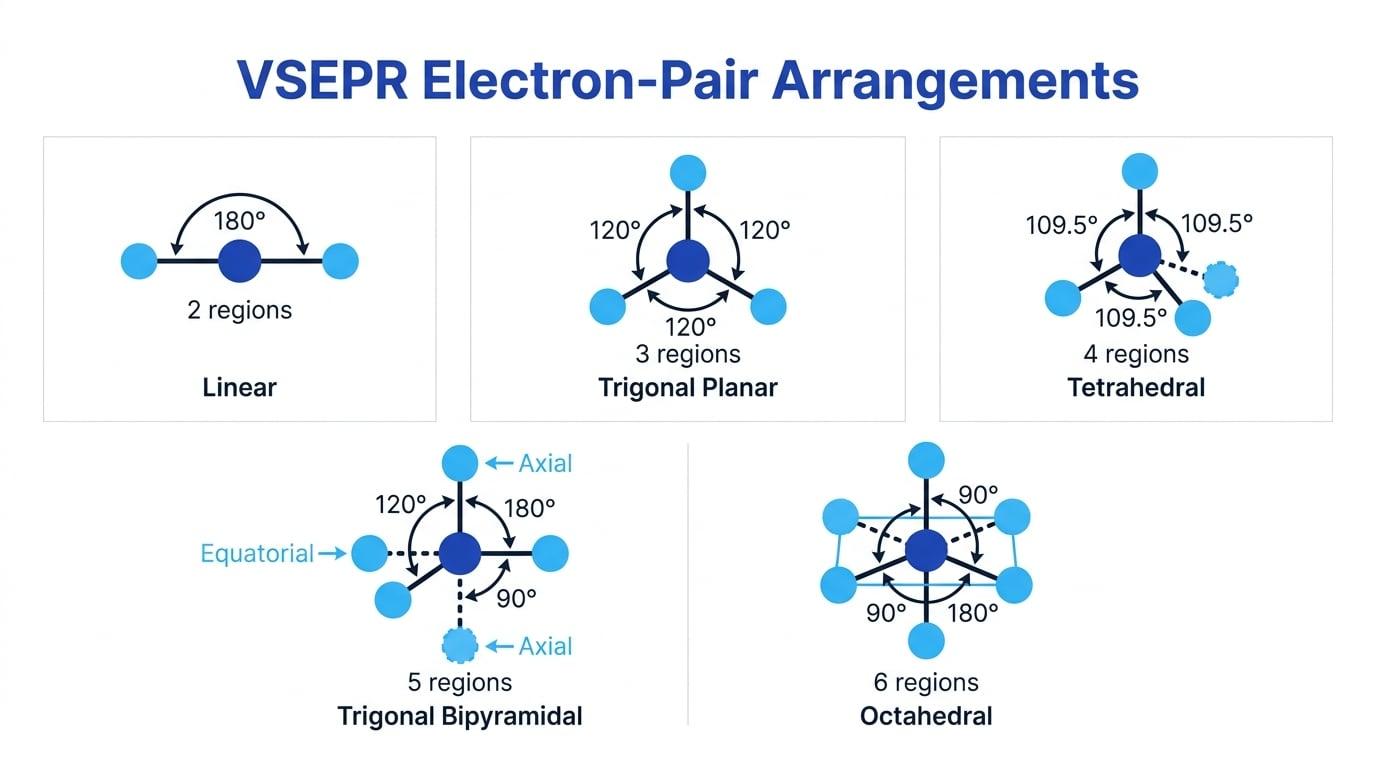
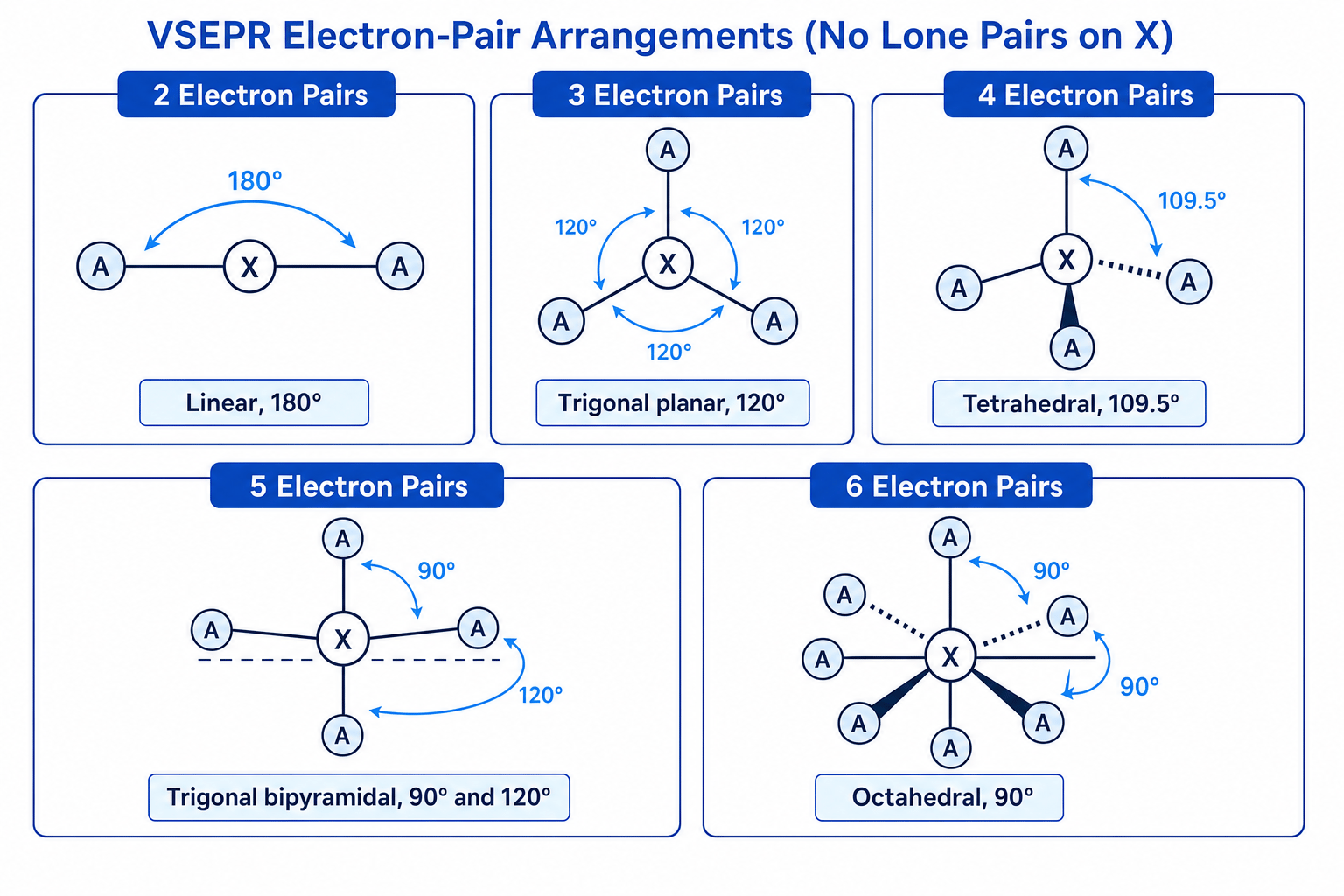
Electron pairs around the central atom arrange themselves as far apart as possible to minimise repulsion.
The standard electron-pair arrangements are the starting point for almost every question in this topic.
Explaining a linear shape
- In BeCl2, beryllium is the central atom and it has two Be–Cl bonding regions around it.
- With only two negative charge clouds, the greatest separation is on opposite sides of the central atom.
- The molecule is therefore linear, with a Cl–Be–Cl bond angle of 180°.
Lone pairs change bond angles
Not all electron-pair repulsions are equal.
The order of repulsion strength is:
lone pair–lone pair > lone pair–bond pair > bond pair–bond pair
A lone pair repels more strongly because it is held by one nucleus rather than shared between two nuclei, so its charge cloud is more concentrated near the central atom.
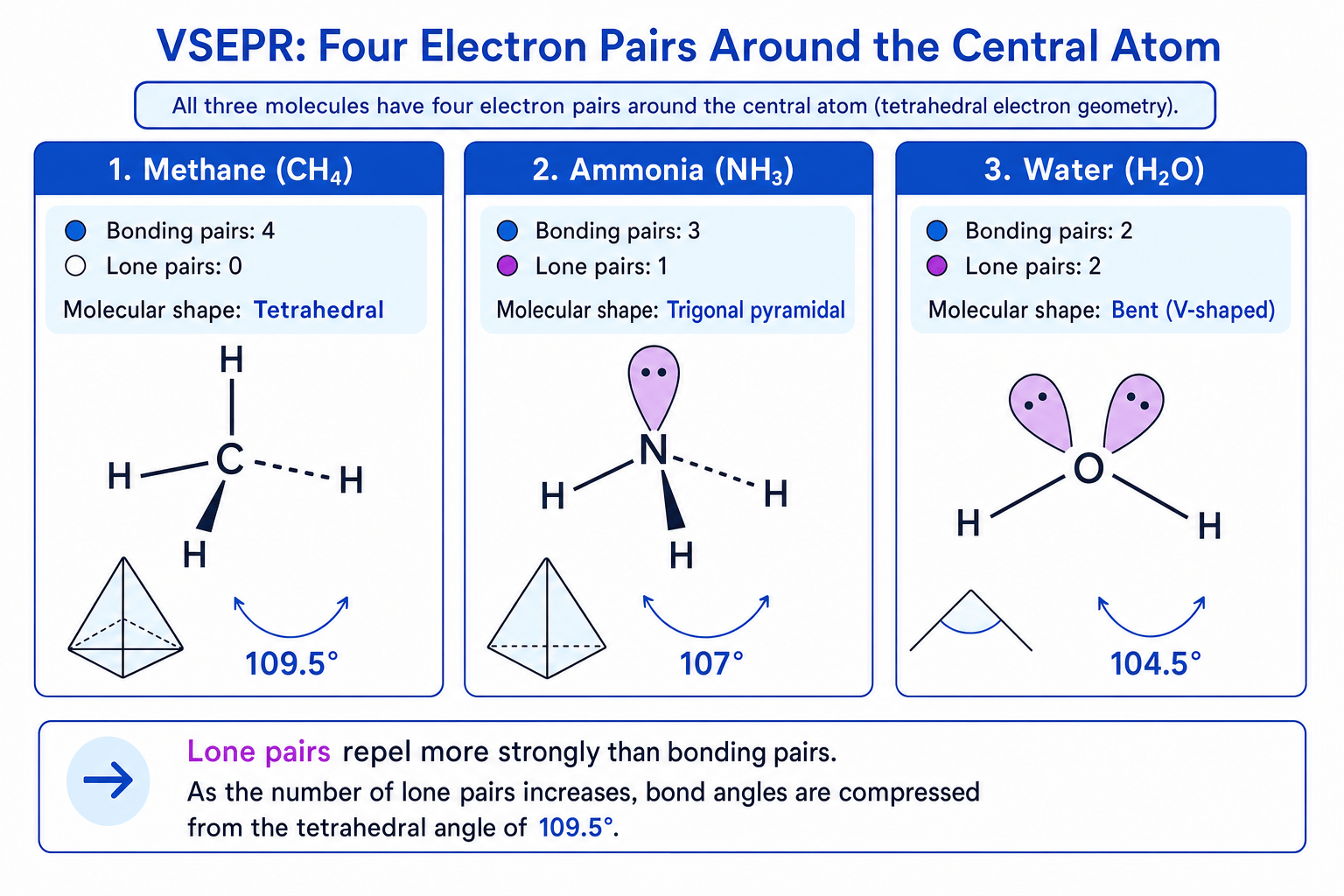
This explains why molecules with the same total number of electron pairs can have different bond angles.
- CH4 has four bonding pairs and no lone pairs: tetrahedral, 109.5°.
- NH3 has three bonding pairs and one lone pair: trigonal pyramidal, about 107°.
- H2O has two bonding pairs and two lone pairs: bent, 104.5°.
Explaining the bond angle in water
- Oxygen has six outer-shell electrons. In H2O it forms two O–H bonds, leaving two lone pairs on the oxygen.
- There are four electron pairs around oxygen, so the electron-pair arrangement starts from tetrahedral, with an ideal angle of 109.5°.
- The two lone pairs repel the bonding pairs more strongly than bonding pairs repel each other, so the H–O–H bond angle is compressed to 104.5°.
- The molecular shape is bent or V-shaped, because shape describes the positions of atoms, not the lone pairs.
Forgetting invisible lone pairs
The shape name is based on the atoms you can “see”, but the bond angle is controlled by all electron pairs, including lone pairs. NH3 is not trigonal planar just because it has three H atoms; it has four electron pairs around nitrogen, so it starts from a tetrahedral arrangement.
Electron-pair arrangement vs molecular shape
These two phrases are related, but not identical.
Arrangement and shape
The electron-pair arrangement includes all bonding pairs and lone pairs around the central atom. The molecular shape describes only the positions of the atoms.
For example, NH3 has a tetrahedral electron-pair arrangement, but its molecular shape is trigonal pyramidal because one corner of the tetrahedron is occupied by a lone pair.
A reliable method for any simple molecule or ion
An ion is a species with an overall positive or negative charge.
Use this method every time:
- Choose the central atom. It is usually the least electronegative atom, meaning the atom with the weaker attraction for bonding electrons. Hydrogen is never the central atom.
- Work out how many bonding regions and lone pairs surround the central atom. A dot-and-cross diagram can help; this is a diagram showing outer-shell electrons from different atoms using different symbols.
- Find the electron-pair arrangement from the total number of charge clouds.
- Name the molecular shape by considering only the atoms.
- Adjust the bond angle if lone pairs are present.
Counting electrons in ions
When counting outer electrons for an ion, add one electron for each negative charge and remove one electron for each positive charge.
Deducing the shape of ammonium ion
- For NH4+, nitrogen contributes 5 outer electrons, four hydrogens contribute 4 electrons, and the positive charge means one electron has been removed: 5+4−1=85 + 4 - 1 = 85+4−1=8 electrons.
- These 8 electrons form 8÷2=48 \div 2 = 48÷2=4 electron pairs around the nitrogen.
- All four pairs are N–H bonding pairs, so there are no lone pairs on the central atom.
- Four bonding pairs repel equally and arrange tetrahedrally, so NH4+ is tetrahedral with bond angles of 109.5°.
Multiple bonds
For shape prediction, a double or triple bond is treated as one bonding region because it lies in one direction from the central atom. For example, CO2 has two C=O bonding regions around carbon, so it is linear.
Core shapes with two to four electron-pair regions
| Total regions around central atom | Bonding regions | Lone pairs | Electron-pair arrangement | Molecular shape | Typical bond angle | Examples |
|---|---|---|---|---|---|---|
| 2 | 2 | 0 | Linear | Linear | 180° | BeCl2, CO2 |
| 3 | 3 | 0 | Trigonal planar | Trigonal planar | 120° | BF3 |
| 3 | 2 | 1 | Trigonal planar | Bent | Slightly less than 120° | SO2 |
| 4 | 4 | 0 | Tetrahedral | Tetrahedral | 109.5° | CH4, NH4+ |
| 4 | 3 | 1 | Tetrahedral | Trigonal pyramidal | About 107° | NH3 |
| 4 | 2 | 2 | Tetrahedral | Bent | 104.5° | H2O |
Shapes with five and six electron-pair regions
Five electron-pair regions give a trigonal bipyramidal arrangement. Three positions are equatorial, around the middle, and two are axial, above and below.
Six electron-pair regions give an octahedral arrangement.
| Total regions around central atom | Bonding regions | Lone pairs | Molecular shape | Typical bond angles | Example |
|---|---|---|---|---|---|
| 5 | 5 | 0 | Trigonal bipyramidal | 90°, 120° and 180° | PCl5 |
| 5 | 4 | 1 | See-saw | Slightly less than 90° and 120° | SF4 |
| 5 | 3 | 2 | T-shaped | About 90° and 180° | ClF3 |
| 5 | 2 | 3 | Linear | 180° | XeF2 |
| 6 | 6 | 0 | Octahedral | 90° and 180° | SF6 |
| 6 | 5 | 1 | Square pyramidal | Slightly less than 90° | BrF5 |
| 6 | 4 | 2 | Square planar | 90° and 180° | XeF4 |
Where lone pairs go
In trigonal bipyramidal arrangements, lone pairs usually occupy equatorial positions first because this minimises 90° repulsions. In octahedral arrangements, two lone pairs go opposite each other to minimise lone pair–lone pair repulsion.
Deducing a T-shaped molecule
- In ClF3, chlorine is the central atom. Chlorine has 7 outer electrons and uses three of them to form three Cl–F bonds, leaving 7−3=47 - 3 = 47−3=4 electrons as two lone pairs.
- The central chlorine has three bonding regions and two lone pairs: five charge clouds in total, so the electron-pair arrangement is trigonal bipyramidal.
- The two lone pairs occupy equatorial positions to reduce strong repulsions.
- The remaining three fluorine atoms form a T-shaped molecule, with bond angles about 90° and 180°.
How to phrase explanations
A strong explanation usually follows this pattern:
- State the number of bonding pairs and lone pairs around the central atom.
- State that electron pairs repel and arrange as far apart as possible.
- If lone pairs are present, compare repulsion strengths.
- Give the shape and bond angle.
For example: “NH3 has three bonding pairs and one lone pair around nitrogen. Four electron pairs arrange tetrahedrally, but the lone pair repels bonding pairs more strongly, compressing the H–N–H angle to about 107°. The shape is trigonal pyramidal.”
In the exam
- Always count electron pairs around the central atom, not the total number of atoms in the formula.
- Give both the shape and the bond angle when asked, then justify angle changes using the repulsion order.
- For unfamiliar ions or molecules, draw a quick dot-and-cross sketch and apply VSEPR rather than trying to memorise the example.
Check yourself
- Why is the bond angle in NH3 smaller than in CH4?
- What shape and bond angle would you expect for BF3?
- How many bonding pairs and lone pairs are around the central atom in H2O?