What you'll learn
- How the four crystal structures are arranged: ionic, metallic, giant covalent and molecular.
- How to predict melting point and electrical conductivity from bonding and structure.
- Why changes of state involve energy changes.
- How to sketch crystal structures with the correct particles and bonding.
The prerequisite idea: particles and attractions
A solid’s physical properties depend on two things:
- What particles are present: ions, atoms, metal ions with electrons, or molecules.
- What holds those particles together: ionic bonding, metallic bonding, covalent bonding, or intermolecular forces.
Crystal lattice
A crystal lattice is a regular, repeating three-dimensional arrangement of particles in a solid. The particles may be ions, atoms, or molecules.
An electrostatic attraction is an attraction between opposite charges. This matters in ionic and metallic structures.
An intermolecular force is an attraction between separate molecules. It is much weaker than a covalent bond within a molecule.
The central rule
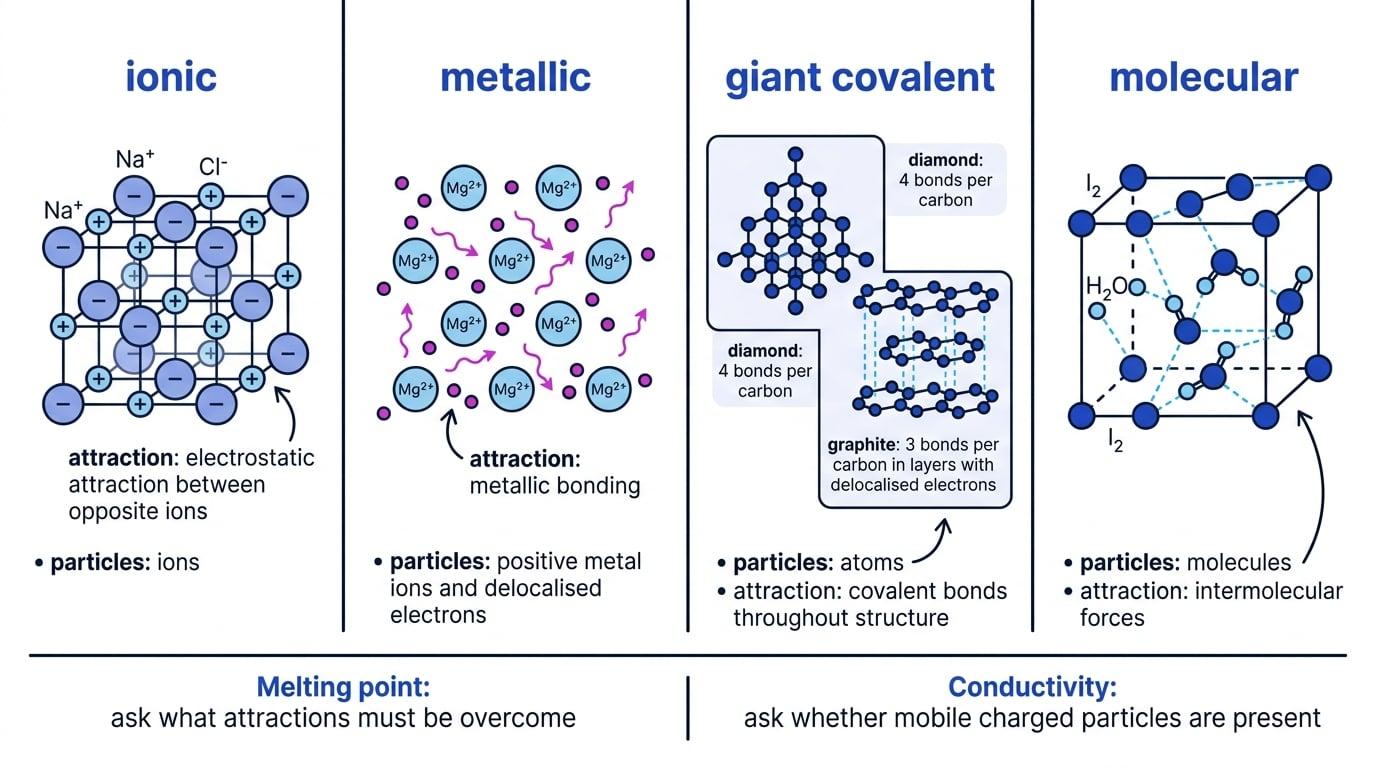
To explain a melting point, ask: what attractions must be overcome? To explain conductivity, ask: are there mobile charged particles?
The four crystal structures
The AQA examples you need are sodium chloride, magnesium, diamond, graphite, iodine and ice.
This overview shows the main particles and attractions in four key structure types.
| Crystal type | Particles in the lattice | Main attraction | Examples |
|---|---|---|---|
| Ionic | Positive and negative ions | Ionic bonding: strong electrostatic attractions in all directions | Sodium chloride |
| Metallic | Positive metal ions and delocalised electrons | Metallic bonding | Magnesium |
| Macromolecular, also called giant covalent | Atoms | Covalent bonds throughout the structure | Diamond, graphite |
| Molecular | Molecules | Intermolecular forces between molecules | Iodine, ice |
Ionic crystals: sodium chloride
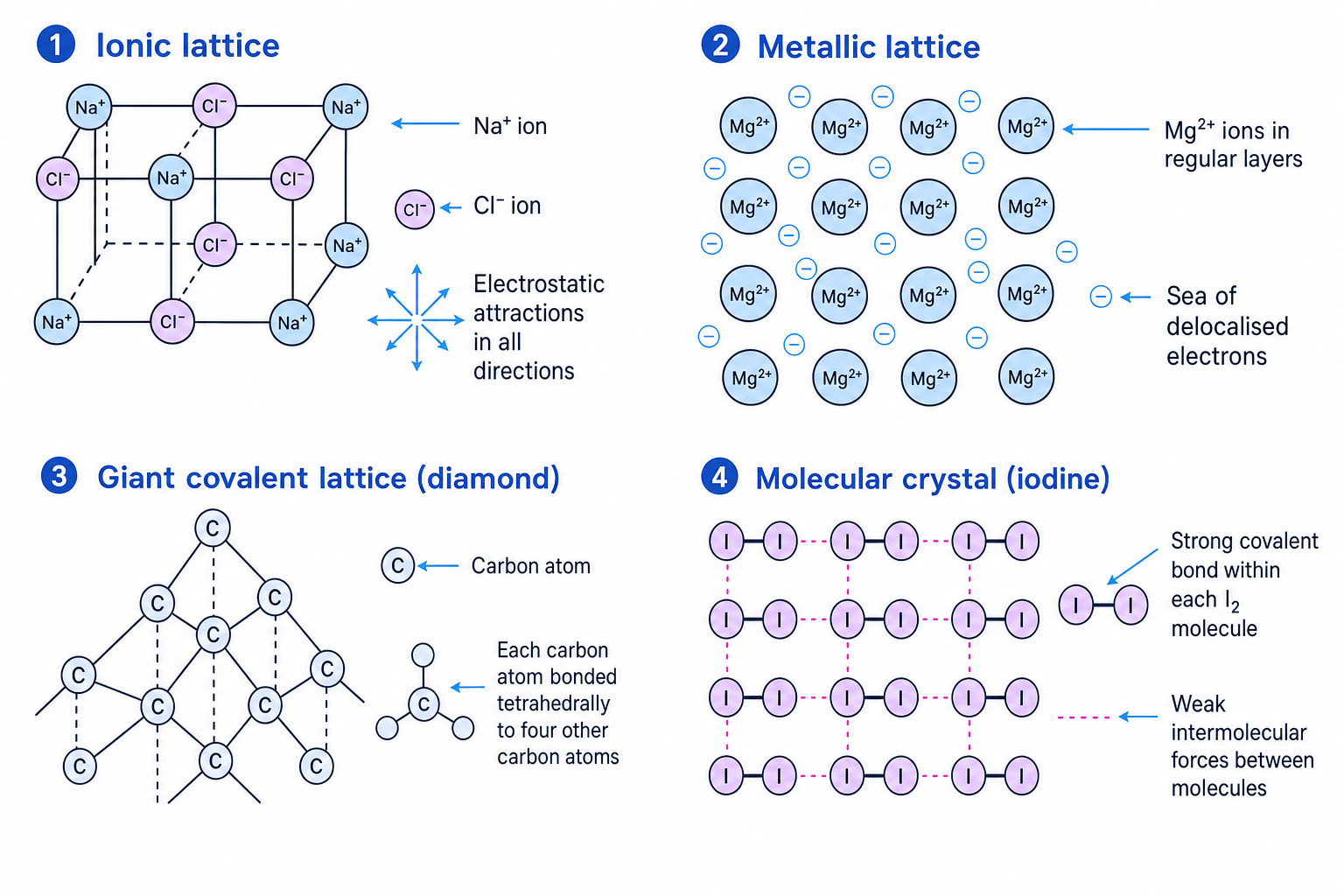
Sodium chloride is a giant ionic lattice. It contains Na⁺ ions and Cl⁻ ions arranged alternately. Each ion is attracted to oppositely charged ions in all directions.
Sodium chloride has a high melting point because many strong electrostatic attractions must be overcome before the ions can move freely.
Solid sodium chloride does not conduct electricity because the ions are fixed in position. When molten, meaning melted, or dissolved in water, the ions are free to move, so it does conduct.
NaCl is not made of molecules
Do not describe sodium chloride as “NaCl molecules”. It is a giant ionic lattice with a repeating ratio of Na⁺ ions to Cl⁻ ions.
Metallic crystals: magnesium
Magnesium has a metallic lattice: positive Mg²⁺ ions arranged in regular layers, surrounded by delocalised electrons.
Delocalised electron
A delocalised electron is an electron that is not fixed between one pair of atoms. In a metal, delocalised electrons can move through the whole structure.
Magnesium conducts electricity as a solid and as a liquid because its delocalised electrons are mobile charged particles.
It also has a relatively high melting point compared with molecular substances because metallic bonding involves strong electrostatic attractions between positive metal ions and delocalised electrons.
Giant covalent crystals: diamond and graphite
A giant covalent structure is a continuous network of atoms joined by covalent bonds. There are no separate molecules.
Diamond
In diamond, each carbon atom forms four covalent bonds to other carbon atoms in a tetrahedral arrangement. This makes diamond:
- very hard
- very high melting
- unable to conduct electricity
Diamond does not conduct because all the outer electrons of carbon are used in covalent bonds, so there are no mobile charged particles.
Graphite
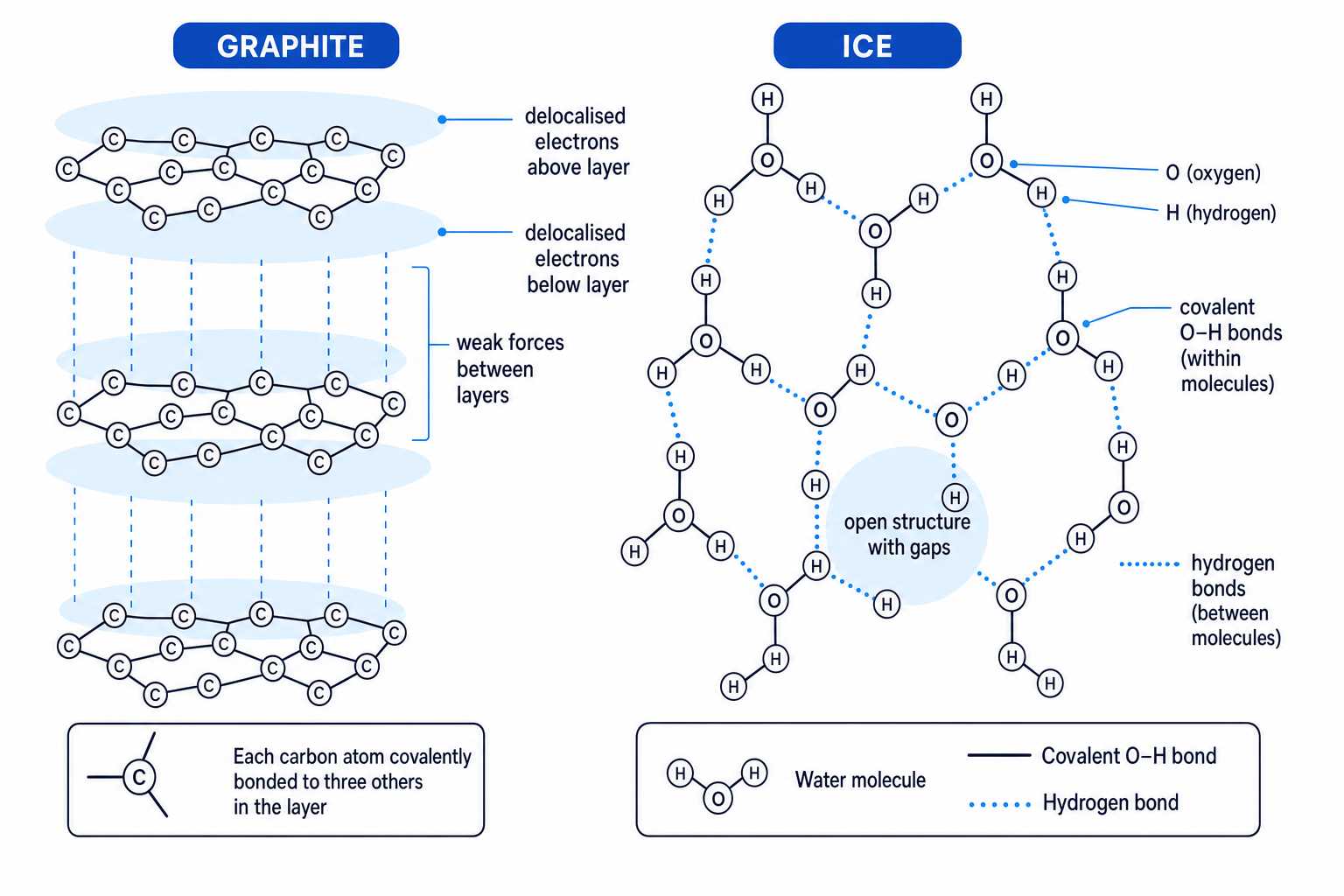
In graphite, each carbon atom forms three covalent bonds in flat hexagonal layers. The fourth outer electron from each carbon becomes delocalised.
Graphite has a high melting point because strong covalent bonds must be broken to melt it. It conducts electricity along the layers because delocalised electrons can move. It is soft and slippery because weak forces between layers allow the layers to slide.
Graphite and ice are common examples where the structure diagram explains the physical properties very directly.
Molecular crystals: iodine and ice
A molecular crystal contains separate molecules arranged in a lattice. The covalent bonds within each molecule are strong, but the forces between molecules are much weaker.
Iodine
Solid iodine contains I₂ molecules. Each molecule has a strong covalent bond between the two iodine atoms, but the I₂ molecules are only held together by intermolecular forces.
Iodine has a much lower melting point than ionic, metallic or giant covalent substances because only intermolecular forces need to be overcome when it melts or sublimes.
Iodine does not conduct electricity because it has no mobile ions or delocalised electrons.
Ice
Ice is a molecular crystal made from H₂O molecules. The water molecules are held in an open lattice by hydrogen bonds, a strong type of intermolecular force.
The open structure contains gaps, so ice is less dense than liquid water. Pure ice does not conduct electricity well because its molecules are neutral and there are no mobile charged particles.
Predicting properties from structure
Electrical conductivity always needs mobile charged particles:
- Metals conduct because delocalised electrons move.
- Graphite conducts because delocalised electrons move along layers.
- Molten or aqueous ionic compounds conduct because ions move.
- Diamond, iodine and pure ice do not conduct because they lack mobile charged particles.
Melting point depends on the strength and number of attractions that must be overcome:
- Giant covalent structures: usually very high melting points.
- Ionic and metallic structures: usually high melting points.
- Molecular structures: usually low melting points, though hydrogen bonding or large molecules can raise them.
Identifying an unknown crystal
A solid has a high melting point. It does not conduct electricity when solid, but it conducts when molten. Identify the likely crystal type.
- The solid does not conduct, so it probably does not have mobile delocalised electrons. This rules out a typical metal and also rules out graphite.
- The molten substance conducts, so charged particles must become mobile when the solid melts.
- This fits an ionic crystal: ions are fixed in the solid lattice but mobile in the molten liquid.
Testing an unknown solid
Useful tests include checking whether the solid conducts, whether a molten sample or aqueous solution conducts, how easily it melts, and whether it dissolves in water. Do not rely on just one observation if the question gives several.
Energy changes during changes of state
A change of state is a physical change such as melting, boiling, freezing, condensing or subliming.
Melting, boiling and subliming are endothermic: energy is absorbed to overcome attractions between particles.
Freezing, condensing and deposition are exothermic: energy is released as attractions form between particles.
During a change of state, the temperature stays constant because the energy supplied is used to overcome attractions rather than increase the particles’ kinetic energy.
Explaining iodine sublimation
Solid iodine can sublime, changing directly from solid iodine to iodine vapour.
- Identify the particles: solid iodine contains I₂ molecules arranged in a molecular crystal.
- During sublimation, I₂ molecules separate from each other, so intermolecular forces are overcome.
- The covalent I–I bonds within the I₂ molecules are not broken, so the vapour still contains I₂ molecules.
Breaking the wrong forces
When a simple molecular substance melts, boils or sublimes, you overcome intermolecular forces, not the covalent bonds inside the molecules.
Drawing crystal structure diagrams
When asked to draw a structure with a specified number of particles, focus on the correct repeating arrangement rather than artistic detail.
For sodium chloride, alternate Na⁺ and Cl⁻ ions. For magnesium, show positive metal ions with delocalised electrons. For diamond, show carbon atoms each bonded to four others. For graphite, show hexagonal layers. For iodine, show I₂ molecules. For ice, show H₂O molecules with hydrogen bonds between molecules.
Drawing an eight-ion sodium chloride lattice
Suppose you are asked to draw a small sodium chloride lattice containing eight ions in total.
- Use eight lattice positions, such as the corners of a small cube.
- Alternate the ions so that each Na⁺ ion is next to Cl⁻ ions, not next to another Na⁺ ion.
- Label four ions as Na⁺ and four ions as Cl⁻, showing a one-to-one ratio and a repeating ionic lattice rather than separate molecules.
Molecules versus atoms in diagrams
If asked to draw four iodine molecules, draw four I₂ pairs, meaning eight iodine atoms in total. Do not draw four single iodine atoms.
In the exam
- For melting point questions, name the structure first, then state the attractions that must be overcome.
- For conductivity questions, explicitly say whether mobile charged particles are present and what they are.
- For diagrams, check whether the question asks for atoms, ions or molecules, then make the number of particles match the wording.
Check yourself
- Why does molten sodium chloride conduct electricity but solid sodium chloride does not?
- Why does graphite conduct electricity but diamond does not?
- When iodine sublimes, which forces are overcome and which bonds remain intact?