

What you'll learn
- What electronegativity means in a covalent bond.
- How to use δ+ and δ− to show a polar bond.
- Why a molecule with polar bonds may or may not have a permanent dipole.
- How to explain dipole cancellation clearly in exam answers.
Start point: covalent bonds and electron density
Before thinking about polarity, start with a simple covalent bond.
Covalent bond
A covalent bond is a shared pair of electrons between two atoms. In bond polarity, you are thinking about where that shared pair spends more time.
The phrase electron density means the region where electrons are most likely to be found. In a perfectly even covalent bond, the electron density is shared symmetrically between the two atoms.
For example, in H₂ or Cl₂, both atoms are the same element. They attract the bonding pair equally, so the bond is non-polar.
Electronegativity: unequal attraction for a bonding pair
Electronegativity
Electronegativity is the power of an atom to attract the pair of electrons in a covalent bond.
Different elements have different electronegativities. If two atoms in a covalent bond have different electronegativities, the bonding pair is pulled more strongly towards one atom.
The more electronegative atom gets a greater share of the electron density.
Electronegativity generally:
- increases across a period, because nuclear charge increases
- decreases down a group, because the bonding pair is further from the nucleus and more shielded by inner electron shells
Fluorine is the most electronegative element. Oxygen, nitrogen and chlorine are also relatively electronegative.
If electronegativity values are given
The atom with the larger electronegativity value attracts the bonding pair more strongly. The bigger the difference, the more polar the covalent bond.
Polar covalent bonds and partial charges
A polar covalent bond is a covalent bond where the shared pair of electrons is attracted more strongly to one atom than the other. The electron distribution is unsymmetrical.
This gives the atoms partial charges.
Partial charge
A partial charge is a small charge caused by unequal sharing of electrons in a covalent bond. It is shown using δ+ and δ−, not full + and − ionic charges.
The rule is simple:
Assigning partial charges
In a polar covalent bond, the more electronegative atom is δ− because it attracts the bonding pair more strongly. The less electronegative atom is δ+.
You can also show bond polarity using a bond dipole arrow. A dipole is a separation of positive and negative charge. The arrow points from the δ+ end towards the δ− end, with a small cross or bar at the positive end.
Adding partial charges to hydrogen chloride
-
Compare the atoms in the bond: chlorine is more electronegative than hydrogen.
-
Chlorine attracts the shared pair of electrons more strongly, so the electron density is shifted towards chlorine.
-
Chlorine is labelled δ− and hydrogen is labelled δ+. The bond dipole arrow points from H towards Cl.
The diagram below shows the key difference between a polar bond and a polar molecule: a bond can be polar, but the whole molecule may still have no overall dipole if the bond dipoles cancel.
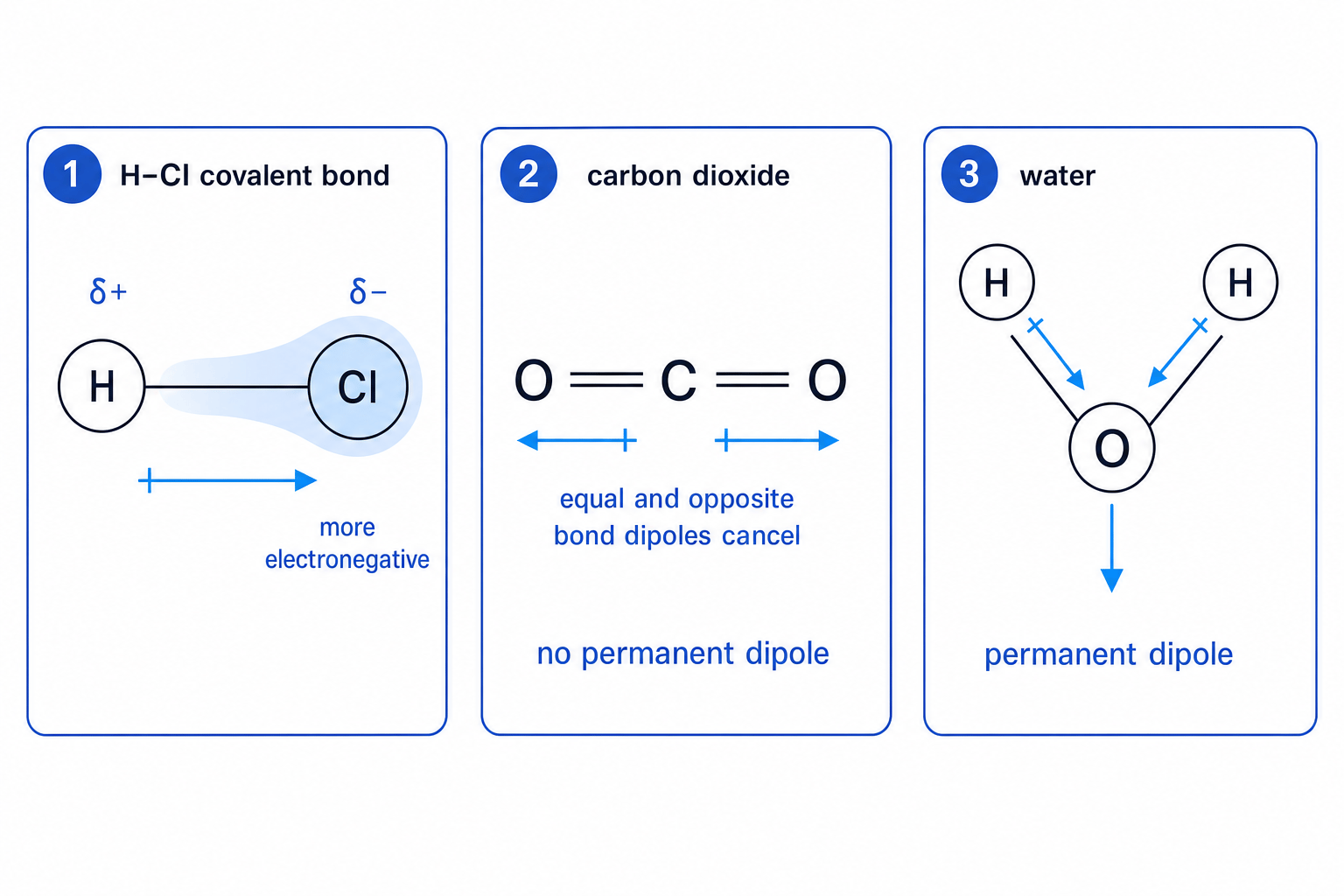
From bond polarity to molecular polarity
A bond dipole is the dipole across one bond. A molecular dipole is the overall dipole across the whole molecule.
Permanent dipole
A molecule has a permanent dipole if it has a fixed separation of charge, so one end of the molecule is δ+ and the other end is δ− overall.
To decide whether a molecule has a permanent dipole, you need two things:
- Are the bonds polar?
- Do the bond dipoles cancel because of the shape?
Bond dipoles behave like arrows: they have a direction and a size. If equal bond dipoles point in opposite directions, they cancel. If they do not cancel, the molecule has a permanent dipole.
Comparing carbon dioxide and water
-
Identify the polar bonds. Oxygen is more electronegative than both carbon and hydrogen, so C=O bonds and O–H bonds are polar, with oxygen δ−.
-
Use the molecular shapes. CO₂ is linear. H₂O is bent because oxygen has two lone pairs, which are pairs of outer-shell electrons not used in bonding.
-
In CO₂, the two C=O bond dipoles are equal and point in opposite directions. They cancel, so CO₂ has no permanent dipole.
-
In H₂O, the two O–H bond dipoles point towards oxygen at an angle. They do not cancel, so H₂O has a permanent dipole.
Why shape and symmetry matter
Some molecules contain polar bonds but are not polar overall. This happens when the molecule is symmetrical and the bond dipoles cancel.
Common examples include:
- CO₂: polar C=O bonds, but the molecule is linear, so the dipoles cancel.
- BF₃: polar B–F bonds, but the molecule is trigonal planar and symmetrical, so the dipoles cancel.
- CCl₄: polar C–Cl bonds, but the molecule is tetrahedral and symmetrical, so the dipoles cancel.
Other molecules have polar bonds that do not cancel:
- HCl: one polar bond, so there is no cancellation.
- H₂O: bent shape, so the O–H bond dipoles add to give a permanent dipole.
- NH₃: trigonal pyramidal shape, so the N–H bond dipoles do not cancel.
- CH₃Cl: not symmetrical enough for the bond dipoles to cancel.
Assuming polar bonds make a polar molecule
Do not write “the molecule is polar because it has polar bonds” without checking the shape. A molecule can have polar bonds but no permanent dipole if the bond dipoles cancel.
Cancellation needs equal dipoles
Bond dipoles only cancel perfectly when they are arranged symmetrically and are the same size. If one outer atom is different from the others, the molecule may have a permanent dipole even if the basic shape looks familiar.
A reliable method
When you are asked whether a molecule has a permanent dipole, use this sequence:
- Compare electronegativities to decide which bonds are polar.
- Add δ+ and δ− to show the direction of each bond dipole.
- Consider the molecular shape.
- Decide whether the bond dipoles cancel.
- Conclude clearly: has a permanent dipole or has no permanent dipole.
In the exam
-
For a polar bond, say: “the more electronegative atom attracts the bonding pair more strongly”.
-
Use δ+ and δ− correctly: the more electronegative atom is δ−.
-
For whole molecules, always mention the shape and whether the bond dipoles cancel or do not cancel.
Check yourself
- In H–Br, which atom would be δ−, and why?
- Why does CO₂ have polar bonds but no permanent dipole?
- Does NH₃ have a permanent dipole? Which shape feature matters?
