

What you'll learn
- How to calculate partial pressures from mole fractions and total pressure.
- How to write a KpK_pKp expression from a balanced gas-phase equation.
- How to calculate KpK_pKp using equilibrium data.
- How pressure, temperature and catalysts affect equilibrium yield and the value of KpK_pKp.
This topic extends the AS idea of equilibrium constants into gas-phase systems. It is A-Level only, so it is assessed in the full A-level papers, not AS.
The equilibrium background
A reversible reaction is one that can proceed in both directions: reactants form products, and products can reform reactants. In a closed system, it may reach dynamic equilibrium.
Dynamic equilibrium
A dynamic equilibrium is reached when the forward and reverse reactions occur at the same rate, so the amounts of reactants and products remain constant, provided temperature stays constant.
For KpK_pKp, we are dealing with gas-phase equilibria.
Homogeneous gas equilibrium
A homogeneous equilibrium is one in which all reactants and products are in the same physical phase. In this topic, every species in the equilibrium expression is a gas, shown by the state symbol (g).
Partial pressures
In a mixture of gases, each gas contributes to the total pressure. That contribution is called its partial pressure.
Mole fraction and partial pressure
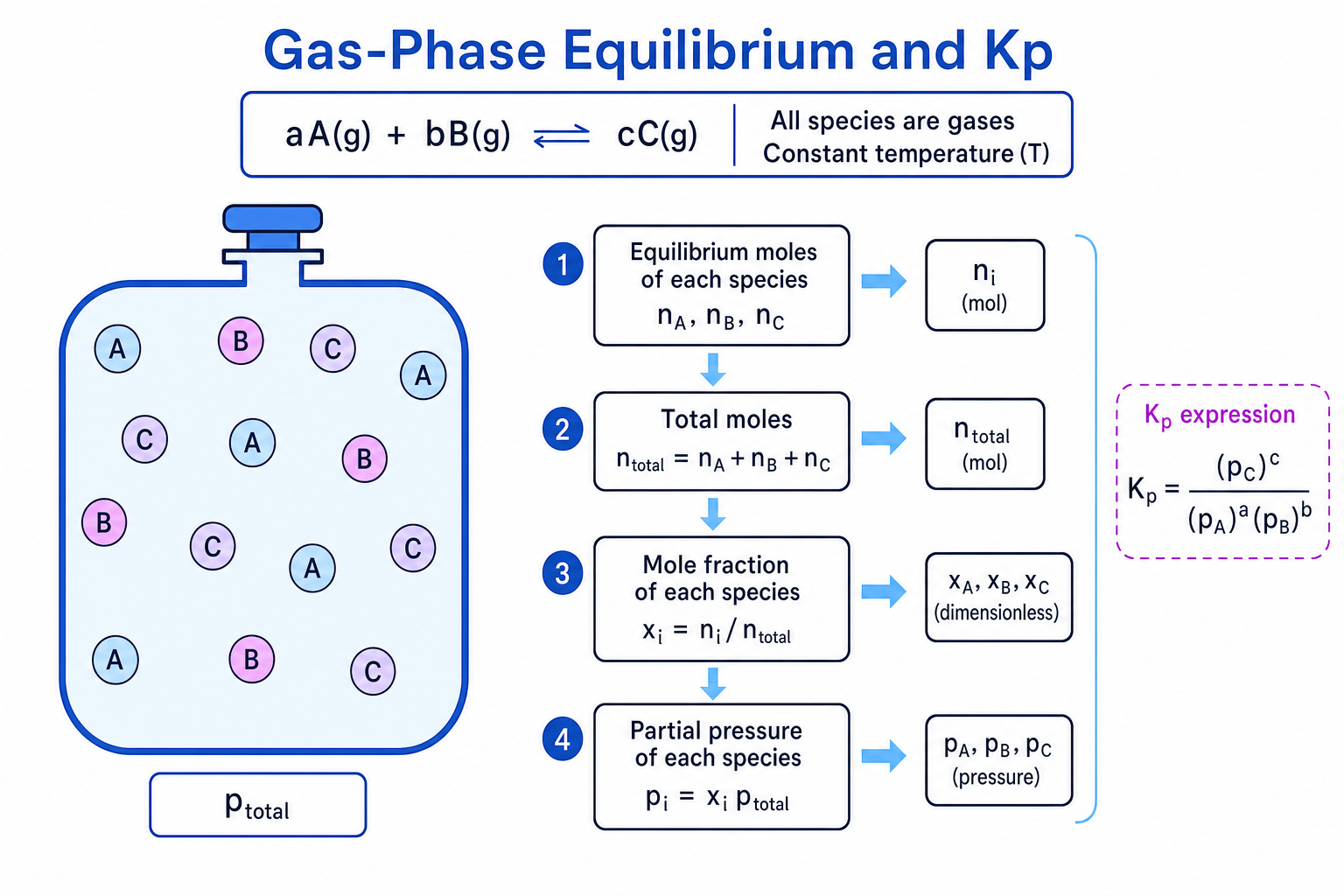
The mole fraction of gas iii is xi=nintotalx_i = \frac{n_i}{n_{\text{total}}}xi=ntotalni. Its partial pressure is pi=xiptotalp_i = x_i p_{\text{total}}pi=xiptotal, where ptotalp_{\text{total}}ptotal is the total pressure of the gas mixture.
The mole fraction has no units because it is a fraction of amounts in mol. Partial pressure has the same unit as total pressure, usually kPa in A-level calculations.
The diagram summarises the route from equilibrium moles to the KpK_pKp expression.
Calculating partial pressures
A gas mixture at equilibrium contains 0.200 mol of N₂, 0.600 mol of H₂ and 0.400 mol of NH₃. The total pressure is 200 kPa. Calculate the partial pressure of each gas.
-
Find the total amount of gas: ntotal=0.200+0.600+0.400=1.200 moln_{\text{total}} = 0.200 + 0.600 + 0.400 = 1.200\ \text{mol}ntotal=0.200+0.600+0.400=1.200 mol.
-
Calculate each mole fraction: xN2=0.2001.200=0.167x_{\text{N}_2} = \frac{0.200}{1.200} = 0.167xN2=1.2000.200=0.167, xH2=0.6001.200=0.500x_{\text{H}_2} = \frac{0.600}{1.200} = 0.500xH2=1.2000.600=0.500, and xNH3=0.4001.200=0.333x_{\text{NH}_3} = \frac{0.400}{1.200} = 0.333xNH3=1.2000.400=0.333.
-
Multiply each mole fraction by the total pressure: p(N2)=0.167×200=33.3 kPap(\text{N}_2) = 0.167 \times 200 = 33.3\ \text{kPa}p(N2)=0.167×200=33.3 kPa, p(H2)=0.500×200=100 kPap(\text{H}_2) = 0.500 \times 200 = 100\ \text{kPa}p(H2)=0.500×200=100 kPa, and p(NH3)=0.333×200=66.7 kPap(\text{NH}_3) = 0.333 \times 200 = 66.7\ \text{kPa}p(NH3)=0.333×200=66.7 kPa.
-
Check the partial pressures add to the total pressure: 33.3+100+66.7=200 kPa33.3 + 100 + 66.7 = 200\ \text{kPa}33.3+100+66.7=200 kPa.
Constructing a KpK_pKp expression
KpK_pKp is the equilibrium constant calculated using equilibrium partial pressures.
Kp
KpK_pKp is the equilibrium constant for a gas-phase system at constant temperature, calculated from the partial pressures of gases at equilibrium.
For the general reaction:
aA(g) + bB(g) ⇌ cC(g) + dD(g)
the expression is:
Kp=(pC)c(pD)d(pA)a(pB)bK_p = \frac{(p_C)^c(p_D)^d}{(p_A)^a(p_B)^b}Kp=(pA)a(pB)b(pC)c(pD)dThe powers come from the stoichiometric coefficients in the balanced equation.
Products over reactants
For KpK_pKp, put equilibrium partial pressures of gaseous products on the top, gaseous reactants on the bottom, and raise each partial pressure to its balancing number.
Writing a Kp expression and units
For the Haber equilibrium, N₂(g) + 3H₂(g) ⇌ 2NH₃(g), write the KpK_pKp expression and state its units if pressures are measured in kPa.
-
Put the product partial pressure on the top and reactant partial pressures on the bottom: ammonia is the product, while nitrogen and hydrogen are reactants.
-
Apply the balancing numbers as powers: Kp=p(NH3)2p(N2)p(H2)3K_p = \frac{p(\text{NH}_3)^2}{p(\text{N}_2)p(\text{H}_2)^3}Kp=p(N2)p(H2)3p(NH3)2.
-
Work out the units from the expression: kPa2kPa⋅kPa3=kPa−2\frac{\text{kPa}^2}{\text{kPa}\cdot\text{kPa}^3} = \text{kPa}^{-2}kPa⋅kPa3kPa2=kPa−2.
Forgetting that the equation matters
KpK_pKp belongs to the exact balanced equation written. If you reverse the equation, the new KpK_pKp is the reciprocal; if you multiply the whole equation by 2, the powers in the expression double.
Calculating KpK_pKp from equilibrium data
A typical calculation follows the same sequence every time:
- Use the balanced equation to find equilibrium moles.
- Add them to get total moles of gas.
- Convert each amount into a mole fraction.
- Convert mole fractions into partial pressures.
- Substitute into the KpK_pKp expression, including units.
Using initial amounts
The KpK_pKp expression uses equilibrium partial pressures, not initial amounts or initial pressures. If the question gives starting amounts, you must first use the reaction stoichiometry to find the amounts present at equilibrium.
Calculating Kp from a degree of dissociation
Dinitrogen tetroxide dissociates according to N₂O₄(g) ⇌ 2NO₂(g). Initially, 1.00 mol of N₂O₄ is placed in a vessel. At equilibrium, 40.0% has dissociated. The total pressure at equilibrium is 125 kPa. Calculate KpK_pKp.
-
Convert the percentage dissociation into reacting moles: 40.0% of 1.00 mol is 0.400 mol, so equilibrium moles are 0.600 mol N₂O₄ and 2×0.400=0.800 mol2 \times 0.400 = 0.800\ \text{mol}2×0.400=0.800 mol NO₂.
-
Find the total moles at equilibrium: ntotal=0.600+0.800=1.400 moln_{\text{total}} = 0.600 + 0.800 = 1.400\ \text{mol}ntotal=0.600+0.800=1.400 mol.
-
Calculate mole fractions: xN2O4=0.6001.400=0.429x_{\text{N}_2\text{O}_4} = \frac{0.600}{1.400} = 0.429xN2O4=1.4000.600=0.429 and xNO2=0.8001.400=0.571x_{\text{NO}_2} = \frac{0.800}{1.400} = 0.571xNO2=1.4000.800=0.571.
-
Calculate partial pressures: p(N2O4)=0.429×125=53.6 kPap(\text{N}_2\text{O}_4) = 0.429 \times 125 = 53.6\ \text{kPa}p(N2O4)=0.429×125=53.6 kPa and p(NO2)=0.571×125=71.4 kPap(\text{NO}_2) = 0.571 \times 125 = 71.4\ \text{kPa}p(NO2)=0.571×125=71.4 kPa.
-
Substitute into the expression: Kp=p(NO2)2p(N2O4)=71.4253.6=95.2 kPaK_p = \frac{p(\text{NO}_2)^2}{p(\text{N}_2\text{O}_4)} = \frac{71.4^2}{53.6} = 95.2\ \text{kPa}Kp=p(N2O4)p(NO2)2=53.671.42=95.2 kPa.
What KpK_pKp tells you about yield
The position of equilibrium describes the relative amounts of reactants and products at equilibrium.
A large value of KpK_pKp usually means products are favoured. A small value of KpK_pKp usually means reactants are favoured. Be careful: because KpK_pKp units depend on the equation, do not compare unrelated reactions just by their numerical values.
Effect of pressure on equilibrium position
For gas equilibria, changing pressure can change the equilibrium mixture.
- Increasing pressure by decreasing volume favours the side with fewer gas molecules.
- Decreasing pressure favours the side with more gas molecules.
- If both sides have the same number of gas molecules, pressure has no effect on the equilibrium position.
At constant temperature, changing pressure does not change the value of KpK_pKp. Instead, the mixture shifts until the partial pressures fit the same KpK_pKp value again.
Pressure changes
The usual pressure rule assumes the pressure is changed by changing the volume of the container. Adding an inert gas at constant volume does not change the partial pressures of the reacting gases.
Effect of temperature on equilibrium position and KpK_pKp
Temperature is different: it changes both the equilibrium position and the value of KpK_pKp.
For an exothermic forward reaction, increasing temperature shifts equilibrium to the reactants and decreases KpK_pKp.
For an endothermic forward reaction, increasing temperature shifts equilibrium to the products and increases KpK_pKp.
Only temperature changes Kp
For a given reaction, KpK_pKp is constant only at a fixed temperature. Pressure and concentration changes can alter the equilibrium position, but temperature changes alter the value of KpK_pKp itself.
Effect of a catalyst
A catalyst increases the rate of reaction by providing an alternative route with lower activation energy. In a reversible reaction, it speeds up both the forward and reverse reactions.
So a catalyst:
- makes equilibrium reached faster
- does not change the position of equilibrium
- does not change KpK_pKp
- does not increase equilibrium yield
Predicting changes for the Haber equilibrium
For N₂(g) + 3H₂(g) ⇌ 2NH₃(g), the forward reaction is exothermic. Predict the effects of increasing pressure, increasing temperature and adding a catalyst.
-
Compare gas moles for pressure: the left side has 4 mol of gas and the right side has 2 mol of gas, so increasing pressure shifts equilibrium to the right and increases the equilibrium yield of NH₃.
-
Use the enthalpy change for temperature: the forward reaction is exothermic, so increasing temperature favours the reverse endothermic direction, decreasing the NH₃ yield and decreasing KpK_pKp.
-
Apply the catalyst rule: a catalyst helps the system reach equilibrium faster, but the equilibrium composition and KpK_pKp are unchanged.
Sanity check
If a question asks whether KpK_pKp changes, your first thought should be temperature. If the temperature is unchanged, KpK_pKp is unchanged.
In the exam
-
Always write the balanced equation first, then build the KpK_pKp expression directly from it.
-
Use equilibrium amounts to calculate mole fractions and partial pressures; do not substitute initial amounts into KpK_pKp.
-
Keep pressure units consistent throughout, then derive the units of KpK_pKp from the expression and round to a suitable number of significant figures.
Check yourself
- Can you calculate partial pressures from equilibrium moles and total pressure?
- Can you write the KpK_pKp expression, including units, for any balanced gas-phase equation?
- Can you explain why temperature can change KpK_pKp, but a catalyst cannot?
