

Here, we will look at how the elements in Period 3 (from sodium to sulfur) behave chemically. You will build on your knowledge of periodicity to understand how structure and bonding dictate macro-scale properties.
What you'll learn
- How sodium and magnesium react with water.
- The equations and observations for Period 3 elements reacting with oxygen to form their highest oxides.
- Why the melting points of these oxides follow a distinctive trend across the period.
- How to predict the pH of the solutions formed when these oxides dissolve in water, and how to write their acid-base equations.
1. Reactions of Sodium and Magnesium with Water
Sodium and magnesium are the two s-block metals in Period 3. Because sodium is in Group 1, it is more reactive than magnesium in Group 2.
Sodium Sodium reacts vigorously with cold water. It melts into a ball, dashes across the surface, and fizzes rapidly as hydrogen gas is produced. It forms a strongly alkaline solution of sodium hydroxide (pH 13–14):
2Na (s)+2H2O (l)→2NaOH (aq)+H2 (g) 2\text{Na (s)} + 2\text{H}_2\text{O (l)} \rightarrow 2\text{NaOH (aq)} + \text{H}_2\text{ (g)} 2Na (s)+2H2O (l)→2NaOH (aq)+H2 (g)Magnesium Magnesium's reaction with cold water is very slow. It will eventually form a weakly alkaline solution of magnesium hydroxide (pH 9–10) and a few bubbles of hydrogen:
Mg (s)+2H2O (l)→Mg(OH)2 (aq)+H2 (g) \text{Mg (s)} + 2\text{H}_2\text{O (l)} \rightarrow \text{Mg(OH)}_2\text{ (aq)} + \text{H}_2\text{ (g)} Mg (s)+2H2O (l)→Mg(OH)2 (aq)+H2 (g)However, magnesium reacts much more vigorously with steam. When heated in steam, it burns with a bright white flame to form solid magnesium oxide and hydrogen gas:
Mg (s)+H2O (g)→MgO (s)+H2 (g) \text{Mg (s)} + \text{H}_2\text{O (g)} \rightarrow \text{MgO (s)} + \text{H}_2\text{ (g)} Mg (s)+H2O (g)→MgO (s)+H2 (g)Watch the state symbols
Notice the difference! Magnesium forms magnesium hydroxide with liquid water, but it forms magnesium oxide when reacting with steam (H2O (g)\text{H}_2\text{O (g)}H2O (g)).
2. Reactions of Period 3 Elements with Oxygen
When heated, the Period 3 elements react with oxygen to form oxides. In most cases, they are oxidised to their highest oxidation states (which correspond to their group number).
Here are the key observations and equations you need to know:
- Sodium: Burns with a yellow flame to produce a white solid.
- Magnesium: Burns with a brilliant white flame to produce a white solid.
- Aluminium: Burns brightly (especially when powdered) to give a white solid powder.
- Silicon: Requires strong heating to react, eventually forming a white solid.
- Phosphorus: Red phosphorus must be heated, but white phosphorus ignites spontaneously in air, burning with a brilliant white flame and producing a dense white smoke.
- Sulfur: Burns in air with a distinctive blue flame to form a colourless, choking gas (sulfur dioxide).
Missing the 4 in phosphorus oxide
Students often write the formula for phosphorus(V) oxide as P2O5\text{P}_2\text{O}_5P2O5. While that is the empirical formula, the molecular formula is P4O10\text{P}_4\text{O}_{10}P4O10. Always use P4O10\text{P}_4\text{O}_{10}P4O10 in your equations to guarantee the marks.
Note on sulfur: Sulfur usually forms SO2\text{SO}_2SO2. It can form sulfur(VI) oxide (SO3\text{SO}_3SO3) but this requires a catalyst (V2O5\text{V}_2\text{O}_5V2O5) and specific conditions (like in the Contact Process).
3. Melting Points of the Highest Oxides
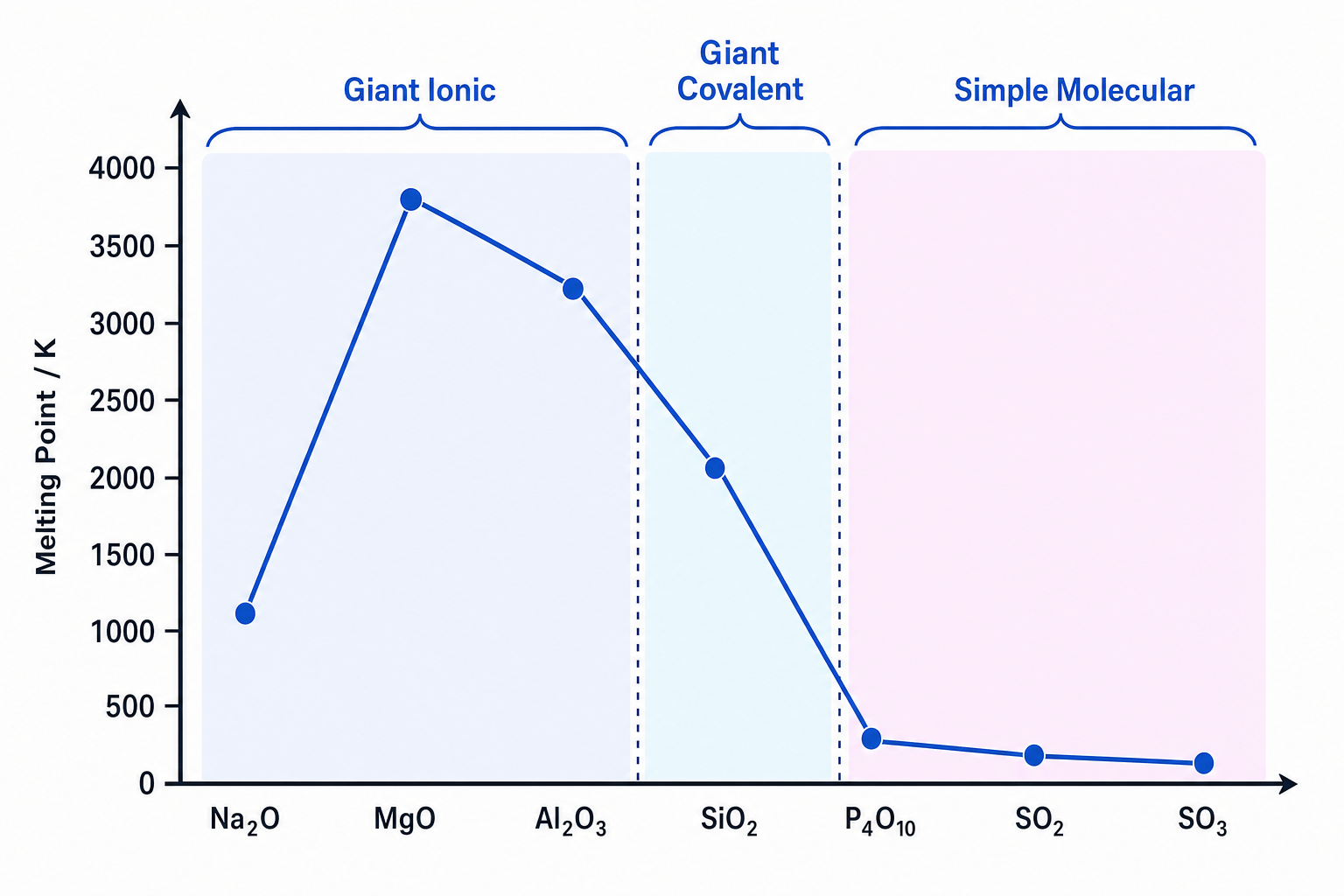
The melting points of these oxides follow a distinct pattern that directly depends on their structure and bonding.
Structure dictates properties
To explain any melting point trend across a period, always state the type of structure (giant ionic, giant covalent, or simple molecular) and the forces that must be overcome.
Giant Ionic Lattices (Na2O\text{Na}_2\text{O}Na2O, MgO\text{MgO}MgO, Al2O3\text{Al}_2\text{O}_3Al2O3)
These metal oxides have high melting points because melting requires breaking strong electrostatic forces of attraction between oppositely charged ions.
- MgO\text{MgO}MgO has a higher melting point than Na2O\text{Na}_2\text{O}Na2O because the Mg2+\text{Mg}^{2+}Mg2+ ion has a greater charge and is smaller than the Na+\text{Na}^+Na+ ion. This creates a stronger electrostatic attraction to the O2−\text{O}^{2-}O2− ions.
- Al2O3\text{Al}_2\text{O}_3Al2O3 has a slightly lower melting point than MgO\text{MgO}MgO. Even though Al3+\text{Al}^{3+}Al3+ has a very high charge, it is so small and highly charged that it strongly distorts the electron cloud of the oxygen ions. This introduces some covalent character into the ionic lattice, lowering the melting point slightly.
Giant Covalent Lattice (SiO2\text{SiO}_2SiO2)
Silicon dioxide has a very high melting point. It forms a giant covalent structure (macro-molecular). Melting it requires breaking many strong covalent bonds between silicon and oxygen atoms, which requires a vast amount of energy.
Simple Molecular Lattices (P4O10\text{P}_4\text{O}_{10}P4O10, SO2\text{SO}_2SO2, SO3\text{SO}_3SO3)
These non-metal oxides have much lower melting points. They consist of separate molecules. Melting only requires breaking the weak intermolecular forces (van der Waals and dipole-dipole forces) between the molecules, not the strong covalent bonds within them.
- P4O10\text{P}_4\text{O}_{10}P4O10 is a relatively large molecule with many electrons, so it has stronger van der Waals forces than SO2\text{SO}_2SO2 or SO3\text{SO}_3SO3, giving it a higher melting point than the sulfur oxides.
4. Reactions of Oxides with Water and pH
The type of bonding (ionic vs covalent) also determines how the oxides behave when mixed with water.
The Ionic Basic Oxides: Na2O\text{Na}_2\text{O}Na2O and MgO\text{MgO}MgO
Ionic oxides contain the oxide ion, O2−\text{O}^{2-}O2−. This is a very strong base and reacts with water to form hydroxide ions (OH−\text{OH}^-OH−).
- Na2O\text{Na}_2\text{O}Na2O dissolves very readily to form sodium hydroxide.
- MgO\text{MgO}MgO is only slightly soluble in water, forming magnesium hydroxide. Because fewer OH−\text{OH}^-OH− ions end up in solution, the pH is lower.
The Insoluble Oxides: Al2O3\text{Al}_2\text{O}_3Al2O3 and SiO2\text{SiO}_2SiO2
Neither aluminium oxide nor silicon dioxide reacts with or dissolves in water. For Al2O3\text{Al}_2\text{O}_3Al2O3, the ionic lattice is too strong; for SiO2\text{SiO}_2SiO2, the giant covalent lattice is too strong. Because they do not dissolve, the pH of the water remains 7.
The Covalent Acidic Oxides: P4O10\text{P}_4\text{O}_{10}P4O10, SO2\text{SO}_2SO2, and SO3\text{SO}_3SO3
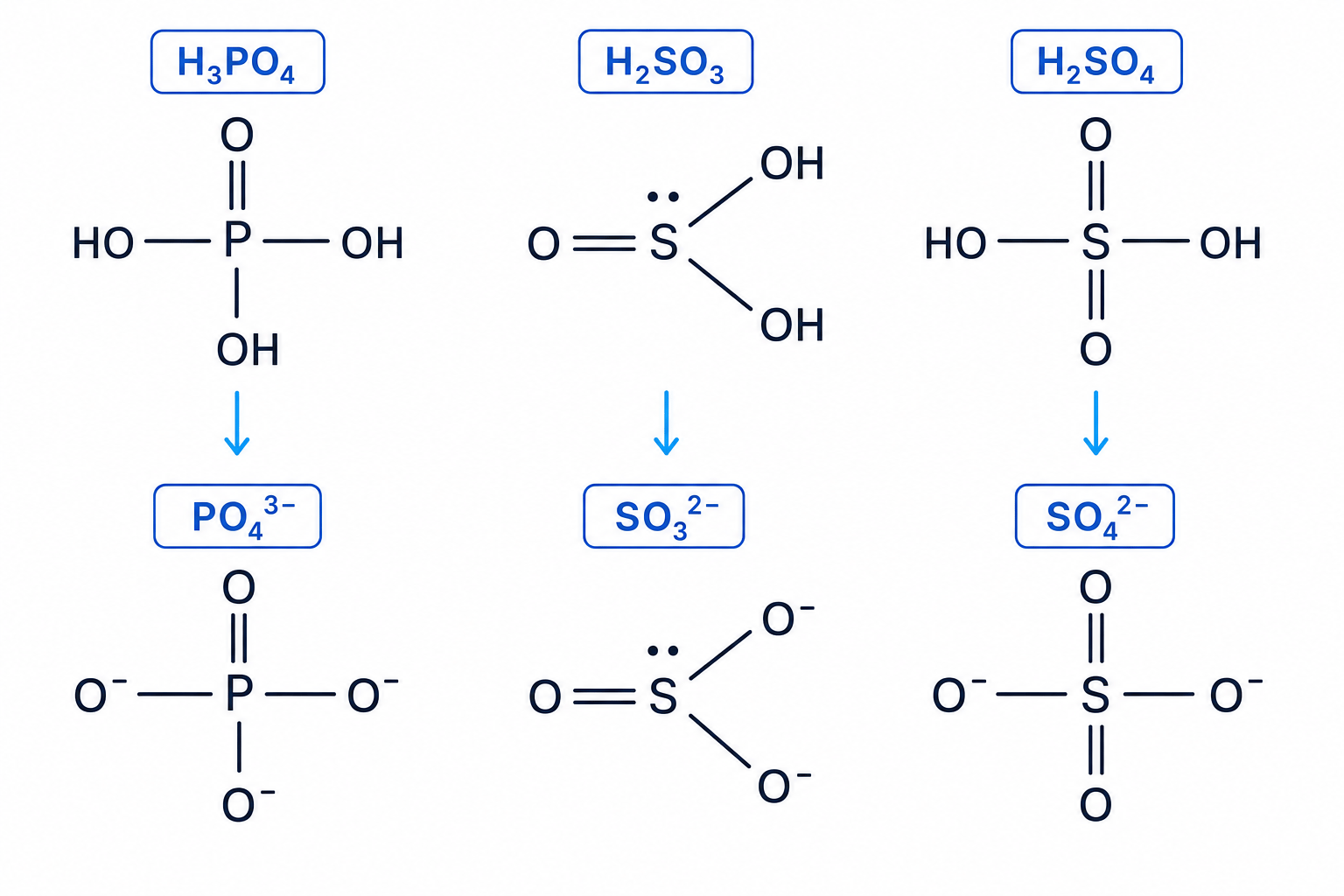
The covalent oxides of phosphorus and sulfur react violently or readily with water to form acidic solutions.
- P4O10\text{P}_4\text{O}_{10}P4O10 reacts vigorously to form phosphoric(V) acid.
- SO2\text{SO}_2SO2 dissolves to form sulfurous acid (sulfuric(IV) acid), which is a weak acid.
- SO3\text{SO}_3SO3 reacts violently to form strong sulfuric(VI) acid.
Below are the structures of the acids and their corresponding anions formed in these reactions:
5. Acid-Base Reactions of the Oxides
You must be able to write equations for the reactions of these oxides with acids and bases.
Basic Oxides reacting with Acids
Basic oxides neutralise acids to form a salt and water.
- Sodium oxide with hydrochloric acid:
- Magnesium oxide with sulfuric acid:
The Amphoteric Oxide: Aluminium Oxide
Amphoteric
An amphoteric substance is one that can act as both an acid and a base. It will react with both bases and acids to form salts.
Aluminium oxide will neutralise an acid:
Al2O3 (s)+6HCl (aq)→2AlCl3 (aq)+3H2O (l) \text{Al}_2\text{O}_3\text{ (s)} + 6\text{HCl (aq)} \rightarrow 2\text{AlCl}_3\text{ (aq)} + 3\text{H}_2\text{O (l)} Al2O3 (s)+6HCl (aq)→2AlCl3 (aq)+3H2O (l)It will also react with hot, concentrated alkalis to form an aluminate complex:
Al2O3 (s)+2NaOH (aq)+3H2O (l)→2NaAl(OH)4 (aq) \text{Al}_2\text{O}_3\text{ (s)} + 2\text{NaOH (aq)} + 3\text{H}_2\text{O (l)} \rightarrow 2\text{NaAl(OH)}_4\text{ (aq)} Al2O3 (s)+2NaOH (aq)+3H2O (l)→2NaAl(OH)4 (aq)The Aluminate Ion
The formula of the aluminate ion formed is usually written as [Al(OH)4]−\text{[Al(OH)}_4\text{]}^-[Al(OH)4]−. Knowing this structure makes balancing the water molecules in the equation much easier.
Acidic Oxides reacting with Bases
The covalent oxides on the right of the period are acidic, so they react with alkalis to form salts and water.
- Silicon dioxide (even though it's insoluble in water) will react with hot, concentrated sodium hydroxide to form sodium silicate:
- Sulfur dioxide reacts with sodium hydroxide to form sodium sulfite (sodium sulfate(IV)):
- Sulfur trioxide reacts with sodium hydroxide to form sodium sulfate (sodium sulfate(VI)):
Let's look closely at writing the most complex of these equations.
Writing the equation for phosphorus(V) oxide and sodium hydroxide
- Identify the salt produced. P4O10\text{P}_4\text{O}_{10}P4O10 is the anhydride of phosphoric acid (H3PO4\text{H}_3\text{PO}_4H3PO4). Reacting it with a base will yield a phosphate salt. The phosphate ion is PO43−\text{PO}_4^{3-}PO43−. The sodium salt is therefore Na3PO4\text{Na}_3\text{PO}_4Na3PO4.
- Write the unbalanced framework.
- Balance the primary non-metal (P). There are 4 phosphorus atoms on the left, so we need 4 phosphate ions on the right.
- Balance the metal (Na). There are 4×3=124 \times 3 = 124×3=12 sodium atoms on the right, so we need 12 NaOH\text{NaOH}NaOH on the left.
- Balance the hydrogen and oxygen. We have 12 hydrogen atoms on the left, so we need 6 H2O\text{H}_2\text{O}H2O on the right. Verify the oxygens: 10 + 12 = 22 on the left. 4×4+6=224 \times 4 + 6 = 224×4+6=22 on the right.
In the exam
- Read the state symbols in the question. If asked for magnesium's reaction with steam, ensure you produce MgO\text{MgO}MgO and not Mg(OH)2\text{Mg(OH)}_2Mg(OH)2.
- When asked to explain the melting point of SiO2\text{SiO}_2SiO2, always include the phrases "giant covalent structure" and "many strong covalent bonds require large amounts of energy to break".
- Acid-base reactions of oxides often carry 2 marks. If you get stuck on balancing, write out the correct chemical formulas for the reactants and products first. One mark is almost always for getting the formulas correct, even if the stoichiometry is wrong.
Check yourself
- Why does MgO\text{MgO}MgO have a higher melting point than Na2O\text{Na}_2\text{O}Na2O?
- What are the observations when white phosphorus burns in oxygen?
- Write the balanced equation for the reaction between aluminium oxide and sulfuric acid.
- Why does SiO2\text{SiO}_2SiO2 have no effect on the pH of water?
