

What you'll learn
- What a reaction mechanism is, and why it explains organic reactions better than an overall equation.
- How to represent free radicals using a dot and write balanced radical mechanism steps.
- How to use curly arrows to show the movement of electron pairs in other organic mechanisms.
- How to avoid common arrow-pushing mistakes in AQA A-Level Chemistry.
Why mechanisms matter
Organic chemistry is not just a list of reactions to memorise. A mechanism explains how a reaction happens: which bonds break, which bonds form, and which particles are involved along the way.
For example, the overall equation for chlorinating methane is:
CH4 + Cl2 → CH3Cl + HCl
That tells you the start and finish, but not the route. A mechanism breaks the reaction into smaller steps.
Reaction mechanism
A reaction mechanism is a step-by-step description of a reaction showing the species involved and how bonds are made and broken.
In AQA organic chemistry, there are two main styles of mechanism notation at this stage:
- Free-radical mechanisms, where radicals are shown using dots.
- Other mechanisms, where full curly arrows show the movement of electron pairs.
The prerequisite idea: bonds are electron pairs
A covalent bond is a shared pair of electrons between two atoms. A lone pair is a pair of electrons on one atom that is not involved in bonding.
When an organic reaction happens, bonds often break and new bonds form. So mechanisms are really about tracking electrons.
Mechanisms track electrons
Organic mechanisms show where electron pairs or unpaired electrons move when bonds are made or broken.
Free radicals
A free radical is a species with an unpaired electron. In mechanisms, the unpaired electron is represented by a single dot, such as Cl• or •CH3.
Free radical
A free radical is an atom or group of atoms with an unpaired electron, shown by a dot.
The dot is not a charge. For example, Cl• is neutral overall, but it has one unpaired electron.
How radicals form
Radicals often form when a covalent bond breaks equally, with one electron going to each atom. This is called homolytic fission.
For chlorine:
Cl2 → 2Cl•
This can be triggered by ultraviolet light, often written as UV or hν.
Dot is not a charge
Do not write Cl⁻ when you mean Cl•. A radical dot shows an unpaired electron; a minus sign shows an extra electron and an overall negative charge.
Free-radical chain mechanisms
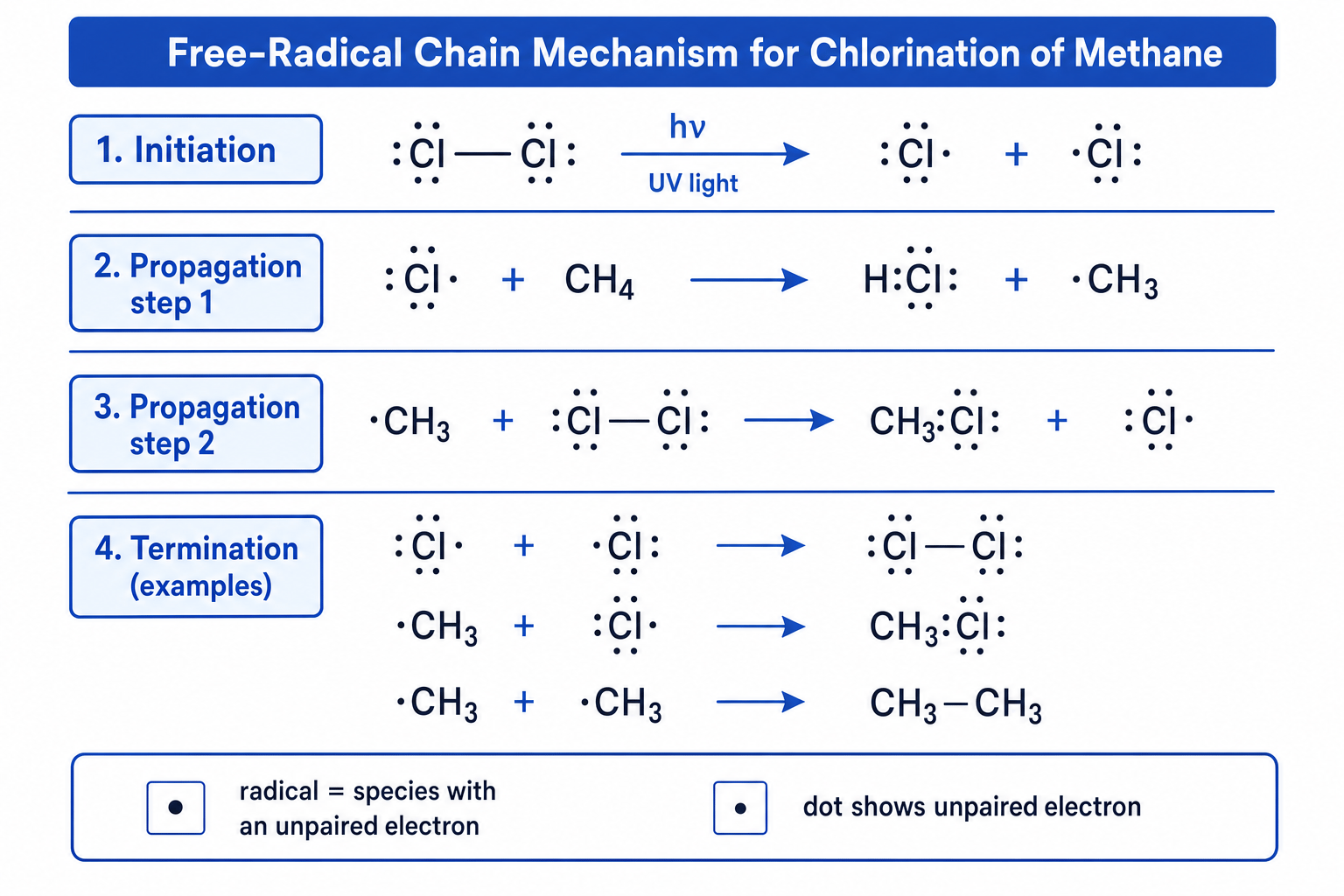
A common A-Level example is the chlorination of methane. The mechanism is a chain reaction, meaning that one radical is regenerated and can continue the reaction.
There are usually three types of step.
Initiation
Initiation is the step that produces radicals.
Cl2 → 2Cl•
Propagation
Propagation steps use a radical and produce another radical, allowing the chain to continue.
Cl• + CH4 → HCl + •CH3
•CH3 + Cl2 → CH3Cl + Cl•
Termination
Termination steps remove radicals by combining two radicals to form a stable molecule.
Examples include:
Cl• + Cl• → Cl2
•CH3 + Cl• → CH3Cl
•CH3 + •CH3 → C2H6
The diagram summarises the radical chain mechanism. Notice that the radical dot is shown, but curly arrows are not required for this specification.
Writing propagation steps
Write the two propagation steps for the chlorination of methane.
-
The chlorine radical removes a hydrogen atom from methane, forming HCl and leaving behind a methyl radical: Cl• + CH4 → HCl + •CH3.
-
The methyl radical then reacts with chlorine, forming chloromethane and regenerating a chlorine radical: •CH3 + Cl2 → CH3Cl + Cl•.
-
Check that each equation is balanced for atoms: the first has one C, four H and one Cl on both sides; the second has one C, three H and two Cl on both sides.
-
Check the chain logic: each propagation step has one radical on the left and one radical on the right, so the radical chain continues.
Spotting propagation
A propagation step usually has one radical as a reactant and one radical as a product. Termination steps usually have radicals on the left but no radicals on the right.
Curly arrows in other mechanisms
Most other organic mechanisms use curly arrows. A full curly arrow represents the movement of an electron pair.
This is different from radical mechanisms, where you only need dot notation and balanced equations.
Curly arrows show electron-pair movement
A curly arrow must start at an electron pair: either a lone pair or a covalent bond. The arrow head shows where that electron pair goes.
There are two essential curly-arrow rules.
Rule 1: forming a covalent bond
When a new covalent bond forms, the curly arrow starts from:
- a lone pair, or
- another covalent bond,
and points towards the atom that will receive the electron pair.
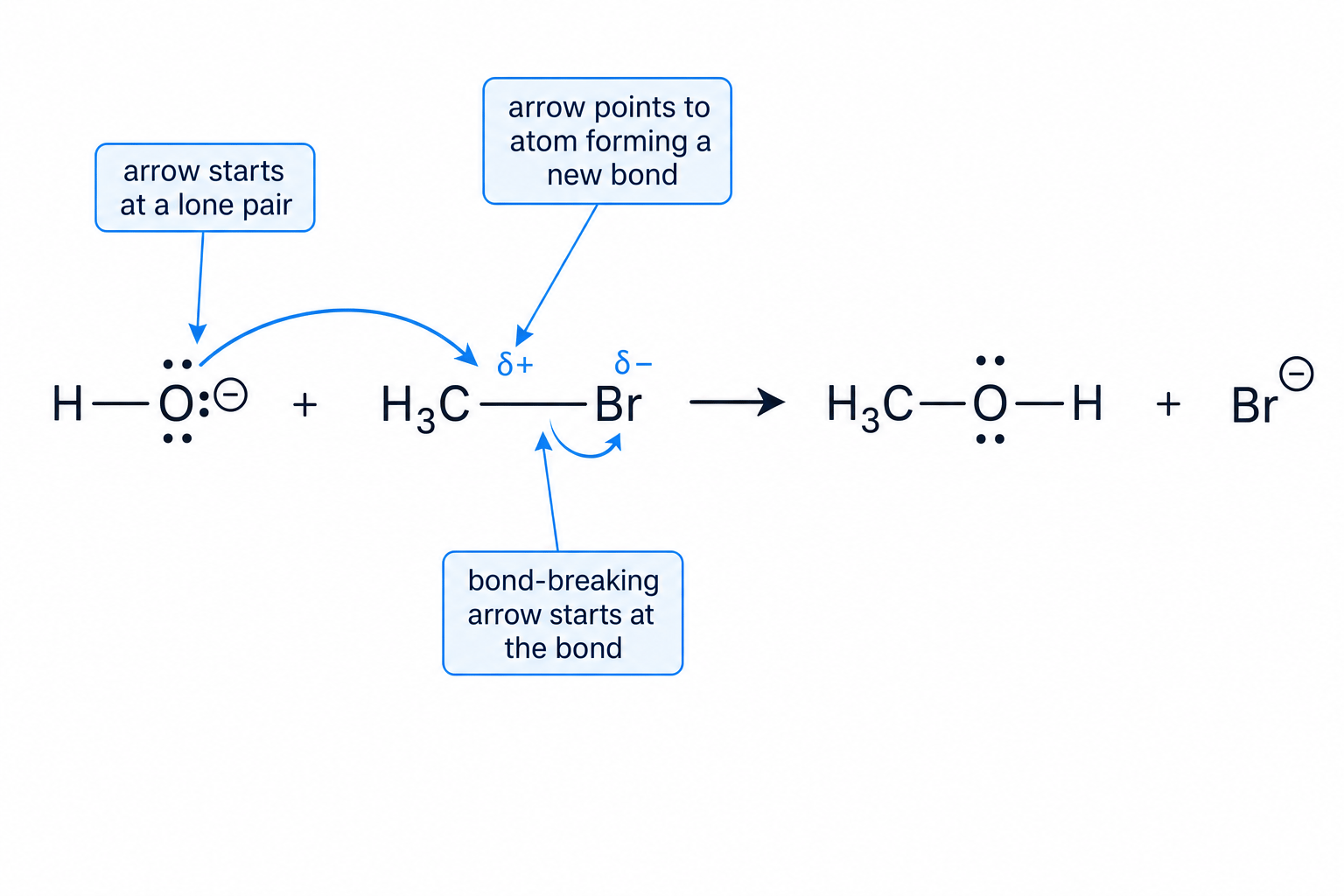
For example, a hydroxide ion, HO⁻, can donate a lone pair from oxygen to an electron-deficient carbon atom.
Rule 2: breaking a covalent bond
When a covalent bond breaks, the curly arrow starts from the bond and points towards the atom that takes the electron pair.
For example, in a C–Br bond, bromine is more electronegative than carbon, so the bond is polarised Cδ+–Brδ−. If the bond breaks heterolytically, bromine takes both bonding electrons and becomes Br⁻.
Heterolytic fission
Heterolytic fission is bond breaking where both electrons in the covalent bond go to one atom, producing ions.
Nucleophiles and electrophiles
You will meet these words throughout organic chemistry, so it is worth getting comfortable with them now.
A nucleophile is an electron-pair donor. It is attracted to electron-deficient areas. Nucleophiles often have:
- a negative charge, such as HO⁻ or CN⁻
- a lone pair, such as NH3
- a region of high electron density, such as a C=C double bond
An electrophile is an electron-pair acceptor. It is attracted to electron-rich areas. Electrophiles often have:
- a positive charge, such as H⁺
- a partial positive charge, such as the carbon in Cδ+–Brδ−
Nucleophile and electrophile
A nucleophile donates an electron pair. An electrophile accepts an electron pair.
Drawing a curly-arrow mechanism
A good mechanism is not just a pretty diagram. It is a logical sequence.
Use this approach:
- Identify the electron-rich site.
- Identify the electron-deficient site.
- Draw the curly arrow from the electron pair to where the new bond forms.
- If a bond breaks, draw a curly arrow starting from that bond.
- Check that atoms, bonds and charges make sense.
Placing curly arrows in substitution
Draw the key curly arrows for the reaction between hydroxide ions and bromomethane.
-
Identify the electron-rich species: HO⁻ has a negative charge and lone pairs on oxygen, so oxygen can donate an electron pair.
-
Identify the electron-deficient atom: in CH3Br, bromine is more electronegative than carbon, so the carbon bonded to bromine is δ+.
-
Show bond formation: draw a curly arrow from a lone pair on oxygen to the carbon atom in CH3Br.
-
Show bond breaking: carbon cannot keep five bonds, so draw a curly arrow from the C–Br bond to Br, forming Br⁻.
-
Check the overall charge: HO⁻ + CH3Br gives CH3OH + Br⁻, so the total charge remains −1.
Arrow from the wrong place
A curly arrow should not start from a positive charge or from empty space. It must start from an electron pair: a lone pair or a covalent bond.
What examiners look for
For this section, the key skill is accuracy. You should be able to:
- write balanced equations for free-radical mechanism steps
- show radical dots clearly
- draw organic structures of the species involved
- draw curly arrows starting and ending in the correct places
- distinguish radical mechanisms from electron-pair mechanisms
In the exam
-
For radical mechanisms, show the dot on every radical and make sure each step is balanced for atoms.
-
For curly-arrow mechanisms, check every arrow starts at a lone pair or bond, never from a charge alone.
-
After drawing products, check charges and bonding: carbon should normally have four bonds, and any ion formed should have a sensible charge.
Check yourself
- What is the difference between a radical dot and a negative charge?
- In a curly-arrow mechanism, where must a curly arrow start?
- Write one initiation, one propagation and one termination step for chlorination of methane.
