What you'll learn
- What structural isomers are, and how to recognise chain, position and functional group isomerism.
- What stereoisomers are, and why some alkenes show E–Z isomerism.
- How to apply Cahn–Ingold–Prelog priority rules to decide whether an alkene is E or Z.
- How to avoid the most common exam traps when drawing isomers.
The big idea: same formula, different molecule
A molecular formula tells you how many atoms of each element are present, for example C₄H₁₀.
A structural formula shows how atoms are connected, often in a shortened form such as CH₃CH₂CH₂CH₃.
Isomer
Isomers are compounds with the same molecular formula but different arrangements of atoms.
The key question is: different in what way?
There are two big categories in this section:
- Structural isomerism — atoms are connected differently.
- Stereoisomerism — atoms are connected in the same order, but arranged differently in space.
Structural isomerism
Structural isomer
Structural isomers are compounds with the same molecular formula but different structural formulae.
This means the same atoms are present, but the bonds between atoms are arranged differently.
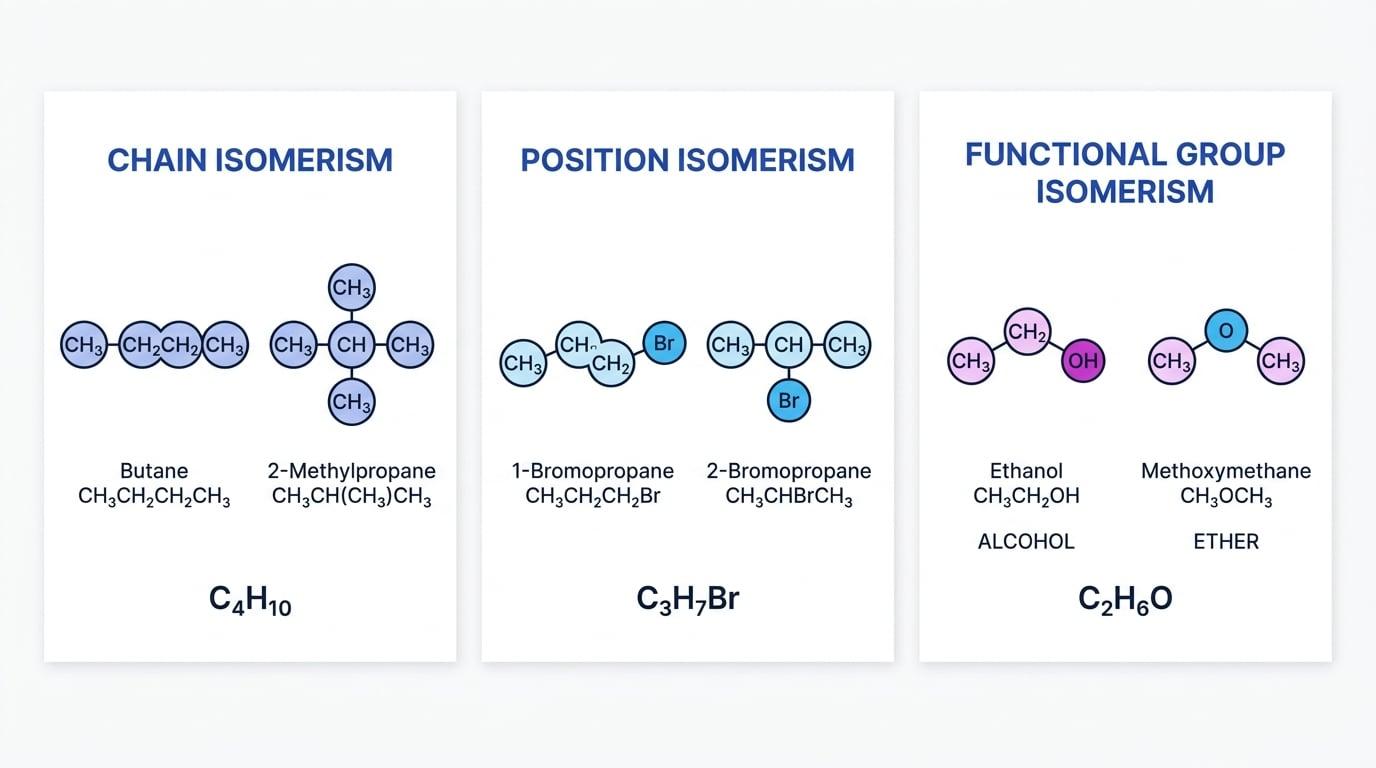
Chain isomerism
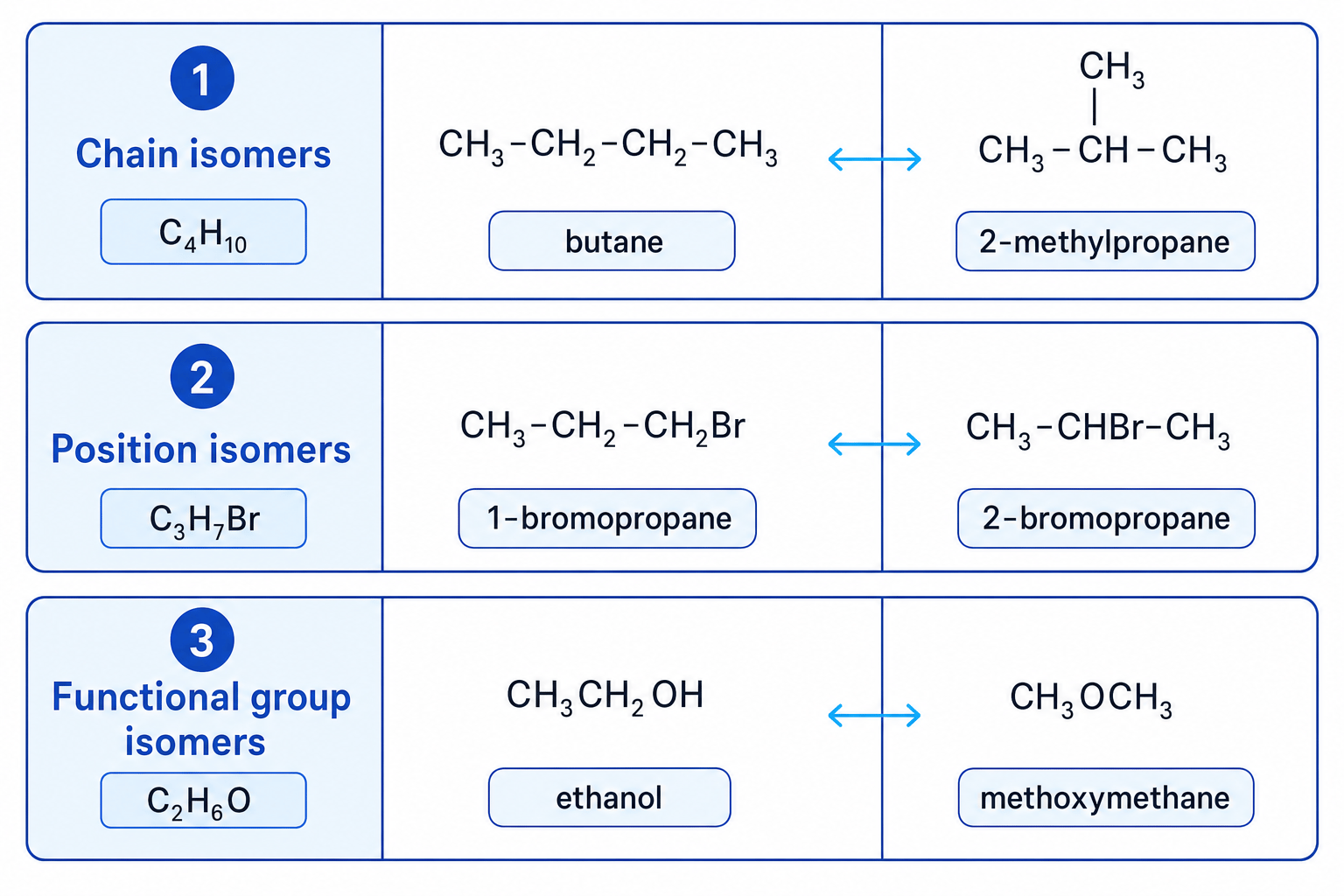
Chain isomers have different arrangements of the carbon skeleton. The carbon skeleton is the pattern of carbon atoms joined together.
For example, C₄H₁₀ can be:
- butane: CH₃CH₂CH₂CH₃
- 2-methylpropane: CH₃CH(CH₃)CH₃
Both have four carbon atoms and ten hydrogen atoms, but one is a straight chain and one is branched.
Position isomerism
Position isomers have the same carbon skeleton and the same functional group, but the functional group is attached in a different position.
A functional group is the atom or group of atoms responsible for the characteristic reactions of an organic compound, such as –OH, –Br, or C=C.
For example:
- 1-bromopropane: CH₃CH₂CH₂Br
- 2-bromopropane: CH₃CHBrCH₃
Both are haloalkanes with formula C₃H₇Br, but the bromine atom is in a different position.
Functional group isomerism
Functional group isomers have the same molecular formula but different functional groups.
For example:
- ethanol: CH₃CH₂OH, an alcohol
- methoxymethane: CH₃OCH₃, an ether
Both have molecular formula C₂H₆O, but they belong to different homologous series.
Classifying structural isomers
Decide what type of structural isomerism is shown by CH₃CH₂CH₂OH and CH₃CHOHCH₃.
-
Check the molecular formulae. Both contain three carbon atoms, eight hydrogen atoms and one oxygen atom, so both are C₃H₈O.
-
Compare the functional group. Both contain the –OH group, so they are both alcohols. That means this is not functional group isomerism.
-
Compare the carbon skeleton. Both use a three-carbon chain, so the carbon skeleton has not changed.
-
Compare the position of the functional group. In CH₃CH₂CH₂OH the –OH group is on carbon 1, while in CH₃CHOHCH₃ it is on carbon 2. These are position isomers.
Different drawing, same compound
Do not count two drawings as isomers just because they face different directions on the page. For example, CH₃CH₂CH₂Br and BrCH₂CH₂CH₃ are the same compound: 1-bromopropane.
Stereoisomerism
Stereoisomer
Stereoisomers are compounds with the same structural formula but a different arrangement of atoms in space.
So for stereoisomers:
- the same atoms are bonded to the same atoms
- the difference is the three-dimensional arrangement
In this part of the specification, the important type is E–Z isomerism in alkenes.
Why alkenes can show E–Z isomerism
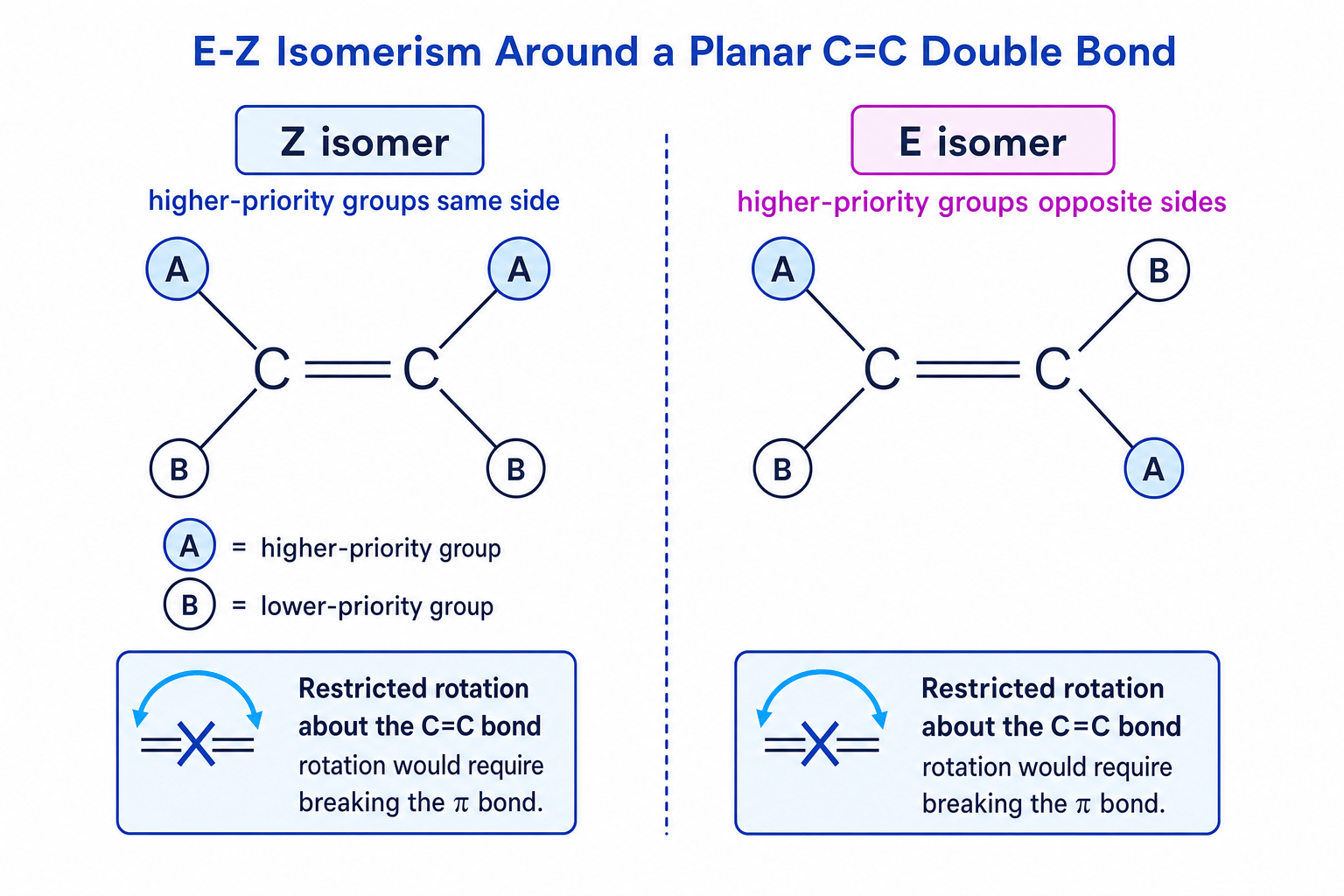
An alkene contains a carbon–carbon double bond, C=C. This double bond is planar, meaning the atoms directly around it lie in a flat arrangement.
A C=C double bond has restricted rotation. You cannot freely rotate around it without breaking the π bond, so groups attached to the double-bonded carbons can be “locked” into different spatial arrangements.
Condition for E-Z isomerism
An alkene can show E–Z isomerism only if each carbon atom in the C=C bond is attached to two different groups.
For example, but-2-ene, CH₃CH=CHCH₃, can show E–Z isomerism because each double-bonded carbon is attached to H and CH₃.
But propene, CH₂=CHCH₃, cannot show E–Z isomerism because one double-bonded carbon has two identical groups: H and H.
Drawing E and Z isomers of but-2-ene
Draw the two stereoisomers of but-2-ene, CH₃CH=CHCH₃.
-
Identify the groups on each carbon in the C=C bond. Each double-bonded carbon is attached to one H atom and one CH₃ group.
-
Decide the higher-priority group on each carbon. Carbon has a higher atomic number than hydrogen, so CH₃ has higher priority than H on both sides.
-
Draw the Z isomer with the two CH₃ groups on the same side of the C=C bond.
-
Draw the E isomer with the two CH₃ groups on opposite sides of the C=C bond.
What do E and Z mean?
The letters come from German:
- Z comes from zusammen, meaning “together”.
- E comes from entgegen, meaning “opposite”.
So:
- Z isomer: the higher-priority groups are on the same side of the C=C bond.
- E isomer: the higher-priority groups are on opposite sides of the C=C bond.
Quick memory aid
Think Z = zame zide. It is not real spelling, but it helps you remember that the higher-priority groups are on the same side.
Cahn–Ingold–Prelog priority rules
The Cahn–Ingold–Prelog priority rules, usually called the CIP rules, are used to decide which group has higher priority on each carbon of the C=C bond.
Rule 1: compare the directly attached atoms
Look at one carbon of the C=C bond at a time.
Compare the atoms directly attached to that carbon. The atom with the higher atomic number gets higher priority.
For example:
- Br has higher priority than Cl.
- O has higher priority than C.
- C has higher priority than H.
Rule 2: if there is a tie, look further along the chain
Sometimes the first atoms are the same. For example, –CH₃ and –CH₂CH₃ are both attached through carbon.
If the directly attached atoms are the same, compare the atoms attached to those atoms, working outwards until you find the first difference.
For –CH₂CH₃ compared with –CH₃:
- the –CH₂CH₃ carbon is attached to C, H and H
- the –CH₃ carbon is attached to H, H and H
Because C has a higher atomic number than H, –CH₂CH₃ has higher priority than –CH₃.
Rule 3: decide E or Z
Once you have found the higher-priority group on each carbon of the double bond:
- same side = Z
- opposite sides = E
Assigning E or Z when priorities tie
An alkene is drawn so that the left-hand C of the C=C has CH₃ above and H below. The right-hand C of the C=C has CH₂CH₃ above and CH₃ below. Decide whether it is E or Z.
-
Compare the groups on the left-hand double-bonded carbon. CH₃ is attached through carbon, while H is hydrogen, so CH₃ has higher priority.
-
Compare the groups on the right-hand double-bonded carbon. Both CH₂CH₃ and CH₃ are attached through carbon, so there is a tie at the first atom.
-
Look one atom further along. CH₂CH₃ has a carbon attached next, whereas CH₃ only has hydrogens attached. Therefore CH₂CH₃ has higher priority than CH₃.
-
Compare the positions of the two higher-priority groups. CH₃ on the left and CH₂CH₃ on the right are both above the C=C bond, so they are on the same side. The isomer is Z.
Using size instead of priority
CIP priority is based on atomic number, not how bulky the group looks. A smaller-looking atom like Br still has higher priority than a carbon-containing group because bromine has a higher atomic number.
Drawing isomers neatly
When you are asked to draw structural isomers, change the connectivity of the atoms.
Useful checks:
- Keep the molecular formula the same.
- Avoid drawing the same structure twice in a different orientation.
- For position isomers, move the functional group to a genuinely different carbon.
- For functional group isomers, change the functional group completely.
When you are asked to draw E and Z isomers, do not change the connectivity. Keep the same groups attached to the same double-bonded carbons, but place the higher-priority groups on the same side or opposite sides.
Not every alkene has E-Z isomers
If either carbon atom in the C=C bond has two identical groups attached, E–Z isomerism is not possible.
In the exam
-
For structural isomer questions, first confirm the molecular formula is unchanged, then decide whether the difference is chain, position or functional group.
-
For E–Z questions, check that both carbons in the C=C bond have two different groups before trying to name the isomer.
-
Apply CIP rules separately to each carbon of the double bond, then compare the positions of the two higher-priority groups: same side is Z, opposite sides is E.
Check yourself
- What type of structural isomerism is shown by 1-bromopropane and 2-bromopropane?
- Why can but-2-ene show E–Z isomerism, but propene cannot?
- In CIP priority rules, what do you do if the two directly attached atoms are the same?